

Apple Pays $2 Billion to Read Your Face
Apple acquired Israeli startup Q.AI for close to $2 billion, gaining facial micro-movement technology that decodes silent speech for future wearables.
Apple acquired Israeli startup Q.AI for close to $2 billion, gaining facial micro-movement technology that decodes silent speech for future wearables.

Moltbot exposed 1,862 servers without authentication. Tesla discontinues flagship cars for unproven robots. Airtable launches AI agents amid platform complaints.

Researchers found 1,862 Moltbot servers exposed without authentication. The viral AI assistant stores credentials in plaintext and invites attack by design.
The administration cut 317,000 federal workers. Now it wants 1,000 tech recruits from Palantir, Amazon, and Microsoft—who keep their stock while shaping government AI. The math is interesting. So are the conflicts of interest.

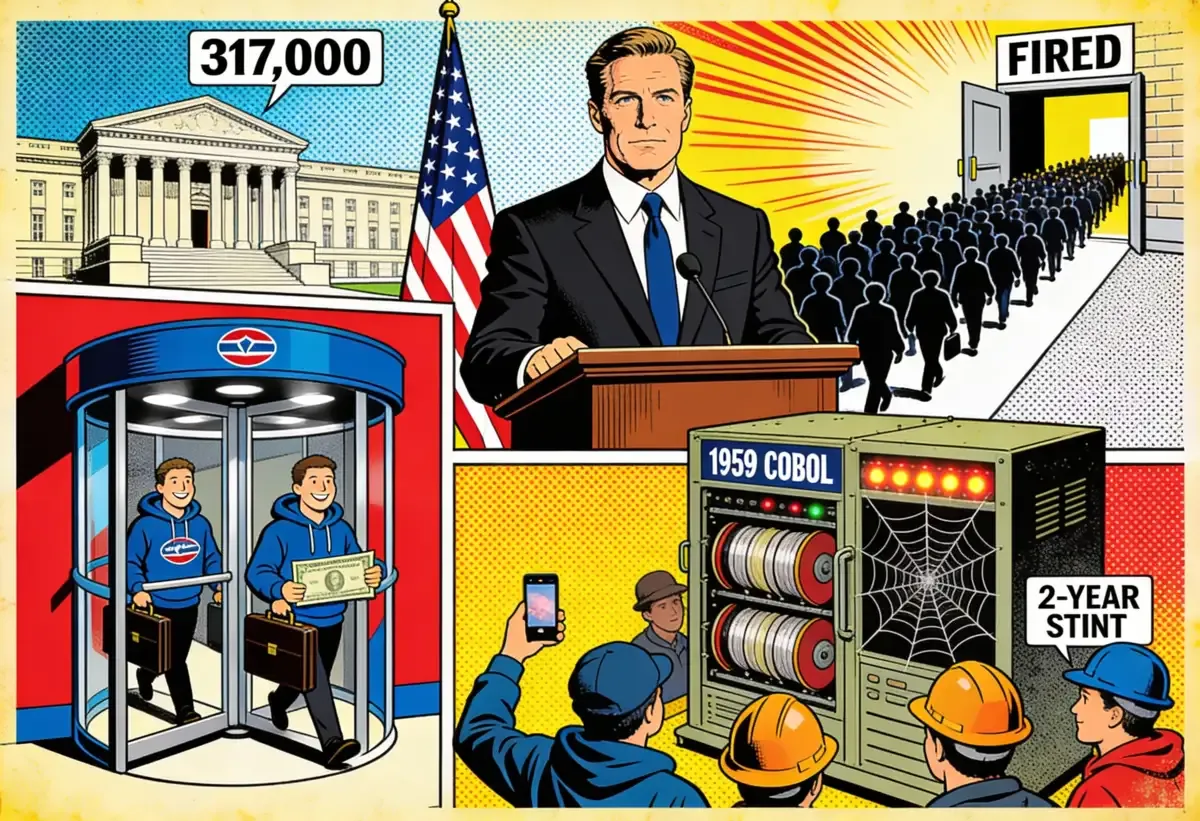
Scott Kupor stood in a television studio Monday morning explaining why the federal government needs to recruit a thousand engineers. The Office of Personnel Management director, a former venture capitalist from Andreessen Horowitz, described "dated" systems and the urgent need for AI talent across federal agencies. He did not mention that his administration had spent the previous eleven months systematically dismantling the teams that once did this work.
The U.S. Tech Force launched December 15 with an ambitious pitch: two-year federal positions paying between $130,000 and $195,000, partnerships with 28 major technology companies, and the promise of private-sector job opportunities afterward. The promotional video compared it to the Manhattan Project. A more accurate comparison might be a hospital advertising for doctors after firing its entire medical staff.
The Breakdown
• The administration lost 317,000 federal workers while hiring 68,000—a net deficit of 250,000, the largest peacetime reduction in history
• Tech Force recruits keep stock in companies like Palantir and Amazon while working on systems those firms bid to maintain
• Previous federal AI hiring retained 37% of recruits—at that rate, 1,000 Tech Force hires become 370 within two years
• GAO's 17-year director retires in December, reducing oversight as Tech Force launches with its corporate partnership structure
The Numbers Tell a Different Story
Under Kupor's own figures, the Trump administration has brought in approximately 68,000 federal workers while losing roughly 317,000. That net deficit of nearly 250,000 employees represents the largest peacetime reduction in federal workforce history. The technology sector absorbed disproportionate casualties.
Strategic AI news from San Francisco. Clear reporting on power, money, and policy. Delivered daily at 6am PST.
No spam. Unsubscribe anytime.
The 18F digital services team, created in 2014 to modernize government technology from within, was disbanded entirely. The IRS lost more than 2,000 technology workers. The original U.S. Digital Service, which spent a decade building institutional knowledge about federal systems, was absorbed into the Department of Government Efficiency and redirected toward an entirely different mission.
Biden's parallel initiative to bring AI professionals into government resulted in about 200 hires. Roughly 75 remain. The Tech Force aims to quintuple that number in a fraction of the time, with an end-of-March deadline for the first cohort.
"Only about 7% of the U.S. government workforce is early career," Kupor told CNBC. "That compares to almost a quarter in the rest of the workforce." He framed this as a problem to solve. He did not address whether accelerating departures among experienced workers might have contributed to it.
The Corporate Partner Structure
The list of participating companies reads like a roster of firms with substantial federal contracting interests. Amazon Web Services, Microsoft, Google Public Sector, Oracle, Palantir, Salesforce. Also present: Anduril, the defense technology company founded by Palmer Luckey, and xAI, Elon Musk's artificial intelligence venture.
These companies can nominate their own employees for government stints. Those employees take leaves of absence but, according to Kupor, do not need to divest their stock holdings. "We feel like we've kind of run down all the various conflict issues," he said, "and don't believe that that's actually going to be an impediment to getting people here."
The arrangement creates a straightforward pipeline. A Microsoft engineering manager takes a two-year government role. She works on AI implementation across federal agencies, potentially influencing procurement decisions and technical standards. She retains her Microsoft equity. She returns to Microsoft with deep knowledge of government systems and relationships with agency leadership.
This is not hypothetical. It is the explicit design.
"Part of a bigger plan which includes embedding tech bro's for 2 year stints at high level positions within agencies," observed one commenter on the federal employee subreddit. The phrasing was crude. The analysis was accurate.
Companies have not made firm hiring commitments for program alumni. Kupor acknowledged this directly: "It wouldn't be appropriate for us to ask companies to hire people without knowing who those people are." The career development pitch, then, rests on expectation rather than guarantee. Tech Force members get government experience and corporate mentorship. What the government gets from the arrangement is less clear.
The Watchdog Vacuum
Gene Dodaro retires at the end of December. Seventeen years running the Government Accountability Office, and his exit happens to coincide with Tech Force's launch. Convenient timing, or just timing. His replacement requires a bipartisan congressional commission, then Senate confirmation. Nobody expects speed.
The interim leader, Chief Operating Officer Orice Williams Brown, inherits an agency that House Republicans proposed to halve in funding earlier this year.
GAO's conflict with the administration has intensified over impoundments, the practice of delaying or withholding congressionally approved spending. The office has issued five decisions finding violations since Trump's second term began, four finding no violations, and two with mixed outcomes. "Our reviews looking at potential impoundment issues have been evenhanded," Dodaro said in his exit interview. "In half of our reports we found problems, and the other half no problems."
Whether that evenhandedness survives the transition remains uncertain. What seems certain is that the Tech Force rollout faces reduced scrutiny at precisely the moment when scrutiny might prove useful.
The program positions itself as nonpartisan. "Positions at Tech Force are not political appointments and serve nonpartisan roles focused on technology implementation," the official website states. But the distinction between political and nonpartisan grows blurry when participants report directly to agency leaders appointed by the president, work on administration priorities like "Trump Accounts," and maintain financial ties to companies seeking government contracts.
Historical Echoes
Congress once had its own technology advisors. The Office of Technology Assessment opened in 1972, ran for 23 years, cost $22 million annually. Defunded in 1995. Lawmakers figured they could learn about technology themselves.
Three decades of congressional hearings suggest otherwise. Senators asking Mark Zuckerberg to explain YouTube became a recurring motif. The fundamental gap between elected officials and the systems they regulate has widened with each technological generation.
Previous attempts to close that gap produced mixed results. Biden's AI talent initiative attracted 200 people. The 75 who remained represent a retention rate of roughly 37 percent. If Tech Force achieves similar results, the government will spend substantial resources recruiting and training a thousand people to end up with 370.
Kupor addressed this indirectly. "I'm not asking people to commit to a 40-year career, civil servant career," he said. "I'm asking people to say, hey, look, do something good for your country for a couple of years." The framing positions government service as a waystation rather than a destination. Which may be honest. It also suggests the administration has made peace with perpetual turnover in technical roles.
The Talent Market Reality
Silicon Valley compensation for AI engineers has reached levels that make government salaries appear quaint. Top researchers command packages exceeding $1 million annually. Even mid-career machine learning engineers at major firms earn $400,000 or more with equity included.
Tech Force's $130,000 to $195,000 range competes reasonably for early-career candidates. It does not compete for the experienced talent that complex government systems require. The "engineering managers from private sector partners" represent a workaround. Let companies pay for expertise development, then borrow that expertise for government projects.
The structure assumes corporate interests and government interests align sufficiently to make this arrangement productive. That assumption deserves examination. A Palantir manager embedded in the Department of Defense works on systems that Palantir might later bid to expand or maintain. An Amazon Web Services engineer helping agencies migrate to cloud infrastructure does so while AWS competes for those same agencies' cloud contracts.
"Great way to access federal data and force us to use their tech," wrote one Reddit user in the federal employee forum. The cynicism reflects lived experience. Federal workers have watched their colleagues depart, their programs dissolve, and their institutional knowledge evaporate. Now they're being asked to welcome private-sector managers who retain equity stakes in competing firms.
What Modernization Requires
Kupor described federal technology as "dated" rather than "good or terrible." The characterization is diplomatic. Systems running on COBOL, a programming language from 1959, still process Social Security checks. The IRS only recently gained the ability to accept electronic returns directly. Veterans Affairs healthcare records remain fragmented across incompatible databases.
Fixing these systems requires sustained investment over years, not two-year rotations. It requires institutional knowledge that accumulates slowly and dissipates quickly when experienced workers leave. It requires relationships between technologists and the program staff who understand what government services actually do.
The 18F model attempted something like this. Small teams embedded within agencies, working iteratively on specific problems, building internal capacity alongside external solutions. It took years to develop. It was eliminated in months.
Tech Force offers something faster and flashier. A thousand engineers arriving by March. CEO speaker series. Job fairs with corporate partners. The marketing suggests transformation. The structure suggests something more familiar. Temporary workers cycling through government roles, accumulating experience that benefits their future private-sector employers, while the underlying systems remain as fragmented as ever.
Maybe this time proves different. Maybe the Manhattan Project comparison reflects genuine ambition rather than promotional excess. Maybe embedding corporate managers in agency leadership actually accelerates modernization rather than regulatory capture.
The evidence will emerge over years, not months. By then, the Tech Force cohort will have moved on to their promised private-sector careers. The government will be recruiting its next thousand engineers. And the federal workforce will still be struggling to explain why the systems remain dated.
Q: What was 18F and why was it disbanded?
A: 18F was a digital services team created in 2014 inside the General Services Administration. It employed designers, engineers, and product managers who worked directly with agencies to modernize outdated systems, building internal capacity rather than relying on contractors. The Trump administration eliminated 18F entirely in early 2025 as part of broader workforce cuts.
Q: Can Tech Force participants really keep their company stock?
A: Yes. OPM Director Scott Kupor confirmed that participants taking leaves from Microsoft, Amazon, or Palantir do not need to divest holdings. Traditional federal ethics rules typically require divestiture when employees work on matters affecting their financial interests. Kupor said the administration has "run down all the various conflict issues."
Q: What is COBOL and why do federal systems still run on it?
A: COBOL dates to 1959 and still processes Social Security payments and IRS returns. The code works, but few programmers learn it today. Rewriting these systems in modern languages would cost billions and risk breaking functions that currently work. Finding qualified maintenance staff has become difficult, yet the legacy code persists.
Q: What are the "Trump Accounts" mentioned in the article?
A: Trump Accounts are a proposed initiative to create individual savings accounts for American citizens, funded by tariffs and federal land leases. The administration has positioned this as a signature priority. Tech Force participants would work on implementation, meaning corporate-loaned engineers could help design systems managing billions in public funds.
Q: How does Tech Force pay compare to private sector AI salaries?
A: Tech Force offers $130,000 to $195,000 annually. Top AI researchers at major tech companies earn over $1 million. Mid-career machine learning engineers at Google, Meta, or OpenAI typically receive $400,000+ with equity. Tech Force salaries compete for recent graduates but fall far short of experienced AI talent compensation.
 Marcus Schuler
 Marcus Schuler
 Marcus Schuler

Tim Cook and Andy Jassy attended a Melania doc screening while Alex Pretti was shot. 500+ tech workers demand action. Most CEOs stay silent.

Anthropic CEO compares Nvidia H200 sales to China to nuclear proliferation. DeepMind's Hassabis says Chinese labs trail by six months.

Palantir CEO Alex Karp, a philosophy PhD, told Davos that AI will destroy humanities jobs while elevating vocational workers. His conclusion: mass immigration becomes economically unnecessary. The self-described progressive runs a company that sells surveillance tools to ICE.

Trump's Greenland tariffs have Europe openly discussing its "trade bazooka," a weapon that could ban U.S. tech firms from 450 million consumers overnight. For Silicon Valley, this isn't about bourbon and motorcycles anymore.
Get the 5-minute Silicon Valley AI briefing, every weekday morning — free.