
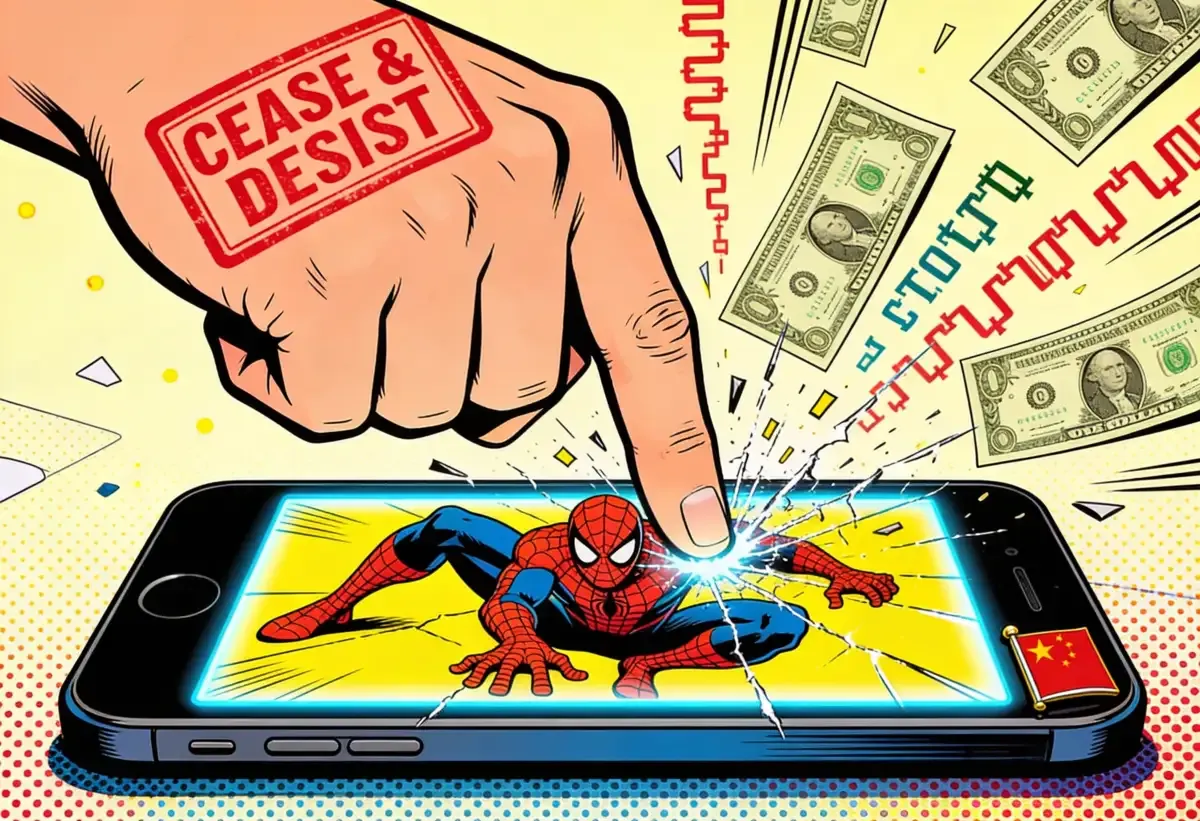
On August 27, 2025, a cease-and-desist letter landed at MiniMax's Shanghai headquarters. Disney, Warner Bros. Discovery, and NBCUniversal had identified over 30 copyrighted characters—Spider-Man, Batman, the Minions, Looney Tunes—being generated by the company's Hailuo AI video tool. The studios called the business model "bootlegging." They filed suit three weeks later in California federal court, seeking $150,000 per infringed work.
Four months after that letter arrived, MiniMax shares opened for trading in Hong Kong. They closed up 109%. Retail investors had oversubscribed by 1,830 times. Alibaba and Abu Dhabi's sovereign wealth fund anchored the deal. The company that Hollywood accused of systematic theft was now worth $6.5 billion.
The collision tells you something about where we are. MiniMax has built what might be the most successful Chinese consumer AI product to ever crack the American market. Talkie, the company's chatbot app, was beating Google-backed Character.AI in U.S. download rankings by mid-2024. Not by a little. Sensor Tower data showed Talkie at number four among AI apps; Character.AI had slipped to tenth. More than half of Talkie's users are American. International revenue—most of it from the U.S.—now accounts for over 70% of the company's total. For a Chinese AI firm operating while Washington debates bans on Chinese tech, that dependency is either a triumph or a trap. Probably both.
The question MiniMax's IPO forces into the open: Can Chinese AI scale globally when its growth depends on Western consumers, its most profitable features require Western intellectual property, and its survival requires Western app stores?
The Model
MiniMax makes money two ways. Consumer apps—Talkie and its domestic equivalent, Xingye—generate 71% of revenue. Enterprise API access brings in the rest.
The consumer side runs freemium. Ads keep the free tier alive. Subscribers pay $9.99 monthly to kill the ads and uncap their message limits. Most users don't pay. The paying ones subsidize the rest. The API business is different. Developers get charged by usage, and the rates are so low they read like mistakes. Text generation costs $0.12 to $0.40 per million tokens. A six-second video clip runs ten cents.
Those numbers are aggressive. Absurdly so. OpenAI charges $15.00 per million input tokens for its o1 model. That's 125 times MiniMax's floor price. DeepSeek, the open-source Chinese lab that spooked the industry in early 2025, charges $0.55. MiniMax undercuts even that.
The strategy is scorched earth. Price so low that competitors cannot survive on the same oxygen. Adoption follows, data accumulates, models improve, and eventually—eventually—margins materialize. Amazon ran this playbook for two decades. Uber is still running it. The difference: MiniMax is now a public company. The losses are no longer theoretical projections in pitch decks. They're quarterly disclosures.
Look at the nine months through September 2025. Revenue hit $53 million. Losses hit $211 million. Cloud bills alone exceeded $150 million. R&D burned through roughly $250 million, with 90% of that going to hardware. Four dollars out for every dollar in.
"It is still early in the China AI investment cycle compared to global peers," said Marvin Chen, an analyst at Bloomberg Intelligence, "so it may be difficult for investors to identify winners and losers."
The IPO prospectus offered little guidance on when losses might narrow. MiniMax is betting that scale will solve the unit economics eventually. The Hollywood lawsuit is betting that "eventually" may not arrive.
The Inflection
ChatGPT launched in November 2022. Eight months later, MiniMax pushed Talkie into international markets. The generative AI land grab was on.
What does Talkie actually do? You build AI characters and talk to them. A therapist who's available at 2 AM. A tutor who never loses patience. A romantic partner who exists entirely on your terms. Character.AI had invented this format and dominated it. But Character.AI fell apart in 2024. Safety scandals. A messy acqui-hire by Google that left the company structure confused. Key executives walking out.
MiniMax stepped into the vacuum. The app crossed 11 million monthly active users by mid-2024, with Americans making up more than half. Fast forward fourteen months. The company's products were pulling 27.6 million MAU worldwide. They'd started 2023 at 3.1 million. Two hundred million cumulative downloads. Two hundred countries. The curve isn't traction. It's contagion.
The flip. While Washington debated bans and Character.AI managed internal turnover, American teenagers simply switched apps. The crossover in mid-2024 suggests that for users, utility beats geopolitics.
Hailuo AI came next. MiniMax launched the video product in March 2024. Text-to-video generation. Type a description, get a clip. By January 2025, Hailuo topped global traffic rankings in its category. MiniMax marketed the tool as "a Hollywood studio in your pocket." The actual Hollywood studios would later cite that phrase in their lawsuit. As evidence of intent.
The technical claims start here. MiniMax says its models outperform competitors at lower compute cost. The MiniMax-01 series handles context windows up to 4 million tokens—20 to 32 times what rivals offer. The trick is something called Lightning Attention. Standard transformer models treat every input token with equal weight. Lightning Attention filters. It learns what matters and skips the rest. The effect is longer memory without proportionally higher cost. At least, that's the pitch. MiniMax also claims its M1 reasoning model runs on 30% of the compute that DeepSeek's R1 needs for equivalent tasks. No independent benchmark backs that up.
Nvidia's Jensen Huang called MiniMax "world-class" at a public event. When Nvidia's CEO names a company, valuations move. But the endorsement carries an awkward subtext. MiniMax runs on Nvidia hardware. American export controls are steadily restricting Chinese access to that hardware. Huang is praising a customer whose ability to buy his chips depends on Washington's mood.
The Constraints
Three forces press on MiniMax's expansion. Each one could break the model.
Intellectual property. The Hollywood lawsuit is not small. Disney went in alongside NBCUniversal and Warner Bros. Discovery. All three major studios, coordinated, alleging "willful and brazen" copyright infringement. Their argument: MiniMax trained Hailuo on copyrighted material, then built a business generating unauthorized videos of protected characters. The law allows $150,000 in statutory damages per infringed work. The studios named more than 30 characters. Multiply that out.
MiniMax's prospectus acknowledged the litigation as a risk factor. It offered no defense. The company hasn't explained where its training data comes from or whether it filters copyrighted outputs. What's obvious: Hailuo's most popular use case—generating videos of beloved characters—is also its most legally exposed.
This is the first time major U.S. entertainment companies have gone after a Chinese AI firm. Settlement is possible. But any settlement that restricts character generation cuts at the product's core appeal.
Watch what's happening to TikTok if you want a preview. Chinese ownership of popular American apps creates political opposition that has nothing to do with product quality. MiniMax gets over 70% of revenue from international markets. The U.S. is the biggest single source. A ban or forced divestiture wouldn't wound the company. It would end it.
Competition without mercy. DeepSeek, MiniMax's most dangerous domestic rival, stays private. It shows no interest in profitability. The R1 model matched OpenAI's o1 on benchmarks at a fraction of the cost. DeepSeek can run a price war forever because it never has to face a quarterly earnings call.
MiniMax does. Every three months, the company must stand in front of public shareholders and explain why it's still losing money while a private competitor keeps undercutting its prices. Public market discipline—usually a source of credibility—becomes a liability when your rival doesn't play by the same rules.
The Bet
MiniMax exists because Yan Junjie got bored with computer vision.
He'd spent six years at SenseTime, the facial recognition giant. By 2019 he was a vice president running 700 engineers. Good job. Secure. But that summer, OpenAI released a video that broke something in his head. The lab's bots were playing Dota 2 against professional gamers. OG, the two-time world champions. The bots won. Yan was a Dota addict himself—played constantly, knew the meta, understood exactly what he was watching. Machines had learned to play a game with 10,000 possible actions per frame better than humans who'd trained for years. After that, he couldn't focus on computer vision. He spent the next two years reading OpenAI papers on company time, waiting for his moment.
December 2021. SenseTime's IPO was weeks away. Yan's stock options were about to vest. He quit anyway. Recruited Zhou Yucong from SenseTime. Added Yang Bin and Yeyi Yun. The company name came from game theory. The minimax algorithm minimizes your losses in worst-case scenarios while maximizing gains. Yan figured that if he was going to compete with OpenAI on a fraction of the resources, he'd better optimize for survival.
The bet worked. Seven funding rounds in four years. More than $1.15 billion raised before the IPO. Tencent, Alibaba, Hillhouse, HongShan. Shanghai's state-owned investment arm came in on the later rounds. Valuation jumped from $2.5 billion in March 2024 to $6.5 billion at IPO. That's 2.6x in under two years.
But the original bet—language models over computer vision—has been replaced by a harder one. MiniMax now needs American consumers to keep downloading a Chinese AI app. Needs Hollywood's lawsuit to fail or settle cheap. Needs Washington to stay distracted. Needs profitability to arrive before any of those constraints snap shut.
"He tasted the bitterness of AI 1.0," one founder from China's "AI Four Little Dragons" said of Yan, referring to the years he spent watching SenseTime's computer vision business stagnate under American sanctions.
The question is whether AI 2.0 tastes different.
What It Signals
MiniMax's debut forces three realities into the open.
First, Chinese companies have closed the capability gap. By late 2025, they held every top spot in open-source model rankings, according to the Artificial Analysis Intelligence Index. MiniMax, Alibaba, DeepSeek, Zhipu AI—all Chinese. The export controls were supposed to hobble them. So far, that hasn't worked.
Second, nobody knows where the legal lines are. Every major AI lab scraped the internet to train its models. The internet is mostly copyrighted material. OpenAI knows this. Anthropic knows this. Google knows this. None of them have faced a full trial on whether that scraping constitutes infringement. MiniMax drew the short straw—first Chinese company to get sued by Hollywood, first to test whether "we trained on your content" holds up as fair use. The verdict will ripple far beyond one Shanghai startup.
Third, public markets might be the wrong venue for foundation model companies. MiniMax lost $4 for every $1 it earned through September 2025. The American comparisons—OpenAI, Anthropic, xAI—all stay private, where you can call those losses "investment" and move on. Going public means disclosing exactly how much it costs to build general-purpose AI. The numbers are ugly. They're supposed to be ugly. But now everyone can see them.
The 109% first-day pop suggests investors don't care. Retail buyers especially may be treating MiniMax as a proxy for Chinese AI—a sector that's minted fortunes for early investors in DeepSeek and others, none of whom trade publicly.
Whether that enthusiasm survives contact with quarterly earnings is another matter.
The Test
MiniMax enters public life with three numbers that will determine whether the stock surge was signal or noise.
First: litigation expense. Maximum statutory damages in the Hollywood lawsuit could theoretically reach into the billions. The more likely scenario is a settlement in the tens of millions, possibly with an injunction restricting character generation. Any outcome that materially limits what Hailuo can do would dent the growth story.
Second: loss trajectory. The company burned $211 million through September 2025 on $53 million in revenue. Investors accepted those terms at IPO because growth ran 130% year-over-year. If growth slows before losses narrow, the valuation falls apart.
Third: international revenue concentration. Seventy percent of revenue comes from outside China. The U.S. is the largest single market. App store removal, forced divestiture, data localization requirements—any of these would hit the business where it's most exposed.
Yan Junjie named his company after an algorithm for optimizing outcomes under adversarial conditions. He now faces adversaries on four fronts: DeepSeek on price, OpenAI on capability, Hollywood on intellectual property, Washington on market access.
The next earnings report lands in March. The Hollywood case moves to discovery shortly after. By summer, the market will know whether MiniMax found a durable path through—or whether the 109% first-day pop was simply the last good price.
❓ Frequently Asked Questions
Q: Who founded MiniMax and what's their background?
A: Yan Junjie founded MiniMax in December 2021 after six years as a vice president at SenseTime, where he ran 700 engineers. He recruited three co-founders: Zhou Yucong (also from SenseTime), Yang Bin, and Yeyi Yun. Yan left SenseTime weeks before its IPO, walking away from vesting stock options to start the company.
Q: What is Lightning Attention and why does it matter?
A: Lightning Attention is MiniMax's proprietary modification to standard transformer architecture. Regular transformers treat every input token with equal weight. Lightning Attention filters inputs, learning what matters and skipping the rest. This lets MiniMax handle context windows up to 4 million tokens—20 to 32 times larger than competitors—without proportionally higher compute costs.
Q: Which copyrighted characters are named in the Hollywood lawsuit?
A: Disney, NBCUniversal, and Warner Bros. Discovery identified over 30 characters in their September 2025 lawsuit. Named characters include Spider-Man, Batman, the Minions, and Looney Tunes. The studios allege MiniMax's Hailuo AI generates unauthorized videos of these protected characters. Statutory damages run $150,000 per infringed work.
Q: Why was Talkie removed from app stores in 2024?
A: Talkie was pulled from app stores in both Japan and the United States during 2024 for regulatory violations. The stores did not specify exact violations. The removals were temporary—the app returned to both markets—but they established a precedent for how quickly platform access can disappear for Chinese-owned apps.
Q: How much funding did MiniMax raise before going public?
A: MiniMax raised over $1.15 billion across seven funding rounds in four years. Key investors include Tencent, Alibaba, Hillhouse, and HongShan. Shanghai's state-owned investment arm participated in later rounds. Valuation jumped from $2.5 billion in March 2024 to $6.5 billion at IPO—a 2.6x increase in under two years.