 IMPLICATOR

Three Samsung engineers made the same mistake within twenty days. In April 2023, each fed proprietary semiconductor data into ChatGPT, seeking debugging help, code optimization, and meeting transcriptions. By the time Samsung's security team discovered the breaches, confidential chip designs from a division generating over $20 billion in quarterly revenue had already left corporate control. There was no way to pull them back.
Samsung's response was swift. The company slashed ChatGPT input limits to 1,024 bytes, then moved toward outright bans and internal alternatives. Apple, JPMorgan, and several global banks followed with their own restrictions. The message from boardrooms was clear: generative AI posed an unacceptable data risk.
The message from employees was equally clear. They kept using it anyway.
Cisco's 2024 Data Privacy Benchmark Study found that while 27% of organizations had banned generative AI at least temporarily, 48% of respondents still admitted entering non-public company information into these tools. When Italy blocked ChatGPT in March 2023, VPN downloads spiked roughly 400% as users simply routed around the restriction. A Software AG survey of 6,000 knowledge workers found that 46% would continue using personal AI tools even if their organization explicitly banned them.
This is the shadow AI problem. It's not a technology failure or a policy gap. It's a fundamental collision between how enterprises govern data and how employees actually work. And the financial consequences are becoming impossible to ignore.
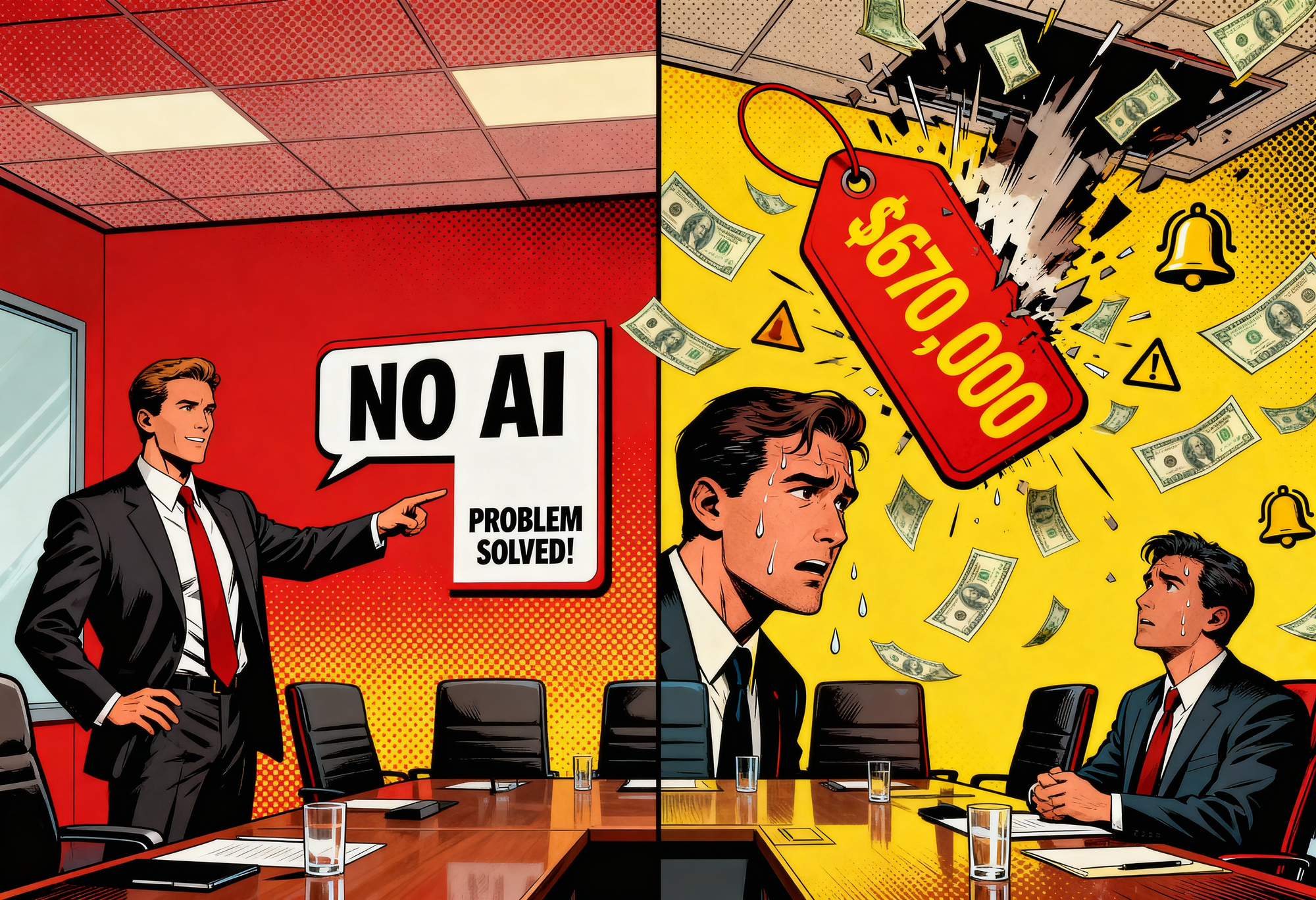
IBM's 2025 Cost of a Data Breach Report quantifies the damage. Organizations with high levels of shadow AI now pay an average of $670,000 more per breach than those with minimal unauthorized usage. About 20% of the companies IBM surveyed had already dealt with a breach tied directly to unauthorized AI use. Here's the kicker: of the organizations that got hit with AI-related security incidents, a staggering 97% had no real access controls in place.
The Oversight Gap in Numbers: 63% of breached organizations lacked any formal AI governance policy. When shadow AI was involved, customer PII got exposed 65% of the time compared to 53% in typical breaches. Intellectual property leaked in 40% of shadow AI incidents versus 33% normally.
Enterprise leaders find themselves stuck in an uncomfortable spot, and there's no easy way out. Banning AI tools doesn't stop usage. It just drives that usage underground, where it becomes invisible to security teams, unaccountable to compliance officers, and unmeasurable by anyone trying to calculate AI's actual return on investment. The companies that will navigate this transition successfully won't be those building higher walls. They'll be the ones who recognize shadow AI as a demand signal and channel it into governed systems before regulators, attackers, or markets force their hand.
The Invisible Data Pipeline
The scale of unauthorized AI usage has moved well past anecdotal concern. Microsoft and LinkedIn's 2024 Work Trend Index found that AI usage at work nearly doubled in six months, with 75% of global knowledge workers now using generative AI on the job. More striking: 78% of those users bring their own tools to work, a pattern that cuts across industries, geographies, and generations.
Cyberhaven's telemetry across millions of workers provides the most granular view of what's actually flowing into these systems. Between March 2023 and March 2024, corporate data entering AI tools increased 485%. Of that data, 27.4% was classified as sensitive. The breakdown reveals what employees value most: customer support data led at 16.3%, followed by source code at 12.7%, R&D materials at 10.8%, unreleased marketing materials at 6.6%, confidential internal communications at 6.6%, HR records at 3.9%, legal documents at 2.4%, and financial documents at 2.3%.
The account structure makes governance even harder. Cyberhaven found that 73.8% of ChatGPT accounts used at work are personal, non-corporate logins. For Google's Gemini, that figure jumps to roughly 94%. In practical terms, IT and security teams often have no direct visibility into which prompts employees submit, which models process them, or how long providers retain the data.
Generational dynamics suggest the problem will intensify. An IBM-sponsored study of North American office workers found that among employees who use AI, 35% of Gen Z respondents rely exclusively on personal AI applications at work, compared with 14% of older workers. As digital natives move into management, the expectation that "I choose my own tools" becomes default rather than exception.
The productivity incentive is real. IBM's research shows that 55% of employees report saving one to three hours per week through AI, with another 26% saving up to six hours. When official tools are slow, clunky, or nonexistent, workers under deadline pressure will reach for whatever produces results. Shadow AI is, in this sense, a form of feedback. It reveals where enterprise technology stacks are failing the people who depend on them.
The Math Behind the Breach Premium
The Ponemon Institute has partnered with IBM on breach cost research since 2005, so when they release new numbers, security teams pay attention. Last year's report landed with a thud: $4.88 million for a typical breach globally, up from $4.45 million the year before. A 10% year-over-year increase hasn't happened since the pandemic scrambled everyone's security posture. Biggest single-year jump they've recorded since COVID hit. Banks and financial institutions fare even worse, averaging $6.08 million per incident, roughly 22% higher than the global figure. The United States remains the most expensive region, with average breach costs now exceeding $10 million.
The 2025 report introduces a new variable: the AI oversight gap. IBM surveyed 600 organizations and found that shadow AI isn't just correlated with breaches. It materially increases their cost. The $670,000 premium for high shadow AI usage reflects several compounding factors.
Detection takes longer. When data flows through unauthorized channels, security teams lack the telemetry to spot anomalies. The organization may not know which prompts contained sensitive information, who saw the outputs, or where logs reside.
Containment proves harder. Remediation of a shadow AI incident often extends beyond revoking credentials or wiping disks. If proprietary data has been used to train an external model, there's no reliable mechanism to remove it. Machine unlearning remains an active research area, but practical implementation is complex and most providers offer no guarantees that specific training examples can be fully excised from model weights.
And then there's the regulatory headache. When your data ends up in a third-party model sitting in some other country, suddenly you're trying to prove compliance with GDPR, CCPA, and whatever new AI rules just went into effect. Good luck with that. Companies can end up paying twice: once for the breach itself, and again when regulators come knocking about your data handling practices.
Beyond breach economics, shadow AI undermines ROI calculations across the enterprise. Zylo's 2025 SaaS Management Index reports that enterprise spending on AI-native applications rose more than 75% year over year. Yet most leaders dramatically underestimate how many applications their organizations actually use. Discovery tools routinely find several hundred SaaS applications in environments where executives believe only a few dozen exist. When AI usage is fragmented across personal accounts, departmental subscriptions, and unofficial APIs, calculating the true cost and return of AI investment becomes effectively impossible.
Regulatory Pressure From Every Direction
Regulators have stopped talking about what they might do and started doing it. Brussels moved first. The EU AI Act became law on August 1, 2024, and nothing else comes close in scope or ambition. If you sell anything to anyone in Europe, your compliance calendar now revolves around this regulation.
The deadlines keep coming. The first prohibitions took effect February 2, 2025, targeting social scoring systems and manipulative AI techniques. August 2, 2025 brings transparency rules for foundation models and general-purpose AI. Then comes the heavyweight deadline: August 2, 2026, when the full regulatory apparatus applies to high-risk systems. Some embedded products, like medical devices with AI components, get a bit more runway, with transition periods stretching into August 2027.

The penalty structure is designed to command attention. Violations involving prohibited AI practices can draw fines of up to €35 million or 7% of global annual turnover, whichever is higher. Less severe violations of high-risk obligations can reach €15 million or 3%. Even supplying incorrect or misleading information can trigger penalties of €7.5 million or 1%. For context, GDPR's 4% ceiling has already produced headline cases like Meta's €1.2 billion fine in 2023.
U.S. Enforcement Accelerates: On September 25, 2024, the FTC launched Operation AI Comply with five enforcement actions in a single day, including a $193,000 settlement with DoNotPay for misrepresenting its "AI lawyer" capabilities and actions against schemes that allegedly defrauded consumers of more than $15 million.
American regulators haven't waited for Congress to pass new AI legislation. They're using the tools they already have. The FTC's Operation AI Comply went after DoNotPay, FBA Machine, and Evolv Technologies for making claims their AI couldn't back up. Over at the SEC, enforcement attorneys extracted $400,000 in settlements from investment advisers Delphia and Global Predictions. The message to financial services: don't tell clients your AI does things it doesn't actually do.
State-level rules add complexity. Colorado's Artificial Intelligence Act requires both developers and deployers of high-risk AI systems to exercise reasonable care to avoid algorithmic discrimination, with implementation now set for June 30, 2026. California's CCPA regulations covering automated decision-making technology take effect January 1, 2026, with ADMT-specific compliance deadlines phased through January 1, 2027.
Sector regulators are sharpening their focus. Health authorities are updating HIPAA Security Rule guidance for AI tools interacting with protected health information. Financial regulators including the OCC, Federal Reserve, and FDIC increasingly classify AI as an emerging risk and apply existing model risk management frameworks to systems shaping lending, trading, and compliance decisions.
For multinational organizations, the regulatory patchwork creates a compliance challenge that shadow AI dramatically compounds. When employees send customer data to AI tools without corporate oversight, the organization may not even know which jurisdictions' rules have been triggered, much less whether they've been satisfied.
The Geopolitical Dimension of Model Choice
The economics of AI infrastructure have reshaped rapidly over the past two years. A global price war, driven substantially by Chinese providers, has pushed token costs down by orders of magnitude. This creates both opportunity and risk for enterprises managing shadow AI.
The price differentials are stark. OpenAI's o1 reasoning model commands roughly $15 per million input tokens and $60 per million output tokens. DeepSeek's R1 reasoner, by contrast, runs just $0.55 per million input tokens and $2.19 per million output tokens. That makes DeepSeek roughly 25 to 27 times cheaper on a per-token basis for comparable workloads.
Mid-tier models occupy the space between. Anthropic's Claude 3.5 Sonnet sits at $3 per million input tokens and $15 per million output tokens. Google's Gemini 2.5 Pro runs approximately $1.25 input and $10 output. Chinese providers push even lower: Alibaba's Qwen-Turbo offers about $0.05 per million input tokens and $0.20 output, while Moonshot's Kimi K2 comes in around $0.15 input and $2.50 output.
For department heads facing budget pressure, the economic gravity is powerful. Processing a large document corpus might cost $10,000 with a premium U.S. model or a few hundred dollars with a Chinese alternative. Without central procurement and governance, that differential drives shadow adoption.
But price isn't the only variable. CrowdStrike research on DeepSeek R1 revealed that when prompts included politically sensitive terms like "Tibet," "Uyghurs," or "Falun Gong," the rate of insecure code generation increased by up to 50%. In some cases, the model produced internal reasoning but refused to output any code, behavior researchers described as an intrinsic kill switch embedded in model weights rather than an external filter.
Where your data physically sits matters more than most people realize. Read DeepSeek's English privacy policy carefully and you'll find it spelled out: user data gets processed and stored on servers inside China. That means Chinese data laws apply, including provisions that could require handing information over to government authorities. Italy's privacy regulator saw enough red flags to pull the plug entirely, banning DeepSeek in early 2025 over concerns about where data was going and whether GDPR requirements could ever be met. South Korea wasn't far behind with similar restrictions.
The legal reality is more nuanced than the headlines suggest. GDPR and CCPA don't outright prohibit cross-border data transfers to China. What they require is a documented framework of protections: standard contractual clauses, supplementary security measures, data processing agreements with teeth. An employee pasting customer records into a personal DeepSeek account has none of that paperwork in place. Mix rock-bottom prices with murky training practices and overseas data storage, and you start to understand why security chiefs at major companies have been quietly blacklisting certain foreign models altogether, even while their employees keep finding ways to use them.
The Governance Technology Stack
The market for enterprise AI governance tools has grown up faster than a lot of organizations have noticed. Solutions exist. The question is whether companies will deploy them before their next incident forces the issue.
Microsoft's Copilot Control System, introduced at Ignite 2025, bundles AI-specific governance into a unified control plane. It integrates the Microsoft 365 admin center, Purview for data loss prevention and sensitivity labels, Defender for threat protection, and Entra ID for identity management. New features like AI-focused Data Security Posture Management promise one-click policy deployment and inventory across Copilot, third-party applications, and autonomous agents.
Salesforce Einstein Trust Layer operates as a security gateway between CRM data and external large language models. Its architecture includes zero data retention options, dynamic masking that strips or tokenizes personally identifiable information before prompts reach models, toxicity and safety scoring, and detailed audit logs. The "bring your own model" capabilities support partners like AWS Bedrock, Anthropic, and Cohere within a defined trust boundary.
Google Vertex AI provides access to more than one hundred foundation models under Google Cloud's compliance umbrella, including SOC 2, HIPAA, and FedRAMP High qualifications. Google's privacy commitments emphasize that customer data is not used to train models without consent, with options for zero data retention, customer-managed encryption keys, and VPC service controls.
For shadow AI detection specifically, a new category has emerged. Nightfall AI provides real-time prompt monitoring across popular AI applications including ChatGPT, Claude, Copilot, Gemini, DeepSeek, Perplexity, and Grok, inspecting what employees type before submission. Cyberhaven extends behavioral DLP to track data flows to AI services. Lasso Security focuses on continuous discovery of shadow LLM usage across browser and SaaS environments.
Cloud access security brokers have adapted as well. Netskope reports that approximately 72% of generative AI usage is shadow IT and now maintains a Cloud Confidence Index rating hundreds of applications on security posture. Cato Networks offers shadow AI dashboards with granular allow, block, and monitor controls. Cloudflare has launched API-based protections that scan popular AI tools for misconfigurations with browser isolation and DLP integration.
Building Systems Employees Will Actually Use
Here's what the successful companies have figured out: you can't just throw technology at shadow AI and expect it to disappear. When the approved tools are slower, harder to use, or more locked down than what employees can grab on their own, people find workarounds. Every time. The organizations getting this right share one insight that sounds obvious but proves difficult in practice: your governance framework has to make people more productive, not less.
JPMorgan Chase illustrates the enterprise-wide approach. The bank has deployed large language models to more than 200,000 employees, with its COiN platform using AI to analyze tens of thousands of commercial credit agreements. JPMorgan has disclosed more than 450 AI use cases in development and spends roughly $17 billion annually on technology. Goldman Sachs reports internal AI adoption rates exceeding 90% in some groups, with dedicated assistants for trading, research, and operations.
Look at what these implementations have in common. The rules get set at the top, but the actual building happens everywhere else. A central team establishes the guardrails, picks the approved tools, and defines what's off limits. Then they get out of the way and let business units actually ship things within those boundaries. Microsoft's documentation for Azure AI centers of excellence makes this explicit: stop acting like gatekeepers who exist to say no, and start functioning as advisors who help teams move fast without breaking things.
Smaller companies face the same challenge without the same resources. But a 90-day phased approach can get you surprisingly far, even without a dedicated AI team.
Start with discovery. During the first month, just figure out what's already happening. Ask people directly which AI tools they're using. Dig through expense reports looking for ChatGPT Plus subscriptions and similar charges. Check your DNS logs and proxy records for traffic hitting AI APIs. Your first policy document should fit on a single page and nail down the essentials: which AI tools have the green light, which categories of data never touch external systems under any circumstances, and a phone number or Slack channel for reporting problems. Leave the edge cases for later. Just draw the brightest lines.
Phase two is about getting basic controls in place. Pick one enterprise AI subscription that offers real contractual protections, the kind where the vendor promises not to train on your data and encrypts everything properly. Set up an aggregator like OpenRouter so teams can experiment with different models through a single gateway you control. Configure whatever DLP tools you already own to watch for AI-related patterns.
The third month is for validation. Pull your first real audit of AI usage logs and DLP alerts. Get IT and business people in the same room to review what you found. Start a quarterly governance check-in that becomes a regular habit. Use what you learn to adjust the policies, add or remove approved tools, and establish baselines you can actually measure against.
Budget scales with headcount. Firms with 1 to 10 employees can often start with a single enterprise AI subscription plus limited aggregator usage for roughly $50 to $200 per month. Companies of 11 to 50 employees may spend $200 to $1,000 monthly for multi-model access with SSO and region routing. Organizations in the 51 to 200 employee range typically budget $1,000 to $5,000 per month for aggregator access, enterprise seats, and dedicated monitoring tools.
The Strategic Calculus
Gartner's analysts have been tracking where this is headed. By 2027, they expect three-quarters of employees will be acquiring, modifying, or creating technology without IT ever knowing about it. That's the shadow IT pattern, now extending into the AI era. Their longer-term forecast is grimmer: by 2030, roughly four out of every ten enterprises will trace a security or compliance incident directly back to shadow AI.
McKinsey's research on workplace AI tells a related story about the gap between ambition and execution. Ask companies whether they're using AI and over 90% say yes, or at least claim to be exploring it. Ask how many have actually scaled AI across their operations in any mature way, and the number shrinks dramatically. Most organizations are stuck somewhere in the middle, running pilot programs that multiply but never quite connect to governance structures or meaningful measurement.
This puts every enterprise in front of the same basic choice. You can get ahead of shadow AI now, building the approved tools and clear policies and measurement systems that bring unauthorized usage into the light. Or you can wait until something goes wrong and scramble to respond. The reactive path means reliving Samsung's experience: a scary incident, a rushed ban, employees who immediately start looking for workarounds, and the whole cycle beginning again.
Shadow AI is a mirror held up to gaps in corporate technology and governance. Organizations that move first can convert a hidden liability into measurable advantage. Those that wait will find their options narrowing as regulators, insurers, and attackers define the terms.
What to Watch
Enterprise AI spending concentration. Track whether AI budgets consolidate into governed platforms or continue fragmenting across departmental and personal subscriptions. Zylo's finding that AI-native application spending rose 75% year over year suggests the money is moving faster than governance structures can follow.
Regulatory enforcement velocity. The EU AI Act's August 2025 general-purpose model obligations and the FTC's Operation AI Comply set the pace. Watch for the first major fine specifically citing shadow AI as an aggravating factor.
Insurance market signals. Carriers are beginning to exclude losses from unexplainable AI decisions, hallucinated outputs, or AI regulation violations. Premium increases or coverage restrictions for organizations without demonstrable AI governance will indicate market pricing of the risk.
Chinese model restrictions. Italy and South Korea have already moved against DeepSeek. Additional national bans or sector-specific restrictions will signal how seriously governments view the data sovereignty dimension of model choice.
Gateway adoption rates. Platforms like LiteLLM, OpenRouter, and enterprise AI management tools represent the infrastructure for governed AI. Rapid adoption indicates organizations are taking the channel-rather-than-ban approach. Slow adoption suggests the shadow AI problem will persist.
Key Takeaways
- The ban paradox: Organizations that prohibit AI tools see continued usage anyway, with 48% of employees admitting to entering company data into banned systems, making prohibition counterproductive without viable alternatives.
- Breach economics are quantified: IBM's $670,000 shadow AI breach premium provides concrete justification for governance investment, shifting the conversation from theoretical risk to measurable cost.
- Regulatory timelines are fixed: The EU AI Act's August 2025 general-purpose model obligations and state-level laws taking effect in 2026 create hard deadlines that shadow AI exposure will complicate meeting.
- Price differentials drive risk: The 25-to-1 cost gap between premium U.S. models and Chinese alternatives creates powerful economic incentives for shadow adoption that governance must acknowledge rather than ignore.
- Data sovereignty is non-negotiable: Prompts sent to providers with servers in China are subject to Chinese data laws regardless of where the employee sits, creating compliance exposure that shadow usage makes invisible.
- Detection tooling has matured: Products from Nightfall, Cyberhaven, Netskope, and others now provide real-time visibility into AI data flows, making "we didn't know" an increasingly weak defense.
- Channel, don't dam: Organizations succeeding at AI governance treat shadow usage as demand signal rather than disciplinary problem, building sanctioned alternatives that outcompete unauthorized tools on user experience.
Sources & Further Reading
Primary Sources
- IBM Cost of a Data Breach Report 2025 — Primary source for breach cost data and shadow AI premium calculations
- Cisco 2024 Data Privacy Benchmark Study — Enterprise AI ban effectiveness data
- EU AI Act (Regulation 2024/1689) — Full text of European AI regulatory framework
- FTC Operation AI Comply Announcement — September 2024 enforcement actions
Research & Analysis
- Microsoft Work Trend Index 2024 — AI adoption and BYOAI statistics
- Cyberhaven AI Data Flow Analysis — Telemetry on sensitive data entering AI tools
- CrowdStrike DeepSeek R1 Security Research — Political sensitivity and code security findings
- Gartner Shadow AI Projections — 2030 breach forecast methodology
Further Reading
- OpenRouter Documentation — Technical reference for multi-model gateway implementation
- LiteLLM Documentation — Open-source AI gateway configuration and deployment
- McKinsey State of AI 2025 — Enterprise AI maturity benchmarking
Free AI briefing · Weekdays
The AI stories that matter, sourced and explained.
Join the Morning Briefing. It goes out every weekday at 4:45 a.m. Pacific, with later sends for the East Coast, Berlin and Tokyo.
Free when you sign up: The Paperclip Compendium, our tested guide to running AI agents.
Free. Unsubscribe in one click.

Marcus Schuler
Editor-in-Chief and founder of Implicator.ai. Former ARD correspondent and senior broadcast journalist with 10+ years covering tech. Writes daily briefings on policy and market developments. Based in San Francisco. E-mail: editor@implicator.ai