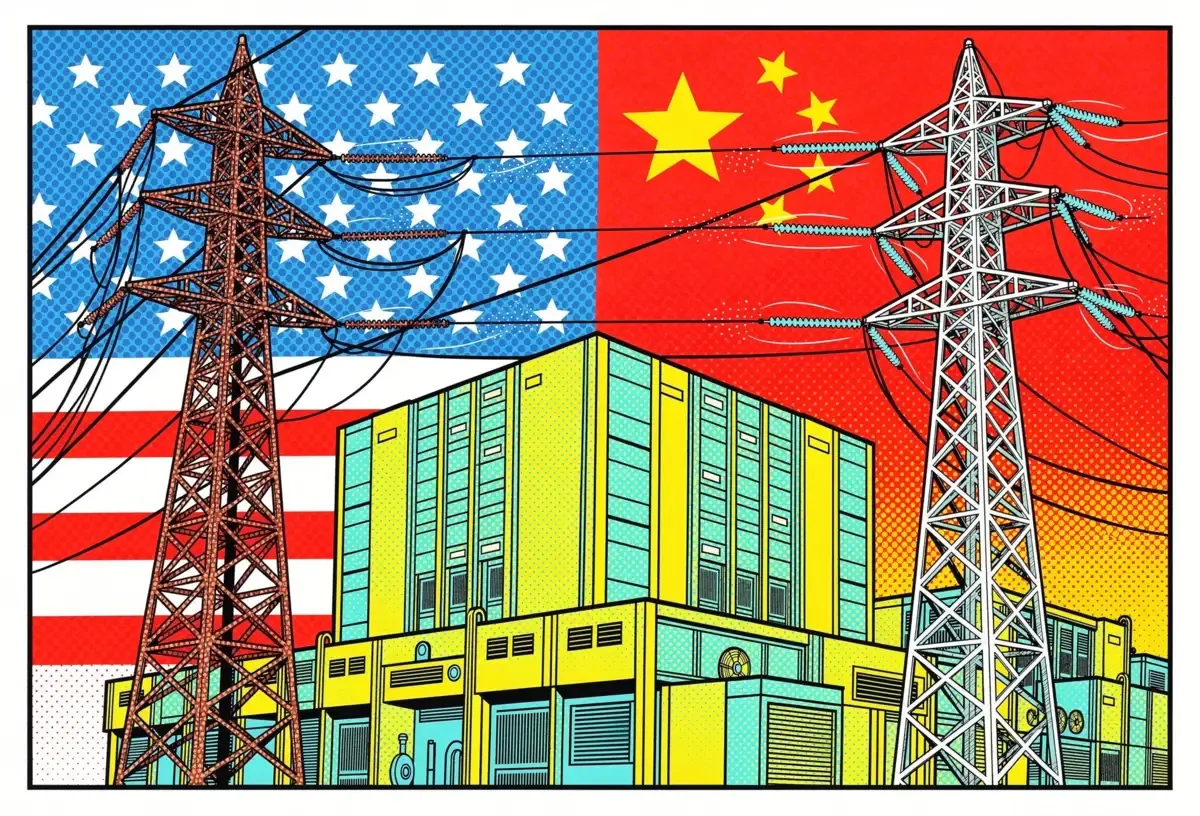
Silicon Valley built the world's most sophisticated AI models. China built the grid to run them.
OpenAI, Anthropic, and Google poured billions into training larger models. They hired the best researchers, bought the most GPUs, published the flashiest benchmarks. Beijing did something else. It spent 15 years building power plants and transmission lines. Chinese data centers now pay roughly half what American ones pay for electricity. The gap widens every month.
Morgan Stanley forecasts China will spend $560 billion on grid projects through 2030, a 45% increase from the previous five years. Goldman Sachs projects the country will have 400 gigawatts of spare capacity by decade's end. That is three times the world's expected data center power demand. Meanwhile, American data centers face a projected 44-gigawatt shortfall within three years, equivalent to New York state's entire summertime capacity.
OpenAI now calls this the "electron gap."
The Breakdown
• Chinese data centers pay 3 cents per kilowatt-hour versus 7-9 cents in the US. Morgan Stanley projects a 44-gigawatt American shortfall by 2028.
• Over 85% of US utilities use Chinese-made inverters. In November 2024, a Chinese manufacturer remotely disabled US devices during a contract dispute.
• US investors pile into Chinese AI despite congressional restrictions. Alibaba up 80% this year; 90% of Morgan Stanley meetings want more China exposure.
• China dominates open-source AI models, optimizing efficiency to reduce power needs. America waits years for grid permits while China's infrastructure is already built.
The Cost Calculus Nobody Discusses
Chinese data centers secure electricity for as little as 3 cents per kilowatt-hour through long-term purchase agreements. In northern Virginia, America's largest data center market, operators typically pay 7 to 9 cents. That differential compounds.
In regions with significant data center activity, American electricity costs have risen 267% over five years. A $100 monthly bill in 2020 becomes $267 today. PJM, the nation's largest grid operator, recently held a capacity auction where prices jumped from $28.92 to $329.17 per megawatt-day. A tenfold increase in two years.
These numbers rarely appear in coverage of the AI competition. They should dominate it.
Why the gap? Different bets on what matters. China built capacity. America assumed the grid would handle whatever came next.
The scale is hard to grasp. Between 2010 and 2024, China added more power production than every other country on Earth combined. Not more than any single competitor. More than all of them. Last year the country generated twice America's output. Today China operates 3.75 terawatts of generation capacity. It has 34 nuclear reactors under construction. In Tibet, crews are building a hydropower project that will produce three times the output of Three Gorges Dam.
"In China, electricity is our competitive advantage," Liu Liehong, head of China's National Data Administration, said in March. American executives worry about whether they can buy enough Nvidia chips. Chinese officials talk about kilowatt-hours.
Inner Mongolia illustrates the scale of China's buildout. The region, designated as one of eight hubs under Beijing's "East Data, West Computing" program, now hosts more than 100 data centers in operation or under development. Officials describe it as a "cloud valley of the grasslands." Ulanqab's gross regional product has increased 50% over five years. Electricity consumption by data centers and IT services rose more than 700% since 2019.
Apple, Alibaba, Huawei, and XPeng all operate facilities there. The ambient air runs cold enough to chill servers without compressors. The open steppe accommodates massive solar and wind installations. Local authorities report $35 billion in computing-industry investments as of June.
The Speed Mismatch
Here's where conventional analysis goes wrong. Most coverage frames the US-China AI competition as a battle over model quality and chip access. That framing made sense two years ago. It increasingly misses the point.
China's limitation is chips. America's limitation is power. But these constraints operate on different timescales.
Chip manufacturing can scale relatively quickly once technical barriers fall. TSMC built its Arizona fab in under four years. Power infrastructure takes decades. America's grid dates to the mid-20th century. Upgrading it requires fighting through fragmented regulatory authority across federal, state, and local jurisdictions, securing permits that routinely take years, and building transmission lines through communities that don't want them.
The Solar Energy Industries Association warned the Energy Department in November that America's AI leadership was "stymied by onerous and unstable permitting policies and insufficient transmission capacity." Eighteen states have over half their planned solar and storage capacity at risk of being blocked.
Bernstein semiconductor analyst Qingyuan Lin offered the clearest assessment: "For the near term, China's lack of leading-edge chip capacity is a tighter constraint than the U.S.'s power bottleneck." But he added something worth remembering. "The longer the AI race lasts, the more opportunities there will be for China to close the gap."
Chinese companies have already demonstrated they can extract remarkable performance from inferior hardware. DeepSeek built models rivaling American leaders while using a fraction of the computing power. Huawei's CloudMatrix 384 system, bundling 384 of its Ascend chips, provides two-thirds more computing power than Nvidia's flagship 72-chip Blackwell system under popular machine learning metrics. It consumes four times the power, according to SemiAnalysis. But when electricity costs half as much, the math still works.
President Trump's recent decision to allow Nvidia's H200 chips into China complicates the blockade strategy. The H200 offers significantly better performance than current Chinese alternatives. Beijing hasn't said whether domestic companies can buy them. That silence matters. The government spent years strong-arming Alibaba, Baidu, and the rest into buying Huawei chips instead of Nvidia. Patriotic purchasing, they called it. Now Nvidia is back on the menu, technically. But nobody in Beijing has told the tech giants they're allowed to eat.
The Security Trap
The energy gap creates a secondary problem that makes the strategic position even more absurd.
America's clean energy transition, meant partly to address power shortfalls, has created new dependencies on Chinese manufacturing. Research firm Strider Technologies found that more than 85% of surveyed utilities use inverter devices made by companies with ties to the Chinese government. These inverters transform solar energy into grid-compatible current. Solar accounts for roughly 90% of new energy added to America's electricity system this year.
In November 2024, Chinese manufacturer Ningbo Deye remotely disabled several of these devices in the US during a contract dispute. Just shut them off from across the Pacific.
"The capability is there; the gun is loaded," said Greg Levesque, Strider's CEO. "Now we are debating whether they will pull the trigger and what the impact would be."
The US-China Economic and Security Review Commission called Chinese inverters "a vulnerability with serious national security implications" in a report last month. Fifty-two Republican lawmakers have called on Commerce Secretary Howard Lutnick to restrict future imports. But banning the devices creates its own problem.
"We don't have a choice to buy all this gear from anywhere else right now," said cybersecurity expert Patrick Miller in congressional testimony. "There is no place to buy it. If you try to rip it out and replace it, there won't be enough power for all the things we need to do."
So America needs more power to compete in AI. Clean energy offers the fastest path to new capacity. Clean energy requires Chinese components. Those components create security vulnerabilities. Restricting them slows the power buildout. Slower power buildout widens the AI gap. This isn't strategy. It's a trap built from accumulated decisions nobody coordinated.
The Capital Contradiction
American policymakers and American investors are moving in opposite directions.
Congress passed defense authorization this week handing Trump power to strengthen Biden-era rules limiting US investment in Chinese high-tech industries. House Speaker Mike Johnson declared that "investments propping up Communist China's aggression must come to an end."
Yet US investors are pouring money into Chinese AI. Alibaba shares have risen more than 80% this year to a four-year high. Tencent and Baidu are up nearly 50%. KraneShares CSI China Internet ETF has grown by $1.4 billion since July to nearly $9 billion. Invesco China Technology ETF has more than doubled to nearly $3 billion.
Morgan Stanley's Laura Wang visited US investors this fall and found 90% wanted to increase China exposure, the highest interest in four years. Billionaire hedge-fund manager David Tepper holds Alibaba as 16% of his disclosed public equities portfolio.
The logic is straightforward. Chinese tech giants trade at significant discounts to US peers on price-to-earnings ratios. DeepSeek proved Chinese companies can build competitive models. Alibaba announced plans to invest $53 billion over three years in AI infrastructure.
"China is such a huge market," said Nomura's Jialong Shi. "We are going to see increasing fund inflow from the U.S. investors."
Public markets face no restrictions on buying Chinese AI exposure. Private investment faces tightening rules. The distinction matters less than it might seem. Capital finds paths.
The Efficiency Endgame
China's response to American chip advantages has produced an unexpected structural shift. The top 10 ranked open-source AI models are now almost entirely Chinese.
DeepSeek, Alibaba's Qwen, and others release their cutting-edge models free. Users can download them, study how they work, adapt them for commercial use. Within days of DeepSeek releasing its R1 model, developers on Hugging Face created more than 500 derivative models downloaded 2.5 million times.
This matters for the infrastructure race. Open-source models get optimized by thousands of engineers simultaneously. Each optimization reduces computational requirements. Each reduction in compute means less power consumed per query, less heat generated, less cooling needed.
Former Google CEO Eric Schmidt has warned that US companies risk ceding open-source AI to China entirely. Venture capitalist Allen Zhu of GSR Ventures put it more directly: "It's much easier for China to catch up on algorithms and AI models than for the US to build up the data centers and power plants that run AI."
The arithmetic compounds in China's favor. American companies train massive models that demand massive power. They wait years for permits to build new capacity. Chinese companies optimize models to run on less hardware, share the improvements publicly, and plug them into a grid that's already been built.
"In 10 years' time, people will look back and see DeepSeek as a turning point in AI development," Zhu said.
Kai-Fu Lee, former president of Google China, reaches for a smartphone analogy. Think iOS versus Android. American AI companies want the Apple model: closed systems, premium pricing, fat margins. That works if you're selling to enterprises with money to burn. But Android runs on 70% of the world's phones. It won. Chinese AI companies are making the same bet, giving away models to own the ecosystem. The profits come later, from the applications built on top.
The US built better AI. China built cheaper power and more efficient code. America is still waiting for permits.
Why This Matters
- For American policymakers: The permitting bottleneck on power infrastructure may matter more than chip export controls. Every year of delay on grid modernization is a year China extends its cost advantage. The security trap with Chinese inverters has no clean solution.
- For investors: Washington restricts private investment while public markets enable unlimited exposure. The 90% of Morgan Stanley's investor meetings seeking China exposure suggests where institutional money is heading regardless of policy signals.
- For the AI industry: Infrastructure advantages and efficiency advantages can prove more durable than model performance advantages. China doesn't need to build better AI if it can run equivalent AI at half the cost while America waits for a substation approval in Virginia.
❓ Frequently Asked Questions
Q: What is China's "East Data, West Computing" program?
A: A 2021 government initiative that routes AI computing demand from populous eastern cities to eight designated hubs in western China where electricity is cheap and abundant. The program fast-tracks permits and land acquisition for data centers in these hubs, and some facilities pay only half their electricity bills, with government subsidies covering the rest.
Q: Why can't the US build power infrastructure faster?
A: Three main bottlenecks. Permits routinely take years to secure across federal, state, and local jurisdictions. Transmission lines face opposition from communities along proposed routes. And 18 states have over half their planned solar and storage capacity at risk of being blocked by regulatory delays. China's centralized system bypasses these obstacles entirely.
Q: What are inverters and why are they a security concern?
A: Inverters convert solar-generated electricity into a current compatible with the power grid. Over 85% of US utilities use Chinese-made inverters with internet connectivity. In November 2024, Chinese manufacturer Ningbo Deye remotely disabled several US devices during a contract dispute, demonstrating that these components can be shut off from China.
Q: How did DeepSeek build competitive AI models with less computing power?
A: DeepSeek focused on algorithmic efficiency rather than brute-force computing. By optimizing model architecture and training methods, it achieved performance rivaling American leaders while using a fraction of the power. The company then open-sourced its models, allowing thousands of engineers worldwide to further optimize them. Within days, developers created 500+ derivative models.
Q: Why don't US companies just move data centers to regions with cheaper electricity?
A: Some do. But even in cheaper US regions, electricity costs remain higher than China's 3 cents per kilowatt-hour. Moving also creates latency issues for real-time AI applications. And the core problem persists: total US capacity is projected to fall 44 gigawatts short of demand within three years. There's not enough power anywhere in the country.
 Maria Garcia
 Marcus Schuler
 Robert Brown