IMPLICATOR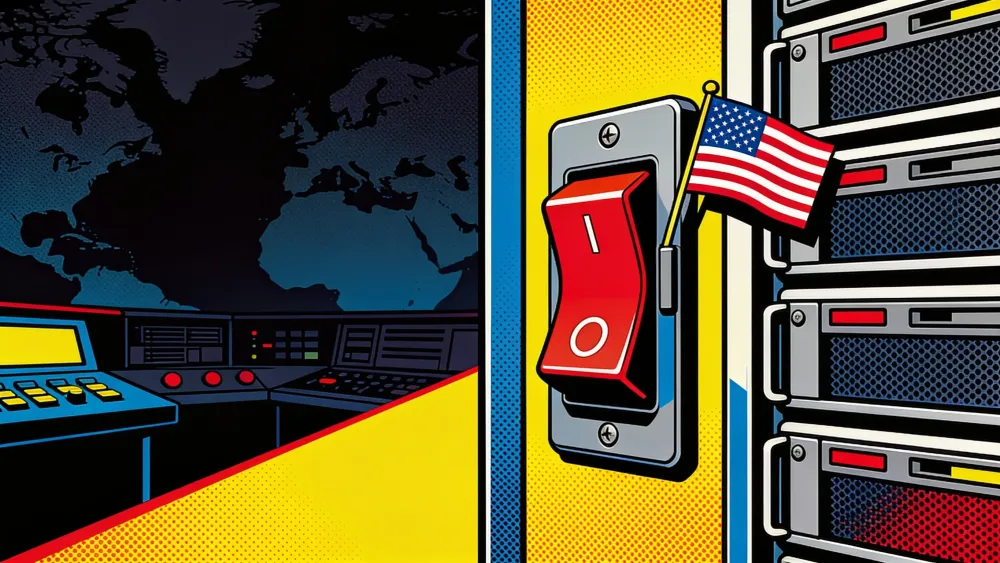
Anthropic disabled its two most capable artificial-intelligence models, Fable 5 and Mythos 5, for every customer worldwide late on June 12, after the US Commerce Department ordered the company to block all foreign nationals from using them, citing national security. The directive arrived at 5:21 p.m. Eastern, three days after Fable 5 had gone on public sale, and the only way to comply was to switch both models off for everyone, the company said.
For European governments, the shutdown settled an argument they had mostly stopped having. The continent's reliance on American technology was already understood and largely accepted. What broke on June 12 was the trust underneath it. A US administration reached for export-control law, the instrument built for weapons and advanced chips, and used it to turn off a commercial software product overnight, for customers who had no part in the dispute. That dependence does not stop at Anthropic. It runs through Google, Amazon Web Services, and Microsoft, the American infrastructure now underneath European business and government.
Key Takeaways
- The US Commerce Department barred all foreign nationals from Anthropic's Fable 5 and Mythos 5, so the company disabled both models worldwide on June 12.
- It is the first time Washington has used export-control law on an AI model itself, not the chips that train it.
- Amazon's Andy Jassy flagged a Fable 5 bypass to officials; Anthropic calls the jailbreak narrow and disputes the order.
- European leaders cast the shutdown as proof their dependence on US cloud and AI, from Anthropic to Google and AWS, is a strategic risk.
AI-generated summary, reviewed by an editor. More on our AI guidelines.
What the Commerce letter ordered
Commerce Secretary Howard Lutnick sent Anthropic chief executive Dario Amodei a letter on Friday placing Fable 5 and Mythos 5 under export controls, barring their export, re-export, or domestic transfer to any foreign national without a license, Axios reported. A license would require a separate, individually validated application, and non-compliance carried financial and civil penalties.
Under the "deemed export" rule, showing controlled technology to a foreign national inside the United States counts as an export abroad, which swept in Anthropic's own foreign-national staff. Because the company could not separate those users in real time, it disabled the models for everyone rather than selectively. Peter Girnus, a senior threat researcher at the Zero Day Initiative, described the outcome plainly: "The munition is in the building and the people who made it are not allowed to look at it."
Anthropic said it "disagree[d] that the finding of a narrow potential jailbreak should be cause for recalling a commercial model deployed to hundreds of millions of people," and that the same capability is available in other public models, including OpenAI's GPT-5.5. Independent evidence that the cutoff had reached API users came from the developer Simon Willison, who scripted repeated calls to the model and logged the moment his access died: a 404 error at 6:59 p.m. Pacific reading "Claude Fable 5 is not available. Please use Opus 4.8."
The Wall Street Journal reported that Amazon chief executive Andy Jassy told Treasury Secretary Scott Bessent and other officials that Amazon researchers had used a series of prompts to make Fable 5 surface information useful for cyberattacks, material the model was built to withhold. Amazon is both a major Anthropic investor and a supplier of the chips in its data centers, which gave the warning weight in Washington. Anthropic and some outside researchers called the flaw basic. Andrew Morris, founder of the security firm GreyNoise Intelligence, said the demonstration was "still a long way from dangerous cybersecurity information," and Katie Moussouris of Luta Security, who said she had read the paper, called it "not a jailbreak."
Washington has used export controls for years to keep advanced chips out of China, but never to switch off a finished model. Treating Fable 5 as a controlled technology, closer to a weapons component than a software subscription, signals how Washington is now prepared to classify a frontier model. Every other US lab now operates knowing its best product can be pulled from the global market by a regulator reacting to a single demonstration, a risk that had been theoretical for OpenAI, Google, and Meta a week earlier.
A fight that began at the Pentagon
The June order was the second time this year Washington has moved against Anthropic, and the pattern started in late winter. In February, the Pentagon moved to label the company a "supply chain risk" after Anthropic refused to let the military use Claude without safety limits, including for autonomous weapons and domestic surveillance. Defense Secretary Pete Hegseth gave Amodei a Friday deadline to drop the safeguards.
When the company held, the Department of Defense applied the designation, the first ever given to a US company, and Trump ordered federal agencies to stop using Anthropic's products. Anthropic sued the Pentagon over the label, citing First Amendment violations, and a federal judge issued a temporary injunction on both actions on March 27. The company won the argument and offered to keep Claude running for the military at cost, but the relationship did not recover.
David Sacks, the White House AI adviser who has called Anthropic's safety messaging "a sophisticated regulatory capture strategy based on fear-mongering," cast the export order as a safety response to a company that "prioritized the continued offering of the consumer model over safety," while denying that the earlier Pentagon fight drove the decision. Anthropic, which spent the year in court with one arm of the government while lobbying another, called the action a misunderstanding.
Semafor reported that the White House imposed the controls partly over suspicions that a China-linked group had accessed Mythos, a claim Anthropic, which blocks access from inside China, disputed. The stated reason stayed narrow, the jailbreak, but the worry Semafor's sources described was distillation, the risk that a rival state could copy the model's capabilities from its outputs.
The article within the article
The Government vs Anthropic
Every clash between Anthropic and the US government, from the first Pentagon fight to the June shutdown.
- February 2026 · The first clashThe Pentagon moves to label Anthropic a "supply chain risk" after the company refuses to let the military use Claude without safety limits, including for autonomous weapons and domestic surveillance.
- February 24, 2026 · The ultimatumDefense Secretary Pete Hegseth tells Amodei to drop Claude's safeguards by Friday or face the designation.
- Late February to early March 2026 · Designated a security riskThe Department of Defense applies the supply-chain-risk label, the first ever given to a US company, barring defense contractors from using Claude. Trump orders federal agencies to stop using Anthropic products, and Claude tops the App Store as enterprises scramble to comply.
- March 9, 2026 · Anthropic suesThe company files two lawsuits challenging the label, citing First Amendment violations.
- March 27, 2026 · A judge intervenesA federal judge issues a temporary injunction on both the designation and the agency ban.
- Early June 2026 · The executive orderTrump signs an AI executive order asking companies to submit new models for voluntary government testing up to 30 days before release, after a signing ceremony was postponed the prior month.
- Early June 2026 · The Mythos expansionAnthropic says it will share Mythos with about 150 organizations through Project Glasswing.
- June 9, 2026 · Fable 5 goes publicAnthropic releases Fable 5, a guardrailed version of its Mythos cyber model.
- June 10, 2026 · The jailbreak surfacesThe jailbreaker "Pliny the Liberator" publishes a public bypass of Fable 5's safeguards. Around the same time, Amazon shows officials a method to pull restricted cyber information from the model.
- June 12, 2026, 5:21 p.m. ET · The shutdownCommerce Secretary Howard Lutnick sends Amodei an export-control letter barring foreign-national access to Fable 5 and Mythos 5. Anthropic disables both models worldwide.
- June 13, 2026 · The accounts divergeDavid Sacks says Anthropic refused to fix the jailbreak. The Wall Street Journal reports that Amazon CEO Andy Jassy's conversations with officials triggered the move. Anthropic begins refunding subscribers.
Why Europe heard more than an Anthropic story
European politicians read the shutdown as a verdict on the whole arrangement. "A nation that depends on others for its technology is a nation that can be unplugged overnight," wrote Bruno Retailleau, France's former interior minister. Benjamin Haddad, the minister delegate for Europe, went further. The continent "cannot settle for being an open market dependent on technologies designed, funded, and controlled elsewhere," he said.
The AI power shifts that move markets, every morning
Strategic AI news from San Francisco. No hype, no "AI will change everything" throat clearing. Just what moved, who won, and why it matters. Daily at 6am PST.
No spam. Unsubscribe anytime.
The order required no misuse by the people it cut off to take effect. British researchers studying the model, British companies testing it, and EU institutions that had been seeking access lost it over an American security dispute they were not party to. The most advanced model on the planet "got switched off by a foreign government," said Al Carns, a British MP and former armed-forces minister, who called it "the story of every industry we used to lead." For Édouard Philippe, the former French prime minister, AI "is now a critical infrastructure, as essential as electricity or the Internet," and "an infrastructure whose models and computing power we do not control is an infrastructure that others can unplug."
Geert Wilders, the Dutch far-right leader, wanted his "Claude Fable 5 back." "AI is more and more national sovereignty," he posted. Jordan Bardella, who heads France's National Rally, demanded faster state backing for Mistral, the same company French ministers had named.
Europe has spent years on digital-sovereignty programs. Gaia-X and sovereign-cloud procurement rules were built on the worry that dependence on American technology could one day be used against them. June 12 turned that hypothetical into a dated event. The dependence was already priced in; what changed is the proof that Washington would act on it, against an ally's researchers and the company's own staff.
Know someone who'd find this useful? ✉️ Email it to a friend in one click, or they can subscribe free here.
Anton Leicht, who studies AI policy at the Carnegie Endowment for International Peace, told TIME the episode showed "how irrelevant most other countries have become to AI policy," because neither foreign markets nor any retaliation factored into Washington's decision. "Only the U.S. builds frontier models, and the U.S. controls almost all the chips needed to train them," he said, putting even a best-case European catch-up at more than two years away.
The bill comes due in Silicon Valley
The company filed confidentially for an initial public offering early in June at a valuation a recent funding round had put near $965 billion, and the order removed its most advanced product from the market the same week SpaceX went public at a $2.1 trillion valuation, the sixth-most-valuable US company. For prospective investors, the order showed that Anthropic's most valuable product can be disabled overnight by government order, a risk most software companies never face.
Anthropic's own paying customers lost access with no warning, a repeat of the March episode when the Pentagon label forced contractors to purge Claude from their stacks. Within hours, the Chinese open-weights developer MiniMax was promoting its new M3 model on the argument that a model a company downloads and runs itself cannot be switched off by anyone's government.
Chris McGuire, a senior fellow for China and emerging technologies at the Council on Foreign Relations, called targeted limits on model access "prudent" but said the across-the-board controls Washington imposed, on every country and without warning, were "just absurd," and described the Commerce Department's wider strategy as "completely incoherent and sabotaging." Dean Ball, who briefly advised the Trump administration on AI, wrote that an administration that wants to sell advanced chips to China had just barred Britain and every other ally from using America's best model, and called the decision "cartoonish."
VentureBeat's enterprise analysis reached the same verdict from the operations side, warning that any company running critical work on a single closed model has built a brittle failure point, and that the practical hedge is to spread workloads across providers, add routing layers, or run open models on its own hardware.
The researcher Gary Marcus argued the order "does China a favor," predicting that Chinese-born researchers at US labs would weigh returning home and that investors would start to wonder whether American AI companies can thrive under the policy. Peter Harrell, a Georgetown Law scholar, objected to being barred as an American from an advanced model "because of a vague and non-public alleged security threat," calling it a "5pm on a Friday" diktat.
Whether Fable 5 returns depends on a negotiation between a company that calls the order a misunderstanding and an administration that judged it serious enough to act; an administration official told Axios the models could stay locked down for "the next few weeks." Anthropic's two lawsuits against the Pentagon are still live, its IPO paperwork is still on the calendar, and a Commerce license, a modified directive, or a lifted control would be needed to restore foreign access. For Europe the more durable question is which cloud and AI contracts come up for renewal next. French politicians are already citing the shutdown to argue for home-grown providers such as Mistral and OVHcloud, and in the Netherlands Geert Wilders has cast the episode as a sovereignty issue; whether those arguments survive the next budget cycle is the part worth watching.
Frequently Asked Questions
Why did Anthropic shut down Fable 5 and Mythos 5?
A US Commerce Department export-control directive barred all foreign nationals, inside or outside the country, from the two models. Anthropic could not separate those users in real time, so on June 12 it disabled both models for every customer worldwide to comply.
What is the "deemed export" rule?
Under US export law, showing controlled technology to a foreign national inside the country counts as an export abroad. That swept in Anthropic's own foreign-national staff and made a worldwide shutdown the only compliant response to the order.
Who triggered the order?
The Wall Street Journal reported that Amazon CEO Andy Jassy told Treasury Secretary Scott Bessent and other officials that Amazon researchers had prompted Fable 5 into surfacing restricted cyber information. Anthropic and some security researchers call the flaw minor and not a true jailbreak.
Why does this matter for Europe?
The order cut off allied researchers and EU institutions that had no role in the dispute. European officials treated it as confirmation that reliance on US providers, from Anthropic to Google and Amazon Web Services, carries strategic risk, reviving sovereignty debates.
Will the models come back?
It depends on talks between Anthropic and the administration. An official told Axios the lockdown could last weeks. Restoring foreign access would require a Commerce license, a modified directive, or a lifted export control.
AI-generated summary, reviewed by an editor. More on our AI guidelines.


Marcus Schuler
Editor-in-Chief and founder of Implicator.ai. Former ARD correspondent and senior broadcast journalist with 10+ years covering tech. Writes daily briefings on policy and market developments. Based in San Francisco. E-mail: editor@implicator.ai