
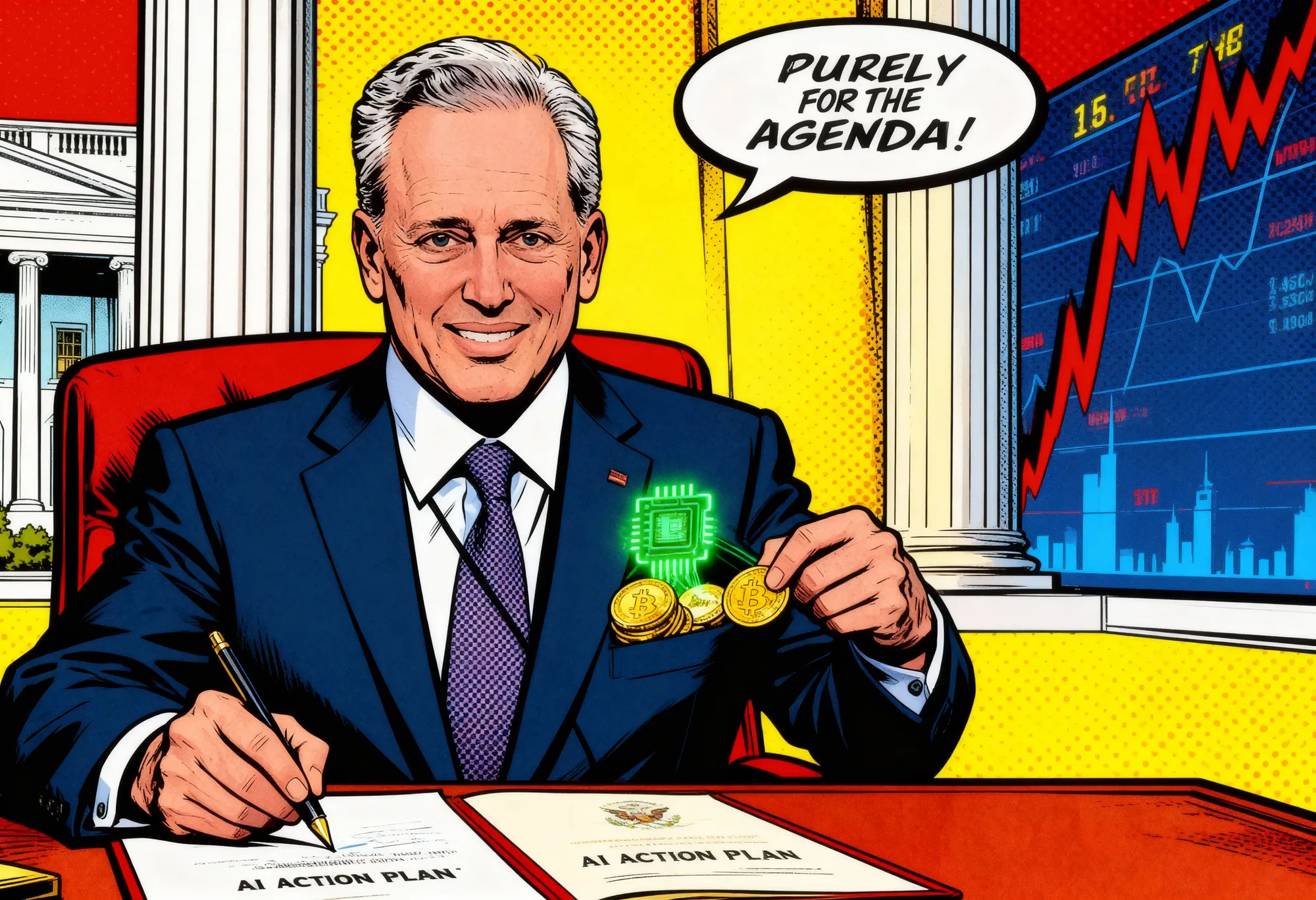
In July, David Sacks stood onstage at a neo-Classical auditorium blocks from the White House, beaming. He had convened top government officials and Silicon Valley executives for a forum on artificial intelligence. President Trump unveiled an “AI Action Plan” that Sacks himself had helped draft. Then Trump picked up his pen, signed executive orders to fast-track the industry, and handed Sacks the presidential pen as a souvenir.
Almost everyone in the audience stood to profit from those directives. Sacks more than most.
A New York Times investigation published November 30 documents what critics have long suspected. Trump’s AI and crypto czar operates one of the most advantageous dual roles in federal government history, shaping policy for Silicon Valley while simultaneously investing in Silicon Valley. The Times’ analysis of his financial disclosures found 708 tech investments, including 449 stakes in AI-related companies and 20 crypto positions that could benefit from the policies he champions.
But the real story is not simply that Sacks holds those positions. The real story is that he is allowed to.
The architecture of federal ethics rules has been stress-tested before. It has never encountered anything quite like this.
The Breakdown
• Sacks retained 449 AI investments by classifying them as "software" or "hardware", exploiting vague definitions in his ethics waivers
• He helped broker a UAE chip deal worth up to $200 billion to Nvidia and backed stablecoin law benefiting his firm's $130M+ BitGo stake
• Bannon's "technocratic oligarchy" critique signals genuine fracture between MAGA populists and Silicon Valley libertarians
• Federal ethics system relies on self-reporting with no enforcement, establishing precedent future administrations will cite
The Special Government Employee Loophole
Sacks occupies Washington through a classification called “special government employee”, a designation typically reserved for experts who temporarily advise agencies. He receives no salary. He keeps his role at Craft Ventures, the firm he founded in 2017. And he continues to benefit from investments while helping craft policies that affect those investments’ value.
In March and again in June, Sacks received White House ethics waivers. The first covered digital assets and crypto. The second covered AI-related holdings. Both rely on the same core assertion. That he had sold or was in the process of selling “over 99%” of holdings that could raise conflict-of-interest concerns.
That 99 percent figure deserves scrutiny.
According to the Times’ analysis of Sacks’s financial disclosures, he has retained 449 AI-related investments and 20 crypto positions. The math works only because of classification choices that strain credulity.
His filings designate 438 tech investments as “software” or “hardware” companies rather than “AI Interests”. Yet those same companies promote AI offerings on their websites, provide AI services to customers, or sit in sectors that are plainly AI-adjacent. Just 11 holdings are formally tagged as “AI Interests”, and 438 others are lumped into the software and hardware bucket even though they are tied to AI.
Forty-one of the retained companies literally have “AI” in their names. Palantir, classified in Sacks’s paperwork as “software as a service”, markets itself to investors as providing “AI-powered automation for every decision”.
One waiver tries to square this circle. It acknowledges that many of Sacks’s software companies “do not currently use AI-related applications in their core business in any material way”, then adds that “many of them are likely to at some point in the future”.
That future arrived years ago for most enterprise software. Anyone tracking the sector knows this. The classification persists anyway, a bureaucratic fiction that serves its purpose.
The waivers do not disclose the dollar value of the retained stakes. They do not specify when Sacks sold the assets he claimed to divest. The public ethics filings omit both timing and valuation, which makes independent verification of his “over 99 percent” divestment claim impossible. Jessica Hoffman, a Sacks spokeswoman, called the conflict narrative “false” and said his government role had cost him rather than benefited him.
The numbers suggest something else. The classification scheme made those numbers possible.
Following the Money to Abu Dhabi
The clearest window into Sacks’s policy influence involves Nvidia, the chip giant whose processors power most AI training worldwide.
Sacks and Nvidia CEO Jensen Huang had not met before Sacks joined the administration. They became close this spring. Both had aligned interests. Huang wanted government clearance to sell AI chips more broadly, despite security concerns that the components could strengthen China’s economy and military. Sacks wanted policies that would expand the AI industry, benefiting his hundreds of positions in AI-adjacent companies.
In White House meetings, according to multiple accounts, Sacks echoed Huang’s argument that restricting chip exports would push Chinese companies to develop alternatives. Better to flood the world with American technology and make foreign developers dependent on the U.S. stack. He worked to undo Biden-era restrictions on chip sales to foreign countries and opposed new rules that would complicate exports to international data centers.
Then came Abu Dhabi.
During Trump’s May trip to the Middle East, the United States and the United Arab Emirates announced plans for the Emirates to purchase up to 500,000 of Nvidia’s most advanced AI chips per year from 2025 through at least 2027, under a broader AI and data center partnership. The chips will feed “Stargate UAE”, a ten-square-mile AI campus in Abu Dhabi with a planned five-gigawatt power capacity, billed as the largest AI data center complex outside the United States.
Some White House and national security officials found the volume alarming. The UAE maintains close ties with China. G42, the state-backed AI firm anchoring the campus, has been scrutinised for past partnerships with Chinese tech companies. Critics inside and outside government warned that large volumes of advanced U.S. chips in the Emirates could leak to Beijing through that relationship.
Despite those concerns, the deal moved forward. Commerce has since approved several billion dollars’ worth of Nvidia exports tied to projects in the UAE, with U.S. cloud providers like Oracle and Microsoft among the beneficiaries. Analysts expect the arrangement to generate tens of billions of dollars in chip and cloud revenues over its lifetime if the full 500,000-per-year allotment is used.
Sacks celebrated the agreement on his podcast. “I would define winning as the whole world consolidates around the American AI” companies, he said, framing the export loosening as a strategic victory.
One obstacle remained. A U.S. ban on direct sales of certain AI chips to China.
In April, the Trump administration had moved to halt exports of Nvidia’s H20 chip to China, an escalation of earlier export controls. Sacks promoted the idea internally that this ban actually helped China by diverting demand to Huawei, which was racing to build a domestic competitor. He argued that over-restricting exports would simply push Chinese developers into Huawei’s arms. Better, in this telling, to “get Chinese developers addicted to the American AI stack”.
In July, Nvidia CEO Jensen Huang met with Trump in person. Shortly afterwards, Huang announced that the Trump administration had given Nvidia the green light to resume H20 sales to China, reversing the April ban. Commerce began granting export licences, letting Nvidia and AMD sell certain AI chips back into the Chinese market under specified conditions.
Hoffman has said Sacks developed his thinking by talking to many people, not just Huang, and “wants the entire American tech stack to win”. She also told reporters that none of his holdings benefited from the Emirates deal.
That claim may be technically accurate on a narrow reading. But it sidesteps the obvious point. Every time policy expands the global market for AI compute, it expands the addressable market for the hundreds of AI-adjacent companies in which Sacks or his funds still hold stakes.
The Stablecoin Play
Cryptocurrency offers a cleaner case study.
Sacks backed legislation called the GENIUS Act, the first comprehensive federal framework for payment stablecoins, the dollar-pegged tokens that function as the crypto system’s primary on-ramps. He praised the bill in interviews, calling it a turning point for U.S. dollar dominance in digital finance. After Trump signed it into law in July, Sacks went on his All-In podcast and described the act as “historic” and “momentous” for the industry.
Here is the relevant disclosure. Craft Ventures owns 7.8 percent of BitGo, a crypto infrastructure company that provides custody and “stablecoin-as-a-service” to issuers. BitGo’s own GENIUS Act page proclaims. “The wait is over. The GENIUS Act is officially signed – marking a defining moment for stablecoin legislation in the US.” The company pitches its platform as tailor-made for the new regulatory framework.
In September, BitGo filed for an initial public offering on the New York Stock Exchange. At its last disclosed valuation in 2023, BitGo was worth $1.75 billion. At that valuation, Craft’s stake would be worth more than $130 million. Recent IPO commentary suggests the market capitalisation could be significantly higher.
Hoffman has argued that the GENIUS Act “contained no specific benefit for BitGo”, noting that stablecoin regulation applies to the entire sector and creates no BitGo monopoly. That is formally correct. The law does not name BitGo.
But when your firm owns nearly eight percent of a company positioned to ride a regulatory wave you helped create, the distinction between “specific benefit” and “general benefit” stops being meaningful outside a courtroom.
The Podcast Problem
Beyond direct investment returns, Sacks has leveraged his government position to build the All-In podcast brand.
All-In, which he co-hosts with fellow investors Jason Calacanis, Chamath Palihapitiya, and David Friedberg, draws roughly six million downloads a month.
His co-hosts have conducted interviews inside the White House. Treasury Secretary Scott Bessent. Commerce Secretary Howard Lutnick. The secretaries of agriculture and interior. An Oval Office tour with Trump himself. The access is extraordinary. It is also commercially valuable.
The podcast’s annual summit has become a money machine. This year’s conference generated about $21 million in ticket sales, up from roughly $15 million last year, according to figures reported in coverage of the Times investigation. In June, the hosts launched a $1,200 branded tequila that reportedly sold out its first 750-bottle run in hours.
Hoffman says Sacks has forgone AI- and crypto-related revenues such as sponsorships that would directly overlap with his government portfolio, but he can share in ticket income, tequila revenue and other commercial deals.
The July AI summit exposed how entangled those streams have become. Sacks initially planned for All-In to host the White House event outright. According to a sponsorship deck reviewed by the Times, the podcast asked potential sponsors to pay $1 million each for access to a private reception and other events at a forum “bringing together President Donald Trump and leading AI innovators”.
White House chief of staff Susie Wiles intervened. She did not want the administration appearing to endorse the All-In brand. Sacks added a co-host, the Hill and Valley Forum, to provide political cover.
Hoffman says All-In ultimately lost money on the event and that no VIP reception took place. She says the only sponsors, Visa and the New York Stock Exchange, “received nothing but logo placements”. That may be true line by line. The proposal existed. The ask was $1 million. The brand still benefited from presidential proximity and visual association even if that specific summit ran in the red.
The rules did not forbid any of it.
MAGA’s Oligarchy Problem
Steve Bannon has been picking fights with Silicon Valley billionaires for months. He has gone after Elon Musk repeatedly on his War Room podcast. Now he is extending that critique to the broader tech influence operation in Trump’s orbit.
What he told the Times would have been unthinkable from a Trump loyalist two years ago. “The tech bros are out of control. They are leading the White House down the road to perdition with this ascendant technocratic oligarchy,” Bannon said.
Bannon, the former White House chief strategist, is articulating something larger than personal grievance. The populist-nationalist wing of MAGA and the techno-libertarian wing are discovering they want fundamentally different things from this administration.
Populists distrust concentrated power. Full stop. They resent coastal elites making policy for flyover country. They view billionaires as suspect regardless of partisan alignment.
Tech libertarians want regulatory rollback. They want government to clear obstacles and then get out of the way. They view wealth accumulation as proof of merit. And they expect campaign contributions and fundraising prowess to purchase influence.
Those worldviews coexisted during the campaign because they shared an enemy. The Biden administration’s regulatory apparatus. Victory has exposed the fault lines. Sacks now sits at the fracture point. A Trump loyalist, yes. But also precisely the kind of coastal elite, the kind of well-connected insider, that populist rhetoric has always claimed to oppose. Both at once.
The White House has not figured out how to square that circle. For now, it is simply living with the contradiction.
The Ethics Infrastructure That Wasn’t
Kathleen Clark, a Washington University law professor who specialises in government ethics, reviewed Sacks’s crypto waiver this summer. Her assessment was blunt. “This is graft.”
The federal ethics system assumes good faith. It relies on self-reported information. It trusts officials to accurately classify their holdings. It offers waivers when strict compliance would be inconvenient. And it lacks robust enforcement mechanisms when the honour system fails.
Sacks has taken full advantage of the available space. The special government employee designation that lets him advise the White House while remaining a venture capitalist. The narrow definition of “AI interests” that excludes hundreds of AI-adjacent companies as long as they can be described as “software” or “hardware”. The valuation opacity that hides the true scale of his retained stakes. The timing ambiguity that makes it impossible for outsiders to know whether policy moves coincided with profitable exits.
His spokeswoman insists this cost him money. Perhaps it did, relative to an alternate universe in which he kept every stake and faced no scrutiny. But the architecture permitted him to retain 449 AI-related investments while helping shape AI policy. It permitted him to promote stablecoin legislation while his firm held a stake worth well over $130 million in a stablecoin infrastructure company positioned to benefit. It permitted him to build a media brand on the back of White House access.
The system did not malfunction. That is the problem. It performed exactly as designed.
Why This Matters
- For AI companies and investors. The regulatory environment is being shaped by someone with direct financial stakes in its outcome. Decisions on chip exports, data-center construction, defence AI procurement and cloud infrastructure will flow from this configuration for years, regardless of who occupies the Oval Office next.
- For government ethics. The Sacks arrangement establishes precedent. Future administrations will cite it. The special government employee classification, already permissive, now encompasses simultaneous venture-capital operations and media empires. Enforcement agencies reviewing similar cases will struggle to draw lines Sacks has not already crossed.
- For the MAGA coalition. Bannon’s “technocratic oligarchy” critique is not just colourful rhetoric. It signals a real ideological fracture. The alliance between populist nationalists and Silicon Valley libertarians was always transactional. Sacks is the test case for whether it can survive contact with governing.
❓ Frequently Asked Questions
Q: What is a "special government employee" and why does this classification matter?
A: A special government employee advises the federal government for 130 days or fewer per year without a regular salary. The classification was designed for short-term experts but carries looser ethics requirements than full-time officials. Sacks uses this status to keep his Craft Ventures role while shaping AI and crypto policy—an arrangement that would typically require divestiture for a regular government employee.
Q: What is the H20 chip and why did the China sales reversal matter?
A: The H20 is Nvidia's AI chip designed specifically for the Chinese market after earlier export controls blocked more powerful models. In April 2025, the Trump administration banned H20 exports to China. By July, after meetings between Sacks, Huang, and Trump, the ban was reversed. The move lets Nvidia compete directly with Huawei in China's AI chip market, worth billions in annual sales.
Q: What is BitGo and how does Craft Ventures' stake connect to the GENIUS Act?
A: BitGo provides custody and infrastructure services to stablecoin issuers—companies that create dollar-pegged crypto tokens. Craft Ventures owns 7.8% of BitGo, worth over $130 million at 2023 valuations. The GENIUS Act that Sacks championed creates the first federal framework for stablecoins, directly expanding BitGo's addressable market. BitGo filed for an IPO in September 2025, positioning Craft for a potentially larger payout.
Q: How do federal ethics waivers normally work, and is Sacks' situation unusual?
A: Ethics waivers let officials participate in matters affecting their financial interests when strict compliance would be impractical. They're supposed to be rare. Sacks received two waivers—one for crypto in March, one for AI in June—that together cover hundreds of investments. Ethics experts like Kathleen Clark have called the arrangement "graft," arguing the waivers are unusually broad and the self-reported classifications lack meaningful oversight.
Q: Could Sacks face legal consequences for these conflicts of interest?
A: Probably not under current rules. Special government employees face fewer restrictions than regular officials, and Sacks obtained waivers for his AI and crypto participation. The ethics system relies on self-reporting with limited enforcement. Criminal conflict-of-interest statutes require proof of knowing violations, which the waivers are designed to prevent. The main risk is reputational damage and congressional scrutiny rather than prosecution.