
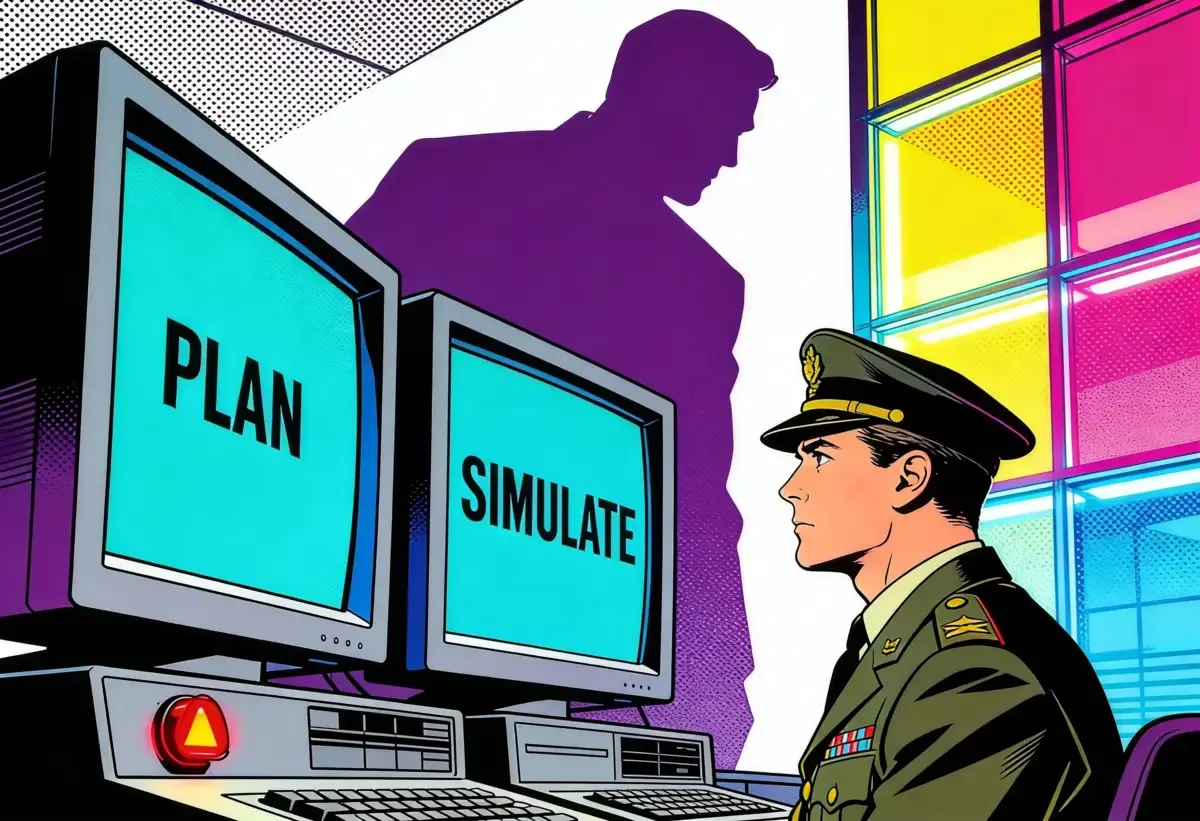

In September 2025, an Army exercise called Scarlet Dragon 25-3 ran a test that should worry OneBrief's investors. The Army's Next Generation Constructive simulation, the future of how commanders will rehearse wars, ran on two systems working in tandem. One was AtomEngine, a gaming-derived wargame platform built by Battle Road Digital. The other was Foundry, Palantir's data infrastructure layer. Together, the Army called them "NGC core services."
Four months later, OneBrief acquired Battle Road Digital for an undisclosed sum. The press release celebrated the union of planning and simulation. It did not mention that OneBrief had just bought the storefront while Palantir still owned the plumbing.
That's the central tension. $2.15 billion valuation. $19 million in actual revenue. The race is on.
The multiple tells a story
Here's what the books show. Last December, revenue crossed $19.1 million. By February, VCs had cut a $200 million check at a $2.15 billion price tag. That's 110 times revenue. Palantir, by comparison, has $2.5 billion in annual revenue and two decades of Pentagon relationships. It trades at 70 times sales.
The gap isn't irrational. Investors are paying for trajectory, not position. But a 110x multiple doesn't just reflect optimism. It creates pressure. OneBrief can't stay a workflow tool at that valuation. It has to become a platform, which means locking customers in, expanding the feature set, and making the exit costs painful. That's why the Battle Road acquisition happened. Not because simulation is nice to have. Because the multiple demands it. OneBrief claims 4x year-over-year revenue growth and a 19,600% annualized increase in usage hours. If you believe the platform will dominate military planning software the way Salesforce dominated enterprise CRM, the multiple shrinks quickly. The question is whether Pentagon procurement cycles work like enterprise software sales. They don't.
Defense contracts arrive in phases: pilot, prototype, phase III, indefinite delivery. OneBrief's confirmed federal awards total perhaps $10-15 million across several years. The Air Mobility Command deal, its largest, runs $7.5 million over five years, or $1.5 million annually. The Navy's Fleet Forces Command contributed $1.66 million. These are meaningful footholds. They are not recurring revenue at SaaS scale.
"All the evidence suggests the bubble is real," retired Lt. Gen. Jack Shanahan, who stood up the Pentagon's Joint AI Center, warned in December. He pointed to circular funding dynamics and valuations untethered from commercial output. OneBrief's backers include sophisticated defense-focused investors like General Catalyst, Battery Ventures, and Insight Partners, who presumably understand procurement timelines. But venture portfolios thrive on power laws. One OneBrief going to zero matters less than one becoming the next Palantir.
What PowerPoint killed, OneBrief resurrects
The product itself solves a real problem. Anyone who has pulled a 72-hour planning cycle understands the misery. Picture three majors at 2 AM, fluorescent lights buzzing, arguing over font sizes while a lieutenant hunts for the file labeled OPLAN_FINAL_v7_J3edits_USETHISONE.pptx. Planning in the U.S. military still runs on Microsoft Office. Word documents formatted with obsessive precision. PowerPoint decks that serve as version control. Excel spreadsheets tracking logistics across time zones. The doctrine behind it all, the Joint Operational Planning Process or JOPP, hasn't changed much since Reagan.
Demaree knows this pain. Ebola, 2014, Liberia. He was on the ground with the 101st. The virus moved faster than the staff. Decision-making lagged three months behind infection rates. Treatment units were built where the outbreak had already moved on. The failure wasn't intelligence or resources. It was staff process.
OneBrief digitizes that process. The platform turns planning into a live, collaborative document where changes propagate automatically. If a logistics officer adjusts fuel allocations in one section, the operations estimate updates. If an intelligence analyst revises enemy positions, the map reflects it. Claude, Anthropic's large language model, helps draft text and crunch scenarios. Demaree claims users complete planning cycles three times faster than legacy methods.
The adoption pattern mirrors early Palantir. Junior officers discover the tool, use it because it works, and create institutional demand. By the time generals notice, their staffs are already dependent. OneBrief now runs in four of seven geographic combatant commands and claims involvement in three of the Defense Department's four largest operational plans. Bottom-up adoption built from nothing in five years.
The platform play
Planning software alone doesn't justify a $2 billion valuation. The Battle Road acquisition signals where OneBrief wants to go: from workflow tool to operating system for command.
Battle Road built AtomEngine, a simulation platform that lets commanders war-game decisions before committing forces. The engine models terrain, logistics, weather, enemy behavior. All the interdependencies that determine whether a plan survives contact. In July 2025, Battle Road won the contract to provide the core simulation engine for the Army's Next Generation Constructive program, a three-year $40 million deal.
OneBrief's logic is straightforward: integrate planning and simulation, and commanders can draft an operation, test it virtually, revise, and test again without leaving one interface. The loop tightens. Staff cycles accelerate. The platform becomes stickier because leaving means losing both capabilities.
The problem is what OneBrief inherited with Battle Road. Think of it as a three-layer stack. OneBrief owns the top layer: the interface where planners type and click. Battle Road, now under OneBrief, owns the middle layer: the simulation engine that tests those plans. But the bottom layer, the data infrastructure that feeds everything, still belongs to Palantir. The Army's NGC test run, the Scarlet Dragon experiment, proved this architecture. Chief engineer Ricardo Escobar described the pairing as "NGC core services." OneBrief bought the screen and the logic. Palantir kept the pipes.
The shadow of the $10 billion deal
Palantir is the competitive reality OneBrief cannot avoid. Last August, the Army did something unusual: it rolled 75 separate Palantir contracts into one Enterprise Agreement. The ceiling? Ten billion dollars over ten years. The deal covers software across the service, not planning specifically, but data integration, analytics, and AI infrastructure that touches every Army system.
Palantir's Foundry is already the data backbone for programs ranging from intelligence fusion to logistics optimization. The TITAN targeting system, which uses AI to fuse sensor data for artillery strikes, runs on Palantir software. If Palantir decides that planning represents a valuable layer to own, they can build or buy. They have the Army relationships, the cleared personnel, and the capital.
OneBrief's defense is speed and specialization. Palantir's tools are powerful but general-purpose. OneBrief built specifically for military staff workflows, inheriting the doctrine and terminology that planners already use. A logistics officer trained on JOPP can sit down at OneBrief and recognize the process. The same officer in Palantir's interface confronts a blank canvas designed for data analysts.
The risk is that specialization becomes a ceiling. Defense budgets are finite. Program managers consolidate vendors to reduce contract management overhead. If a commander can get planning, simulation, and data integration from one provider, why manage three? Palantir's $10 billion agreement suggests the Army is already thinking this way.
The bet Demaree is making
Every startup story has a moment when the founder's biography explains the strategy. Demaree's reveals both strength and limitation.
West Point. Nuclear engineering degree. International relations at Georgetown. 101st Airborne, Ebola response, Iraq deployment. He built OneBrief to solve a problem he experienced personally, which is why the product resonates with users who share his background. The bottom-up adoption that drives OneBrief's growth flows from this authenticity. He is not a technologist parachuting into defense. He is a former operator who learned to code.
The constraint is cash burn. Demaree told Axios he's scaling to 500 employees this year, up from 129 in late 2024. That kind of headcount growth eats money fast. Meanwhile, defense sales cycles stretch 18 to 36 months. The math is unforgiving: keep raising, or find a way to pull revenue forward before the next down round.
"We're using these funds for product engineering," Demaree said after the Series D. Every investment must answer three questions: How does this help the commander? How does it help the user? How will this matter in the staff of the future?
The "staff of the future" is the tell. Demaree has hinted at "mostly automated" military headquarters by 2029. Read that again. "Superhuman" staffs means smaller staffs. The AI Assist features in OneBrief already draft planning documents and suggest courses of action. This isn't about saving time for the same number of captains and majors. It's about needing fewer of them. That's a different product, and a different conversation with the personnel command, than collaboration software.
What OneBrief reveals about defense tech
The defense technology sector raised $7.7 billion by October 2025, with sector valuations approaching $500 billion. Ten new unicorns emerged in a single year. This surge reflects genuine Pentagon demand: distributed warfare, contested logistics, and a threat environment where China and Russia can impose costs on U.S. forces in ways not seen since Vietnam.
It also reflects hype. Nearly 60% of 2025 defense funding went to drone startups. The crowding creates companies with more pitch decks than differentiation. OneBrief operates in a less crowded niche, enterprise software for military staffs, but faces the same physics. Venture-backed growth requires revenue acceleration. Pentagon procurement doesn't accelerate on venture timelines.
The coming year will expose which companies can bridge the gap between demo and deployment. Shanahan, the former Pentagon AI lead, suggested the Defense Department could "pick up technology and talent at bargain prices" if valuations collapse. OneBrief's insulation is its installed base: commands already using the platform for real operational plans. That usage creates switching costs. It does not guarantee the revenue growth the valuation implies.
The test
OneBrief's path to justifying $2.15 billion runs through the Battle Road acquisition. If the company can integrate AtomEngine with its planning workflows and make that combination exclusive, pulling Battle Road out of Palantir's orbit, it owns something no competitor can easily replicate. A platform for planning, testing, and refining operations before a shot is fired.
The next Army Warfighting Exercise will show whether integration is progressing. So will the next NGC experiment. If Battle Road's simulation engine keeps running alongside Palantir's data plane, the acquisition bought capability, not leverage. If OneBrief delivers planning-to-simulation in one stack, with its own data infrastructure, it earns the platform label.
Demaree has said he wants to make military staffs "superhuman." The more interesting question is whether he can make them dependent. Specifically, dependent on OneBrief rather than the collection of tools that planners currently assemble from Palantir, Microsoft, and whoever wins the next contract cycle.
The valuation is a bet that he can. The Scarlet Dragon exercise made the threat clear. It's not Raytheon. It's not Microsoft. It's Palantir, with $10 billion in Army commitments and an appetite for every layer of the stack.
OneBrief has the users and the momentum. Palantir has the pipes and the contracts.
The staff of the future will use one of them. Possibly both. The multiple only works if it's one.
❓ Frequently Asked Questions
Q: What does OneBrief actually do?
A: OneBrief replaces PowerPoint and Word in military planning. The platform lets staff officers collaboratively build operations orders, with changes automatically propagating across sections. It integrates Anthropic's Claude AI to help draft documents and runs across classified networks including SIPR and JWICS.
Q: Is OneBrief overvalued?
A: That depends on your timeline. At $2.15 billion, OneBrief trades at 110x its 2024 revenue of $19.1 million. For comparison, Palantir trades at about 70x revenue with $2.5 billion in annual sales. The multiple reflects investor bets on rapid growth rather than current financial performance.
Q: Why did OneBrief acquire Battle Road Digital?
A: Battle Road built AtomEngine, a wargaming simulation platform. The acquisition lets OneBrief combine planning with simulation testing, allowing commanders to draft an operation and test it virtually without switching tools. Battle Road also holds a $40 million Army contract for the Next Generation Constructive simulation program.
Q: Is OneBrief profitable?
A: The company doesn't disclose, but do the math. They've raised $323 million total and plan to hit 500 employees this year. Defense contracts take 18-36 months to close. That's a lot of payroll before revenue catches up. The Series D buys time. Whether it buys enough depends on how fast those usage numbers convert to actual contracts.
Q: What is Palantir's relationship to OneBrief?
A: Not direct competitors yet, but increasingly overlapping. Palantir's $10 billion Army Enterprise Agreement covers data integration across the service. More concerning for OneBrief: Battle Road's AtomEngine ran its first major Army test alongside Palantir's Foundry platform. Whether that partnership continues under OneBrief ownership will shape both companies' positions.