IMPLICATOR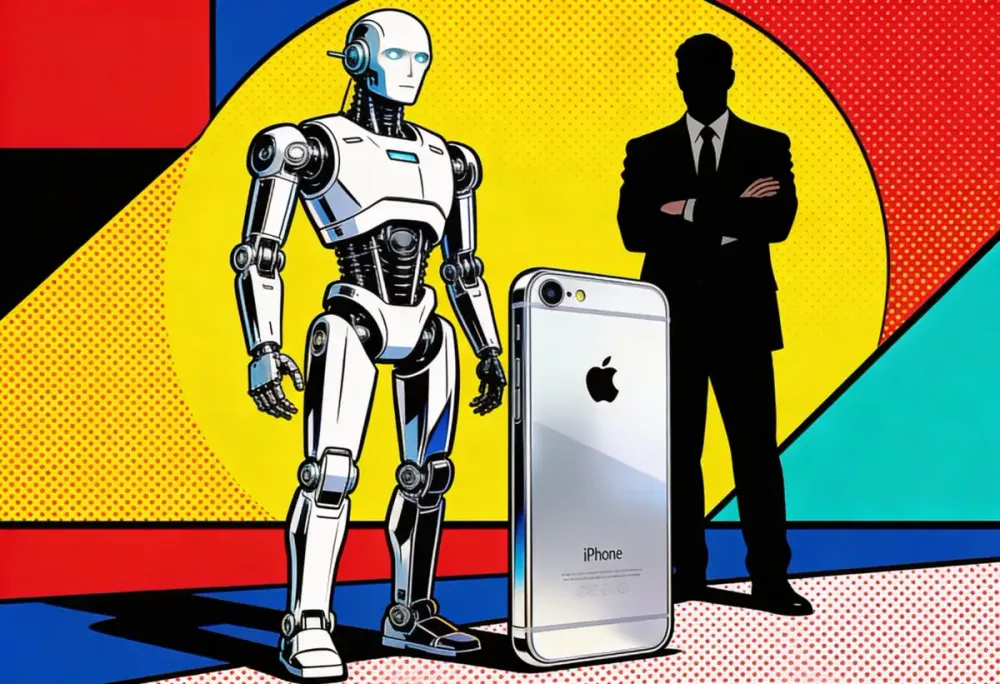
When Apple needed someone to introduce the iPhone Air to the world last September, they chose Abidur Chowdhury. The London-born industrial designer stood in front of the camera, rotating the device slowly under harsh studio lighting to catch the machined bevel, and walked viewers through the thinnest iPhone ever made. His hands were steady. His explanation of how the engineering team shaved millimeters from the chassis was rehearsed but natural. It was a two-minute video, but at Apple, appearing in launch footage is a signal. The company was grooming him.
Two months later, Chowdhury left. Bloomberg reported his departure "made waves internally," though the company line insisted it was unrelated to the iPhone Air launch. Where he went remained a mystery until Monday, when Brett Adcock announced that Chowdhury had joined Hark as head of design.
If you haven't heard of Hark, that's by design. Adcock put $100 million of his own cash into the thing back in December. Nobody paid much attention. A billionaire starts another AI company—file it under "Tuesday." But the Chowdhury hire changes the calculus. An AI lab's first major recruit is... an industrial designer? The guy who shaped iPhones?
The Breakdown
• Brett Adcock self-funded Hark with $100M, hired 30 engineers from Google/Meta/Amazon, and poached Apple's iPhone Air designer Abidur Chowdhury
• Hark promises "human-centric AI" while Adcock runs Figure AI ($39B valuation), suggesting a vertical stack connecting robot hardware to AI software
• Adcock's brother Colby runs Scout AI for defense robotics with DoD contracts—the family is positioning across commercial and military physical AI
• First Hark model ships summer 2026; the $100M is seed money with a "Head of Capital Formation" role signaling a larger raise ahead
The man running two companies
Brett Adcock collects ambitious projects the way other founders collect advisory board seats. He sold his first company, the recruiting platform Vettery, to Adecco for $110 million in 2018. He took his second, the air taxi startup Archer Aviation, public via SPAC. His third, the humanoid robotics company Figure AI, raised over $1 billion last September at a $39 billion valuation, making it the most valuable robotics startup in the world.
Now he's running Hark simultaneously, serving as CEO of both companies. The internal memo announcing the lab promised to build "human-centric AI" that can "think proactively, recursively improve, and care deeply about people." Most mission statements are noise. This one stopped me. Human-centric. Humanoid robots. Adcock's primary business builds machines shaped like people. His side project promises AI that "cares deeply" about them. Coincidence seems unlikely.
Adcock grew up on a family farm in central Illinois. His official biography notes he "learned year after year how to create something of value for the world from nothing." The phrasing is revealing. Value from nothing. The language of a man who sees himself building something fundamental, not iterating on existing products.
Hark's compute cluster went live earlier this week. The company has hired 30 engineers from Google, Meta, Amazon, and Apple, with plans to reach 100 by mid-2026. The first AI model ships this summer. That's an aggressive timeline for a lab that officially didn't exist three months ago.
Why a designer?
Chowdhury's hire makes no sense if you think of Hark as a pure AI research lab. Labs hire researchers, infrastructure engineers, people who can wrangle GPUs and optimize training runs. They don't typically lead with industrial designers who spent six years shaping consumer hardware.
But consider Chowdhury's actual expertise. At Apple, he worked on physical products. The iPhone Air wasn't just thin; it required rethinking how components fit together, how users would hold the device, how the industrial design would communicate premium quality. Before Apple, he ran his own consultancy working with hardware startups. His Red Dot Award came for a product called "Plug and Play." The man thinks in objects.
Now place that expertise next to the reality of the factory floor. For eleven months, Figure 02 has been stationed at BMW's Spartanburg plant, its rubberized grippers clamping onto sheet metal parts for the X3 chassis. It ran ten-hour shifts, servos whining as it slotted components into place. But the context matters: a BMW spokesperson told Fortune that only a single robot operated at a time, and only during the silence of non-production hours. The gap between the press release and the reality is sharp. One robot. Non-production hours. That's not a deployment; that's a science project with a corporate sponsor.
Humanoid robots creep people out. Nobody admits this in investor presentations, but it's true. A robotic arm welding car frames is fine—it's a tool. A five-foot-eight machine with a head and shoulders standing in your living room is different. People will tolerate a lot from a Roomba. From something that looks like it might have opinions? The bar is higher. If Figure wants to put these things in homes someday, the engineering is only half the problem. The other half is making sure people don't hate being around them.
Hark and Figure may share more than a CEO.
The compute question
AI labs live and die by their access to computing power. OpenAI, Anthropic, Google DeepMind, and a handful of Chinese labs have locked up the world's supply of high-end chips. If you know the economics of model training, the math here bothers you. A hundred million dollars buys a seat at the table, not a meal. Competing at the frontier requires billions.
Adcock knows this. Hark's job listings include a Head of Capital Formation role, suggesting the self-funded phase is temporary. The $100 million is seed money. The real raise comes later, once the team is assembled and the first models prove the concept.
But what concept? "Human-centric AI" is vague enough to mean almost anything. The timing offers a clue. Figure AI's Series C funding announcement specifically mentioned plans to "build next-generation GPU infrastructure to accelerate training and simulation" for their Helix AI platform. If Hark is developing AI systems optimized for embodied robots, Adcock may be building his own vertical stack: robots from Figure, intelligence from Hark, design from Chowdhury.
The math is speculative but suggestive. Figure operates robots that generate continuous data about physical interactions with the real world. That data is valuable for training AI systems that need to understand how objects behave, how spaces are navigated, how tasks are performed. Hark could be the company that turns Figure's operational data into general-purpose AI models, which then improve the robots, which generate more data.
Adcock hasn't confirmed this publicly. He might be building something else entirely. But he's a founder who has repeatedly demonstrated a preference for owning the entire value chain rather than depending on partners.
The family business
The Adcock influence in AI and robotics extends beyond Brett. His brother Colby runs Scout AI, a defense-focused startup building autonomous systems for military applications. Scout emerged from stealth last April with $15 million in seed funding and multiple Department of Defense contracts already in hand.
Scout's flagship product is Fury, a "Vision-Language-Action foundation model" designed to let a single soldier command multiple robots using natural language. The company's prototypes are already operating autonomously at a test facility in the Santa Cruz Mountains: a ground vehicle called G01 churning through dirt trails, a drone called A01 hovering with the high-pitched whine of military-grade rotors. Booz Allen Hamilton led Scout's seed round, lending defense establishment credibility to the operation.
Colby Adcock sits on Figure AI's board. The brothers aren't just diversifying; they're pincer-moving the robotics market. Brett takes the commercial high ground with factory floors and eventually living rooms. Colby takes the defense contract low ground with Pentagon budgets and battlefield deployments. The companies share a board member and, presumably, notes. Whether they eventually merge or stay separate matters less than what they're collectively building: an Adcock footprint across every vector where physical AI might land.
What Apple lost
Apple keeps losing designers, and not the ones they can afford to lose. Jony Ive walked in 2019—that one made headlines. Evans Hankey took over, stuck it out for four years, then quit too. Less fanfare that time, but the message was clear enough. The younger designers noticed. Some bolted for startups where they could actually ship things. Others took jobs at venture firms, which pay well and involve a lot of opinions about other people's products. Chowdhury chose the AI route, same as a half-dozen others from the same Cupertino campus.
The exodus reflects a shift in where ambitious designers see opportunity. At Apple, you might spend years refining the curvature of a laptop hinge. At a robotics startup, you might define how humans interact with machines for the first time. The frontier has moved.
Chowdhury was six years into his Apple tenure. He'd risen far enough to present at launch events. He left anyway. The AI startup wasn't even identified when Bloomberg first reported his departure, suggesting he accepted the Hark role before the company went public. He knew what he was joining before anyone else did.
Apple declined to comment on the departure, beyond noting it was unrelated to the iPhone Air. The company rarely comments on personnel matters. But for Apple, the pain isn't the empty chair. It's the signal that chair sends to the rest of the design studio: the most interesting problems are no longer in Cupertino. For a generation of designers, Apple was the terminal station, the place you arrived after proving yourself elsewhere. Now the ambitious ones are leaving for startups that didn't exist six months ago.
Building in public, sort of
Adcock's approach to Hark sits between stealth mode and full publicity. He announced the company's existence, named the mission, disclosed the funding amount. He didn't reveal what products Hark is building, what the compute infrastructure looks like, or who else has been hired beyond Chowdhury.
The pattern resembles how he built Figure. That company stayed quiet for its first year, then dropped a demonstration video that racked up millions of views. The robot took a few steps. Then it picked something up. Then it responded to a voice command. Each clip was maybe thirty seconds, carefully lit, no visible wires or handlers. The internet lost its mind. Adcock had figured out how to make robotics go viral.
Hark may follow the same playbook. Assemble the team. Build the infrastructure. Develop the technology. Then reveal it all at once, with demos polished enough to capture attention and define the narrative before critics can respond.
The first model ships this summer. We'll know more then.
The bet
If you're trying to understand what Adcock is building, ignore the mission statements. Watch where he's spending. He put $100 million of his own money into Hark at a moment when he could have invested that capital in Figure, or kept it liquid, or diversified into other founders' companies. He's betting on AI separate from robotics, but probably connected to it.
Chowdhury spent six years at Apple worrying about how a phone sits in your palm. Now he's running design for an AI lab. Strange hire, until you remember what Adcock's other company builds. The engineers make more sense on paper: thirty people so far, mostly ex-Google, ex-Meta, a few from Amazon. They've shipped real models, not just arxiv papers. Adcock wants them shipping again by summer, which is nuts. Six months to stand up a new lab and release something worth talking about? Most startups are still arguing about health insurance at that point.
Adcock built one company that sold, one that went public, and one worth $39 billion. He's running two companies at once while his brother builds a third for the Pentagon. The family may be assembling something larger than any individual venture: a collection of companies positioned to dominate wherever physical AI lands.
Or maybe he's spread too thin. Running two companies as CEO while your brother runs a third and you sit on his board—that's a lot of calendar. The $100 million is real money, but it's also a fraction of what he's worth on paper. If Hark flames out, Adcock will be fine. The question is whether he can actually focus long enough to ship something.
Chowdhury took the bet. He left one of the most prestigious design jobs in technology for a company that had existed for a few weeks. Whatever Adcock showed him was compelling enough to abandon the sure thing for the uncertain one.
The designer who introduced the iPhone Air to the world is now figuring out what robots should look like. That's not a small career move. And Adcock, running two companies from the same chair, seems to think it's exactly the kind of person he needs.
❓ Frequently Asked Questions
Q: Who is Abidur Chowdhury?
A: Chowdhury is a London-born industrial designer who joined Apple in 2019 and rose to present the iPhone Air at Apple's September 2025 launch event. He won a Red Dot Design Award in 2016 and ran his own design consultancy before Apple. He left in November 2025 and joined Hark as head of design.
Q: How is Hark different from Figure AI?
A: Figure AI builds humanoid robots—physical machines that work in factories and may eventually enter homes. Hark builds AI models. Adcock runs both as CEO, and the companies may feed each other: Figure's robots generate real-world data, Hark's AI learns from it, and the improved AI makes better robots.
Q: What is Scout AI and how does it connect to Brett Adcock?
A: Scout AI is a defense robotics startup founded by Colby Adcock, Brett's brother. It raised $15 million in April 2025 and has Department of Defense contracts. Colby sits on Figure AI's board. The brothers are positioning across commercial (Brett) and military (Colby) applications of physical AI.
Q: Can $100 million compete with OpenAI and Google in AI?
A: Not at the frontier. Training large language models costs billions. But Hark may be targeting a narrower problem—AI for embodied robots—where less compute goes further. The $100M is likely seed funding; Hark's job listings include "Head of Capital Formation," signaling a larger raise is coming.
Q: What happened with Figure's robot at BMW?
A: Figure AI deployed its Figure 02 robot at BMW's Spartanburg plant for 11 months, claiming it loaded parts for 30,000+ vehicles. But a BMW spokesperson told Fortune only one robot worked at a time, and only during non-production hours. The reality is smaller scale than the press releases suggest.
 Marcus Schuler
 Marcus Schuler
 Robert Brown

Marcus Schuler
Editor-in-Chief and founder of Implicator.ai. Former ARD correspondent and senior broadcast journalist with 10+ years covering tech. Writes daily briefings on policy and market developments. Based in San Francisco. E-mail: editor@implicator.ai