IMPLICATOR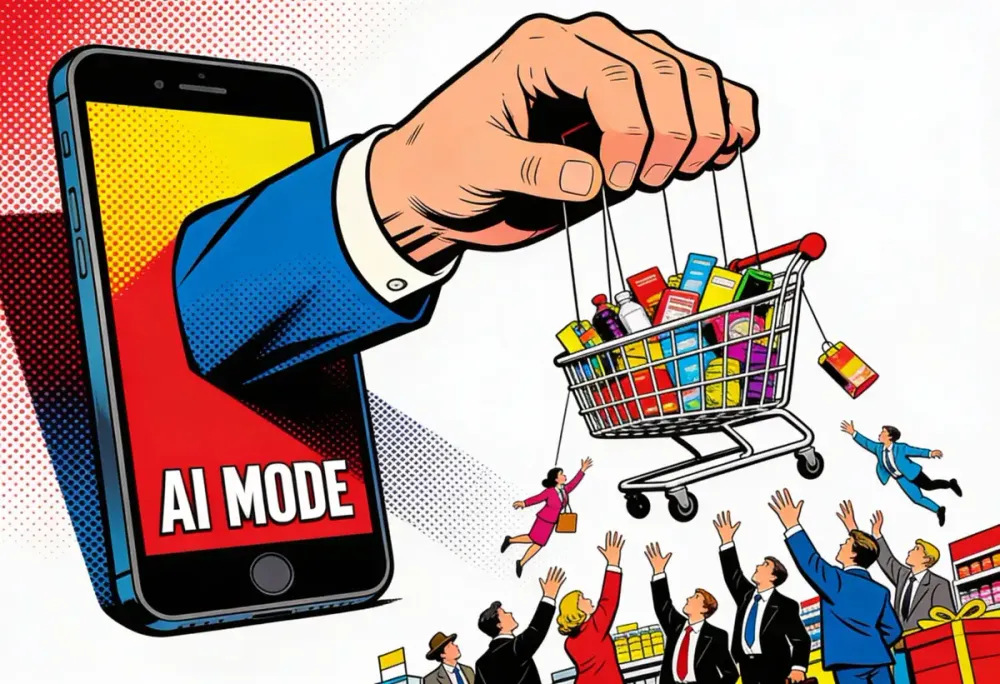
Google calls it an "open standard." Twenty retail giants signed on. The checkout button is moving from your website to someone else's search bar.
At the National Retail Federation conference in New York this week, Google unveiled the Universal Commerce Protocol, a technical specification that sounds like plumbing but functions like a toll road. UCP establishes how AI agents talk to retail systems. Discovery, checkout, post-purchase support. The whole buying journey, routed through a standardized set of commands that any AI can speak.
Shopify helped write it. Etsy and Wayfair contributed. Target and Walmart signed on. The major card networks blessed the protocol within weeks. More than twenty companies across payments and retail have given their approval.
Which raises an obvious question: Why are so many merchants eager to let Google stand between them and their customers?
The Breakdown
• UCP enables checkout directly in Gemini and AI Mode, using Google Pay, with merchants losing 33-76% of upsell opportunity
• Shopify is opening its Catalog database to non-clients, positioning itself as infrastructure for agentic commerce
• Direct Offers lets retailers bid for visibility at the exact moment of purchase decision in AI Mode
• Morgan Stanley projects 20% of U.S. e-commerce ($385B) could flow through AI agents by 2030
The Pitch
The logic sounds reasonable enough. People have started asking chatbots what suitcase to buy instead of typing keywords into a search bar. ChatGPT becomes the shopping advisor. Gemini handles the skincare research. And once the AI makes its recommendation, shoppers don't want to click away to some retailer's website to finish the purchase. They want to buy right there, mid-conversation.
For this to work, AI systems need a common language to communicate with retail backends. A way to check inventory in real time. A way to apply discount codes. A way to charge the card.
UCP provides that language. It connects "consumer surfaces" (Google's AI Mode, the Gemini app, potentially others) to "business backends" (the store's inventory, checkout, and fulfillment systems). The protocol handles everything from product discovery to payment authorization. Compatible with existing industry standards. Works with multiple payment providers.
Google has already built the first implementation. Soon, shoppers using AI Mode in Chrome or the Gemini app will be able to purchase directly from eligible retailers. No need to visit the store's website. Google Pay handles the transaction. PayPal support coming later.
"Instead of requiring unique connections for every individual agent, UCP enables all agents to interact easily," Vidhya Srinivasan, Google's VP of Ads and Commerce, explained.
One protocol. Every agent. Seamless shopping.
The Trap
Richard Crone runs a payments consulting firm. He's been watching these dynamics for decades. His assessment of UCP cuts through the corporate optimism.
"If the checkout goes to Gemini, the merchant loses the last touch point," Crone told American Banker. The last touch point matters. It's where retailers cross-sell, upsell, and capture data. That final moment before purchase represents 33% to 76% of incremental revenue, depending on the category.
Gone.
"That whole concept of driving the customer outside of the merchant's control has unprecedented disintermediation costs and channel conflict risk," Crone continued. "You're going to let somebody shop using your inventory and close the sale off-site? That has the potential to dramatically reduce you to nothing more than a warehouse or fulfillment center."
Warehouse. Fulfillment center. These are not compliments in retail.
The merchants signing onto UCP are making a bet. They're trading direct customer relationships for visibility in AI-powered discovery. The calculation assumes that agentic commerce will grow large enough to justify the margin compression. Morgan Stanley projects 20% of U.S. online shopping could flow through AI agents by 2030. That's roughly $385 billion.
But visibility isn't free. And the party controlling the discovery layer always extracts rent.
Google's Three-Part Play
UCP isn't arriving alone. Google announced three additional tools at NRF that fill in the commercial architecture.
First: Business Agent. A branded chatbot embedded in Google Search results. You type a question about Lowe's cabinet dimensions or Reebok shoe widths, and a virtual sales associate answers in the brand's voice, right on the search page. No clicking through to the retailer's FAQ. Poshmark is live at launch, with more retailers able to switch it on through Merchant Center.
Second: Direct Offers. An ad format built for AI Mode. Google's algorithm watches the conversation and determines when you're close to pulling the trigger. At that precise moment, a retailer can inject a discount into the AI's response. Twenty percent off. Free shipping thrown in. The coupon appears exactly when you're wavering.
Third: Enhanced Merchant Center attributes. Dozens of new data fields that help products surface in conversational commerce contexts. Not just keywords anymore. Answers to common product questions. Compatible accessories. Substitutes. The kind of information an AI needs to recommend intelligently.
Taken together: Google is building the discovery engine, the conversation layer, the checkout flow, and the advertising format. Merchants supply the inventory and fulfillment. The customer relationship lives on Google's surface.
Shopify's Angle
Shopify co-developed UCP, but the Ottawa company has its own agenda. At NRF, Shopify announced it's opening its Catalog service to non-clients.
Catalog is Shopify's centralized product database. It already feeds into ChatGPT, Microsoft Copilot, and Perplexity through what the company calls "agentic storefronts." Now retailers who don't use Shopify's commerce platform can still pay for Catalog access. Their products will show up when AI agents go shopping.
Shopify's VP of Product, Vanessa Lee, pitched UCP as the fix for checkout complexity. Her explanation: "We wanted to acknowledge that there's actually a lot of work that goes on behind the scenes to make that checkout as seamless as possible. One thing that we learned over the last two decades was that every single checkout is unique."
UCP standardizes those unique checkouts into something agents can understand. Shopify's Catalog provides the product data those agents need to shop.
The business model here is straightforward: become the rails. Shopify won't directly monetize most UCP transactions. But if the standard catches on, Shopify merchants get an early advantage. And non-merchants start paying for Catalog access.
Harley Finkelstein, Shopify's president, said the quiet part on the company's November earnings call. "What we're really trying to do is laying the rails for agentic commerce."
Rails. Infrastructure. Toll roads by another name.
The Advertising Question
Google has been testing ads in AI Mode for months. Direct Offers represents the next iteration: advertising designed specifically for conversational commerce contexts.
The mechanic works like this: A shopper asks Gemini for a "modern, stylish rug for a high-traffic dining room." The AI generates recommendations based on product attributes. But if a retailer has set up a Direct Offers campaign, their discount can appear alongside the recommendation. "Rugs USA: 20% off through Friday."
Google's AI decides when offers are relevant. Petco is already piloting, alongside e.l.f. Cosmetics, Samsonite, and Rugs USA. Discounts are just the start. Bundles are coming. Free shipping too. Whatever closes the deal.
This is where the economics get interesting. Traditional search ads capture intent at the query level. Direct Offers captures intent at the decision level. Closer to the transaction means more valuable. More valuable means higher prices.
The merchants participating in UCP aren't just giving up their checkout flow. They're potentially entering an auction for visibility at the exact moment their products are being considered. That's a different kind of relationship than organic search.
What the Payments Companies See
Visa, Mastercard, and the major processors endorsed UCP quickly. Their logic differs from the retailers'.
For payment companies, agentic commerce creates new fraud vectors. An AI agent claims to have user authorization. How does the merchant verify? Who's liable for chargebacks? What constitutes valid consent when a bot made the purchase decision?
UCP addresses this through what Google calls "verifiable credentials." Every authorization includes cryptographic proof of user consent. The protocol separates payment instruments (what consumers use to pay) from payment handlers (the processors), enabling "open interoperability."
Pablo Fourez, Mastercard's chief digital officer, called out the opportunity directly: "Open, interoperable protocols are the spark for agentic commerce. Mastercard is leaning in with the industry to advance protocols that embed trust, security, and responsibility from day one."
Day one means writing the rules before the market hardens. Payment networks have learned this lesson from watching card rails struggle against digital wallets and BNPL. Better to be at the table than on the menu.
The Cloud Piece
Google Cloud also announced Gemini Enterprise for Customer Experience at NRF. This is the B2B complement to the consumer-facing tools.
The suite includes a shopping agent that handles complex reasoning and multi-modal interactions. A customer experience agent studio for building custom bots. Vertex AI-powered search for product discovery. A food ordering agent for restaurants.
Kroger and Lowe's are launch customers.
Carrie Tharp, Google Cloud's VP of Global Solutions, outlined the pitch: "Agents can execute complex, multi-step, prescriptive actions across every consumer and operational touch point. Most retailers are still in the early days of evolving discovery and the modern customer journey is very fragmented."
Fragmented journeys are Google's specialty. Search was the first defragmentation layer. Maps became the second. Now AI agents want to be the third.
Who Wins This?
The honest answer: the company controlling discovery.
Retail has always been a fight for attention. Department stores aggregated attention through real estate. Shopping malls aggregated attention through tenant mix. Amazon aggregated attention through selection and convenience. Google aggregated attention through search.
Each aggregation shifted power. Brands that once owned customer relationships became suppliers to distribution platforms. The platform extracts margin. The supplier competes on efficiency.
UCP accelerates this pattern for the AI era. Merchants who adopt gain visibility in agentic commerce contexts. They lose control of the checkout experience, the customer data, and the upsell opportunity. The trade might be worth it. If 20% of e-commerce flows through AI agents by 2030, invisibility isn't an option.
But "open standard" is doing heavy lifting here. UCP is technically open. Any platform can implement it. In practice, Google built the specification, runs the first implementation, and controls the primary discovery surfaces. Shopify co-authored the protocol and happens to sell Catalog access.
Open standards become power when the standard-setter also controls the infrastructure.
The Test
Adobe reported that generative AI drove 693% more traffic to retail sites during the holiday season. That number obscures a critical detail: Adobe didn't specify how much traffic converted.
Traffic without conversion is a cost center, not a revenue stream.
The real test for UCP comes in the next twelve months. Will merchants see higher conversion rates through agentic checkout? Will the loss of customer data offset the visibility gains? Will Direct Offers pricing become prohibitive?
If agentic commerce delivers genuine lift, merchants will accept the new architecture. If it bleeds margin without building loyalty, the coalition will fracture.
Walmart's John Furner declared that the company is "driving" the shift from traditional commerce to agent-led buying. That's the bet: lead the transition rather than suffer it.
The alternative is watching from the warehouse.
❓ Frequently Asked Questions
Q: What is the Universal Commerce Protocol?
A: UCP is an open standard co-developed by Google, Shopify, Walmart, Target, and others that allows AI agents to handle the entire shopping journey. It establishes how chatbots communicate with retail inventory, checkout, and fulfillment systems.
Q: How does checkout work in Google's AI Mode?
A: Shoppers can complete purchases directly in AI Mode or the Gemini app using Google Pay, with PayPal coming later. The transaction happens without visiting the retailer's website. Retailers remain the merchant of record but lose control of the checkout experience.
Q: What do merchants lose by adopting UCP?
A: Merchants lose the "last touch point" where upselling and cross-selling happen, which represents 33-76% of incremental revenue. They also lose direct customer data and control over the checkout experience. One payments consultant warned merchants could become "nothing more than a warehouse."
Q: What are Direct Offers?
A: Direct Offers is a new Google Ads format for AI Mode. When Google's algorithm detects a shopper is close to buying, retailers can surface exclusive discounts directly in the AI response. Petco, e.l.f. Cosmetics, Samsonite, and Rugs USA are piloting.
Q: Why did payment companies endorse UCP so quickly?
A: AI agents create new fraud risks around authorization and consent verification. UCP addresses this with "verifiable credentials" and cryptographic proof of consent. Card networks like Visa and Mastercard want to write the rules before the market hardens, rather than face disruption like they did with digital wallets.

Maria Garcia
Tech culture and generative AI reporter covering the intersection of AI with digital culture, consumer behavior, and content creation platforms. Focusing on technology's beneficiaries and those left behind by AI adoption. Based in California.