
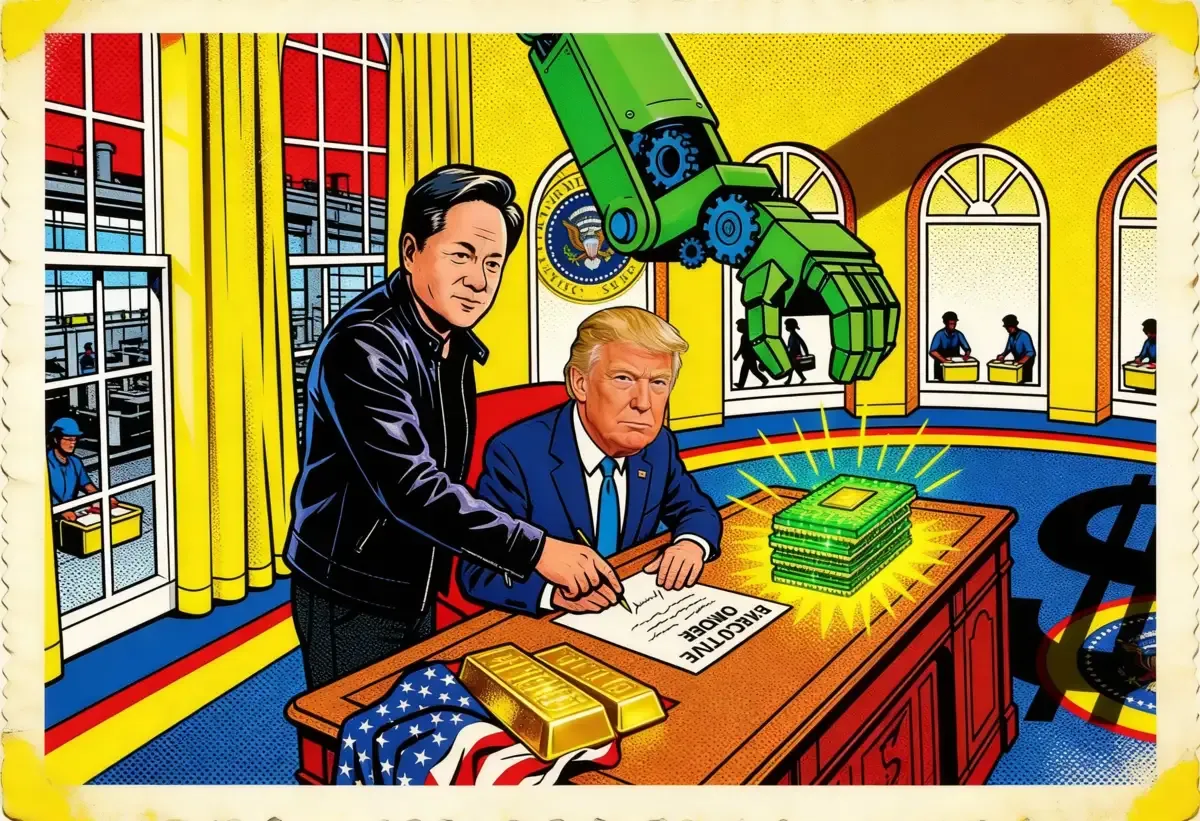
The executive order Donald Trump signed Thursday claims to block states from regulating artificial intelligence. It cannot do this. Executive orders are not laws. They do not preempt state authority. Anyone who stayed awake during middle school civics knows the president cannot simply declare state legislatures irrelevant.
Yet the order exists. Major outlets reported it as though presidential memos now override federalism. And somewhere in a corner office, Jensen Huang is smiling.
An administration that cannot pass legislation through Congress is resorting to theatrical governance, while the tech executives who helped fund Trump's return to power collect their payment in regulatory capture. The constitutional questions are almost secondary to what this episode reveals about who actually runs American technology policy in 2025.
The Breakdown
• Trump's order directs DOJ to sue states over AI laws, but the order itself admits it needs Congress to actually preempt them
• Nvidia CEO Jensen Huang lobbied for the order and got H200 chip exports to China approved the same week, with no interagency review
• GOP populists including DeSantis and Bannon opposed the order as a Silicon Valley power grab, forcing last-minute language compromises
• The dormant commerce clause legal strategy could backfire, creating precedent to invalidate all state tech laws including Republican anti-censorship measures
The Memo That Thinks It's a Law
Trump's executive order contains a revealing admission buried in its own text. "My Administration must act with the Congress to ensure that there is a minimally burdensome national standard," it reads. Must act with Congress. Because Congress makes laws. The president signs them.
Then the order proceeds as though this sentence never existed.
It establishes an "AI Litigation Task Force" within the Department of Justice, tasked with challenging state laws that conflict with "the policy set forth in this order." Not federal law. The order's policy. The administration invented a policy preference, then directed federal lawyers to sue states for violating that preference.
Colorado passed a law requiring AI systems to protect against algorithmic discrimination in hiring, housing, and lending decisions. The order frames this as forcing AI to "produce false results." The law actually addresses a documented problem: algorithms trained on biased data perpetuate that bias at scale. Garbage in, garbage out. Colorado wants the garbage filtered.
Accuracy isn't the concern. The order's drafters, led by White House AI czar David Sacks, want freedom from accountability. Any requirement that AI systems produce defensible outputs becomes, in this framing, ideological interference.
The enforcement mechanisms get creative. States with "onerous" AI laws face losing access to BEAD broadband funding, the Biden-era program that allocated billions for internet infrastructure. Using congressionally appropriated funds as leverage to coerce state policy compliance isn't novel corruption. Just unusually transparent.
Get Implicator.ai in your inbox
Strategic AI news from San Francisco. No hype, no “AI will change everything” throat clearing. Just what moved, who won, and why it matters. Daily at 6am PST.
No spam. Unsubscribe anytime.
NPR noted the order "probably isn't legal." Above the Law called it "hallucinating more fake law than any AI." Even Steve Bannon, hardly a friend to regulatory bureaucracy, observed that Sacks had "completely misleads the President on preemption" after failing twice to jam similar provisions into must-pass legislation.
OpenAI itself has acknowledged that federal preemption of state AI laws requires an act of Congress. The company pushing hardest for regulatory freedom understands the constitutional limits better than the White House enforcing them.
The Chip Whisperer
No interagency review. No formal export control process. A conversation between two men, one of whom runs a company valued above a trillion dollars.
That's how the H200 chip export decision happened. The same week Trump signed the AI order, he approved Nvidia's sale of advanced AI chips to China. The decision blindsided national security hawks who had spent years constructing export control regimes specifically designed to prevent this hardware from reaching Chinese developers. Commerce Secretary Howard Lutnick described the arrangement with disarming candor: "the great American technologist talking to the great businessman president, and they reached what they thought was the right answer for this particular moment."
Jensen Huang had never visited the Oval Office before January 2025. Now the Nvidia CEO is a regular fixture, and his influence extends well beyond ceremonial photo opportunities.
In late January, as DeepSeek's release rattled assumptions about American AI dominance, Huang met with Trump, Sacks, and AI adviser Sriram Krishnan. It was the first of several such meetings. By last month, Huang was expressing support for the executive order limiting state AI regulation directly to Sacks and Krishnan. The Wall Street Journal reported the meeting. Nobody disputed its significance.
A former Trump Commerce official, speaking anonymously, identified the structural problem. "There is no chip expert in the White House. That's why we're in the trouble we're in." Semiconductor policy, one of the most consequential domains in great power competition, is being shaped by the CEO whose company profits most from fewer restrictions.
Nvidia occupies a peculiar position in the current AI economy. The company supplies the GPUs that every major AI lab requires. When OpenAI announces a $500 billion infrastructure commitment, much of that money flows to Nvidia. When hyperscalers build data centers, they're buying Nvidia hardware. The company doesn't build AI systems. It sells the picks and shovels.
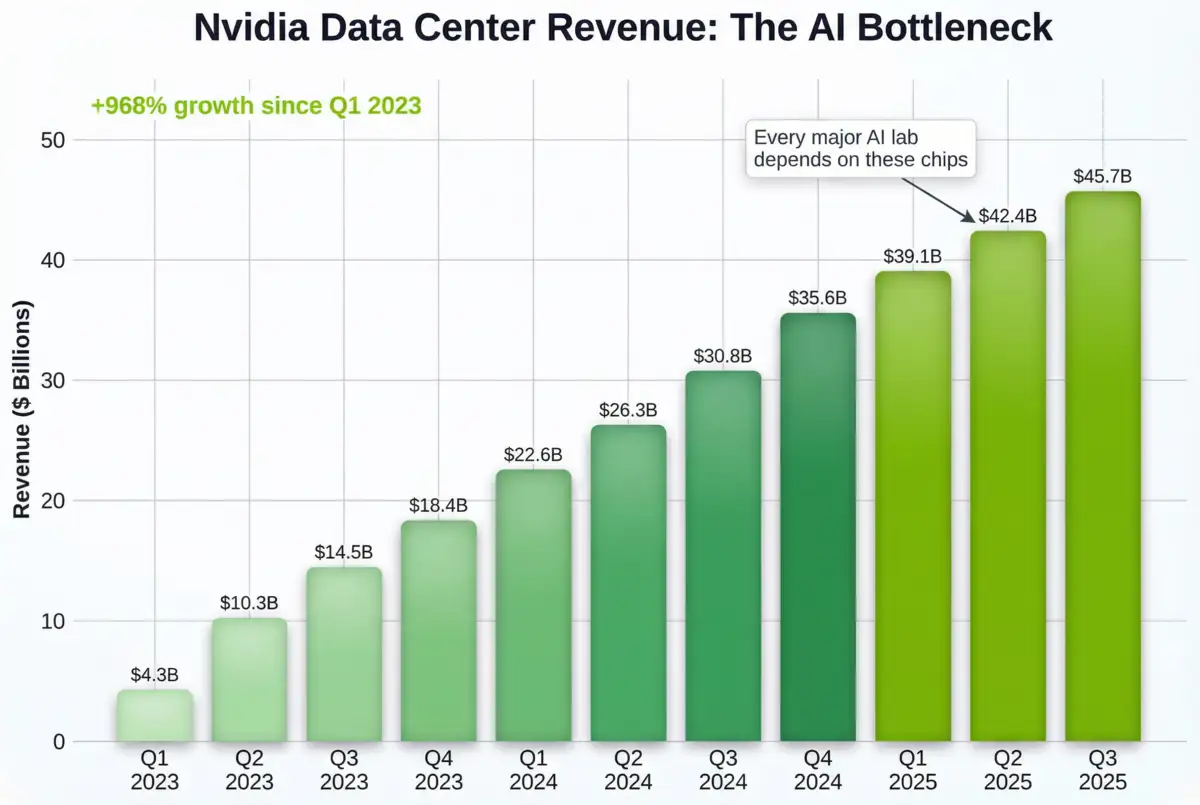
This creates interesting incentive structures. Nvidia benefits from maximum AI development with minimum regulatory friction. Export controls reduce the addressable market. State laws requiring algorithmic accountability add compliance costs that might slow adoption. Every barrier to AI deployment is a barrier to GPU sales.
Huang's policy preferences and Nvidia's commercial interests align perfectly. That's not corruption in any prosecutable sense. It's something more subtle: the gradual replacement of public deliberation with private negotiation between executives and politicians who share donors and incentives.
The Base Realizes It's Been Traded
For weeks before Trump signed the order, an unusual coalition mobilized against it. Ron DeSantis, the Florida governor whom Sacks once backed for president, posted criticism on X. Marjorie Taylor Greene declared that "states must retain the right to regulate and make laws on AI." Steve Bannon turned his War Room podcast into a platform for opposition. Conservative advocacy groups called the White House. Governors demanded explanations.
The complaints weren't about AI specifically. They were about federalism, and about who the Republican Party actually serves.
"It feels like millions of votes across the country just got traded for thousands of [venture capitalist] and tech rich votes in regions Republicans will never win," one person involved in opposing the order told the Washington Post. The source noted the contrast with Trump's campaign imagery. Shoveling fries at McDonald's in Pennsylvania. Positioning himself as the candidate of working people against coastal elites.
Now the working-people president was signing orders drafted by Silicon Valley investors to benefit trillion-dollar corporations.
Sacks and Krishnan scrambled to contain the damage. They called governors, including Arkansas's Sarah Huckabee Sanders. They met with conservative activist Mike Davis, who had been warning in Fox News appearances about "Big Tech's AI amnesty scam." They modified the order's language to specify that federal preemption wouldn't override state authority on "the 4 Cs": child safety, communities (meaning data center regulation), creators (copyright), and censorship.
These carve-outs calmed the immediate revolt. DeSantis went quiet. Sanders issued a statement about "working with his administration." Davis appeared on Bannon's show calling the final version a win for Trump rather than "the tech bros."
The underlying tension hasn't dissolved. States' rights Republicans watched their party's leadership execute a federal power grab on behalf of California venture capitalists. The compromise language offers rhetorical cover without legal substance. If the order's preemption theory holds, future administrations can simply define different state laws as "onerous" and threaten the same consequences.
Trump's coalition in 2024 ran on suspicion of concentrated corporate power. Some of those voters lost manufacturing jobs to offshoring. Others lost tech jobs to H-1B visa holders. Different grievances, same enemy: the coastal elite who'd rigged the economy for themselves. Now those voters get to watch Jensen Huang walk in and out of the Oval Office while David Sacks rewrites state law by executive fiat. The fry cook photo op feels like a long time ago.
The Accidental Nuclear Option
The legal strategy here could backfire in ways the drafters haven't thought through.
Trump's order leans on the dormant commerce clause to challenge state AI laws. The argument goes like this: states can't pass laws that burden interstate commerce. AI systems cross state lines. So state AI regulation is unconstitutional. QED.
Except courts have avoided pushing this logic very far. And for good reason. The dormant commerce clause is a nuclear option. Use it broadly and you don't just wipe out AI regulations. You take out basically any state law touching internet-connected services.
Every state privacy law. Every age verification requirement. Every content moderation mandate. Every red state law targeting "Big Tech censorship." Every blue state law claiming to protect children online. All of it regulates services that cross state boundaries. All of it, under an aggressive dormant commerce clause theory, becomes constitutionally suspect.
If Trump's DOJ successfully argues this position to keep Silicon Valley donors happy, they create precedent that future administrations and tech companies can use against any state regulation they dislike. Republicans who championed state-level social media laws targeting perceived liberal bias would watch those laws evaporate under doctrine established by a Republican administration protecting AI companies from accountability.
Courts have mostly used the First Amendment to strike down problematic state tech laws. It's a narrower tool, less likely to create sweeping collateral damage. The dormant commerce clause approach is a flamethrower brought to a surgery.
Techdirt's Mike Masnick noted the potential for blowback with something approaching glee. Most state internet regulation is "awful and a mess," he wrote. Watching it all get swept away by Trump's own legal strategy would be "hilarious." Also catastrophic for federalism as a governing principle.
The Question Nobody Wants Answered
Behind the constitutional theater and corporate capture lies a simpler anxiety that almost nobody in power will address directly.
At a recent event, Bernie Sanders pressed Geoffrey Hinton, the AI pioneer who left Google over safety concerns, on employment effects. Sanders noted the standard reassurance: technology displaces some jobs but creates others. Is AI different?
"Yes, this is very different," Hinton replied. "The people who lose their jobs won't have other jobs to go to if AI gets as smart as people, or smarter. Any job they might do can be done by AI."
Tech leaders haven't absorbed the implications, Hinton added. "They haven't really thought through the massive social disruption we'll get if we get very high unemployment."
They whisper it in private.
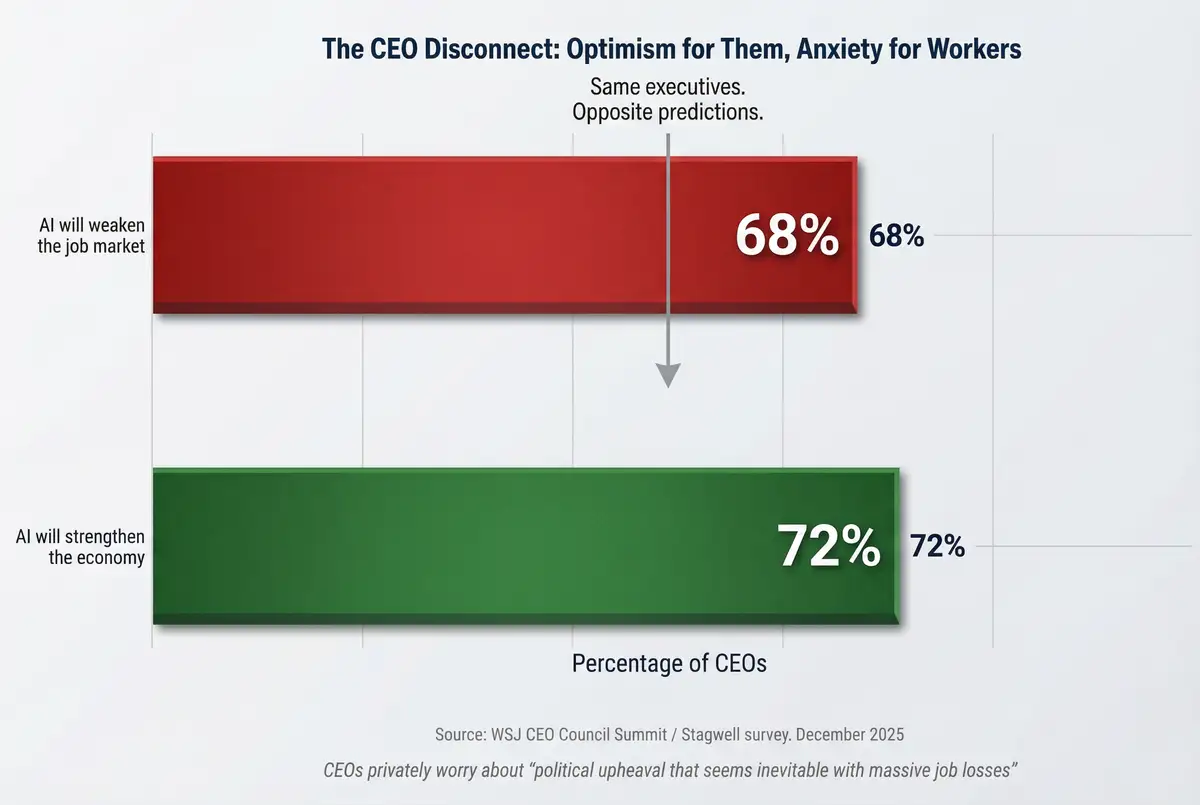
A Wall Street Journal survey of CEOs found nearly 70% expect AI will weaken the U.S. job market, even as they remain optimistic about economic growth. That's not a contradiction. It's a prediction about who captures the gains. Privately, some executives told the Journal they worry about "political upheaval that seems inevitable with massive job losses."
The White House economic adviser Kevin Hassett offered the standard historical comparison at a recent CEO summit. Electricity was disruptive but beneficial. So was the internal combustion engine. So were computers. AI will follow the same pattern.
This misses Hinton's point. Previous technologies automated physical tasks, then routine cognitive tasks, while creating new categories of work that required human judgment, creativity, and social intelligence. AI potentially automates judgment, creativity, and social intelligence themselves. What's left?
Trump's order treats AI development as pure upside requiring protection from meddlesome state legislators. The populist opposition focuses on regulatory process and states' rights. Neither engages the employment question.
Somewhere in Austin or Seattle, a software engineer is reading about these executive orders while updating their LinkedIn profile, just in case. They've seen the demos. They know what Claude and GPT-5 can do with a code prompt. The severance math runs through their head at 2 a.m. How many months of runway? What transferable skills, exactly, when the skill being transferred to machines is thinking?
The people writing these orders know exactly what's coming. They plan to be on the side of the equation that owns the robots. The states can fight over who pays for the unemployment checks.
Why This Matters
- For state legislators: The order signals aggressive federal challenges to AI accountability laws. Courts will probably reject the preemption claims eventually. But "eventually" might be three or four years of litigation. The technology doesn't wait for judges.
- For tech investors: Nvidia's direct line to the Oval Office establishes a template. Export controls, state regulations, and federal oversight are all negotiable when the right CEO makes the right calls. The regulatory risk premium for AI investment just dropped.
- For workers in automatable roles: Neither party is preparing for large-scale labor displacement. The administration's position, that AI development requires maximum freedom, forecloses the policy conversations that might cushion transitions. By the time unemployment numbers force action, the companies will be too essential to regulate.
❓ Frequently Asked Questions
Q: Can Trump actually block state AI laws with an executive order?
A: No. Executive orders direct federal agencies, they don't override state laws. The order itself admits it "must act with the Congress" to create a national standard. What Trump can do is direct the DOJ to sue states, hoping courts will strike down their laws. Legal experts say this strategy lacks grounding in existing federal law.
Q: What is the dormant commerce clause and why does it matter here?
A: It's a constitutional doctrine that limits states from passing laws that burden interstate commerce. Trump's order uses it to argue state AI laws are unconstitutional because AI crosses state lines. The risk: if courts accept this logic broadly, it could invalidate almost any state law regulating internet services, including Republican-backed social media laws.
Q: Which state AI laws could face federal challenges?
A: Colorado's algorithmic discrimination law is explicitly named in the order. It requires AI systems used in hiring, housing, and lending to protect against bias. California has pending AI safety legislation. Other states with data privacy laws or AI disclosure requirements could also face challenges from the new DOJ task force.
Q: Who is David Sacks and what role does he play?
A: Sacks is Trump's White House AI and crypto czar, a Silicon Valley venture capitalist who previously backed Ron DeSantis for president. He drafted the executive order and led negotiations with Republican critics. He also tried twice to include similar provisions in must-pass legislation before turning to the executive order approach.
Q: What is BEAD funding and how is the administration using it?
A: BEAD (Broadband Equity Access and Deployment) is a Biden-era program allocating billions for internet infrastructure. Trump's order threatens to withhold these congressionally appropriated funds from states with "onerous" AI laws. Critics call this extortion, using federal money as leverage to force state policy changes.
Q: What are the "4 Cs" carve-outs in the final order?
A: After Republican pushback, Sacks added language saying the order wouldn't override state authority on child safety, communities (data center regulation), creators (copyright protection), and censorship. These carve-outs calmed critics like Mike Davis and Steve Bannon, though legal experts question whether they have actual binding force.
Q: What did Nvidia get the same week as this order?
A: Trump approved Nvidia's export of H200 chips to China, with the U.S. receiving 25% of sales. The decision bypassed normal interagency review for export controls. Commerce Secretary Lutnick described it as a direct deal between Huang and Trump. National security officials had spent years building restrictions specifically to prevent this hardware reaching China.
Q: Why did some Republicans oppose this order?
A: States' rights conservatives saw it as federal overreach benefiting Silicon Valley. DeSantis, Bannon, and Marjorie Taylor Greene publicly criticized the draft. One insider told the Washington Post it felt like "millions of votes across the country just got traded for thousands of [venture capitalist] and tech rich votes." The populist wing views it as Trump siding with coastal elites over his base.
 Maria Garcia
 Robert Brown
 Marcus Schuler
Sign up for Implicator.ai
Strategic AI news from San Francisco. Clear reporting on power, money, and policy. Delivered daily at 6am PST.
No spam. Unsubscribe anytime.