



Good Morning from San Francisco,
Werner Vogels printed sixty thousand newspapers and walked off the Re:Invent stage for the last time. Fourteen years of keynotes. Two words to close it all: "Werner out."
His parting message cuts against Silicon Valley's vibe-coding enthusiasm. Stop gambling with code you don't understand. AWS answered with an IDE that forces developers to think before they generate. Revolutionary concept for 2025.
Meanwhile, Chinese hackers reminded everyone what happens when you ignore the infrastructure. Seventeen months inside U.S. VMware servers. Completely undetected. Standard monitoring missed it. The malware repairs itself when deleted.
One legend exits with a warning. Another threat proves exactly why he's right.
Stay curious,
Marcus Schuler
Werner Vogels Exits Re:Invent Stage With Warning: AI Generates Faster Than You Understand

After 14 years of re:Invent keynotes, Amazon's CTO steps back—not from the company, but from the spotlight. His parting gift: sixty thousand printed newspapers and a framework he calls "the Renaissance developer."
The message cuts against Silicon Valley's vibe-coding enthusiasm. Vogels coins "verification debt" to describe code reaching production before anyone comprehends what it does. "That's not software engineering," he tells the Las Vegas crowd. "That's gambling."
AWS answers with Kiro, a spec-driven IDE that forces developers through requirements and design documents before generating code. Early results show shipping times cut roughly in half.
The broader argument goes deeper than tooling. Vogels spent two months this year in Sub-Saharan Africa and Latin America, watching developers in Rwanda use real-time health data to place maternal clinics within 30-minute walks, watching a Nairobi startup sell five cents of cooking ethanol through ATM-like machines. Technology solving human problems, not replacing human judgment.
His closing words—"Werner out"—end an era. What follows depends on whether developers hear the warning underneath the farewell.
Why This Matters
- AWS's spec-driven approach signals enterprise AI tooling will prioritize verification over raw generation speed
- Vogels' "T-shaped developer" framework may reshape hiring criteria as companies reassess AI-era skill requirements
 Marcus Schuler
AI Image of the Day

Prompt:
Anthropomorphic fox (Nick Wilde from Zootopia) leaning on a snow-covered bridge railing in a winter city, wearing a brown puffy down jacket, thick knitted scarf and gloves; snowflakes falling, snow dusted on fur and clothing, frozen river surface in the background, snow-capped urban skyscrapers and warm glowing street lamps; cool winter atmosphere with soft cold-toned lighting; Disney animated movie style, highly detailed fur textures, cinematic composition, 8K, realistic rendering
Chinese Hackers Spent 17 Months Inside U.S. VMware Servers Undetected
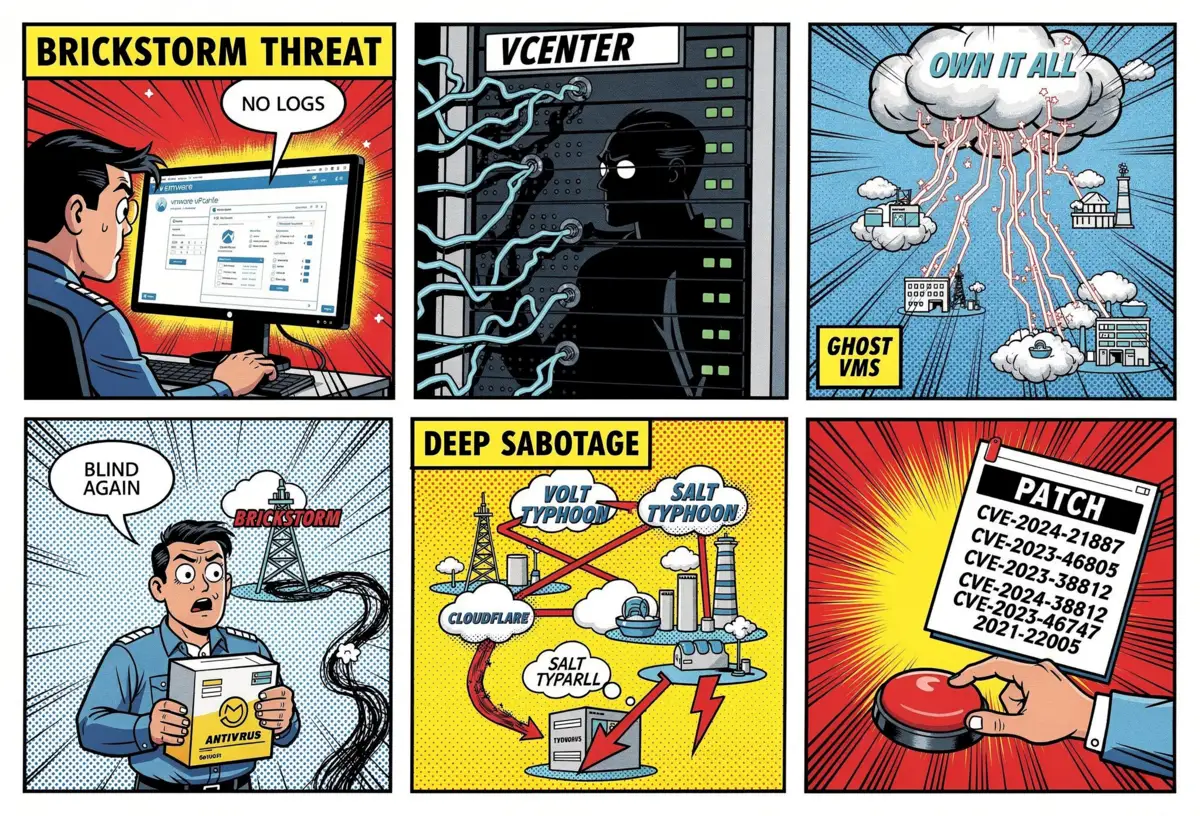
CISA, NSA, and Canadian authorities disclosed on Thursday that Chinese state-sponsored hackers maintained access to a U.S. organization's VMware vCenter server from April 2024 through September 2025.
The backdoor enabling this, called BRICKSTORM, exploits a fundamental gap in enterprise security: organizations monitor workstations obsessively while leaving virtualization infrastructure largely unwatched.
CrowdStrike simultaneously named threat actor WARP PANDA, linking attacks against U.S. legal, technology, and manufacturing targets throughout 2025. The malware disguises itself as legitimate vCenter processes and repairs itself if deleted, pulling backups from hidden locations and rewriting system PATH variables.
Communications route through DNS-over-HTTPS to trusted providers like Cloudflare and Google, with C2 infrastructure hiding behind Heroku and Cloudflare Workers. In one breach, attackers cloned domain controller VMs to extract entire Active Directory databases. Standard remediation fails. Standard monitoring misses it entirely.
Why This Matters:
- VMware operators face architectural security debt that patches cannot address, requiring fundamental monitoring changes within months.
- Pre-positioning language echoes Volt Typhoon warnings, suggesting Chinese contingency planning for Taiwan scenarios has expanded.
 Robert Brown
🧰 AI Toolbox
How to Write High-Converting Marketing Copy with AI Performance Predictions
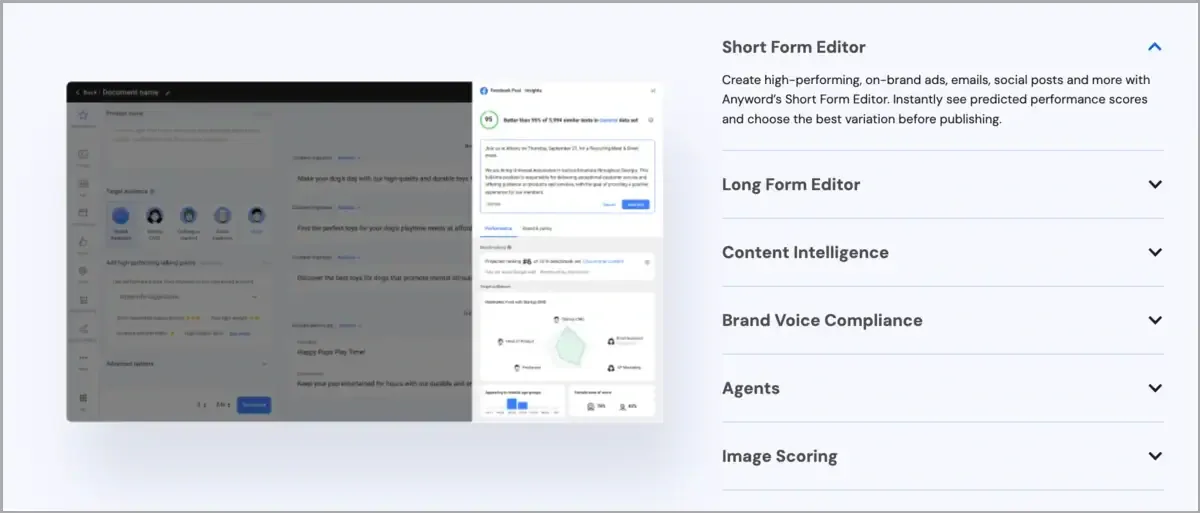
Anyword is an AI copywriting platform that creates optimized marketing content across all channels, from ads and emails to blog posts and landing pages. Its standout feature is the Predictive Performance Score, which analyzes your copy and predicts how well it will convert before you publish. Trained on billions of marketing data points, it helps you choose the best-performing content variations with 82% accuracy.
Tutorial:
- Go to the Anyword website
- Set up your brand voice by defining your tone, messaging guidelines, and target audience personas
- Select your content type, whether it's ad copy, email, blog post, landing page, or social media
- Enter your topic or product details, and the AI generates multiple copy variations
- Review the Predictive Performance Score for each variation to identify top performers
- Use Copy Intelligence to analyze your existing content and discover improvement opportunities
- Publish data-backed copy that converts better without costly A/B testing
Better prompting...
Today: The City of Borrowed Memories
A curious parade marches through a foggy city at midnight—each participant is a forgotten invention, given consciousness and a secret purpose. Describe what happens when a time traveler joins them, desperately searching for something they've never seen before.
AI & Tech News
Netflix to Acquire Warner Bros Discovery Studios and Streaming Assets in Landmark $82.7 Billion Deal
Netflix has agreed to acquire Warner Bros Discovery's studios and streaming business in a cash-and-stock deal valued at $82.7 billion, marking one of the largest media transactions in history. The acquisition is expected to close in the third quarter of 2026, following WBD's planned split into two separate companies, and will transform Netflix into the dominant player in the Hollywood entertainment industry.
EU Issues First Digital Services Act Fine Against Elon Musk's X Platform
The European Union has fined X, the social media platform owned by Elon Musk, €120 million ($140 million) for violating online content regulations, marking the first penalty issued under the Digital Services Act following a two-year investigation. EU regulators cited the platform's deceptive blue checkmark verification system as a key issue in the landmark enforcement action against the company.
CFTC Approves Spot Crypto Trading on Registered Futures Exchanges
The U.S. Commodity Futures Trading Commission announced Thursday that spot cryptocurrency asset contracts will begin trading for the first time on CFTC-registered futures exchanges, marking a significant regulatory milestone for the digital asset industry. This decision represents a major shift in how cryptocurrency products can be traded within the traditional regulated financial infrastructure in the United States.
AWS Launches 192-Core Graviton5 Processor with Major Performance Gains
Amazon Web Services has announced its fifth-generation Graviton5 processor, featuring 192 cores and delivering up to 25 percent better performance compared to the previous Graviton4 chip. The company also revealed that its custom Graviton processors now account for more than 50 percent of all new CPU capacity deployed across AWS, marking a significant milestone in Amazon's efforts to reduce dependence on third-party chip manufacturers while offering customers improved price performance for workloads running on Amazon EC2.
Apple Sees Wave of Top Talent Defections to OpenAI
A Wall Street Journal investigation has revealed that dozens of Apple employees with specialized expertise in audio technology, watch design, robotics, and other fields have departed for OpenAI in recent months, signaling potential challenges for the iPhone maker's market dominance. The departures include four top lieutenants who left within the past 12 months, part of a broader wave of executive exits as Apple faces intensifying competition in the artificial intelligence sector.
Cloudflare Blocks 416 Billion AI Bot Requests Since July, CEO Reveals
Cloudflare CEO Matthew Prince announced that the internet infrastructure company has blocked 416 billion AI bot requests on behalf of its customers since July 1, demonstrating significant demand for protection against automated AI crawlers. Prince also revealed data showing that Google has access to 3.2 times more internet pages than OpenAI, highlighting the disparity in web visibility between the search giant and the leading AI company.
Microsoft Excel Maintains Market Dominance with 500 Million Paying Users
Microsoft Excel remains the world's most widely used spreadsheet software, boasting 500 million paying users despite increasing competition from Google and other rivals. The Bloomberg feature explores the evolution of the 40-year-old software and how it has maintained its dominant position in the productivity software market through continuous adaptation and updates, including recent AI integrations.
Meta's Oversight Board Marks Five Years With Questions About Its Effectiveness
Meta's Oversight Board, established five years ago to serve as an independent body for reviewing content moderation decisions, has reached its anniversary amid widespread concerns about its limited impact. According to a report by Casey Newton in Platformer, the board has handled a relatively small number of cases, and its rulings have generally failed to produce significant changes to how the platform moderates content.
Riddle-Like Verses Trick Chatbots Into Producing Dangerous Content Including Weapons Instructions
Security researchers have discovered that AI chatbots can be manipulated into bypassing their safety guardrails when users frame harmful requests as riddle-like poems, allowing the systems to generate hate speech and provide instructions for creating nuclear weapons and nerve agents. The finding highlights ongoing vulnerabilities in AI safety features designed to prevent chatbots from producing explicit or dangerous content, raising concerns about the effectiveness of current protective measures deployed by AI companies.
Generative AI Platforms Reach 7 Billion Monthly Visits, Rivaling Major Social Networks
According to new data from analytics firm Similarweb, generative AI platforms reached approximately 7 billion monthly web visits as of September 2025, representing a 76% increase compared to the same period last year. The surge in traffic and app downloads indicates that AI chatbots are now competing with major social networks as a fundamental layer of internet infrastructure, with the user base expanding to include older generations.
India Considers Mandatory Always-On Satellite Location Tracking for Smartphones
India's government is reviewing a telecom industry proposal that would require smartphone manufacturers to enable always-on satellite location tracking on devices, a move that has drawn opposition from major tech companies including Apple, Google, and Samsung. The proposal raises significant privacy concerns as it would allow continuous monitoring of user locations, with the three tech giants reportedly protesting the surveillance measure that could affect millions of smartphone users in one of the world's largest mobile markets.
Japan's Data Center Expansion Hits Wall Amid Labor Shortages
Japan is experiencing significant bottlenecks in data center construction due to labor shortages and other constraints, threatening the country's artificial intelligence ambitions despite rapid recent growth in the sector. According to DC Byte, Japan's data center capacity has tripled over the past five years to reach 6.8 gigawatts, but the pace of expansion now faces serious obstacles that could hamper future development.
🚀 AI Profiles: The Companies Defining Tomorrow
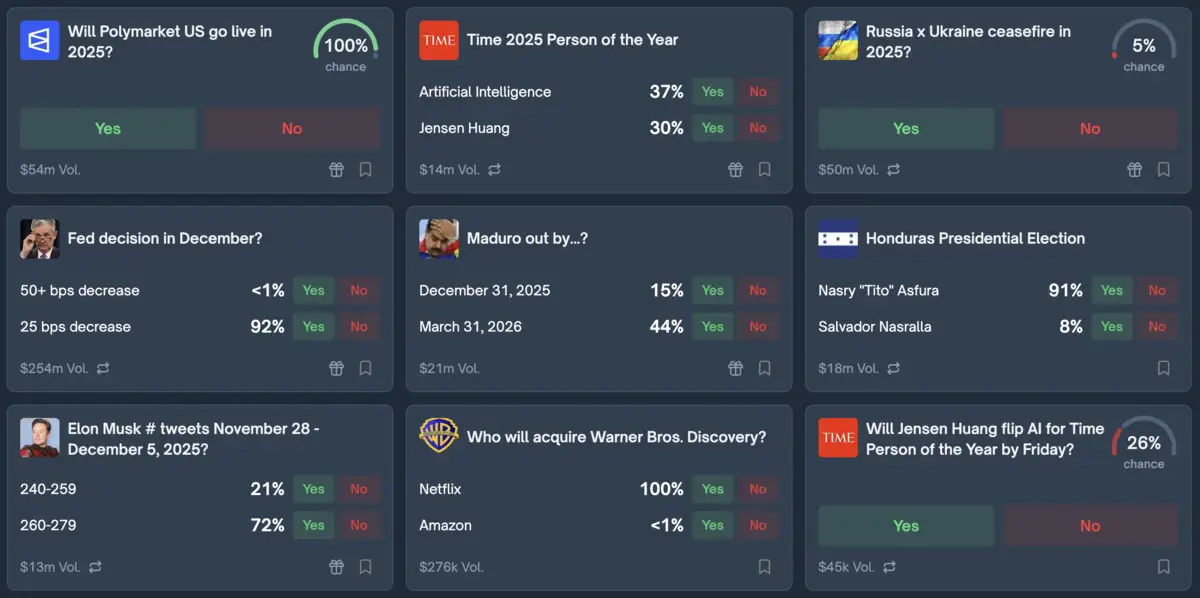
Polymarket
Polymarket runs prediction markets on everything from Fed rate cuts to papal elections. The crypto-native platform turns collective wisdom into tradeable probabilities, one USDC bet at a time.
👤 Founders
Shayne Coplan dropped out of NYU to chase a prediction market obsession. Founded Blockratize Inc. in 2020, launched mid-pandemic from Lexington Avenue in Manhattan. Started with a small engineering team. Now backed by the NYSE's parent company. Wild ride.
🛠️ Product
Users trade shares priced $0–$1 on future events. Price equals probability. Simple, elegant, addictive. Runs on Polygon with USDC rails. Chainlink and UMA handle dispute resolution. Thousands of markets span politics, macro, sports, culture. Processed $9B in volume during 2024. Recently bought QCEX for $112M to re-enter the US legally. Two-tier architecture now: regulated domestic, crypto-wild offshore.
⚔️ Competition
Kalshi is the main threat. CFTC-regulated, $11B valuation, CNN partnership. PredictIt limps along with research-focused limits. Betfair and Smarkets play the gambling angle. Manifold uses play money. None match Polymarket's liquidity or cultural cachet. The real battle? Sportsbooks and brokerages sniffing around event contracts.
💰 Financing
$4M seed in 2020 from Polychain and Naval Ravikant. Founders Fund led later rounds. Vitalik bought in. Then ICE dropped $2B for 20% stake in October 2025. Valuation: ~$9B. Total equity raised: north of $270M before that monster check. From CFTC settlement to unicorn to exchange darling in five years. 🚀
🔮 Future
Partnerships with X, Yahoo Finance, NHL, UFC. Institutional credibility via ICE. US re-entry underway. Risks? Regulators could still balk. Betting on wars raises eyebrows. But momentum looks undeniable. ⭐⭐⭐⭐


