Implicator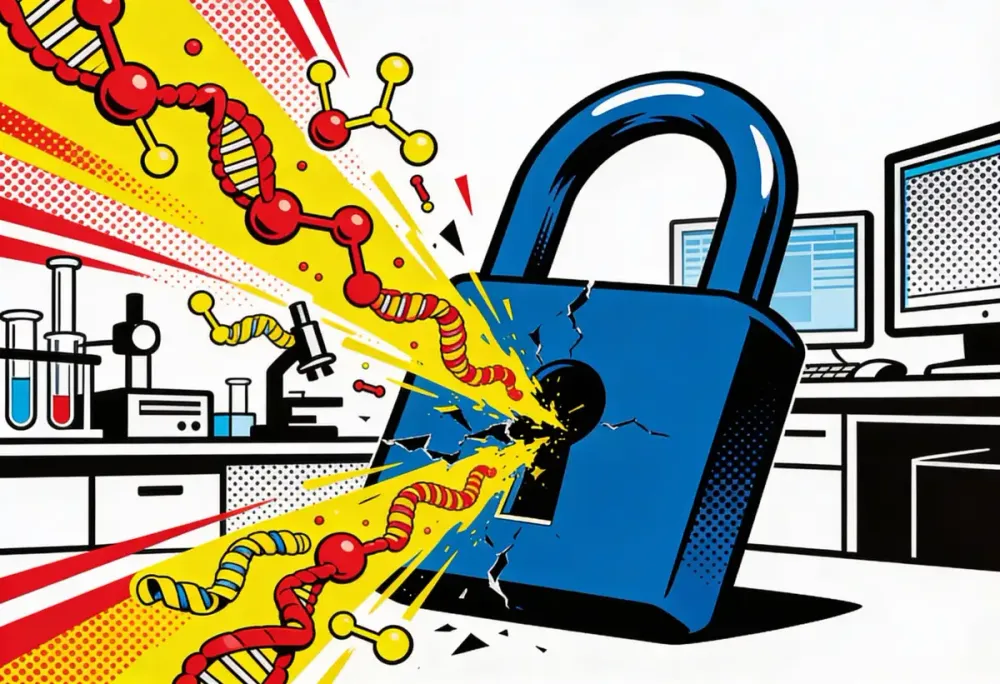
Last spring, DeepMind shipped AlphaFold 3. You know the drill by now. Protein folding, solved. Drug binding, predicted. DNA interactions, modeled. Hassabis did the press tour. Nature published the paper.
But something was different this time.
The researchers who downloaded the paper started reading the licensing terms. Code: locked. Weights: restricted. Commercial applications: forbidden. If you wanted to predict how drugs bind to proteins—the one thing pharmaceutical companies actually pay for—you had to go through Isomorphic Labs. That's DeepMind's drug discovery spinoff. The one sitting on $3 billion in tentative deals with Eli Lilly and Novartis.
By December, three PhD students at MIT had reverse-engineered the architecture and released their own version. They put it on GitHub under Apache 2.0. Anyone could download it. Anyone could use it commercially. They called it Boltz-1.
Get Implicator.ai in your inbox
Strategic AI news from San Francisco. No hype, no "AI will change everything" throat clearing. Just what moved, who won, and why it matters. Daily at 6am PST.
No spam. Unsubscribe anytime.
The Vacuum Google Created
Here's the part that got people angry.
Back in 2021, Google played nice. AlphaFold 2 came out with an Apache 2.0 license, which meant you could do whatever you wanted with it. Fork it. Train on your own data. Build products. Sell those products. Structural biology became free infrastructure overnight. A researcher at Merck and a grad student working out of a cramped lab in Mumbai got identical tools. So did Pfizer. So did some two-person startup running out of a garage in San Diego. Nobody had an edge because everybody had access.
Then Google changed the rules.
AlphaFold 3 was better—it could handle drug-protein interactions, exactly what pharmaceutical companies need. But academics only. No commercial use. No training your own versions.
The exits that led somewhere useful? Locked.
Nature got nervous. The journal published an editorial second-guessing its own decision to run the paper without the accompanying code. Researchers pointed to the obvious reason: Isomorphic Labs was using AlphaFold 3 internally for those billion-dollar pharma partnerships. Releasing the model would hand competitors identical capabilities.
Gabriele Corso, Jeremy Wohlwend, and Saro Passaro saw what was happening. They spent four months rebuilding the thing. December 2024, Boltz-1 went live. The benchmarks matched AlphaFold 3 on the metrics drug companies actually track. You can pull it from GitHub right now. The pharmaceutical industry finally had somewhere else to go.
Selling Pickaxes in a Gold Rush
The company closed a $28 million seed round this January. Same day, announced they're working with Pfizer. The deal structure explains how Boltz plans to make money without charging for the models.
The code stays free. Non-negotiable. Pull Boltz-1 or Boltz-2 from GitHub right now. Run predictions on your own hardware. The founders built the company on this premise. They're not backing off.
So where's the revenue? Pfizer isn't paying for access to the algorithm. They're paying Boltz to fine-tune models on Pfizer's proprietary molecular data, plug the platform into existing workflows, handle the compute. Co-development, not licensing. The models get better through real-world pharmaceutical feedback. Pfizer gets custom versions trained on its own compounds. Boltz gets paid.
The economics become obvious when you look at what Boltz replaces. Traditional binding affinity calculations cost around $100 each. Physics-based simulations. Six to twelve hours per run. Boltz-2 does the same calculation in twenty seconds on a single GPU. Pennies. When you're screening millions of candidate molecules, that's not incremental improvement. You can suddenly afford to explore chemical space that was economically off-limits before.
Think Red Hat. Linux was free. Red Hat made billions on enterprise support, integration, the guarantee that someone picks up the phone when production breaks. Boltz-1 is free. Boltz charges for everything that makes it usable at pharmaceutical scale.
Why This Moment
Three things opened the door.
Google's restrictions handed competitors a recruiting pitch they couldn't have bought. We're the team that believes this technology should be open. Forty outside contributors improved Boltz-1 in the months after release. The GitHub repo became a gathering point for researchers who were frustrated with Google's bait-and-switch.
Then there's the compute story. Training a frontier biology model in 2023 meant resources only Google-sized companies could marshal. But Recursion Pharmaceuticals partnered with MIT. Their BioHive-2 supercomputer sits in a building in Salt Lake City, humming through 504 H100 GPUs. Two exaflops of AI performance. The kind of hardware that used to require a billion-dollar balance sheet. With the right industry partner, a talented academic team could now compete.
And the buyers showed up. AI drug discovery spending topped $6 billion last year. Projections say $160 billion by 2035. GSK announced $30 billion in U.S. R&D investments. Every major pharmaceutical company is shopping for AI capabilities. The demand exists.
The founders' credentials helped. Corso built DiffDock, a molecular docking model that won best paper at NeurIPS 2022. Running inside pharmaceutical companies now. Part of NVIDIA's BioNeMo platform. Biotech startups worldwide. Wohlwend developed machine learning tools for immunology already deployed in industry. Both trained under Regina Barzilay and Tommi Jaakkola at MIT's Jameel Clinic. Probably the most productive academic lab in AI-for-biology right now.
They weren't unknown researchers hoping someone would notice. They were already embedded in the pharmaceutical AI community when Google created the opening.
The Gravity Pressing Back
Boltz operates in brutal territory.
Isomorphic Labs has the original AlphaFold 3, $600 million in fresh funding from Thrive Capital, and those Eli Lilly and Novartis partnerships potentially worth $3 billion. Hassabis runs both DeepMind and Isomorphic. Shared the 2024 Nobel Prize in Chemistry for the AlphaFold work. He's told interviewers Isomorphic could become a $100 billion company. Whether you believe that number or not, the resources available to him dwarf what Boltz can marshal.
Chai Discovery, backed by OpenAI, raised $130 million in December at a $1.3 billion valuation. More than forty times Boltz's seed round. Chai-2 doesn't just predict structures. It designs antibodies from scratch. Further down the value chain. Closer to actual drug candidates rather than infrastructure.
OpenFold3, from a consortium including Columbia University, Lawrence Livermore National Laboratory, and Novo Nordisk, offers another fully open alternative. Backed by AWS compute. Pharmaceutical companies sharing training costs through federated learning. May have deeper industry integration by virtue of the consortium structure.
The crowded field matters because Boltz is selling infrastructure, and infrastructure commoditizes. If Boltz-2, Chai-1, and OpenFold3 all hit roughly the same accuracy, pharmaceutical companies negotiate on price and integration. The model becomes a commodity. Differentiation erodes.
But the real constraint isn't competitive. It's biological.
Nine out of ten drugs fail in clinical trials. That number hasn't budged in forty years. Doesn't matter how much the preclinical tools improved. AI makes structure prediction faster and cheaper. What it hasn't done is make drugs more likely to work in actual human beings.
Phase I trials for AI-discovered molecules show 80-90% success. AI is good at designing molecules with drug-like properties. Phase II, where you actually test efficacy in patients? Roughly 40% success. No better than historical averages. Insilico Medicine is probably the highest-profile company in AI drug discovery. Their Phase 2a data came out in 2024. The drug they'd designed entirely with AI? It didn't beat placebo. Not statistically, anyway.
Structure prediction isn't the bottleneck. The bottleneck is that mice and cell lines don't behave like the chaotic mess of human biology. Your model can nail the binding prediction in a simulation. The drug still fails because a 65-year-old diabetic with three comorbidities doesn't respond the way the cell culture did.
Boltz makes the early stages faster and cheaper. It doesn't solve the translation gap that kills most drugs.
The Founders' Gamble
Corso left his PhD to become CEO. Wohlwend and Passaro joined him. The bet is specific: open-source infrastructure can capture long-term value even when the models themselves are free.
Here's the logic. Pharmaceutical companies won't build their own foundation models. The expertise is too specialized. Compute requirements too heavy. Talent too scarce. They'll buy the capability. Question is from whom.
Isomorphic is the luxury option. The original AlphaFold 3, integrated with DeepMind's research pipeline, presumably premium pricing with restrictive terms. Boltz is the enterprise open-source alternative. Models anyone can audit, modify, verify. Paid services for integration and customization. Pharmaceutical companies have regulatory requirements that may favor transparency. FDA approval requires explainability. Black-box predictions from proprietary systems create documentation headaches.
The public benefit corporation structure matters. Boltz locked itself into keeping models open. That's a signal to the open-source community: we won't pull an AlphaFold 3. We won't build adoption with free tools and yank them away once you're dependent. The PBC designation makes that kind of pivot legally messy.
Corso put it this way to MIT News: "The reason we believe that it's really important for these models to be out there in the open is, at the end of the day, 99.9% of drug developers or biologists are outside of companies like Isomorphic."
The bet is that 99.9% is a big enough market.
What Boltz Reveals
Drug companies used to build competitive advantages through chemistry know-how, clinical trial networks, relationships with regulators. The algorithms were secondary. You won by having better molecules, not better predictions.
AI flips that. The algorithms now determine which molecules are worth synthesizing. Control the best prediction tools and you control which compounds enter development pipelines. When Google locked AlphaFold 3, it was trying to position itself as gatekeeper for drug discovery itself.
Boltz, Chai Discovery, OpenFold. These represent pharma's response. Fund the alternatives. Avoid dependence on a single provider. Pfizer's partnership with Boltz isn't really about technology. It's about making sure critical infrastructure stays accessible and competitive.
This pattern will repeat wherever AI creates essential infrastructure for an industry. Open versus closed will determine market structure. Google's decision to restrict AlphaFold 3 may have been the smart short-term play. It also sparked well-funded competitors into existence. Academic researchers organized within months. Venture capital came in behind them. Pharma signed partnership deals.
The industry rejected the closed approach and built around it.
The Test
Boltz-2 shipped in June 2025. Recursion Pharmaceuticals has been running it internally and reports better results for virtual screening and lead optimization than they got with Boltz-1. The Pfizer partnership will generate real-world validation data through 2026 and 2027.
The meaningful test isn't whether the models work. They clearly do. Boltz-2 matches physics-based methods at a thousand times the speed. The test is whether drugs discovered using Boltz actually perform better in clinical trials.
If Phase II success rates for Boltz-assisted programs beat the 28.9% industry average, the thesis is validated. AI infrastructure genuinely accelerates drug discovery in ways that matter to patients. If the rates are comparable, Boltz is a cost-reduction tool but not a medical breakthrough. The drugs are cheaper to find. They're not more likely to work.
First clinical data from Boltz-assisted programs will emerge in 2027 or 2028. Until then, the company is selling speed and cost savings. Valuable, but not transformational. The transformation requires surviving the gap between prediction and biology that has defeated every prior wave of drug discovery technology.
Pfizer's scientists are already running the models. Molecules are entering development pipelines. The trials will follow. Three years from now, we'll know whether Boltz built a better pickaxe or discovered a new kind of mine.
Frequently Asked Questions
Q: How does Boltz make money if its models are free?
A: Boltz charges for enterprise services, not the models themselves. The Pfizer partnership involves fine-tuning models on Pfizer's proprietary data, integrating with existing workflows, and providing compute infrastructure. The code is free; the implementation at scale is the product.
Q: How does Boltz-2 compare to AlphaFold 3 in accuracy?
A: Boltz-2 matches AlphaFold 3 on standard protein structure benchmarks and adds binding affinity prediction that approaches physics-based free-energy perturbation methods. The key difference is speed: Boltz-2 runs 1000x faster, reducing prediction time from hours to seconds and cost from $100 to cents.
Q: Why did Google restrict AlphaFold 3's commercial use?
A: Isomorphic Labs, Google's drug discovery subsidiary, uses AlphaFold 3 internally for its own pharmaceutical partnerships worth up to $3 billion with Eli Lilly and Novartis. Releasing the model commercially would let competitors access the same capabilities Isomorphic is selling.
Q: Who are Boltz's main competitors?
A: Isomorphic Labs (Google/DeepMind), Chai Discovery ($1.3B valuation, backed by OpenAI), and OpenFold3 (Columbia University consortium with pharmaceutical partners). Each offers different trade-offs between openness, integration, and commercial terms.
Q: Can AI drug discovery actually reduce clinical trial failure rates?
A: Unproven. AI-discovered drugs show 80-90% Phase I success but only ~40% in Phase II, comparable to traditional methods. The 90% overall failure rate persists because the gap between animal models and human biology remains unsolved. AI makes early discovery faster and cheaper, not necessarily more successful.
Harkaram Grewal
Maps the India–Germany–U.S. AI triangle from New Delhi. Background in cross-market operations and business development. Writes about supply chains, enterprise adoption, and talent—the unsexy forces that actually move global AI.