Implicator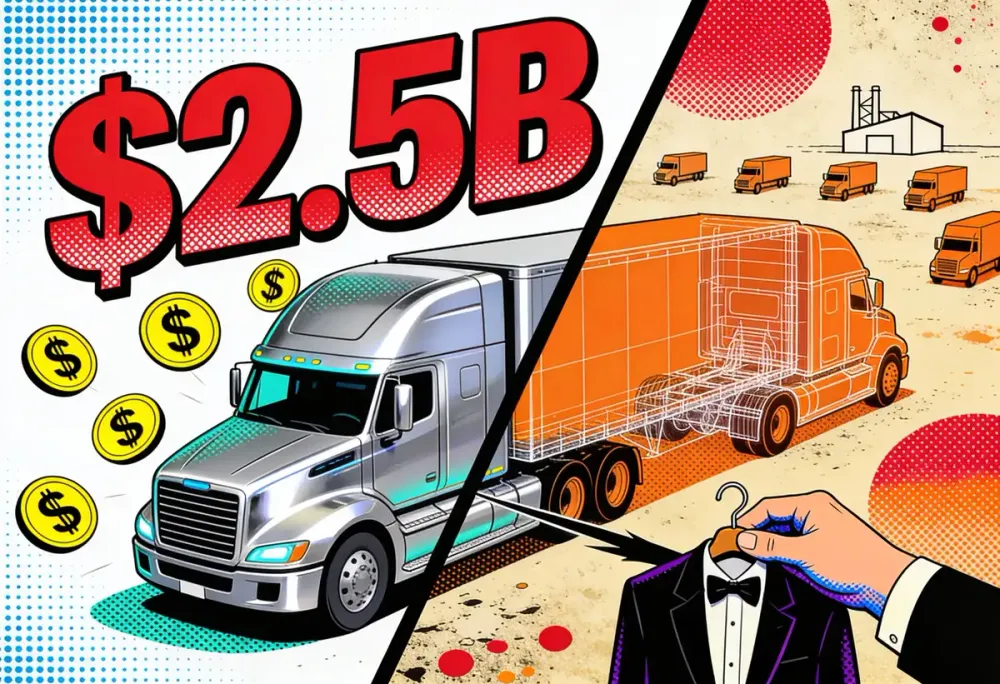
Look at Kodiak AI's $2.5 billion valuation and you see a technology company ready to transform freight. Look at what it announced Monday at CES and you see a different picture: a startup that still needs someone else to build its trucks.
The company partnered with Bosch to manufacture hardware for its autonomous driving systems. Bosch—the world's largest automotive supplier—will provide sensors, steering components, and the production expertise to integrate these systems either on factory lines or through third-party retrofits. Kodiak frames this as a scaling move, bringing "production-grade" components to autonomous trucks.
What it actually reveals is the gap between building technology and building a manufacturing business.
Kodiak went public three months ago through a SPAC merger. It currently operates eight driverless trucks hauling sand and water for Atlas Energy Solutions on private lease roads in the Permian Basin—dusty, empty routes where a sensor glitch means hitting a berm, not a minivan. That's eight trucks, out of a 100-truck order, running the same industrial loops in West Texas.
Neither company provided a timeline for when these new manufacturing systems might reach production.
Key Takeaways
• Kodiak AI partnered with Bosch for autonomous truck manufacturing three months after its $2.5 billion SPAC merger
• Currently operates just eight driverless trucks in controlled Permian Basin conditions, not highway freight operations
• Neither company provided production timelines, suggesting the partnership serves investor signaling more than near-term manufacturing
• Autonomous systems cost $150,000 per truck with unproven economics outside industrial applications
The Manufacturing Reality
Kodiak has already developed what it calls a complete self-driving system with redundant braking, steering, sensors, and computers. Until now, Roush Industries served as the upfitter, converting standard trucks into autonomous ones for the Atlas Energy deployment. Switching to Bosch signals that Roush's capabilities don't match what Kodiak needs for volume production.
Bosch will supply sensors, steering technologies, and other actuation components. More significantly, Bosch brings experience integrating complex systems into automotive production lines—precisely what Kodiak lacks.
Sign up for Implicator.ai
Strategic AI news from San Francisco. Clear reporting on power, money, and policy. Delivered daily at 6am PST.
No spam. Unsubscribe anytime.
Kodiak's founder Don Burnette said the company needs "manufacturing experience and a robust supply chain" to advance deployment. He's right. Kodiak spent years perfecting its AI driver software and sensor stack. But software competence doesn't translate to manufacturing competence. Building eight trucks for a single customer in West Texas is engineering. Building hundreds or thousands economically requires supply chain management, quality control at scale, parts standardization, service networks.
Bosch has those capabilities. Kodiak does not.
What Going Public Actually Bought
Kodiak completed its SPAC merger in September 2025. Three months later it announces a manufacturing partnership. That sequencing matters.
Public companies need to demonstrate forward momentum, particularly SPACs, which often trade on promises rather than present revenue. Kodiak's pitch to investors centered on being one of the few autonomous trucking companies operating vehicles without safety drivers in commercial service. Eight trucks in the Permian Basin became the proof point.
But eight trucks don't generate meaningful revenue. The partnership announcement with Bosch serves a different function—it signals to investors that Kodiak has a path from limited deployment to volume production. Whether that path exists operationally matters less than whether it exists as a story.
Notice what wasn't announced: production timelines, pricing, committed orders beyond Atlas Energy. Nothing about which truck manufacturers might actually integrate Kodiak's systems on assembly lines. Paul Thomas, president of Bosch North America, called the partnership "a valuable opportunity to deepen our understanding of real-world autonomous vehicle requirements." Translation: we're learning, not shipping.
The Broader Economics Problem
Kodiak's move reflects a wider pattern across the autonomous vehicle sector. After years of development spending, investors want to see actual business models. The pivot to freight trucks made sense theoretically—more predictable routes than consumer vehicles, clearer paths to profitability, concentrated customer bases willing to pay for efficiency gains.
Except when you run the numbers, the economics get tight. Autonomous truck systems cost serious money—sensors, redundant computers, specialized actuators. Then there's software development, high-definition mapping, remote monitoring, liability insurance. All of that needs to be offset by labor savings.
Which assumes trucks operate continuously without human drivers. Except you still need humans for loading, unloading, fueling, handling exceptions. Current autonomous systems work on highways but fail at the first and last miles—the parts touching actual customers. Kodiak's Permian Basin deployment works because those private lease roads eliminate variables. Same routes, same conditions, no surprises.
Highway freight is different. Kodiak targets "driverless highway operations in the second half of 2026," but highway operations involve weather, construction, accidents, and unpredictable traffic patterns that industrial loops don't. The technology gap between controlled environments and open highways remains substantial.
Manufacturing as Signal Versus Substance
Partnerships with established automotive suppliers serve legitimate technical purposes. They also serve signaling purposes that have nothing to do with near-term production.
Think of this as renting a tuxedo for the public markets. Bosch's name lends instant credibility. Investors stop asking "does it work?" and start asking "when will it scale?" That's better positioning for a company three months into its life as a public entity at a $2.5 billion valuation.
Kodiak borrows Bosch's manufacturing reputation. Bosch gains insight into autonomous vehicle requirements while selling components. The lack of a production timeline suggests this remains exploratory. Both sides benefit from the announcement whether production happens in 2026, 2028, or never.
Complex hardware businesses develop through partnerships that create options. Not all options convert to products. Investors should know the difference between announced partnerships and shipping capacity.
What Actually Gets Built
The test for Kodiak isn't whether Bosch can supply sensors and steering systems. The test is whether anyone buys trucks with those systems installed.
Kodiak needs truck manufacturers to integrate its autonomous platform on factory production lines, or it needs fleet operators to pay for retrofits. Either way, someone has to write a check for technology that currently works in the Permian Basin and nowhere else at scale.
Truck manufacturers operate on thin margins. They resist complexity that adds cost without guaranteed demand. Fleet operators do similar math. Spend $150,000 per truck for systems that only work on limited routes? The payback stretches years. Assuming the technology proves reliable outside test environments, which it hasn't yet.
The Permian Basin deployment offers a proof point, but industrial applications don't validate highway freight. Oil field operations involve private roads, controlled access, and customers willing to pay premium prices for solutions to specific problems. Highway freight involves public infrastructure, regulatory complexity, and customers who optimize for cost per mile.
Kodiak's announcement positions the company for eventual highway deployment. But "eventual" carries meaningful uncertainty.
The Path Forward
Autonomous trucking companies face a timing problem. The technology continues improving, but not fast enough to match investor expectations set during fundraising. Going public accelerates this tension—private companies can iterate quietly, but public companies need quarterly progress.
Kodiak's partnership with Bosch addresses one specific constraint: manufacturing capability. It doesn't address the harder questions around unit economics, regulatory approval for highway operations without safety drivers, customer demand at viable price points, or competition from larger players with deeper resources.
The announcement tells us Kodiak recognizes it can't manufacture at scale alone. That's progress. Whether it translates to trucks on highways generating profitable revenue remains the actual test.
What's missing is the hard middle—the operational proof that autonomous freight trucks make economic sense outside industrial applications. Partnership announcements don't answer that question. They postpone it.
❓ Frequently Asked Questions
Q: Why can't Kodiak just build the trucks themselves?
A: Manufacturing at scale requires capabilities Kodiak doesn't have—supply chain networks, quality control systems, parts standardization, and service infrastructure. Building eight trucks for one customer is engineering. Building thousands economically requires production expertise that takes decades to develop. Bosch has been doing this for 137 years.
Q: What makes the Permian Basin easier than highway driving?
A: Private lease roads in oil fields run the same routes daily with minimal traffic, no pedestrians, and controlled access. Highway freight involves construction zones, weather changes, merging traffic, emergency vehicles, and unpredictable road conditions. The sensor systems that work on empty industrial loops struggle with the complexity and edge cases of public roads.
Q: How does the $150,000 autonomous system cost break down?
A: Hardware includes lidar sensors ($5,000-$15,000), radar arrays, cameras, redundant computers, and specialized steering actuators. Then there's software licensing, high-definition mapping subscriptions, remote monitoring infrastructure, and liability insurance. Installation and integration add another $20,000-$30,000. These costs don't include ongoing software updates or maintenance.
Q: What's a SPAC merger and why does it matter here?
A: A SPAC (Special Purpose Acquisition Company) is a shell company that raises money then merges with a private company to take it public, skipping the traditional IPO process. SPACs typically trade on growth promises rather than current revenue. Kodiak went this route in September 2025, which means it faces pressure to show progress quickly.
Q: Who else is trying to build autonomous trucks?
A: Waymo operates autonomous trucks in limited areas. Aurora works on highway freight. TuSimple collapsed after regulatory issues. Embark shut down in 2023. Most players shifted from "full autonomy everywhere" to controlled environments or specific routes. The sector has seen consolidation as economics proved harder than early projections suggested.

Robert Brown
Tech journalist. Lives in Marin County, north of San Francisco. Got his start writing for his high school newspaper. When not covering tech trends, he's swimming laps, gaming on PS4, or vibe coding through the night.