
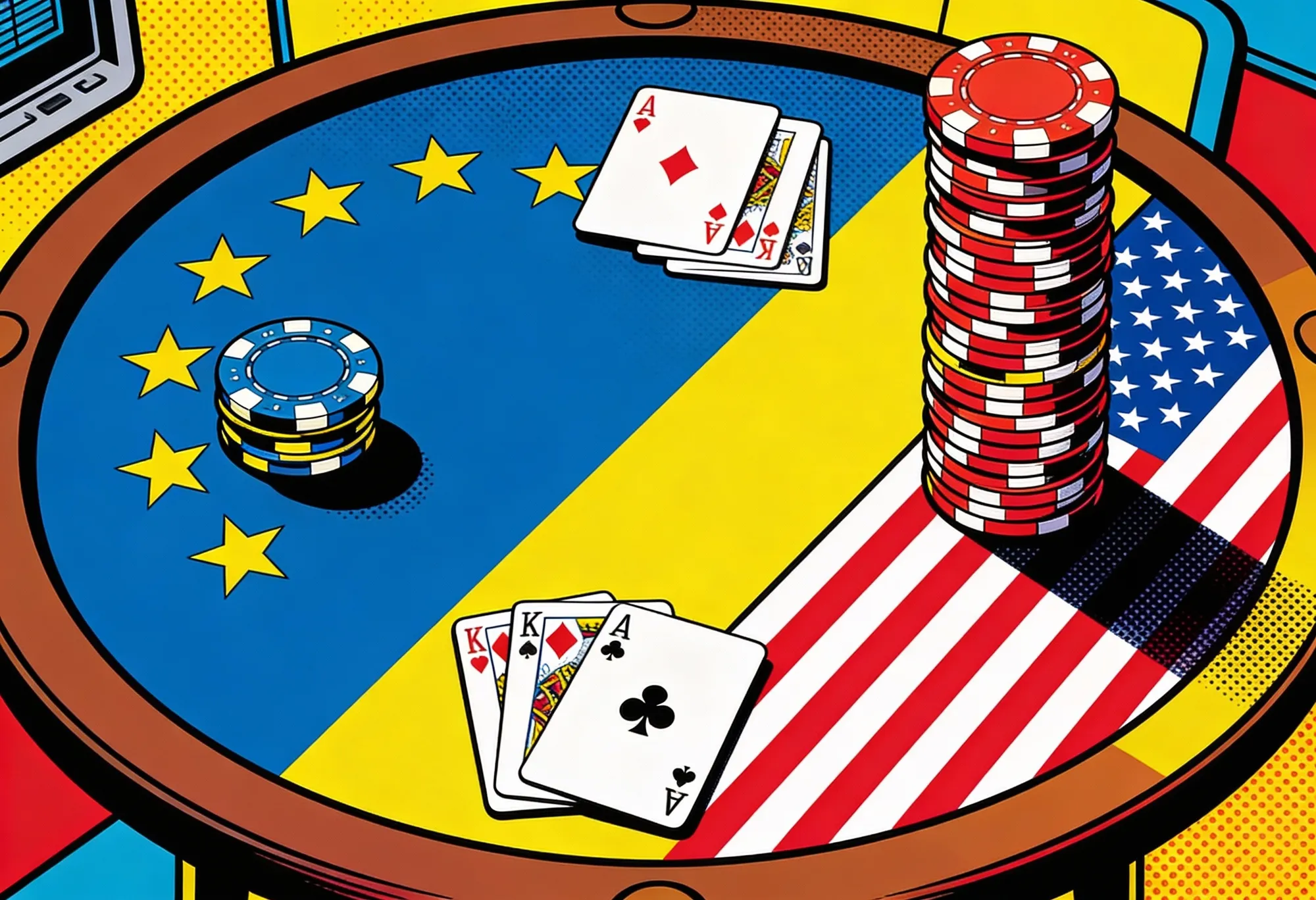
You want the number? Fifty-eight billion. That's what European startups pulled in last year. Sounds like a lot. Then you look across the Atlantic. North American venture jumped 46 percent year over year, fueled by AI mega-rounds that made Europe's haul look quaint.
Nine percent growth in Europe. Call it a calculated bet at a table where America keeps raising. The patient has a pulse. Not much more. And the players across the felt? Getting restless.
But something did shift in how that capital got allocated. Artificial intelligence became Europe's top sector for startup investment, for the first time ever, pulling in seventeen and a half billion compared to just over ten billion the year before. Fintech, the continent's old flagship, dropped to fourth with $7.4 billion. The deck got reshuffled. Now the question is whether Europe can turn this AI enthusiasm into companies that actually matter globally, or whether it's just soaking up overflow from a wave that crested somewhere else.
The Breakdown
• European VC hit $58B in 2025, up 9% YoY. AI led all sectors for the first time with $17.5B invested.
• Deal counts fell for the fourth straight year. Fewer startups funded, larger rounds for those that are.
• UK share dropped to 29% as France and Germany closed the gap. Paris hosts Mistral, Munich hosts Helsing.
• Europe's AI funding equals 8% of global total. American startups raised nine times more in the same sector.
The numbers tell two stories
Crunchbase put the 2025 total at $58 billion. The fourth quarter ran hot. Sixteen point six billion deployed, 27 percent above the same stretch a year earlier. Late-stage rounds did most of the lifting. Nine point two billion across 87 deals in Q4. Two-year high.
PitchBook came at it differently, pegging total European VC around €66 billion, call it $78 billion, for a 6.5 percent bump. The gap between datasets matters less than what both show: money flowing again, deal count still falling. Four years running now. Fewer rounds, bigger checks.
What does that actually mean? Fewer companies getting funded. The ones that do are raising fatter rounds. Bar's higher.
Venture growth rounds grabbed roughly two-thirds of all deal value last year. Hasn't been that concentrated since 2017. Early-stage money in Q4 actually shrank. Down 4 percent from a year earlier. Landed at $5.3 billion across about 250 rounds. Seed held flat, two billion spread over 750-plus deals. So the broad base of European entrepreneurship keeps churning at roughly the same clip, but the escalator to scale-up status? Steeper now.
AI's takeover happened fast
Three years ago, fintech owned European venture conversations. London's neobanks. Berlin's payment processors. Stockholm's buy-now-pay-later darlings. Hard to believe now.
European AI funding? Almost doubled from 2024 to 2025. The sector now claims somewhere between 31 and 39 percent of all European VC raised, depending on how you slice it, whether you count companies using AI as plumbing or building AI as product. Doesn't matter. The shift is obvious.
Walk into Mistral's offices in the 2nd arrondissement and you'll meet engineers who said no to Google. Said no to OpenAI. The Paris frontier lab raised close to two billion in a round ASML led. That deal alone would've ranked among Europe's largest startup rounds in any sector, any prior year. Arthur Mensch, the CEO, carries himself like someone who knows he's holding strong cards.
Join 10,000+ AI professionals
Strategic AI news from San Francisco. No hype, no "AI will change everything" throat clearing. Just what moved, who won, and why it matters. Daily at 6am PST.
No spam. Unsubscribe anytime.
Helsing in Munich, defense AI, pulled in €600 million. Isomorphic Labs in London, the DeepMind spinout chasing AI drug discovery, raised €523 million. Black Forest Labs out of Freiburg, the team behind Flux image generation, joined the list of European AI shops commanding real money.
Healthcare and biotech took second at $13.4 billion. Hardware came third, $10.8 billion, a bucket that includes data centers, wearables, defense tech, quantum, aerospace, robotics, energy. Europe seems to be betting on atoms as much as bits.
Geography reshuffles
Britain still leads. Grip's looser though. UK startups raised about $17 billion, 29 percent of the European total. Down from a third the year before. You feel it in Shoreditch pitch meetings. Founders fielding questions about why they're not incorporated in Paris. Or Amsterdam.
France and Germany are catching up. French startups took in $8.5 billion. German companies, $8.4 billion. Each now represents about 15 percent of continental funding. Gap between second and third? Basically gone.
The smaller markets surprised. Switzerland pulled $3.6 billion. Netherlands, $3.4 billion. Spain, $2.9 billion. Finland, $2.2 billion. Every one of them raised more than they did in 2024. The UK was the exception.
Something worth noting there. Britain's startup infrastructure got built earlier, more aggressively, than its continental peers. London's financial plumbing, its regulatory flexibility, powered that. Now the edge looks like it's eroding. Mistral is in Paris. Helsing is in Munich. Talent and capital spreading out. UK investors see it.
Brexit keeps complicating things. Hiring, fundraising, all of it messier for London-based startups now. Bank of England rate decisions hit tech valuations differently than ECB policy does. And the UK's AI safety approach diverged from the EU AI Act, creating headaches for companies trying to serve both markets. London's venture class looks cornered these days, defending a position that used to hold itself.
The American comparison stings
Can't analyze European venture without facing the gap head-on. If you're a European founder watching this play out, it hurts.
North American VC surged 46 percent year over year in 2025, driven by AI rounds that dwarf anything Europe managed. About half of all global venture funding last year went to AI-related companies. The global total came to $211 billion. That's an 85 percent jump from 2024. American companies took $159 billion of it. Almost four-fifths of global AI investment, in other words.
Europe's $17.5 billion in AI funding works out to about 8 percent of the global pot. Same population as the US, roughly. GDP in the same neighborhood. Yet American AI startups raised nine times more.
Some of that comes down to structural stuff. The hyperscalers running compute for AI training and inference are American. The people who built foundational models clustered in the Bay Area, increasingly in New York. American pensions, endowments, sovereign wealth allocations to venture dwarf what European institutions commit.
But part of the gap is choices. European regulation tends to restrict before it enables. GDPR reshaped data practices globally. It also hit small companies with compliance costs they struggled to absorb. The EU AI Act might land the same way. Brussels worries more about what AI could break than what it could build.
Daily at 6am PST
Don't miss tomorrow's analysis
The AI trends shaping venture, policy, and product. No breathless headlines. Just who moved, what broke, and why it matters.
Free. No spam. Unsubscribe anytime.
What comes next
Here's where you pick a side.
Optimists point to the IPO pipeline. A few European AI companies are approaching the scale where going public makes sense. Mistral, if it keeps this trajectory, could test the markets within two years. Exits like that would return capital to LPs and restart a cycle that's been mostly frozen since 2021-2022.
Defense tech is picking up, especially in Central and Eastern Europe. Several CEE-focused defense funds launched last year. Helsing proved European defense AI can raise at scale. With a land war grinding on at Europe's eastern edge, the sector looks more attractive to European investors than it would've five years back.
New funds keep popping up. United Founders raised €80 million for quantum, cybersecurity, MedTech, AI. 6 Degrees Capital closed €154 million targeting early-stage enterprise software and fintech across the continent. The institutional scaffolding for European venture keeps building out even when exits disappoint.
Pessimists look at four straight years of shrinking deal counts and see something broken, not bent. They watch the best European AI engineers take offers from American companies. Or move to San Francisco and start their own shops there. The compute gap between American hyperscalers and European alternatives keeps widening.
I lean pessimist. The bull case needs too many things to break right, in sequence: IPOs that actually happen, geopolitics that keep favoring defense, deep tech bets that won't pay off for years. The bear case just needs current trends to continue. Usually the safer read.
The deep tech gambit
One thread ties these pieces together. European money seems to be chasing deep tech, the kind of companies that need genuine scientific breakthroughs, not just business model cleverness. That's where the continent thinks it can compete.
Lab spinouts from European universities hit their stride last year. Around 80 deep tech startups, the kind that spun out of university labs, hit billion-dollar valuations last year. Others crossed $100 million in annual revenue. Research institutions and commercial capital are getting more tangled up with each other.
Makes strategic sense. Europe has first-rate research universities. It has less of the startup infrastructure that helps consumer apps scale fast. If you're going up against American competitors, don't pick the fight where network effects and capital intensity decide the winner. Pick the one where scientific talent and patient money matter more.
Quantum. Fusion. Advanced materials. Novel therapeutics. These take years to reach commercial viability. They also resist the flip-it-quick mentality that runs through American venture. A European fund willing to wait eight years for an energy breakthrough faces different competition than one chasing social apps.
Does the gambit pay off? Depends on execution. Depends on whether European capital markets can handle timelines that stretch past most fund cycles. The money showed up in 2025. The real test comes when those companies need their next rounds, and the ones after that, under market conditions no one can forecast.
Fifty-eight billion bought Europe a seat at the table. The continent is playing tight, betting selective, hoping the cards turn. But the stack across the felt keeps growing. And the blinds keep going up.
Frequently Asked Questions
Q: How much did European startups raise in 2025?
A: European venture capital totaled $58 billion according to Crunchbase, or approximately €66 billion ($78 billion) per PitchBook's methodology. The discrepancy reflects different counting approaches, but both show roughly 6-9% growth year over year.
Q: Which sector led European venture investment in 2025?
A: Artificial intelligence led for the first time, pulling in $17.5 billion compared to $10 billion in 2024. Healthcare/biotech came second at $13.4 billion, hardware third at $10.8 billion, and fintech dropped to fourth with $7.4 billion.
Q: Which European countries attracted the most venture funding?
A: The UK led with $17 billion (29% of total), down from a third in 2024. France raised $8.5 billion, Germany $8.4 billion. Switzerland, Netherlands, Spain, and Finland all grew their VC totals compared to the prior year.
Q: What were the largest European AI funding rounds in 2025?
A: Mistral AI raised close to $2 billion led by ASML. Helsing (defense AI, Munich) raised €600 million. Isomorphic Labs (drug discovery, London) raised €523 million. Black Forest Labs (image generation, Freiburg) also raised substantial capital.
Q: How does European AI funding compare to the US?
A: Europe's $17.5 billion in AI funding represents about 8% of global AI venture investment. American companies captured $159 billion, or 79% of the $211 billion global total. US AI startups raised roughly nine times more than their European counterparts.