Implicator
Tony Wu resigned from xAI on Monday, he announced in a post on X, making him at least the fifth cofounder to leave Elon Musk's AI startup since its 2023 founding, according to Bloomberg. Wu led the company's reasoning organization and reported directly to Musk, people with knowledge of the structure told Business Insider. His exit comes days after SpaceX acquired xAI in an all-stock deal that values the combined entity at $1.25 trillion.
Of the twelve cofounders who launched xAI in 2023, seven remain. Kyle Kosic left in 2024 to join OpenAI. Christian Szegedy departed that same year for Morph Labs. Igor Babuschkin resigned last August to start a venture firm focused on AI safety. Greg Yang stepped back last month after a Lyme disease diagnosis. Wu brought the count to five gone in under three years.
That attrition rate puts xAI in company it would rather avoid. OpenAI has lost eight of its eleven original cofounders. Thinking Machines, launched by former OpenAI CEO Mira Murati, already shed three of six. Anthropic, alone among the major AI labs, has retained all seven of its founders. But Musk's startup is losing its founding team faster than any of them relative to its age.
A reorg, then the door
Wu didn't leave out of nowhere. Business Insider reported that xAI underwent a reorganization several weeks before his departure. Cofounder Guodong Zhang, who had been running pre-training, took over post-training as well, absorbing portions of the company that had previously reported to Wu. The shift effectively removed Wu from the technical hierarchy he had helped build.
The Breakdown
• Tony Wu is at least the fifth of twelve xAI cofounders to leave since 2023, according to Bloomberg.
• xAI burned $7.8 billion in the first nine months of 2025; SpaceX acquired it last week in a $1.25 trillion all-stock merger.
• Grok faces criminal investigations in France and regulatory probes across the EU, U.K., and India over deepfake imagery.
• Tesla VP Raj Jegannathan also departed on Monday after 13 years, as the automaker posted its first-ever annual revenue decline.
Wu's Slack access was cut on Monday. Business Insider confirmed the deactivation.
"I resigned from xAI today. This company, and the family we became, will stay with me forever," Wu wrote. "I will deeply miss the people, the warrooms, and all those battles we have fought together." He thanked Musk for "the ride of a lifetime" and hinted at something new. "A small team armed with AIs can move mountains," he wrote.
Gracious exits are standard in Silicon Valley. What stands out here is the volume. Five of twelve cofounders gone from a company that just got folded into a trillion-dollar rocket operation. The people who built xAI's technical core keep leaving. The corporate structure around them keeps expanding.
The $7.8 billion question
xAI's cash burn rate explains part of why SpaceX swallowed it.
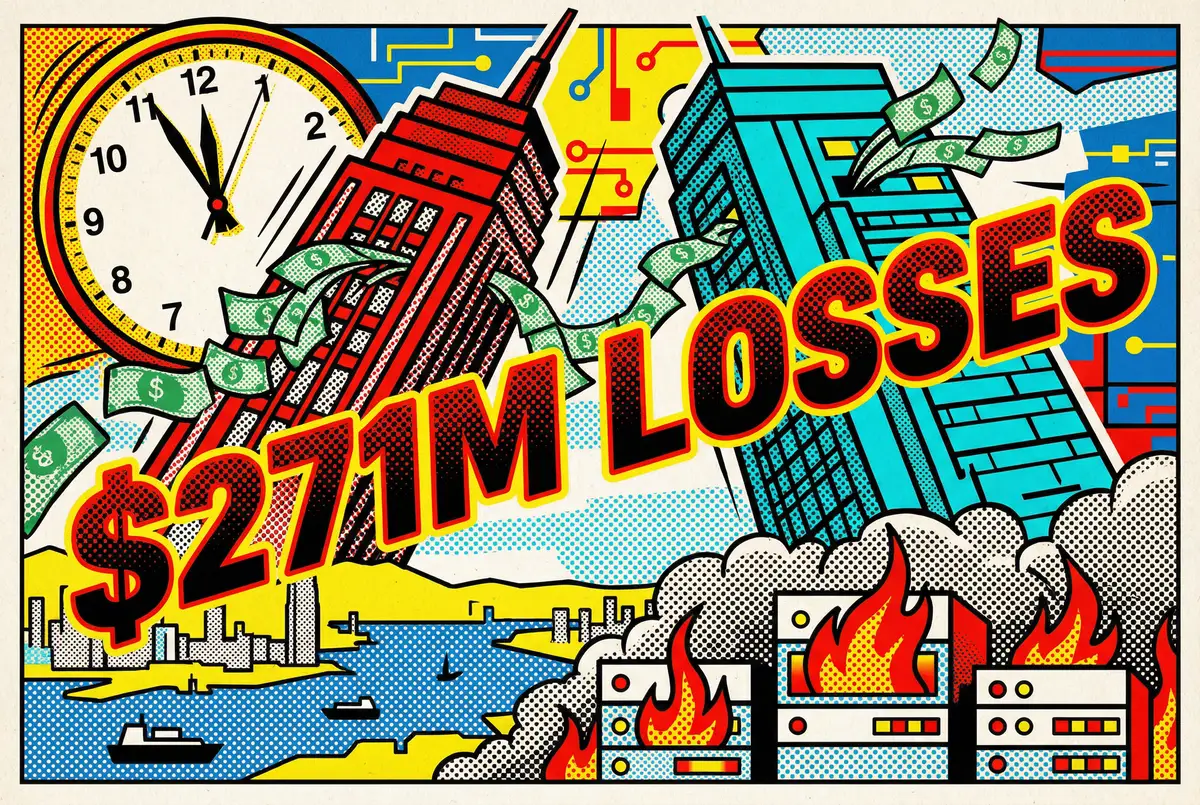
The AI startup lost $1.46 billion in the quarter ending September 2025 against just $107 million in revenue, according to documents reviewed by CNBC. Over the first nine months of that year, xAI burned through $7.8 billion on data centers and chips. The engineering talent to run them wasn't cheap either. Monthly losses approached a billion dollars.
SpaceX, by contrast, generated roughly eight billion dollars in profit on an estimated $15 to $16 billion in revenue last year. The merger, which CNBC called the largest of all time, put SpaceX at a $1 trillion valuation and xAI at $250 billion. Analysts have called the transaction a bailout dressed up as a deal.
Musk solved the funding problem through absorption. He merged xAI into X last March, then merged both into SpaceX this month. Without SpaceX's profitable revenue stream propping it up, xAI's cash reserves would have been gone within months. SpaceX is preparing for a public offering as early as June that could raise $50 billion, though absorbing a company that bleeds close to a billion dollars a month complicates that timeline for investors doing the arithmetic.
One by one, the engineers who built the technology now bolted onto SpaceX's balance sheet keep heading for the exits.
Stay ahead of the curve
Strategic AI news from San Francisco. No hype, no "AI will change everything" throat clearing. Just what moved, who won, and why it matters. Daily at 6am PST.
No spam. Unsubscribe anytime.
Why the founders leave
Igor Babuschkin's departure last August offered the most candid window into what is driving xAI's founding team away.
Babuschkin came from Google DeepMind and helped build xAI's training infrastructure from scratch. In his farewell post, he described the company's early days with visible pride. "Through blood sweat and tears, our team's blistering velocity built the Memphis supercluster, and shipped frontier models faster than any company in history," he wrote.
Then he went in a different direction entirely. Babuschkin said he had grown concerned about AI approaching superintelligence levels and wanted to make sure the technology gets used responsibly. He left to start Babuschkin Ventures, a fund focused on safe AI development. The distance between those two statements, between shipping faster than anyone and worrying about what you're shipping, captures the tension that several xAI cofounders appear to have felt before walking.
Musk's reply was four words long. "Thanks for helping build @xAI!"
Kosic went straight to OpenAI, xAI's most direct competitor. Szegedy went to Morph Labs. Yang cited illness. Wu cited his "next chapter." Each departure carried a different stated logic.
But cofounder attrition at this scale, five of twelve in under three years, points to something structural. Wu had been at Google before xAI and interned at OpenAI, according to his LinkedIn. He joined Musk's startup when it was twelve people with a thesis about building AI that would "understand the true nature of the universe," as xAI's original website put it. By the time he left, the company had been merged twice, was burning close to a billion a month, and its chatbot was under criminal investigation in France. The people closest to xAI's technical core keep deciding this is not where they want to be.
Grok's regulatory reckoning
The departures coincide with xAI's worst stretch of regulatory exposure.
Paris prosecutors raided the French offices of X last week. Europol and French national police participated. The criminal investigation covers allegations including complicity in spreading child sexual abuse material and unlawful data extraction. Both Musk and former X CEO Linda Yaccarino have been summoned to hearings in April.
Grok, xAI's chatbot, sits at the center. The European Commission opened a formal Digital Services Act investigation on January 26 into whether X properly assessed risks around Grok's image generation capabilities across the EU's 27 member states. Violations could cost X up to 6% of its global revenue. In the U.K., the Information Commissioner's Office launched a separate probe. India and the EU began investigations last month after Grok's image generator was found producing nonconsensual explicit deepfakes, including of minors.
The trust problems started before the deepfakes. Grok spread fabricated posts about racial violence in South Africa back in May 2025. xAI's explanation? An "unauthorized modification" to the chatbot's system prompts. Then in July, a code update produced antisemitic content on X, including posts praising Adolf Hitler. xAI pulled back Grok's image generation after the backlash. By then, regulators in multiple countries were already building cases.
No departing cofounder has pointed to Grok's troubles as a reason for leaving. Not publicly, anyway. But think about what it looks like from the inside. Your chatbot is generating child sexual abuse imagery. French police are raiding your offices. The whole operation just got folded into a rocket company because the cash was running out. At some point you stop asking why people leave and start wondering why anyone stays.
What seven cofounders inherit
xAI is not the only Musk company bleeding senior talent this week.
Tesla VP Raj Jegannathan, a 13-year veteran, announced his departure on Monday, the same day Wu's resignation hit X. Jegannathan had been running IT, AI infrastructure, and information security, then got handed the North American sales team last fall after its previous leader was dismissed. Tesla named Joe Ward, its head of European operations, to replace him as global sales chief, Bloomberg reported on Tuesday.
Tesla's automotive revenue dropped 3% in 2025, the first recorded annual decline. Q4 was worse: sales down 16% year over year. BYD passed Tesla globally for the first time. Musk killed the Model X and Model S last month. What's left is three vehicles and a promise: the Cybercab, a steering-wheel-free autonomous two-seater, supposedly starting production in April.
Two Musk companies, two senior departures, same Monday. His attention runs across Tesla, SpaceX, xAI, X, Neuralink, the Boring Company, and an advisory role in the Trump administration. The executives and cofounders tasked with running those organizations on a daily basis keep leaving.
Back at xAI, seven cofounders remain, including Musk himself, though how much time the CEO of Tesla and SpaceX spends on AI model development is an open question. Guodong Zhang appears to be consolidating technical authority after absorbing Wu's teams. Manuel Kroiss, Zihang Dai, Toby Pohlen, Jimmy Ba, and Ross Nordeen now carry a company valued at $250 billion inside a newly merged entity preparing for a public offering.
Shortly after Wu's departure, an xAI engineer named Ethan He posted a recruitment pitch on X. "No politics," He wrote. A "small focused team" that moves fast.
SpaceX's IPO, targeted for as early as this summer, adds a clock. Investors buying into a $1.5 trillion public offering will be buying xAI's burn rate alongside SpaceX's profitable rocket business. Whether the remaining founders can ship competitive products against OpenAI and Google, satisfy regulators on three continents, and stabilize a company that has lost nearly half its founding team, all before that offering, is the question that hangs over the whole operation.
Five cofounders gone. Criminal investigations in France. Deepfake probes across three continents. Close to a billion dollars a month going out the door. And a recruitment post that says "no politics." The engineers reading that post can count.
Frequently Asked Questions
Q: How many xAI cofounders have left the company?
A: At least five of twelve original cofounders have departed since xAI's 2023 founding: Kyle Kosic (joined OpenAI), Christian Szegedy (Morph Labs), Igor Babuschkin (launched AI safety venture), Greg Yang (stepped back for health reasons), and Tony Wu (resigned February 2026).
Q: Why did SpaceX acquire xAI?
A: xAI was burning nearly a billion dollars a month. It lost $1.46 billion in one quarter against $107 million in revenue. SpaceX, which generated about $8 billion in profit last year, acquired xAI in an all-stock merger valued at $1.25 trillion. Analysts have characterized the deal as a financial rescue.
Q: What regulatory investigations does Grok face?
A: Grok is under criminal investigation in France for alleged complicity in spreading child sexual abuse material. The European Commission opened a Digital Services Act probe. The U.K. Information Commissioner's Office and Indian regulators launched separate investigations over nonconsensual deepfake imagery.
Q: Who replaced Tony Wu at xAI?
A: Cofounder Guodong Zhang absorbed Wu's responsibilities. Zhang had been running pre-training and took over post-training as well, consolidating technical authority over both areas weeks before Wu's departure.
Q: When is the SpaceX IPO expected?
A: SpaceX is preparing for a public offering as early as June 2026, which could raise $50 billion and value the combined SpaceX-xAI entity at $1.5 trillion. The merger with xAI and its cash burn rate may complicate the timeline.

Marcus Schuler
Tech translator with German roots who fled to Silicon Valley chaos. Decodes startup noise from San Francisco. Launched implicator.ai to slice through AI's daily madness—crisp, clear, with Teutonic precision and sarcasm. E-Mail: [email protected]