Tim Cook built Apple's leadership into a monument of stability. In 2025, that monument cracked. Meta poached AI and design chiefs with $25M packages. The chip architect may follow. What broke inside the world's most valuable company?
OpenRouter's 100 trillion token study was supposed to prove AI is transforming everything. The data shows something else: half of open-source usage is roleplay, enterprise adoption is thin, and one account caused a 20-point spike in the metrics.
The New York Times sued Perplexity for copyright infringement—months after signing an AI licensing deal with Amazon. Perplexity built revenue-sharing programs for publishers. The Times declined to join any of them. Now lawyers are involved.
Amazon just fired a massive salvo in the AI assistant wars. Alexa Plus launched Wednesday, marking the biggest overhaul of the voice assistant since its 2014 debut.
The upgraded assistant costs $19.99 monthly—but comes free with Prime membership. That's a shrewd move by Amazon, instantly giving it a massive potential user base without requiring additional subscription fees from its 200+ million Prime members.
Alexa Plus promises to transform how we interact with our smart homes. Gone are the stilted, command-based exchanges. The new system handles natural conversations, remembers context from earlier chats, and acts proactively on your behalf.
"Until this moment, we have been limited by technology," declared Panos Panay, Amazon's devices chief who previously led Microsoft's Surface team. The wait appears worth it. Alexa Plus can now book restaurant tables, purchase concert tickets, analyze documents, and even check your security cameras to confirm if someone walked the dog.
Credit: amazon.com
The system pulls its smarts from multiple AI models. Amazon's in-house Nova model powers some features, while others tap Anthropic's technology. The assistant chooses the optimal model for each task. This flexibility extends to third-party services, with launch partners including Uber, OpenTable, Sonos, Zoom, and Ticketmaster.
Content partnerships boost Alexa's knowledge base too. The Associated Press, Reuters, TIME, and Politico provide real-time information about news, sports, and financial markets.
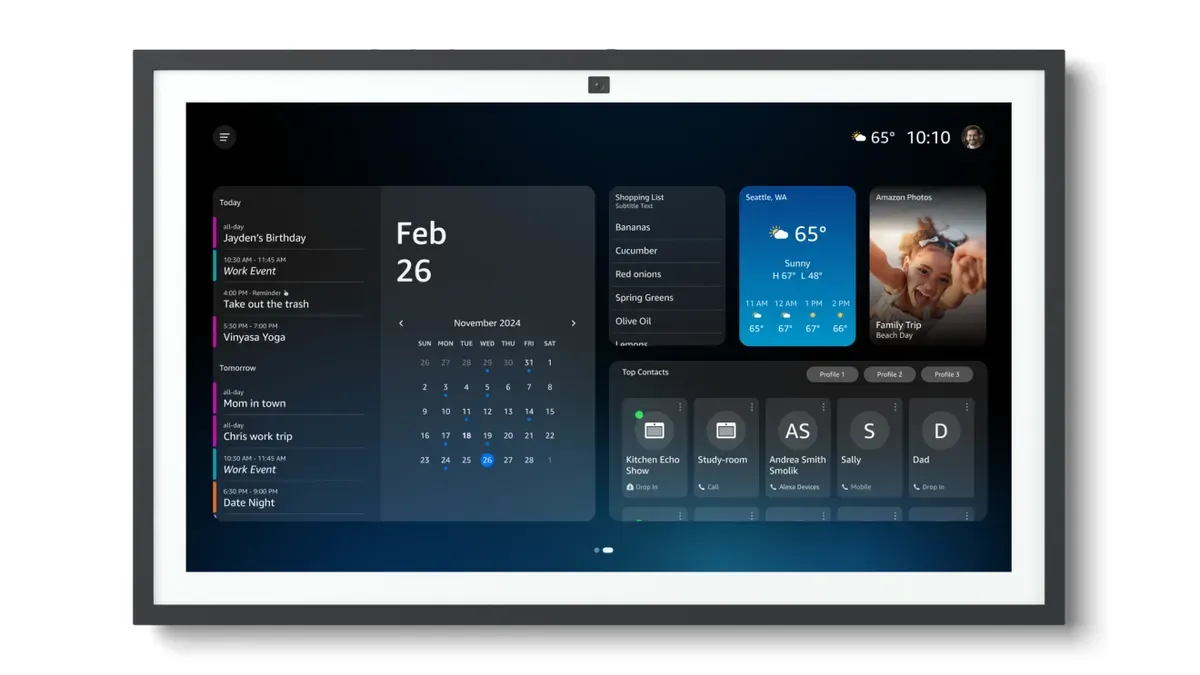
Alexa Plus works across Echo devices, with initial rollout focusing on Echo Show 8, 10, 15, and 21 models. The company also redesigned the visual interface for displays, adding customizable widgets and improved smart home controls.
The upgrade arrives at a critical moment. While Alexa dominated the smart speaker market for years, Google's Gemini, OpenAI's ChatGPT, and Apple's forthcoming Siri upgrade threaten Amazon's position. The company clearly hopes Alexa Plus recaptures its innovation edge.
The new Alexa Plus will start rolling out in the U.S. in the next few weeks, with access coming in waves over the coming months. Initially, it will be available for households with Echo Show 8, 10, 15, and 21 devices.
According to the announcement, "early access" will begin in March 2025, so the first wave of users should get access within the next few weeks.
Why this matters:
Amazon just transformed millions of existing smart speakers into AI powerhouses overnight, potentially leapfrogging competitors through sheer market presence.
The free inclusion with Prime membership creates an instant massive user base for Amazon's AI, generating valuable data while making advanced AI accessible to mainstream consumers.
By focusing on practical tasks rather than just answering questions, Amazon positions Alexa Plus as a genuine assistant rather than merely a chatbot with a voice.
Tech translator with German roots who fled to Silicon Valley chaos. Decodes startup noise from San Francisco. Launched implicator.ai to slice through AI's daily madness—crisp, clear, with Teutonic precision and sarcasm.
E-Mail: marcus@implicator.ai
Tim Cook built Apple's leadership into a monument of stability. In 2025, that monument cracked. Meta poached AI and design chiefs with $25M packages. The chip architect may follow. What broke inside the world's most valuable company?
The New York Times sued Perplexity for copyright infringement—months after signing an AI licensing deal with Amazon. Perplexity built revenue-sharing programs for publishers. The Times declined to join any of them. Now lawyers are involved.
Chinese hackers operated inside U.S. VMware servers for 17 months undetected. The malware repairs itself when deleted. It hides where most security teams don't look. CISA's December 4 advisory exposes an architectural blind spot in enterprise defense.
Werner Vogels ends his 14-year keynote streak by handing out printed newspapers and warning developers about "verification debt." His parting message: AI generates code faster than humans can understand it. The work is yours, not the tools.