Implicator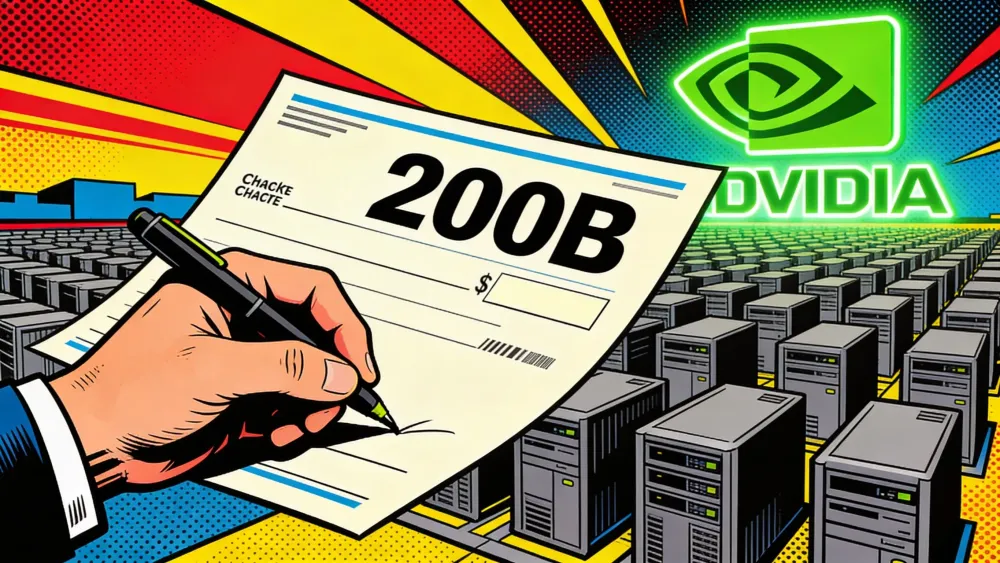
Andy Jassy spent nearly an hour on Amazon's earnings call earlier this month repeating a phrase nobody asked him to say. "This isn't some sort of quixotic top-line grab." He said it once. Then again. He cited demand signals. He invoked AWS's track record. He reminded analysts that 24% growth on a $142 billion run rate is different from a higher percentage on a smaller base.
The market heard all of it, then sold the stock down 10%.
Amazon will spend $200 billion in capital expenditures this year, more than any other company on the planet. Most of it goes to AWS. Most of that goes to AI infrastructure. Jassy framed the figure as confidence. Wall Street read it as desperation. Both readings are probably correct, because this is a company spending more money than any competitor while controlling less of the outcome than it has in years.
The raw numbers look fine if you squint. AWS revenue grew 24% in the fourth quarter to $35.6 billion, the fastest growth in 13 quarters. The order backlog hit $244 billion, up 40% year over year. Custom chips from Trainium and Graviton reached a combined $10 billion annual revenue run rate. Amazon disclosed that number for the first time. Real money.
But formidable numbers and a strong competitive position are different things. And the competitive picture is where Jassy's $200 billion starts looking less like a show of strength and more like the cost of not falling further behind.
The Argument
• Amazon's $200B capex plan is the largest in tech history, $50B above Wall Street expectations
• Azure added more incremental revenue than AWS in 2025, eroding Amazon's cloud lead
• Roughly 60% of hyperscaler AI capex flows to Nvidia, not to the companies writing the checks
• Internal morale is fraying: engineers prefer Anthropic's Claude over Amazon's own Nova model
The money buys concrete, not advantage
Amazon knows how to build things. Fulfillment centers, logistics networks, submarine internet cables, custom silicon. This institutional muscle is genuine. AWS added nearly four gigawatts of data center capacity in 2025 and plans to double that by 2027. The company runs more than 900 facilities worldwide.
Here's the problem. In classic cloud computing, infrastructure was the moat. You built the data centers, you controlled pricing, you owned the customer relationship. AWS rode that logic for 15 years.
AI flips the equation. The scarce resource isn't server racks. It's silicon, and Nvidia controls that market. It's frontier models, and OpenAI, Anthropic, and Google own those. It's developer loyalty, and Amazon is not winning there.
Consider where the $200 billion actually flows. Roughly 60% of hyperscaler AI capex ends up at Nvidia, according to industry estimates. Amazon is trying to claw back margin with Trainium, its AI training chip. But Nvidia's volume remains easily 10 times larger, and its annual performance cadence is widening the gap. As AWS CEO Matt Garman candidly admitted at Cisco's AI Summit, Nvidia commands 70-80% gross margins. "A big part of that margin goes to Jensen and the team."
Amazon writes the checks. Nvidia cashes them.
Jassy's barbell has a hollow middle
On the earnings call, Jassy offered what he clearly considered a strategic frame. AI demand, he said, looks like a "barbell." On one end, AI research labs spending "gobs and gobs of compute." On the other, enterprises using AI for customer service and automation. In the middle, the production workloads and AI-native businesses that "may end up being the largest and the most durable" part of the market.
Clever framing. Also a confession. The ends of the barbell are where the money sits today, and Amazon is losing at both.
The AI lab end first. Microsoft locked in OpenAI with a $250 billion cloud contract. Oracle signed $300 billion worth of deals with the same company. Amazon's arrangement with OpenAI, inked only after Microsoft allowed a corporate restructure? Thirty-eight billion. Amazon invested $8 billion in Anthropic, but Google backed the startup first. If you're keeping score, the AI lab end of the barbell has already been leased to other landlords.
On the enterprise end, the number that should worry Seattle most has nothing to do with AI labs. In calendar year 2025, Microsoft Azure added approximately $23.9 billion in incremental revenue. AWS added about $21.3 billion. Azure is now growing faster in absolute dollars than the company that invented cloud computing. Jassy told investors AWS generated more incremental revenue than competitors. That claim, as analyst Dave Vellante documented, does not hold up against Azure.
So Jassy bets on the middle. His own word for it was "may." It "may" become the largest segment. When you're spending $200 billion, "may" is doing too much work.
Day two smells different from the inside
Jeff Bezos coined the phrase "day two" in 2018. It describes a company in stasis, followed by irrelevance, followed by what Bezos called "excruciating, painful decline." Several current AWS employees told the Financial Times they fear the company is sliding toward it.
The internal signals are hard to wave away. A nervous Amazon consolidated its chip, model, and advanced research teams under a single leadership structure in December, a defensive reorganization that happens when separate units aren't delivering. The company cut roughly 30,000 of 350,000 corporate roles.
And then there's Nova, Amazon's homegrown AI model. Executives market it as a low-cost alternative to frontier models. Benchmarks show it underperforms the best from OpenAI, Google, Meta, and Anthropic. Internally, some employees call it "Amazon Basics," the label the company slaps on generic household products. Asked about Nova, one AWS engineer shrugged it off to the FT. He didn't even know Amazon had built one.
Management wants 80% of developers coding with AI at least once a week. Most of the engineers who bothered chose Anthropic's Claude, not their employer's product. Amazon spent $8 billion investing in Anthropic. Its own staff are the proof that investment was necessary.
This is the gap $200 billion cannot close. You can pour concrete and rack servers in 18 months. You cannot build a competitive model strategy, developer trust, or an engineering culture that believes in its own tools on any timeline that satisfies investors. AWS still generates more than 60% of Amazon's operating profit. But the engine that funds everything else is running on institutional anxiety, not confidence.
Stay ahead of the curve
Strategic AI news from San Francisco. No hype, no "AI will change everything" throat clearing. Just what moved, who won, and why it matters. Daily at 6am PST.
No spam. Unsubscribe anytime.
The cash flows everywhere except to shareholders
Follow the cash. Nvidia captures the largest share of every AI capex dollar. Anthropic gets a deeper partnership and a customer base whose own engineers validate its products over Amazon's. Enterprise buyers gain pricing power as three hyperscalers bid aggressively for their AI workloads. Even OpenAI benefits, having extracted a cloud deal from Amazon to supplement its existing Microsoft and Oracle arrangements.
Shareholders face a grimmer picture. Morgan Stanley projects Amazon could hit negative free cash flow of $17 billion in 2026. Bank of America sees it worse, projecting a $28 billion deficit. Amazon pulled in $139.5 billion in operating cash flow last year, a record. Yet free cash flow cratered from $38.2 billion to just $11.2 billion because the infrastructure binge ate the rest. In an SEC filing last Friday, the kind that lands after markets close and before a long weekend, Amazon told investors it may need to raise equity and debt. A company that famously funded growth from operating cash is now signaling it might have to borrow.
Not because the business is broken. Because the spending is outrunning even Amazon's cash machine.
Two years to prove the barbell isn't hollow
Jassy will get his answer within two years. If enterprise production AI workloads flow to AWS at scale, if the middle of the barbell fills out, then the capex binge mirrors the same bet that built AWS in 2006. The long game would have worked again.
But if Azure keeps adding more revenue, if Nvidia keeps widening the silicon gap, if Trainium stays a supply-constrained niche rather than a Graviton-scale platform, Amazon will have spent $200 billion building the most expensive infrastructure layer for someone else's AI revolution. The world's best-equipped data centers, waiting for workloads that migrated somewhere else.
On the earnings call, Jassy asked investors to remember how AWS started. Patiently, expensively, against skepticism. Fair enough. But the original AWS was built into open space, with no competitor spending comparable money at comparable scale. This time, Amazon is building into a three-way fight where the other two have stronger AI stories and the biggest AI labs have started building their own infrastructure entirely.
Amazon's stock fell for eight consecutive sessions after earnings. The market has rendered its early verdict. Whether Jassy can reverse it depends on something $200 billion alone cannot purchase. A reason for the next generation of AI developers to pick Amazon's stack over everyone else's.
Frequently Asked Questions
Q: Why did Amazon's stock drop after announcing $200 billion in capex?
The $200 billion figure landed more than $50 billion above analyst expectations. Combined with a profit forecast that missed estimates, investors worried the spending would compress margins and push free cash flow negative. Morgan Stanley projects a $17 billion FCF deficit in 2026.
Q: What is Amazon's Trainium chip and how does it compare to Nvidia?
Trainium is Amazon's custom AI training chip, designed to reduce AWS dependence on Nvidia GPUs. Combined with Graviton, it hit a $10 billion annual revenue run rate. But Nvidia's volume remains roughly 10 times larger, and its annual performance improvements are widening the gap rather than narrowing it.
Q: What does Jassy mean by the AI demand 'barbell'?
Jassy describes AI demand as concentrated at two ends: large AI labs spending heavily on compute, and enterprises using AI for routine tasks. He argues the middle, production workloads and AI-native businesses, will become the largest segment. Critics note that middle market barely exists yet.
Q: How does AWS compare to Microsoft Azure in 2025?
AWS remains the largest cloud provider at a $142 billion run rate with 24% growth. However, Azure added approximately $23.9 billion in incremental revenue in calendar year 2025 versus AWS's $21.3 billion, meaning Azure is now gaining faster in absolute dollars.
Q: What is Amazon's Nova AI model and why is it controversial internally?
Nova is Amazon's homegrown AI model, marketed as a low-cost alternative to frontier models. It underperforms offerings from OpenAI, Google, and Anthropic on independent benchmarks. Some employees call it 'Amazon Basics,' and several AWS engineers told the Financial Times they prefer using Anthropic's Claude for coding.
Related Stories


Harkaram Grewal
Maps the India–Germany–U.S. AI triangle from New Delhi. Background in cross-market operations and business development. Writes about supply chains, enterprise adoption, and talent—the unsexy forces that actually move global AI.