 IMPLICATOR
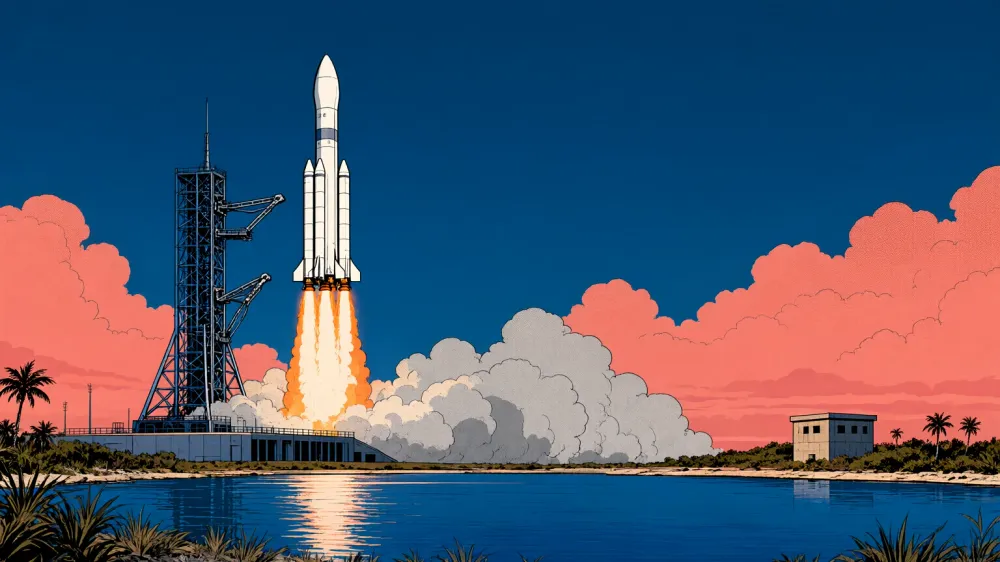
A United Launch Alliance Vulcan rocket failed on Sunday shortly after liftoff from Florida, destroying its payload of 40 satellites for Amazon's Leo internet network. It was the first mission failure in the 20-year history of ULA, the joint venture of Boeing and Lockheed Martin. The flight was the first of 38 Vulcan launches booked by Amazon, and Vulcan is on contract to launch roughly half of the US military's national security space missions in the next few years.
What Changed
- A ULA Vulcan rocket failed on Sunday shortly after liftoff from Florida, destroying 40 satellites for Amazon's Leo network.
- It was the first mission failure in ULA's 20-year history, and the cause was not immediately clear.
- Amazon has 37 more Vulcan launches reserved with ULA, each slated to deliver 40 or more Leo satellites.
- The Pentagon had not yet approved Vulcan to resume national security flights, pending its performance on the Amazon mission.
AI-generated summary, reviewed by an editor. More on our AI guidelines.
What went wrong
The rocket lifted off from Cape Canaveral Space Force Station at 12:40 p.m. ET, after two days of delays. It was Vulcan's fifth flight since its 2024 debut and its first in nine months.
ULA said in a statement that the vehicle "suffered an anomaly 10 minutes into the flight and failed to deliver the Amazon mission to orbit." The company said it did not immediately have "any specific data to understand what occurred."
Accounts of where the trouble began differ. Multiple sources told Ars Technica the anomaly occurred in the booster stage of the rocket, not the Centaur V upper stage or the solid rocket boosters. Spaceflight Now reported that the anomaly came during the Centaur's burn.
The booster's main engines were supposed to shut down just shy of the flight's five-minute mark. They continued firing for at least 30 additional seconds.
Blue Origin, Jeff Bezos' space company, supplies the BE-4 and is working closely with ULA to determine the cause. It remains unclear whether the engine was responsible. Vulcan and Blue Origin's New Glenn share the same BE-4 main engine. A New Glenn rocket exploded during a ground test in Florida in May, and investigators traced the explosion to a faulty valve on one of its BE-4 engines. ULA CEO Mark Peller said before the flight that Vulcan's BE-4 engines had been retrofitted to fix the oxygen valve problem behind that explosion.
Amazon's arithmetic
Since 2025, 398 Leo satellites have been deployed across 14 launches, about 12% of the 3,236 satellites Amazon needs for global service coverage. SpaceX's Starlink has more than 11,000 satellites and millions of customers worldwide.
"For Amazon, the loss of 40 satellites is less of a concern than the delay this will cause in future ULA launches of their satellites," said Todd Harrison, a senior fellow at the American Enterprise Institute.
Amazon has 37 more Vulcan launches reserved with ULA, each slated to deliver 40 or more Leo satellites to orbit. Melissa Wuerl, Amazon Leo's director of launch systems, called it the program's "primary workhorse over the next several years" in a preview of the mission.
Amazon recently announced it had manufactured its 1,000th satellite, meaning more than half of its network nodes are sitting in storage. The company has hoped to start initial internet service this year.
Know someone who'd find this useful? ✉️ Email it to a friend in one click, or they can subscribe free here.
"There is risk with any launch, and that's especially true for inaugural missions like LV-01," Amazon said.
The Pentagon's queue
The Pentagon had not yet approved Vulcan to resume flying national security payloads, pending its performance with the Amazon mission. The Space Force paused Vulcan national security launches after February. Vulcan's earlier delays forced Space Force officials to move six national security launches from ULA to SpaceX.
"This is a huge setback for ULA," Harrison said. "The launch market is already tight with demand starting to exceed supply, and this mishap only makes that worse."
The failure is expected to lead to a lengthy technical investigation that would keep the rocket off the market for months. SpaceX is no longer accepting bookings for the Falcon 9. New Glenn has been grounded since May.
Amazon has 10 more missions booked on SpaceX's Falcon 9. Its next scheduled Leo launch is an Ariane 6 mission carrying 36 satellites, targeted for Nov. 23 at the earliest.
Frequently Asked Questions
What happened to the Vulcan rocket?
ULA said the vehicle suffered an anomaly 10 minutes into the flight and failed to deliver the Amazon mission to orbit. The 40 Amazon Leo satellites on board were destroyed. It was the first mission failure in ULA's 20-year history.
What caused the failure?
ULA said it did not immediately have specific data on what occurred. Multiple sources told Ars Technica the anomaly occurred in the booster stage, while Spaceflight Now reported it came during the Centaur's burn. It remains unclear whether the BE-4 engine was responsible.
How many Leo satellites does Amazon have in orbit?
Since 2025, 398 Leo satellites have been deployed across 14 launches, about 12% of the 3,236 satellites Amazon needs for global service coverage. SpaceX's Starlink has more than 11,000 satellites.
Why does the delay matter more than the lost satellites?
Todd Harrison of the American Enterprise Institute said the loss of 40 satellites is less of a concern for Amazon than the delay to future ULA launches. Amazon has 37 more Vulcan launches reserved, and the investigation is expected to keep the rocket off the market for months.
What does the failure mean for the Pentagon?
The Pentagon had not yet approved Vulcan to resume flying national security payloads, pending its performance with the Amazon mission. Vulcan's earlier delays already forced Space Force officials to move six national security launches from ULA to SpaceX.
AI-generated summary, reviewed by an editor. More on our AI guidelines.



Marcus Schuler
Editor-in-Chief and founder of Implicator.ai. Former ARD correspondent and senior broadcast journalist with 10+ years covering tech. Writes daily briefings on policy and market developments. Based in San Francisco. E-mail: editor@implicator.ai