IMPLICATOR
Andrew Tulloch is leaving Meta after waiting for the company to launch Muse, its new personal AI agent, according to a person briefed on the matter. His departure comes roughly eleven months after he joined last October. His exit adds to a series of departures from Meta Superintelligence Labs.
What Changed
- Andrew Tulloch is leaving Meta roughly eleven months after joining in October 2025, having held his departure until the company shipped Muse, according to a person briefed on the matter.
- Zuckerberg pursued him in August 2025 with an offer reported at as much as $1.5 billion over at least six years, a figure Meta spokesman Andy Stone called "inaccurate and ridiculous." Tulloch rejected it, then joined two months later on a package reported to be smaller.
- He worked in TBD Lab, the frontier-research group inside Meta Superintelligence Labs run by Alexandr Wang. The wider division has lost researchers repeatedly since it was formed in 2025.
- Tulloch could not be reached, Meta has not commented, and neither his reason for leaving nor his destination is known.
AI-generated summary, reviewed by an editor. More on our AI guidelines.
The recruitment and reversal
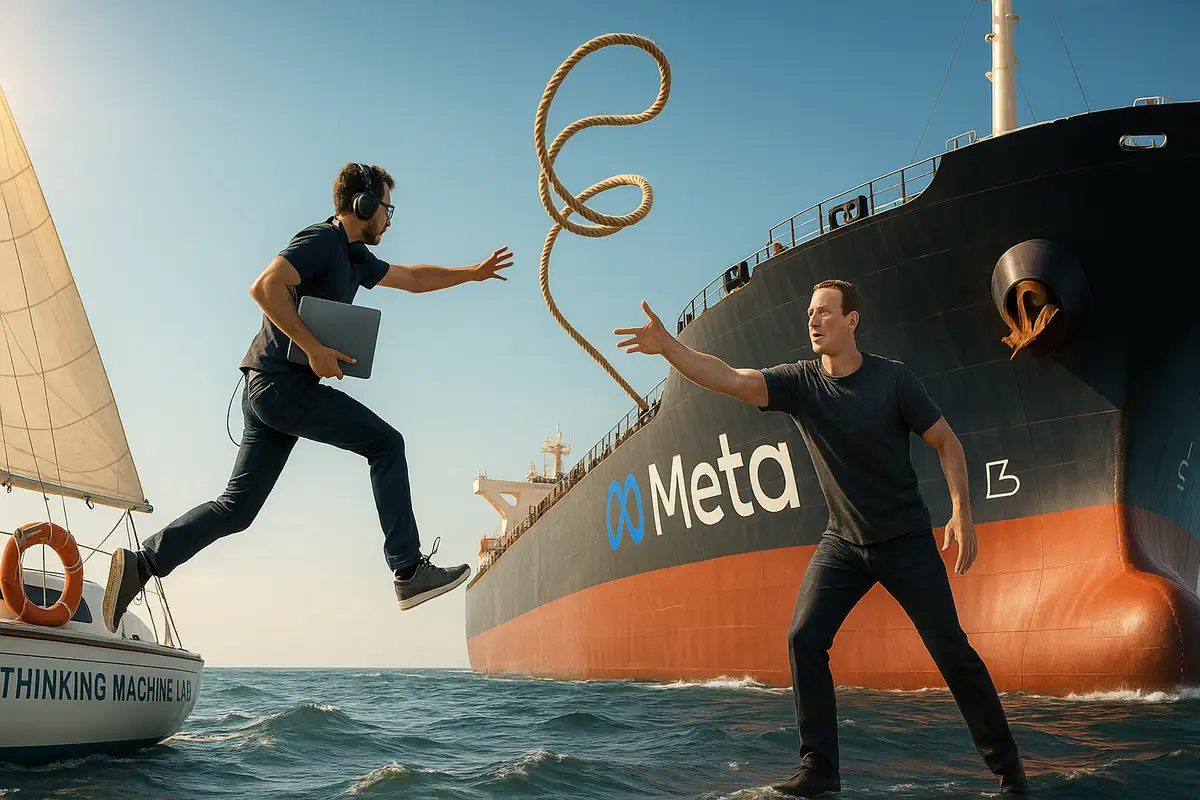
Tulloch co-founded Thinking Machines Lab with Mira Murati in February 2025. By August, Zuckerberg had made a disputed attempt to buy the startup for about $1 billion. After Murati declined, he approached more than a dozen of the startup’s roughly 50 employees, including Tulloch.
The offer described in August 2025 carried a reported value, disputed by Meta, of as much as $1.5 billion over at least six years, contingent on top bonuses and extraordinary stock performance. Tulloch rejected it.
Meta spokesman Andy Stone called that description “inaccurate and ridiculous.” He said any compensation package depended on the stock rising. Stone also denied that Meta had tried to buy Thinking Machines Lab.
In October 2025, Tulloch joined Meta anyway. A person close to the deal put the accepted package below both the original offer and the reported figure. Thinking Machines Lab’s spokesperson said: “Andrew has decided to pursue a different path for personal reasons.”
Tulloch worked in TBD Lab, the small frontier-research group within Meta Superintelligence Labs under Alexandr Wang.
FREE · ABOUT FIVE MINUTES
Follow the AI talent war as it turns.
Implicator cuts the flood to the developments worth your attention, with concise reporting on what changed and why it matters. Delivered every weekday at 4:45 a.m. Pacific, 7:45 a.m. Eastern.
From San Francisco. No spam. Unsubscribe anytime.
Semafor’s exclusive rests on one unnamed person briefed on the matter. Tulloch could not be reached, and Meta has not commented on his departure. His reason for leaving and destination are unknown; no successor has been named or operational consequence reported.
The launch he waited for
Announced Tuesday, September 8, Muse runs on the Muse Spark model family developed under Wang. It can carry out tasks such as sending emails and booking travel, continuing to work after users close the app.
At launch, Muse is available only in the United States, with a free tier and monthly subscriptions of $20 for Power and $100 for Maximum. Each user gets a dedicated cloud computer, called Muse Secure VM. A separate Sentinel control layer governs access to the internet and connected services, requesting approval for sensitive actions.
Meta plans a confidential version before the end of 2026, designed to prevent even the company from accessing a user’s workspace.
Earlier departures
By late August 2025, at least three researchers had resigned from the new superintelligence lab, including Rishabh Agarwal. A broader count found that at least eight employees had left less than two months after the initiative was announced. Ethan Knight left TBD Lab within weeks of joining.
Know someone who'd find this useful? ✉️ Email it to a friend in one click, or they can subscribe free here.
“It was a tough decision not to continue with the new Superintelligence TBD lab, especially given the talent and compute density,” Agarwal wrote.
Meta paused hiring across MSL in late August 2025 except for business-critical roles. Chief AI scientist Yann LeCun left in November 2025. Ruoming Pang, recruited from Apple in July 2025 on a package reported above $200 million, left for OpenAI in February 2026 after roughly seven months.
Hiring beyond Meta
Zeki Data’s analysis tracked 20,900 people in research and advanced-engineering roles at 10 companies, using public information compiled in August 2026. That method may undercount staff.
DeepMind’s arrivals-to-departures ratio fell from about 12-to-1 in the second quarter of 2023 to roughly 2-to-1 in the third quarter of 2026. It was still adding more researchers and advanced engineers than it lost.
“They had the crown in Europe forever, and then it started to erode from a very high base,” said Zeki founder Tom Hurd. “The likes of Microsoft AI Superintelligence and Meta Superintelligence are eating into their market share, and then there's OpenAI and Anthropic on the side.”
Frequently Asked Questions
Who is Andrew Tulloch?
An AI researcher who co-founded Thinking Machines Lab with Mira Murati in February 2025. He joined Meta in October 2025 and worked in TBD Lab, the frontier-research group inside Meta Superintelligence Labs led by Alexandr Wang.
How much was Tulloch offered to join Meta?
An offer described in August 2025 carried a reported value of as much as $1.5 billion over at least six years, contingent on top bonuses and extraordinary stock performance. Meta disputed that description. Tulloch rejected the offer, then joined in October 2025 on a package a person close to the deal put below both the original offer and the reported figure.
What is Muse?
Meta's personal AI agent, announced Tuesday, September 8, 2026. It runs on the Muse Spark model family and can send emails and book travel, continuing to work after users close the app. It is available only in the United States, with a free tier and subscriptions of $20 for Power and $100 for Maximum.
Why does this departure matter?
Semafor, which reported the departure from a single unnamed source, describes Tulloch as one of the highest paid employees in the tech industry, and the disputed $1.5 billion figure would, if close to accurate, have made him the highest paid employee in the industry's history. His exit follows a run of departures from the same division.
How many people have left Meta Superintelligence Labs?
By late August 2025 at least three researchers had resigned, and a broader count found at least eight employees had left less than two months after the division was announced. Ruoming Pang, recruited from Apple, left for OpenAI in February 2026 after roughly seven months. Separately, Meta chief AI scientist Yann LeCun left the company in November 2025.
AI-generated summary, reviewed by an editor. More on our AI guidelines.
Related stories
Free AI briefing · Weekdays
The AI stories that matter, sourced and explained.
Join the Morning Briefing. It goes out every weekday at 4:45 a.m. Pacific, with later sends for the East Coast, Berlin and Tokyo.
Free when you sign up: The Paperclip Compendium, our tested guide to running AI agents.
Free. Unsubscribe in one click.

Marcus Schuler
Editor-in-Chief and founder of Implicator.ai. Former ARD correspondent and senior broadcast journalist with 10+ years covering tech. Writes daily briefings on policy and market developments. Based in San Francisco. E-mail: editor@implicator.ai