IMPLICATOR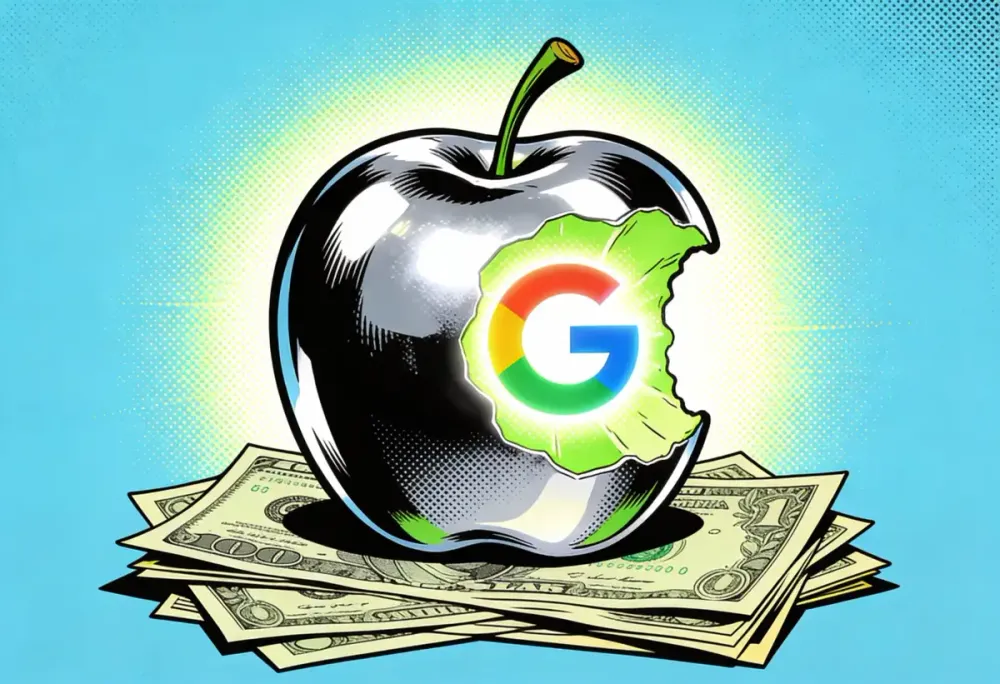
The press release hit inboxes at 8 PM on a Sunday. No briefing. No embargo. Just a PDF dropped into the void while the markets were closed and the tech press was half-watching football. Apple and Google issued a joint statement, 147 words total, confirming what Bloomberg had reported weeks earlier: the next generation of Apple Foundation Models will be built on Google's Gemini technology. A multi-year deal. Roughly $1 billion a year. And a Siri upgrade that's been promised since 2024.
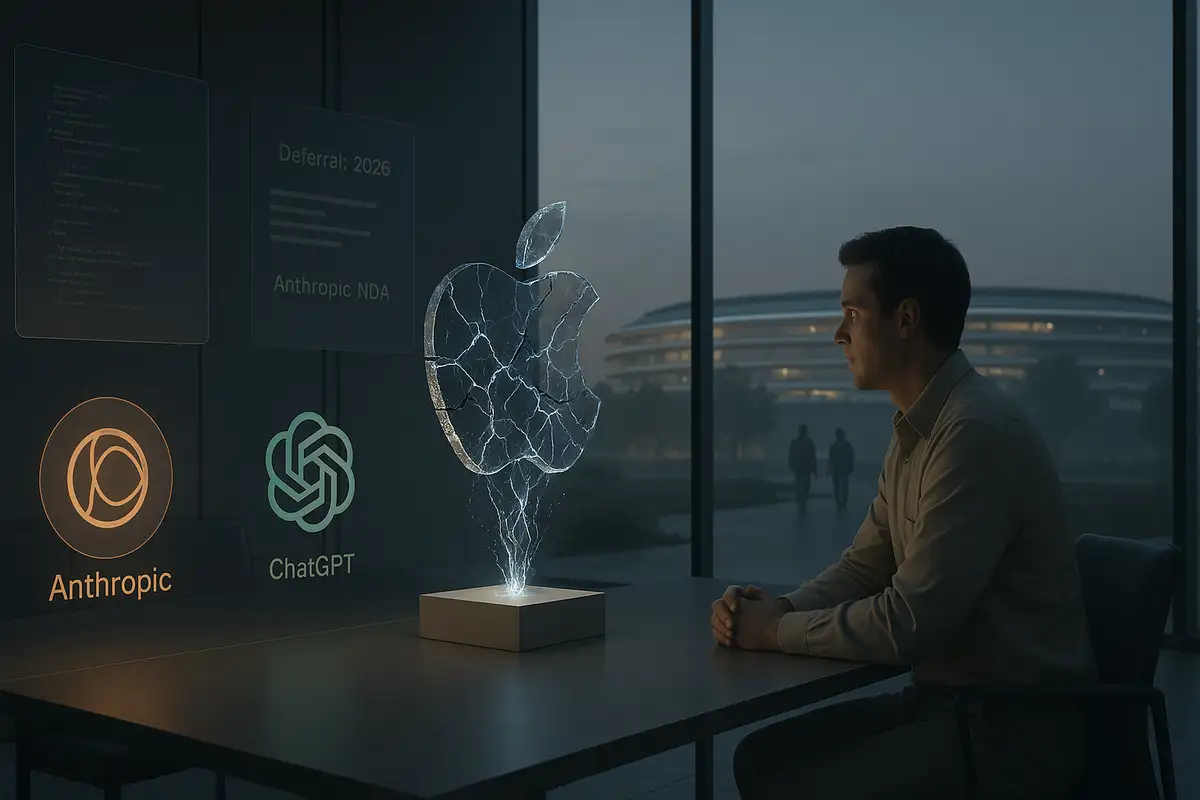
That's the official version. Here's what actually happened: Apple tried to build its own AI. It failed. And now it's paying a competitor to do the work while pretending the arrangement is strategic. This is the silence of a company that hates admitting it needs help.
The Breakdown
• Apple will pay Google ~$1 billion annually to license Gemini for its foundation models and Siri upgrade
• The deal inverts 15 years of Apple collecting rent from Google—now Apple is the tenant
• Same day, Apple announced Creator Studio ($13/month) to compete with Adobe instead of AI leaders
• Alphabet's market cap passed Apple's for the first time since 2019 as Google logged its best stock year since 2009
The telling detail nobody is discussing
Read the joint statement carefully. "Google's AI technology provides the most capable foundation for Apple Foundation Models." The word "foundation" appears twice in four words. It's not elegant phrasing. It's revealing.
A foundation doesn't have a foundation. But Apple's does now. The construction that was supposed to support everything else never got built. So Apple is renting Google's.
The statement went to CNBC first—specifically to Jim Cramer, of all people. Not the tech press. Not a carefully staged announcement at Apple Park. A press release on a Sunday, handed to a stock market personality who's been wrong about Apple more times than anyone can count. Proud partners don't bury announcements on Sunday nights.
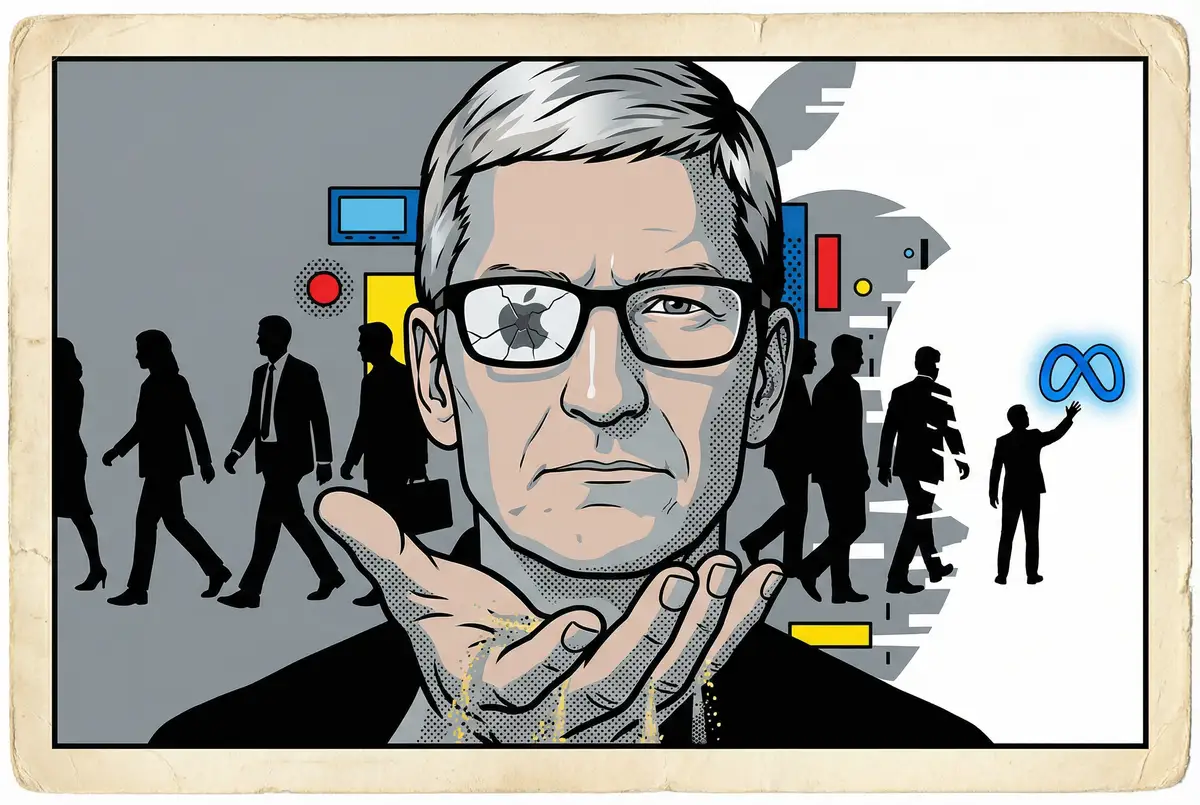
Think about what happened before this. Tim Cook stood in front of employees in August 2024 and promised AI would be the priority. Giannandrea, the AI chief, got shuffled out of his role a few months later. Engineers started jumping to Meta. And Siri? The "more personalized" version was supposed to ship in 2024. Slipped to 2025. Slipped again. Apple's statement each time read like a form letter. "It's going to take us longer than we thought." We know.
And while Cupertino fumbled, Alphabet's market cap passed Apple's. First time since 2019. Google logged its best stock year since 2009. The company that once seemed existentially threatened by ChatGPT had executed a comeback that made Apple's AI struggles look even more conspicuous.
What $1 billion a year actually buys
The deal structure tells a story Apple would rather not advertise. Google already pays Apple an estimated $15-20 billion annually to remain the default iPhone search engine. Now Apple is paying Google $1 billion a year to license Gemini. The money doesn't matter. The dependency does. For fifteen years, Google paid Apple for access to users. Now Apple pays Google for the brain in the phone. The polarity of the relationship just flipped. Apple used to be the landlord collecting rent. For the technology that matters most, Apple is now the tenant.
Analysts are working hard to reframe this as strategy. "Apple is using Gemini as a foundational model layer, then building its own systems on top," one told Tom's Guide. Another insisted Apple "doesn't need to win the AI arms race" because it's "not a cloud company."
But that's rationalization dressed as analysis. Apple spent years telling investors it could develop world-class AI in-house. It built custom silicon. It acquired machine learning startups. It hired researchers from Google and OpenAI. The entire pitch for Apple Intelligence was that Apple would do AI differently—better privacy, better integration, better everything.
What Apple delivered instead: notification summaries that garble headlines into nonsense. Image Playground that generates Pixar-style slop. And Siri still asking "here's what I found on the web" in response to basic questions.
Stay ahead of the satisficing curve
Strategic AI news from San Francisco. No hype, no "AI will change everything" throat clearing. Just what moved, who won, and why it matters. Daily at 6am PST.
No spam. Unsubscribe anytime.
The Siri problem runs deeper than infrastructure
You've done this. Asked Siri to set an alarm "for three thirty." Watched it pick 3:30 AM. The spinning animation. The cloud doing something. Then an answer to a question you never asked. Every iPhone owner has been there, staring at the screen, wondering why a trillion-dollar company can't parse AM from PM.
That pause is Apple's AI gap made audible. Sixteen years since Apple acquired the technology behind Siri. ChatGPT was built in a fraction of that time. Google's Gemini models now power everything from Gmail to Pixel phones. And Apple still can't make Siri understand context.
The personalized Siri upgrade, finally expected in iOS 26.4 this spring, promises on-screen awareness, deeper per-app controls, and better understanding of personal context. Apple's demo showed someone asking about their mother's flight and lunch reservation based on information from Mail and Messages.
That sounds impressive until you realize Google Assistant has been doing this for years. The benchmark Apple is racing toward is last generation's table stakes.
Privacy is the story Apple wants you to hear
Every statement about the Google deal emphasizes the same point: "Apple Intelligence will continue to run on Apple devices and Private Cloud Compute, while maintaining Apple's industry-leading privacy standards." Analysts at Morningstar dutifully repeated that the arrangement "will help Apple's reputation for security and privacy remain intact."
This is the story they need you to believe. Apple chose Google for strategic reasons, not because it failed to build competitive AI. Privacy controlled. User experience maintained. Business as usual.
But nobody in Cupertino wants to touch this one: if privacy-first AI is the future, why couldn't Apple build it? Two hundred billion in cash. Custom chips designed in-house. Control over the entire stack, silicon to services. Apple had every advantage. The company that was supposed to do AI differently couldn't do AI at all.
It couldn't. Or at least, it couldn't fast enough to matter.
The retreat to safe harbor
Rough seas, and Apple heads for the bay it knows. Same day the Gemini news dropped, Apple announced Creator Studio. You get Final Cut and Logic, plus Pixelmator and some others. Costs less than a Netflix subscription, $13, and students pay almost nothing. Available January 28.
This is the bay. The AI race is the open water where Apple is drowning. Creative software is the shallow harbor where Apple is the apex predator. The timing of the announcement tells you everything about where Cupertino thinks it can win.
Creator Studio undercuts Adobe by $47 a month for a comparable bundle. That's a margin attack Apple can execute. It requires no breakthrough research. No hiring wars. No multi-year development cycles that keep slipping. Just aggressive pricing against a competitor that's spent years gouging its customers.
While Google and Microsoft and Meta pour billions into model development, Apple is releasing a subscription bundle. One company is fighting for the future of computing. The other is fighting for the video editing market.
Daily at 6am PST
Don't satisfice. Get the full picture.
No breathless headlines. No "everything is changing" filler. Just who moved, what broke, and why it matters.
Free. No spam. Unsubscribe anytime.
What happens when Apple loses its narrative
The hardest thing for Apple in 2026 isn't building better AI. It's maintaining the story that made investors believe Apple was different.
For two decades, the pitch worked like this: Apple arrives late to markets, does things better, and charges a premium for the privilege. The iPod wasn't first. The iPhone wasn't first. The Apple Watch wasn't first. But Apple's versions were better, and customers paid accordingly.
AI doesn't fit that pattern. There's no late-entry advantage when the race depends on data and compute at scales Apple never prioritized. The models are trained on trillions of parameters in data centers that consume the output of power plants. Apple's strengths—privacy, integration, user experience—are the things you layer on top. They're not the foundation.
And now Apple is licensing someone else's foundation.
The question nobody is asking
Here's what analysts should be considering instead of inventing strategic justifications: what happens to Apple's AI positioning when the underlying models belong to Google?
Today, users can already choose between Siri (with ChatGPT as a fallback) and the Gemini-powered future Apple just announced. The company says it's keeping both. But maintaining multiple AI backends creates complexity without coherence. Which model answers which question? Who gets the data? What happens when Google's offering improves faster than Apple's wrapper?
Siri's competitive moat was never the model underneath—it was the access. System-level controls. On-device data. The integration with calendars and messages and apps that third-party assistants couldn't touch. But access only matters if the AI is capable of using it.
Apple's advantage is the front door. Google now provides what's behind it.
The deal runs for multiple years. The Siri upgrade arrives in months. Apple's position is now simple. It isn't racing anymore. It's paying to ride.
Frequently Asked Questions
Q: How much is Apple paying Google for Gemini?
A: Bloomberg reported Apple will pay approximately $1 billion annually to license Google's Gemini models and cloud technology for its foundation models and the upcoming Siri upgrade.
Q: When will the new Gemini-powered Siri be available?
A: The more personalized version of Siri is expected with iOS 26.4, targeting March or April 2026. This comes after multiple delays from the original 2024 timeline.
Q: What happened to Apple's own AI development?
A: Apple's in-house AI efforts stalled badly. AI chief John Giannandrea was reassigned, top talent left for Meta, and Apple Intelligence features launched with underwhelming performance. The Siri overhaul is roughly 18 months behind schedule.
Q: Will Apple still use ChatGPT alongside Gemini?
A: Apple says it's keeping its existing ChatGPT integration for certain queries even after Gemini-based Apple Intelligence rolls out. The company hasn't announced changes to the OpenAI partnership.
Q: What is Apple Creator Studio?
A: Creator Studio is Apple's new software bundle launching January 28, 2026. It includes Final Cut Pro, Logic Pro, Pixelmator Pro, and other creative tools for $13/month ($3 for students), undercutting Adobe by $47/month.

Marcus Schuler
Editor-in-Chief and founder of Implicator.ai. Former ARD correspondent and senior broadcast journalist with 10+ years covering tech. Writes daily briefings on policy and market developments. Based in San Francisco. E-mail: editor@implicator.ai