IMPLICATOR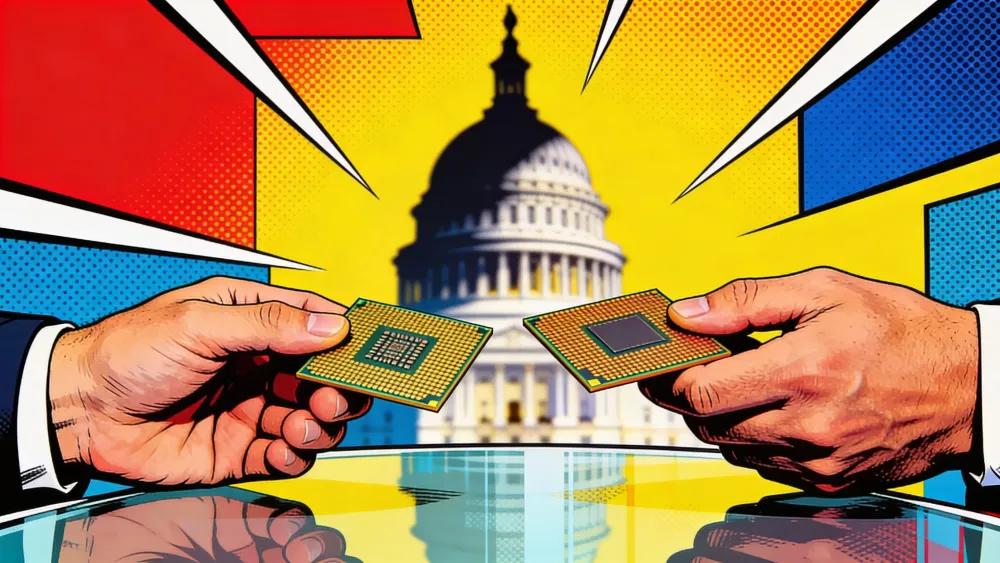
Donald Trump posted a Truth Social attack on Intel CEO Lip-Bu Tan at 4:39 in the morning, Pacific time, on August 7, 2025. "The CEO of INTEL is highly CONFLICTED and must resign, immediately," he wrote, per Reuters. Within weeks, Reuters reported, Tan left a 40-minute Oval Office meeting with an $8.9 billion deal that handed the U.S. government a 9.9% stake in Intel, funded by $5.7 billion in unpaid CHIPS Act grants and $3.2 billion from a separate Secure Enclave program. Commerce Secretary Howard Lutnick later posted a video captioned "The Art of the Deal: Intel."
On Friday, that caption got a customer. The Journal broke the story Friday: after more than a year of negotiations, the two companies signed a preliminary deal in recent months for Intel to fabricate some of Apple's in-house chip designs. That match makes the deal politically significant. Apple is the customer Intel Foundry has needed for years. Intel is the U.S.-based capacity Apple now needs. And the Trump administration has spent the past year using its 9.9% Intel stake to push customers toward those fabs.
The ask kept moving.
Key Takeaways
- Apple and Intel reached a preliminary agreement Friday for Intel to manufacture some Apple-designed chips, after more than a year of WSJ-reported talks.
- The U.S. government's 9.9% Intel stake, acquired for $8.9 billion last August, helped bring Apple to the table, the Journal said.
- Intel Foundry posted $5.4 billion Q1 2026 revenue but a $2.437 billion operating loss, making Apple's qualification the first major external customer signal.
- Intel stock closed up 13.96% at $124.92 Friday, roughly six times the government's $20.47 entry price.
AI-generated summary, reviewed by an editor. More on our AI guidelines.
Capacity forced the hedge
Tim Cook did not describe Intel on Apple's most recent earnings call. He described scarcity. Cook told investors "the Mac Mini and the Mac Studio may take several months to reach supply-demand balance." Apple raised the Mac Mini's starting price a day later. Apple ships more than 200 million iPhones a year, plus millions of iPads and Macs, and is on track in 2026 to buy more than 100 million advanced chips produced by TSMC in Arizona.
That makes the Intel talks less nostalgic than mechanical. The previous Apple-Intel partnership, fourteen years long, ended in 2020. It included the 2015 12-inch MacBook and its butterfly keyboard. Apple now designs; Intel fabricates. "Intel is the only place that can scale up capacity as a viable second source," Creative Strategies' Ben Bajarin told CNBC. Apple is TSMC's second-largest customer behind Nvidia, Bajarin said, and that rank no longer gives Apple priority on supply. "Nobody can build fast enough," he told CNBC.
Validation is what Intel sells
And that is the point. CNBC reported that Intel Foundry posted $5.4 billion in Q1 2026 revenue, up 16% year over year, and a $2.437 billion operating loss in the same quarter. The problem is fixed cost built for external customers who have not yet arrived in enough volume.
Bajarin put the technical step plainly. Intel's current 18A node is "a little bit rough," he told CNBC, while 18A-P "cleans a lot of stuff up." Supply-chain analyst Ming-Chi Kuo has said Intel could ship Apple's lowest-end M-series processor as early as 2027, The Verge reported. Musk's $119 billion Terafab commitment points to Intel's future 14A node, not expected before 2029. Faster signal. Better customer. That makes Bajarin's next line matter: "They've got through the rough patch and can now be considered validated as a credible second source."
Get Implicator.ai in your inbox
Strategic AI news from San Francisco. No hype, no "AI will change everything" throat clearing. Just what moved, who won, and why it matters. Daily at 6am PST.
No spam. Unsubscribe anytime.
The hedge still has limits
Which raises the question of what Apple actually bought. The Journal said it remains unclear which products Intel would make, and reports do not establish volumes, node choice, pricing, or shipping date. "We talk to Intel all the time," Apple procurement chief David Tom told the Journal in February. He declined to say more.
The deal is narrower. It says Apple is willing to spend engineering time qualifying Intel, not that it is moving its most sensitive silicon away from TSMC. An Intel spokesperson told Reuters its 18A technologies are "progressing well" and "strong interest" remains for 14A. Intel's 2025 Form 10-K said it may "pause or discontinue" 14A and successor leading-edge nodes if it cannot secure a significant external customer and meet milestones. Nvidia's $5 billion investment in Intel came with no manufacturing commitment, and Tan said, "Right now we are focused on collaborations." Apple is the stronger signal because it asks Intel to pass a manufacturing test.
Washington found the lever
But this misses the deeper shift. Lutnick has met "repeatedly" over the past year with senior Apple officials, Musk, and Nvidia CEO Jensen Huang, the Journal reported. He pressed Cook. He pressed Musk. He pressed Huang. The Journal also reported that Trump personally advocated for Intel in a White House meeting with Cook. With Apple, the three companies Washington pushed toward Intel have all signed something.
The market priced the lever in real time. Intel closed Friday at $124.92, up 13.96%, after touching $130.57 intraday; Apple closed at $293.32, up 2.05%, while TSMC's U.S.-listed ADR slipped 0.60%, according to TECHi. The government's entry price was $20.47 a share when the stake was announced last summer, roughly one-sixth of Friday's close. Trump previewed the argument in January. "As soon as we went in, Apple went in, Nvidia went in, a lot of smart people went in," he said.
A Commerce Department official told Reuters the U.S. stake gives Intel "a shot at success but not a leg up" and said Intel is not "too strategic to fail." Foreign chipmakers operating in the U.S. told Reuters they worry that officials will tip customers toward Intel. Friday made both readings plausible: a potential customer win, an unproved foundry, and a government shareholder with reason to keep pressing. At 4:39 a.m., Trump tried to push Tan out. On May 8, Washington pushed Apple in.
Frequently Asked Questions
What did Apple and Intel actually agree to?
A preliminary deal for Intel to manufacture some Apple-designed chips, per the Wall Street Journal. Talks have been underway for more than a year. The specific products, volumes, manufacturing node, pricing, and shipping date have not been disclosed by either company. Both Apple and Intel declined to comment.
Why is Apple talking to Intel now?
Apple is TSMC's second-largest customer behind Nvidia and is constrained by TSMC's wafer capacity, according to Creative Strategies analyst Ben Bajarin. Tim Cook said on Apple's most recent earnings call that the Mac Mini and the Mac Studio may take several months to reach supply-demand balance. Intel is the only other foundry that can scale advanced-node capacity quickly.
What role did the Trump administration play?
Commerce Secretary Howard Lutnick met repeatedly with Tim Cook, Elon Musk, and Nvidia CEO Jensen Huang to push them toward Intel, the WSJ reported. Trump personally pressed Cook in a White House meeting. The U.S. government holds a 9.9% Intel stake from an $8.9 billion deal struck last August, funded by $5.7 billion in unpaid CHIPS Act grants and $3.2 billion from a separate Secure Enclave program.
Will Intel make iPhone chips?
It is not clear yet. The reports do not establish which Apple products Intel will manufacture. Analyst Ming-Chi Kuo has said Intel could ship Apple's lowest-end M-series processor as early as 2027, per The Verge. Bajarin expects the work to land on Intel's 18A-P node, which scales next year.
How did the market react?
Intel stock closed Friday at $124.92, up 13.96%, after touching $130.57 intraday. Apple closed at $293.32, up 2.05%. TSMC's U.S.-listed ADR slipped 0.60%. The U.S. government's stake, acquired at $20.47 per share when the deal was announced last summer, is now worth roughly six times its entry price.
AI-generated summary, reviewed by an editor. More on our AI guidelines.



Marcus Schuler
Editor-in-Chief and founder of Implicator.ai. Former ARD correspondent and senior broadcast journalist with 10+ years covering tech. Writes daily briefings on policy and market developments. Based in San Francisco. E-mail: editor@implicator.ai