IMPLICATOR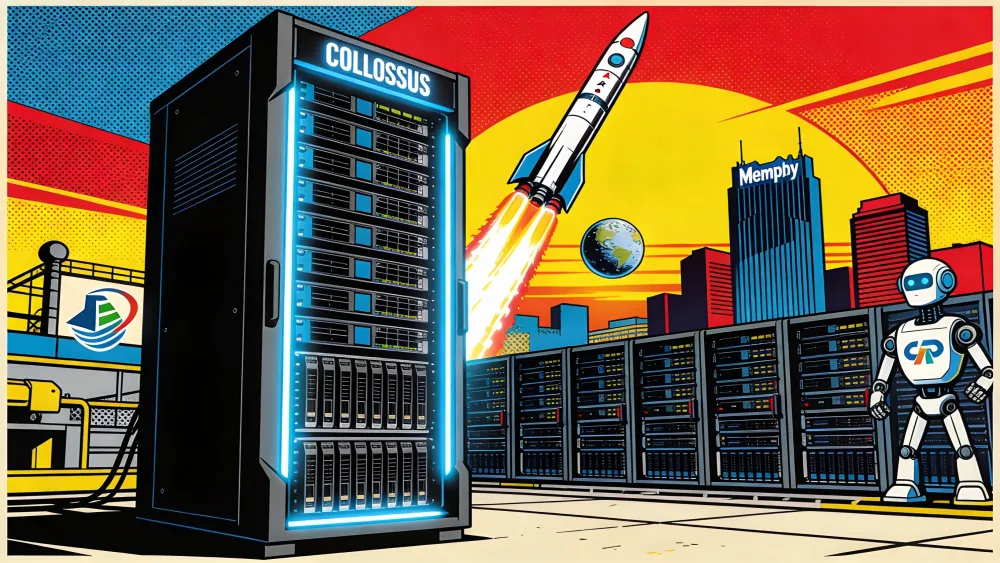
Ami Vora reached the SpaceX line at 09:12 Pacific time on Wednesday morning, on stage at Anthropic's Code with Claude developer conference in San Francisco. The room was waiting for model news. Instead, Anthropic's chief product officer announced the company had signed a deal to use 100 percent of the compute at SpaceX's Colossus 1, the 220,000-GPU Memphis cluster Jensen Huang once called a 122-day build, since doubled, and folded into SpaceX in February. "We're partnering with SpaceX to use all the capacity of their Colossus One data center," Vora said.
Anthropic was founded in 2021 by former OpenAI staff led by Dario and Daniela Amodei as the safety-first alternative to faster-moving AI labs. On Wednesday, the alternative became a customer of the most aggressive of those labs, repackaged inside SpaceX. The deal directly addresses an embarrassing capacity shortfall that had Pro subscribers complaining since March. It also ties Anthropic's compute to a data-center footprint already under federal Clean Air Act litigation.
Key Takeaways
- Anthropic signed Wednesday to lease 100% of SpaceX's 220,000-GPU Colossus 1 cluster, doubling Claude Code rate limits this month.
- The deal lands as SpaceX targets a $1.5 trillion IPO and consolidates AI compute, chips, and coding tools under Musk's control.
- Colossus operations face NAACP and Earthjustice Clean Air Act litigation over 27 unpermitted gas turbines in Southaven, Mississippi.
- Anthropic was excluded from May Pentagon AI deals while xAI was included; the SpaceX lease deepens the political asymmetry.
AI-generated summary, reviewed by an editor. More on our AI guidelines.
The bargain that solved the rate-limit problem
The Colossus 1 lease gives Anthropic more than 300 megawatts of new capacity within the month, per the company's blog post. That sits beside Anthropic's larger commitments: an up-to-5-gigawatt Amazon deal arriving "by the end of 2026," a 5-gigawatt Google-Broadcom deal coming online "in 2027," a $30 billion Microsoft-NVIDIA Azure partnership, and a $50 billion Fluidstack build-out. Colossus 1 is the only one online this month.
Vora used the announcement to deliver what developers came for. Claude Code's five-hour rate limits double for Pro, Max, Team, and seat-based Enterprise customers. Peak-hours throttling on Pro and Max accounts ends. API rate limits for Claude Opus rise considerably. One Pro subscriber, paying $200 a year, told The Register on March 31 that "out of 30 days I get to use Claude 12." Vora said API volume is up 17x year-over-year.
Anthropic admitted in late March that "people are hitting usage limits in Claude Code way faster than expected." Thirty-six days later, the public response was a SpaceX deal.
What SpaceX gets in return
The deal lands as SpaceX prepares for an IPO that Sacra estimates is targeted near $1.5 trillion, the largest public offering in corporate history if it holds. SpaceX absorbed xAI on February 2 in an all-stock deal that valued the AI subsidiary at $250 billion against roughly $3.8 billion in combined xAI-and-X annualized revenue, or about 66 times revenue, against OpenAI's 25x and Anthropic's 19x at their last marks. The math, as Implicator wrote in January, needed something to make the AI subsidiary look less expensive on a customer-revenue basis.
A marquee enterprise customer signing for 100 percent of Colossus 1 gives SpaceX a customer-revenue proof point ahead of the listing. The same week, SpaceX filed plans for an initial $55 billion Texas Terafab semiconductor project, potentially rising to $119 billion, alongside a standing $60 billion option to acquire coding startup Cursor. The Anthropic lease accelerates a consolidation already underway inside SpaceX: rockets, AI compute, chips, and coding tools, all under Musk's control.
The compute calculus behind every AI deal
Strategic AI news from San Francisco. No hype, no "AI will change everything" throat clearing. Just what moved, who won, and why it matters. Daily at 6am PST.
No spam. Unsubscribe anytime.
The orbital pitch and the Memphis lawsuit
Both companies expressed interest in pursuing "multiple gigawatts of orbital AI compute capacity." SpaceX's blog framed the rationale: "The compute required to train and operate the next generation of these systems is outpacing what terrestrial power, land, and cooling can deliver on the timelines that matter." Space-based compute, the post added, "offers near-limitless sustainable power with less impact on Earth."
The NAACP and Earthjustice are suing xAI in federal court for operating 27 unpermitted methane gas turbines at the Southaven, Mississippi site that powers Colossus 2. Those turbines have potential annual NOx emissions of more than 1,700 tons, according to the Southern Environmental Law Center. A separate SELC study of 41 proposed permanent turbines on the same broader xAI footprint estimated $30 to $44 million in annual health damages across North Mississippi and West Tennessee, in regions that include predominantly Black neighborhoods of South Memphis.
Implicator covered the orbital pitch in January, when SpaceX asked the FCC to authorize one million orbital data center satellites. The filing carried no hardware specs. The Memphis lawsuit does.
The detente nobody asked for
Musk has called Anthropic "Misanthropic" and "evil." In February he posted that the company "hates Western Civilization," and he has accused it of stealing training data "at a massive scale." On Wednesday he posted on X that he had spent the previous week with senior Anthropic staff. "Everyone I met was highly competent and cared a great deal about doing the right thing," he wrote. "No one set off my evil detector." He added that SpaceX "reserves the right to reclaim the compute" if Anthropic's AI "engages in actions that harm humanity."
The detente has political asymmetry. On May 1, the Pentagon awarded classified-network AI deals to multiple firms including SpaceX. Anthropic was excluded after refusing Defense Department requests to drop safety guardrails on Claude for use in autonomous weapons. Four days later, the Trump administration's AI Standards Center signed new pre-deployment agreements with Microsoft, Google DeepMind, and xAI, leaving Anthropic's older 2024 partnership untouched.
In a single week, Anthropic was outside the Pentagon's new-agreement roster, outside the new federal AI-safety partnerships, and renting compute from a company Musk now controls.
Vora's keynote ended without a model announcement. The news, Simon Willison wrote on his live blog, was the SpaceX deal. The room had wanted product. What Vora delivered was the price of capacity: an alternative AI lab whose alternative now runs on Musk's silicon, on a data-center footprint already in federal court, with the orbital pitch waiting in reserve. At 09:12 Pacific the alternative ran out.
Frequently Asked Questions
What did Anthropic announce on May 6, 2026?
Anthropic CPO Ami Vora announced at the Code with Claude conference that Anthropic has signed a deal to use 100% of SpaceX's Colossus 1 data center, gaining over 300 megawatts of capacity within the month. Claude Code's five-hour rate limits double for Pro, Max, Team and seat-based Enterprise customers, peak-hours throttling ends, and Claude Opus API limits rise considerably.
How much of SpaceX's Colossus is Anthropic now leasing?
Anthropic is leasing 100% of Colossus 1's compute, including 220,000 NVIDIA GPUs and over 300 megawatts of power. SpaceX absorbed xAI in February 2026 in an all-stock deal that valued xAI at $250 billion. Colossus 1 is in Memphis. A separate facility, Colossus 2, is being built in Mississippi.
What is the orbital data center plan?
Both companies expressed interest in pursuing "multiple gigawatts of orbital AI compute capacity." SpaceX argues that the compute required to train next-generation models is outpacing what terrestrial power, land and cooling can deliver. SpaceX itself notes the orbital project is in early stages and may not achieve commercial viability.
Why was Anthropic excluded from Pentagon AI deals?
Anthropic was excluded from a May 1 Pentagon classified-network AI deal after refusing Defense Department requests to drop safety guardrails on Claude for use in autonomous weapons. Four days later, the Trump administration's AI Standards Center signed new pre-deployment evaluation agreements with Microsoft, Google DeepMind, and xAI.
What environmental issues affect xAI's Colossus operations?
The NAACP and Earthjustice are suing xAI for operating 27 unpermitted methane gas turbines at a Southaven, Mississippi site that powers Colossus 2. The Southern Environmental Law Center estimates the unpermitted plant could emit more than 1,700 tons of nitrogen oxides annually, with $30-44 million in projected annual health damages from the broader 41-turbine footprint.
AI-generated summary, reviewed by an editor. More on our AI guidelines.

Marcus Schuler
Editor-in-Chief and founder of Implicator.ai. Former ARD correspondent and senior broadcast journalist with 10+ years covering tech. Writes daily briefings on policy and market developments. Based in San Francisco. E-mail: editor@implicator.ai