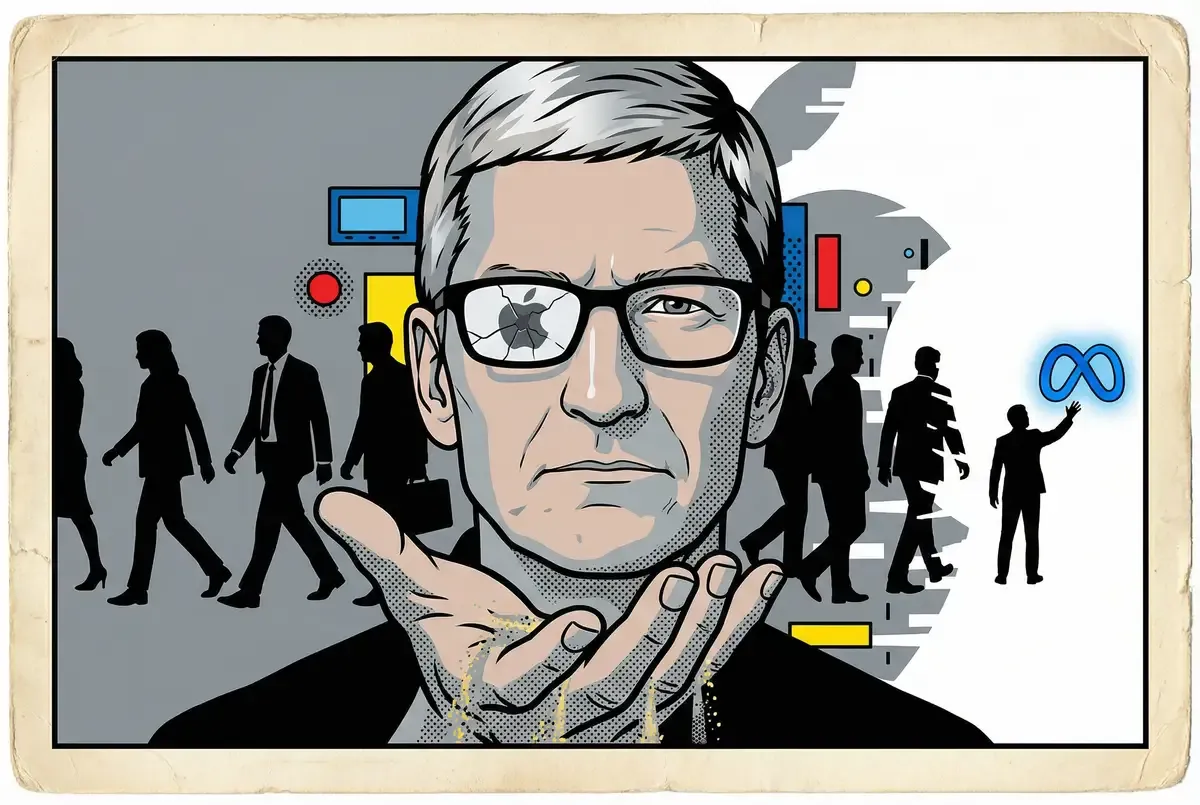
Tim Cook built Apple into a $3.5 trillion company by doing something Steve Jobs never could: making operational excellence look easy. For fourteen years, the same faces appeared at product launches, the same names signed the press releases, the same executives collected their restricted stock units while analysts marveled at Apple's "stability." That stability was always part mythology. Now it's collapsing in real time.
Since January 2025, Apple has lost or announced the departures of its COO, CFO, general counsel, AI chief, design chief, and environment head. The company's chip architect, Johny Srouji, told Cook he's considering leaving for another company. And Meta, the rival Cook once said he "wouldn't be in the same situation" as, has systematically dismantled Apple's AI and design teams with compensation packages worth tens of millions per year.
Apple calls these planned retirements. That framing requires ignoring everything happening underneath.
The Breakdown
• Apple lost its COO, CFO, AI chief, design chief, and general counsel within 12 months, its largest leadership turnover since Steve Jobs died
• Meta hired nine ex-Apple employees in 2025, offering packages worth $25 million annually to poach AI and design talent
• Chip architect Johny Srouji told Cook he's considering leaving, reportedly preferring not to work under a different CEO
• Succession planning has accelerated with John Ternus emerging as the leading candidate to replace Cook, potentially in 2026
The Meta Pipeline
Meta hired nine former Apple employees in 2025. Not random engineers. The heads of foundational AI models, robotics research, Siri's intelligence systems, and human interface design. Alan Dye, who shaped the Apple Watch UI and Vision Pro software for a decade, now reports to Andrew Bosworth as Meta's Chief Design Officer. Ruoming Pang, who led the 100-person team building Apple's large language models, runs Meta's "Superintelligence" research group.
The compensation tells part of the story. Meta offered packages worth $25 million annually to poach Apple's AI talent. Apple, despite sitting on $162 billion in cash, operates within rigid salary bands that made counter-offers difficult. But money alone doesn't explain why Ke Yang quit his Siri leadership role after just weeks on the job. Or why the entire AI robotics software team scattered.
Something structural broke.
Apple's AI researchers watched the company consider licensing OpenAI and Anthropic models to fill gaps in Siri's capabilities. That decision, however pragmatic, signaled doubt in their work. The secrecy that defines Apple's culture, which works brilliantly for hardware reveals, suffocates researchers who want to publish findings and iterate publicly. Meta promised experimental freedom. Apple offered more NDAs.
John Gruber, writing at Daring Fireball, captured the Dye departure with unusual sharpness: "It's now clear that Dye's moral compass was not aligned with Apple's either. Tim Cook and the rest, or at least most, of Apple's senior leadership apparently couldn't see that." Cook once told Kara Swisher he'd never be in Zuckerberg's position. Now his design chief works for Zuckerberg. The irony cuts.
The Departures, Mapped
The scale becomes clearer in aggregate:
| Name | Role | Tenure | Announced | Destination |
|---|---|---|---|---|
| Jeff Williams | Chief Operating Officer | 27 years | Jul. 2025 | Retired; Sabih Khan promoted to COO |
| Luca Maestri | Chief Financial Officer | 11 years | Aug. 2024 | Stepped back; Kevan Parekh named CFO |
| John Giannandrea | SVP, Machine Learning & AI | 8 years | Dec. 2025 | Retiring spring 2026; phased out since March |
| Alan Dye | VP, Human Interface Design | 10 years | Dec. 2025 | Meta, Chief Design Officer |
| Ruoming Pang | Director, Foundation AI Models | 4 years | Jul. 2025 | Meta, Superintelligence team lead |
| Jian Zhang | Lead AI Scientist, Robotics | 10 years | Sep. 2025 | Meta, Reality Labs Robotics |
| Ke Yang | Head of Siri Search Intelligence | — | Oct. 2025 | Meta, AI search and reasoning |
| Kate Adams | SVP, General Counsel | 8 years | Dec. 2025 | Retiring late 2026; Jennifer Newstead (from Meta) succeeds |
| Lisa Jackson | VP, Environment & Policy | 12 years | Dec. 2025 | Retiring Jan. 2026; duties split across Legal and Operations |
| Johny Srouji | SVP, Hardware Technologies | 17 years | Dec. 2025 (rumored) | Considering departure; Cook offering CTO title to retain |
That's not a transition. That's an evacuation.
The Srouji Problem
The Johny Srouji situation deserves particular attention. Apple Silicon exists because of him. The M-series chips. The Intel breakup. That efficiency advantage the MacBook Air holds over every Windows competitor. All Srouji. The iPhone's neural engine, the on-device AI processing Apple keeps touting. Him again.
Bloomberg's Mark Gurman reported Saturday that Srouji told Cook he's "seriously considering" leaving for another company. Not retiring. Leaving. At 61, with his legacy secured, he's apparently weighing options elsewhere.
Cook's response reveals desperation. He's offering "substantial pay packages" and floating a promotion to Chief Technology Officer, a role that would make Srouji Apple's second most powerful executive. But here's the telling detail: sources say Srouji "would prefer not to work under a different CEO."
Read that again. Apple's chip chief doesn't want to work for whoever replaces Cook. The succession question isn't just about who leads Apple next. It's actively destabilizing retention right now.
If Srouji leaves, Apple loses the person most responsible for its hardware differentiation. His lieutenants, Zongjian Chen and Sribalan Santhanam, are capable. But institutional knowledge walks out doors. It doesn't transfer through memos.
The Giannandrea Reckoning
The framing around John Giannandrea's departure matters. Apple called it a retirement. But Tim Cook had already lost confidence in his AI chief's ability to execute. That's the harsher read.
Giannandrea came from Google in 2018, where he'd run search and AI. Big hire. Finally, the narrative went, Apple was getting serious about machine learning. Seven years later, Siri remains a punchline. Apple Intelligence launched with delays and underwhelming features. The planned Siri overhaul, supposed to compete with ChatGPT-style capabilities, sits roughly eighteen months behind schedule.
Cook began phasing Giannandrea out in March 2025, according to Bloomberg. The December "retirement" announcement was a formality. Craig Federighi runs AI now, at least in practice. And Apple poached Amar Subramanya from Microsoft (he'd spent 16 years at Google before that) to take the VP of AI title. The company is rebuilding its AI leadership from scratch while pretending continuity.
The Siri team saw two leaders quit within months. Robby Walker left earlier in 2025. His replacement, Ke Yang, departed after weeks. The project meant to make Siri competitive with Google's Gemini and OpenAI's products now lacks stable leadership.
The Design Vacuum
Apple's design organization has been bleeding since Jony Ive walked in 2019. Watch what happened next. Evans Hankey took over industrial design. Then Hankey quit in 2023. The hardware design team drifted without a clear leader for months. Dye kept software interfaces running. Now Dye works for Zuckerberg. Each exit made the next one easier.
Now Ive works with OpenAI. His startup io was acquired for over $6 billion to build AI-enhanced devices that will compete directly with Apple's hardware. The man who designed the iPhone is helping Sam Altman's company challenge it. OpenAI has hired dozens of Apple engineers across iPhone, Mac, camera technology, silicon design, audio, wearables, and Vision Pro. Tang Tan, one of Apple's top hardware executives, joined two years ago. Cheng Chen, a senior director overseeing display technologies including Vision Pro optics, is the latest to depart.
The brains are only flowing one direction. Out.
Steve Lemay, Dye's replacement, has spent 25 years at Apple and worked on every major interface since 1999. Employees reportedly feel enthusiasm about his promotion. But Lemay inherits a team that's seen multiple colleagues leave for Meta since 2023. The "Liquid Glass" UI elements Dye championed drew sustained user criticism. Whether Lemay represents continuity or course correction remains unclear.
Cook now oversees design directly, a responsibility Williams held before his retirement. Cook is not a designer. He's the guy who made Apple's supply chain so tight that competitors gave up trying to match it. Some people compare this to Jobs, who also involved himself directly in design decisions. The comparison flatters Cook. Jobs obsessed over bezels and button feel. Cook obsesses over inventory turns.
The Succession Accelerates
All of this unfolds against intensified planning for Cook's own exit. The Financial Times reported in November that Apple's board has "stepped up succession planning" with Cook potentially departing as soon as 2026. Cook turned 65 last month. His 15th anniversary as CEO and Apple's 50th anniversary both land next year.
John Ternus runs hardware engineering. He's 50. Insiders see him as the frontrunner to replace Cook. He led the Apple Silicon transition, which went about as smoothly as any major platform shift in tech history. Apple keeps putting him on stage at product launches. That's not an accident. You don't get more face time unless someone's grooming you for something bigger.
But the executive exodus complicates that transition. Whoever takes over inherits a depleted AI organization, a design team in flux, and potentially no chip architect if Srouji departs. The deep bench that made Apple's leadership changes manageable over the past decade has thinned considerably.
Gizmodo's Mike Pearl noted that Cook taking over Jeff Williams' duties, rather than replacing him, raised eyebrows across Silicon Valley. Cook is an operations expert, not a product visionary. Williams was the creative counterbalance. Now Cook oversees design directly. Steve Lemay, a 25-year Apple veteran, leads Human Interface design. The structure works on paper. Whether it produces the next iconic product remains unproven.
What Actually Broke
The conventional explanation frames this as demographic inevitability. Many departing executives are in their sixties. Retirements cluster. The timing looks worse than it is.
That explanation fails to account for the mid-career defections. Dye is 52. The AI researchers leaving for Meta aren't retiring. They're choosing to build elsewhere.
Three fractures run through Apple's leadership crisis:
First, the AI culture clash. Apple's secrecy works for hardware surprises. It suffocates AI research. Engineers who want to publish papers, attend conferences openly, and iterate publicly found themselves constrained by NDAs and approval processes designed for product launches. Meta's labs encourage publication. Google's research teams operate semi-independently. Apple treated AI researchers like they were building unreleased iPhones. The talent left.
Second, the compensation asymmetry. Apple's equity-heavy packages made sense when the stock appreciated 30% annually. In a flatter market, Meta's willingness to pay $25 million in guaranteed annual compensation looks different. Apple's rigid salary bands, a feature of Cook's operational discipline, became a liability when competitors decided AI talent justified exceptional offers. The company reportedly increased retention bonuses after Meta's 2021 poaching wave. Those bonuses expired. The poaching resumed.
Third, the strategic uncertainty. Apple's internal AI teams watched leadership consider licensing OpenAI and Anthropic models rather than building comparable capabilities in-house. That decision might be pragmatic. It also signaled doubt. Researchers who joined to build Apple's AI future found themselves potentially supporting integration work for external technology. Some stayed. Roughly a dozen senior AI researchers didn't.
Cook built something remarkable. Revenue tripled during his tenure. The services business became a profit engine. The supply chain operates with ruthless efficiency. But the leadership apparatus that executed that strategy is disassembling simultaneously, not sequentially. That's not transition planning. That's institutional stress.
Why this matters:
- For investors: Apple's hardware roadmap, including foldable devices and AR glasses, depends on leadership continuity that no longer exists. The AI catch-up timeline extends with every senior departure.
- For the industry: Meta's systematic poaching demonstrates that Apple's talent moat was shallower than assumed. Expect similar raids on other perceived "stable" tech giants.
- For Apple's next CEO: John Ternus, or whoever takes the role, inherits a company mid-reorganization with depleted AI capabilities and a chip architect considering exit. The honeymoon period will be short.
❓ Frequently Asked Questions
Q: Why can't Apple just match Meta's compensation offers?
A: Apple uses rigid salary bands tied to job levels, a system Cook built for operational consistency. Meta offered guaranteed packages worth $25 million annually. Apple's compensation leans on stock grants, which lose appeal when share prices flatten. The company issued retention bonuses in 2021, but those vested and the poaching resumed.
Q: Who is John Ternus and why is he the likely next CEO?
A: Ternus, 50, runs Apple's hardware engineering. He led the Apple Silicon transition from Intel and gets more stage time at product launches each year. Apple promotes insiders, and Ternus knows the product culture deeply. The Financial Times reported he's "widely seen as Cook's most likely successor."
Q: What happened to the Siri overhaul?
A: Apple planned a major Siri upgrade with ChatGPT-style capabilities for 2025. It's now roughly 18 months behind schedule. The project lost two leaders in months: Robby Walker left in early 2025, his replacement Ke Yang quit weeks later for Meta. Apple now relies partly on Google's Gemini to fill gaps.
Q: What is Meta's "Superintelligence" team that keeps hiring Apple people?
A: Meta formed this AI research group to build advanced large language models. Ruoming Pang, who ran Apple's 100-person foundational AI team, now heads it. Meta staffed the group with several former Apple researchers using packages reportedly worth tens of millions annually. The team focuses on artificial general intelligence research.
Q: Why is Johny Srouji considering leaving at 61 instead of retiring?
A: Srouji isn't retiring—he's weighing offers from other companies. Bloomberg reported he "would prefer not to work under a different CEO," suggesting Apple's succession uncertainty influenced his thinking. Cook offered him a CTO title and substantial pay, but questions about who leads Apple next appear to be a factor.