IMPLICATOR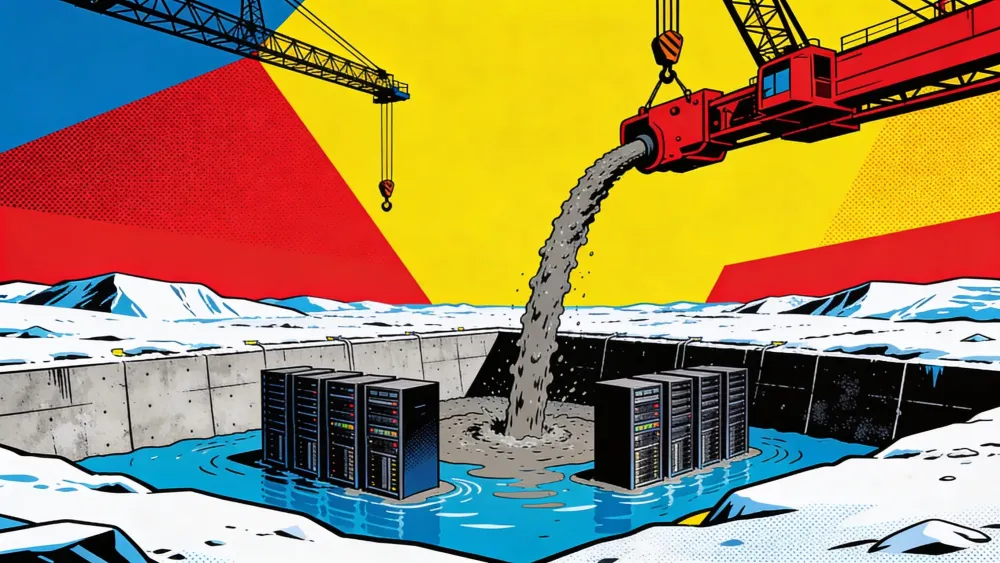
UK-based Nscale closed a $2 billion Series C today, the largest funding round ever completed by a European startup, according to the company. Norwegian industrial group Aker ASA and Dallas-based 8090 Industries led the round, which values the two-year-old data center operator at $14.6 billion. Nvidia, Dell, Citadel, Jane Street, Lenovo, Nokia, and Point72 also invested, with Goldman Sachs and J.P. Morgan running the placement.
Nscale also brought on three new directors. Sheryl Sandberg left Meta's COO role and has since co-founded her own venture fund. Nick Clegg served as UK Deputy Prime Minister, then ran Meta's global affairs operation until 2025. Susan Decker ran Yahoo and now sits on the Berkshire Hathaway board. Taken together, the capital and the names point toward a US initial public offering that CEO Josh Payne has said could happen as early as this year.
The $2 billion includes a $433 million pre-Series C SAFE that Nscale closed in October 2025. Since its $1.1 billion Series B last September, the company has pulled in more than $4.5 billion in equity alone. Add the $1.4 billion delayed-draw term loan it secured in February, partly from Blue Owl Capital, and total capital raised in six months approaches $6 billion. Nscale estimates it will need more than $45 billion for data center projects over the next five years, according to the New York Times. The gap between what the company has and what it needs is the story the board hires are meant to close.
The Breakdown
- Nscale closed a $2 billion Series C at $14.6 billion valuation, Europe's largest startup round.
- Sheryl Sandberg, Nick Clegg, and Susan Decker join the board, signaling IPO preparation.
- The company needs $45 billion over five years but has raised roughly $6 billion so far.
- Aker-Nscale Norwegian joint venture folds into Nscale ahead of a potential US listing.
A coal miner's pitch
Josh Payne spent three years working in an Australian coal mine before bouncing through protein supplement websites, a construction recruitment platform, and renewable energy finance. Cheap Scandinavian power pulled him north. "I stayed for two weeks, and I left with a letter of intent to acquire a project, which at the time was a Bitcoin mine," he told the New York Times of his first trip to Norway in 2022. A day and a half of flying each way, from Sydney. He launched Nscale out of London in 2024 and within months was pitching GPU-dense data centers to Microsoft.
Microsoft said yes. Bloomberg estimated the resulting contract at $23 billion last year. The deal catapulted Nscale into the front ranks of a sector the industry calls neoclouds, companies that absorb the financial risk of building AI infrastructure so that hyperscalers don't have to. CoreWeave in New Jersey, Nebius in Amsterdam, and IREN in Sydney run similar models. Every neocloud tells the same story. There aren't enough GPUs to go around, Amazon and Google and Microsoft can't build fast enough on their own, and younger operators think they can fill the gap.
Neoclouds carry all the downside that hyperscalers want off their books. These companies finance GPU clusters, lease land, build cooling systems, and lock in power purchase agreements on their own balance sheets. When the contracts are flowing, the economics work. When they don't, the operator is left holding depreciating hardware in a facility designed for a single purpose.
OpenAI signed on for the Stargate Norway project near the Arctic Circle, targeting 100,000 Nvidia GPUs by the end of 2026. ByteDance became a customer. Jensen Huang gave Payne a bottle of Johnnie Walker after the two companies struck a deal. "He was surprised to hear I came from the coal mines," Payne told the New York Times.
Nscale now operates data centers across five countries and is expanding into Southeast Asia. One facility in Texas alone would run 104,000 Nvidia GB300 GPUs. All told, the company's power appetite hits 5.5 gigawatts, more electricity than five million American homes draw. Payne said the company builds only where it already has customers lined up. "We are experiencing insatiable demand," he said.
But the neocloud model carries concentrated exposure. Microsoft and other AI companies use firms like Nscale to acquire compute quickly, then wait to see whether demand justifies building their own capacity. If a hyperscaler walks when its contract expires, the neocloud is left holding depreciating GPUs and debt inside a facility built for one customer. Nscale's average contract length runs about five and a half years. Its data centers are designed to last more than 15.
Three board seats, one signal
Sandberg's appointment carries the most operational weight. Introduced to Payne through a headhunter late last year, she scaled Meta's advertising business from $10 billion to hundreds of billions during her 14-year tenure as COO, giving her firsthand experience with the data infrastructure that now powers modern AI systems. She co-founded Sandberg Bernthal Venture Partners after leaving Meta and told the Times she conducted due diligence on Nscale before agreeing to join. She compared Payne's drive to Mark Zuckerberg's.
"My job is to come on the board and use the experience I have to help Josh navigate those challenges," she said. "Every market, every business has its risks."
Decker brings governance depth from a different angle. A former Yahoo president, she sits on the Berkshire Hathaway board and holds seats at Costco and Vox Media. She has spent decades inside boardrooms where energy, infrastructure, and financial services were the agenda. Exactly the sectors Nscale is wading into.
Clegg is the political hire. He served as UK Deputy Prime Minister before running Meta's global affairs operation, then joined venture firm Hiro Capital as a general partner in December 2025 to focus on AI and spatial computing investment across Europe. European governments are actively looking for non-American AI infrastructure partners, and Nscale is courting sovereign contracts across the UK and EU. Clegg's regulatory fluency and political networks give the company a direct line into conversations that most startups cannot access.
Before Monday, Nscale's board consisted of Payne, investor Rael Nurick, Jacob Leschly, and Aker CEO Øyvind Eriksen. Competent operators, but light on the Silicon Valley governance credentials that public market investors want to see when pricing a $14.6 billion company. That just changed.
Stay ahead of the curve
Strategic AI news from San Francisco. No hype, no "AI will change everything" throat clearing. Just what moved, who won, and why it matters. Daily at 6am PST.
No spam. Unsubscribe anytime.
Folding Norway into one roof
Nscale announced a second structural move alongside the funding: the Aker-Nscale joint venture, formed in July 2025 to develop Norwegian data center operations, will be absorbed entirely into Nscale. Aker retains a 24% stake in the combined entity. Eriksen keeps his board seat. Existing projects at the Glomfjord and Narvik sites continue as planned.
"This step strengthens execution by putting delivery and governance under one roof, while keeping continuity for the people and projects already underway," Eriksen said in a statement.
The consolidation simplifies Nscale's corporate structure ahead of a US listing. Nscale has already hired Goldman Sachs and JPMorgan as underwriters, Reuters reported earlier this year. Payne confirmed IPO ambitions to CNBC in October and told the Times on Monday that the company might go public as early as 2026 to raise additional capital. At $9 million per megawatt of data center capacity, the cost of staying private keeps climbing.
Cheap power underwrites the whole Norway play. Three cents per kilowatt-hour, that's what dams near Glomfjord and Narvik charge. Most of Europe pays seven times that. Payne spotted the gap back in 2022, long before every fund manager in the world started asking about GPU cooling costs.
The $45 billion question
Then the math. Nscale needs $45 billion over five years, the Times reported. It has raised roughly $6 billion. Every new facility across six countries requires power procurement, permits, GPU supply, cooling infrastructure, and people willing to pour concrete in places like the Arctic Circle. None of that is guaranteed on the timelines Nscale has laid out, and the company has not yet completed a full delivery cycle at the scale it is now targeting.
Part of the February debt came from Blue Owl Capital, a lender the New York Times reported has drawn scrutiny for risky lending practices. Nscale is stacking debt on equity at a pace that would make any credit analyst anxious.
And the nervous money is getting louder. "It increasingly appears to us a question of when, not if, the AI bubble bursts," hedge fund Man Group wrote in a recent report. Even Google's CEO has warned publicly about bubble dynamics while committing tens of billions to AI infrastructure himself. The worry specific to neoclouds is structural: they build facilities designed to last 15 years on contracts that cover five.
Eriksen sounded emboldened. Nscale could acquire struggling competitors "when the correction happens," he told the Times.
You don't typically hear a board member talking about picking off rivals on the same day the company announces its largest raise. That's the tell. Nscale's backers are confident the buildout is permanent, but they expect casualties along the way. Local opposition has already frozen $98 billion in US data center projects. Power constraints, permitting fights, and cooling physics are thinning the field before the first real correction even arrives.
What the IPO clock looks like
If Nscale files this year, it would ask public markets to price a two-year-old company at $14.6 billion. The board appointments, the Norwegian restructuring, the Goldman and JPMorgan hires, all of it is sequenced for a listing that Payne clearly wants sooner rather than later.
Between now and that filing, Nscale has to prove it can build. A 104,000-GPU facility in Texas. A hundred thousand GPUs running in Norway by December. Data centers across six countries. A customer roster where one Microsoft deal accounts for tens of billions. This stopped being a startup a long time ago. It is an industrial operation running on startup capital and startup timelines.
Payne frames it in grander terms. "This is the fourth industrial revolution," he said Monday. "We are building this foundation that the market sits on, the engine of superintelligence."
Foundation is the right word. The concrete is still pouring.
Frequently Asked Questions
What is a neocloud?
Neoclouds build and operate GPU-dense data centers, renting compute capacity to AI developers. They absorb the financial risk of infrastructure that hyperscalers like Microsoft prefer to outsource. CoreWeave, Nebius, and IREN are other examples. The model works when contracts flow but concentrates risk if customers leave.
Who are Nscale's biggest customers?
Microsoft is by far the largest, with Bloomberg estimating their contract at $23 billion. OpenAI is the anchor customer for the Stargate Norway project targeting 100,000 GPUs. ByteDance has also signed on. Nscale says it builds only where customers are already committed.
Why did Nscale hire Goldman Sachs and JPMorgan?
Both banks are serving as underwriters for a potential US initial public offering. CEO Josh Payne has said the company could go public as early as 2026. The board appointments of Sandberg, Clegg, and Decker add governance credibility that IPO investors expect.
How much capital has Nscale raised in total?
Roughly $6 billion in six months: a $1.1 billion Series B in September 2025, a $433 million SAFE in October, a $1.4 billion term loan in February 2026, and the $2 billion Series C announced Monday. The company estimates it needs $45 billion over five years.
What risks does the neocloud model carry?
Nscale's average contracts run about five and a half years, but its data centers last 15-plus years. If major customers don't renew, the company holds depreciating hardware and debt. Part of its financing comes from Blue Owl Capital, a lender facing scrutiny. Hedge fund Man Group has warned the AI bubble may burst.


Free AI briefing · Weekdays
The AI stories that matter, sourced and explained.
Join the Morning Briefing. It goes out every weekday at 4:45 a.m. Pacific, with later sends for the East Coast, Berlin and Tokyo.
Free when you sign up: The Paperclip Compendium, our tested guide to running AI agents.
Free. Unsubscribe in one click.

Marcus Schuler
Editor-in-Chief and founder of Implicator.ai. Former ARD correspondent and senior broadcast journalist with 10+ years covering tech. Writes daily briefings on policy and market developments. Based in San Francisco. E-mail: editor@implicator.ai