IMPLICATOR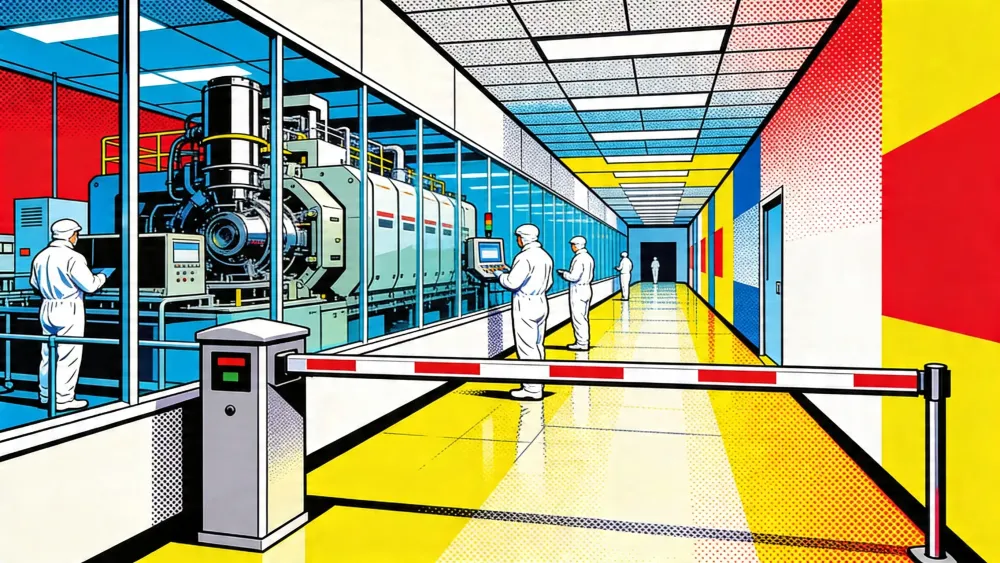
Christophe Fouquet did not need a new slogan on April 15. He had a number.
ASML, the Dutch company that makes the lithography systems behind advanced chips, raised its 2026 sales outlook to €36 billion to €40 billion after reporting €8.8 billion in first-quarter sales and €2.8 billion in net income. The old range was €34 billion to €39 billion. Gross margin stayed where it was, at 51% to 53%.
That last part matters. ASML did not tell investors it had found a cleaner path to profit. It told them customers were paying to get through the same physical gate faster.
The public story is easy. AI demand is strong. Chipmakers need more tools. ASML sells those tools. Shares move, analysts update models, everyone files the same paragraph.
The private truth is harsher. The AI race has run into a tollbooth. Not the GPU tollbooth everyone watched in 2023. Not the data-center power tollbooth that now haunts grid operators. This one sits in Veldhoven, where each extra wafer of advanced logic or high-bandwidth memory depends on machines that cannot be copied, rushed, or waved through by a budget committee.
ASML's raised guidance is the market admitting that machine time has become the scarce product.
Key Takeaways
- ASML's guidance raise prices scarce machine time, not just stronger AI demand.
- Memory drove the surprise as HBM shortages reached the lithography layer.
- China has shifted from growth cushion to downside band for ASML.
- The next signal is Low-NA EUV capacity, not quarterly orders.
AI-generated summary, reviewed by an editor. More on our AI guidelines.
The raise was not the real message
ASML's first-quarter result looked clean on the surface. CNBC reported that sales and profit beat LSEG consensus. The 2026 revenue range moved up. But the cleaner read is not "demand is better." Demand was already obvious from the record €13.2 billion in net bookings ASML reported for the fourth quarter of 2025, including €7.4 billion tied to EUV systems.
The April 15 message was conversion.
The company entered January carrying €38.8 billion in backlog. Fine. Paper demand. The money gets real only after a scanner lands in a fab, service teams tune the tool, field upgrades take, and revenue can be booked. Customers can sign long-term agreements. They can shout about AI factories. They can reserve capacity years ahead. None of it produces a wafer until ASML and its suppliers move a tool into place, qualify it, and keep it running.
That is why the company's installed-base business deserves more attention than the headline raise. Installed Base Management sales reached €2.49 billion in the first quarter, up from €2.13 billion in the prior quarter. In plain English, customers are not just waiting for new machines. They are squeezing more output from the machines already on the floor.
Investors can read that as confidence. They should also read it as anxiety.
When customers pay for field upgrades and performance packages, they are buying time. They are trying to pull capacity forward before new fabs arrive. ASML's guidance raise says the anxiety has become billable.
Memory dragged the bottleneck upstream
The surprise inside the quarter was memory. CNBC also reported that 51% of ASML's first-quarter new-tool sales went to memory, up from 30% in the previous quarter. South Korea accounted for 45% of system sales. China fell to 19%, down from 36%.
That is not a normal regional shuffle. It is the HBM shortage showing up in ASML's order book.
High-bandwidth memory sits beside AI accelerators and feeds them data fast enough to keep the processors useful. It is also a factory hog. It consumes more wafer, packaging, and process resources than conventional memory. As we wrote in December, AI is not merely creating new chip demand. It is cannibalizing old supply chains to feed itself.
Now the same pressure has reached lithography.
SK hynix, Samsung, and Micron are chasing HBM because the margins are better and the customers are desperate. S&P Global Market Intelligence reported that SK hynix plans to buy roughly $8 billion of ASML EUV equipment by the end of 2027. The same research group expects conventional DRAM revenue per bit to jump in 2026 as HBM pulls capacity away from ordinary memory.
That is the loop. AI labs need accelerators. Accelerators need HBM. HBM makers need advanced DRAM capacity. Advanced DRAM capacity needs lithography. The tollbooth gets paid at every pass.
The institutional emotion here is not excitement. It is fear of being last in line.
China stopped being the cushion
For ASML, China used to absorb a different kind of pressure. While EUV systems were blocked, Chinese customers bought large volumes of DUV equipment for mature-node capacity. That helped ASML through weaker parts of the cycle.
That cushion is thinner now.
Get the AI infrastructure story before it hits the invoice
Strategic AI news from San Francisco. No hype, no "AI will change everything" throat clearing. Just what moved, who won, and why it matters. Daily at 6am PST.
No spam. Unsubscribe anytime.
China's share of ASML system sales fell to 19% in the first quarter. ASML had already told investors that China's 2026 share would likely land near 20%, closer to backlog than the inflated levels of 2024 and 2025. Reuters reported that tougher export controls could pull ASML toward the low end of its new range, though some demand might be absorbed by other customers.
That sentence does a lot of work.
In a weak market, lost China sales would leave a hole. In this market, ASML can plausibly send scarce output to Taiwan, South Korea, or other customers racing to add AI-related capacity. That does not make export controls painless. It means the pain is now a range problem, not the whole story.
This is why the guidance raise is more interesting than a China-risk note. ASML raised the range while explicitly saying export-control talks are not settled. The floor moved up anyway. Taiwan, South Korea, and other buyers are pulling hard enough to carry part of the policy load.
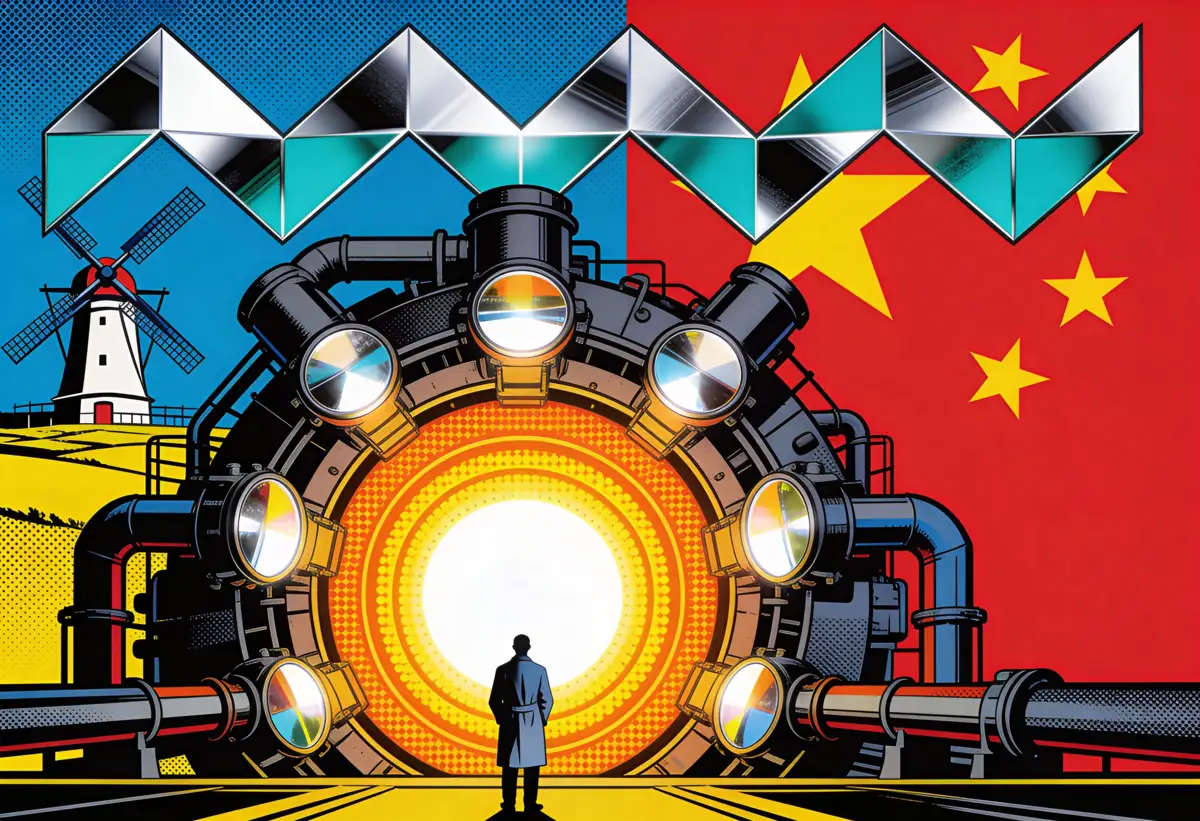
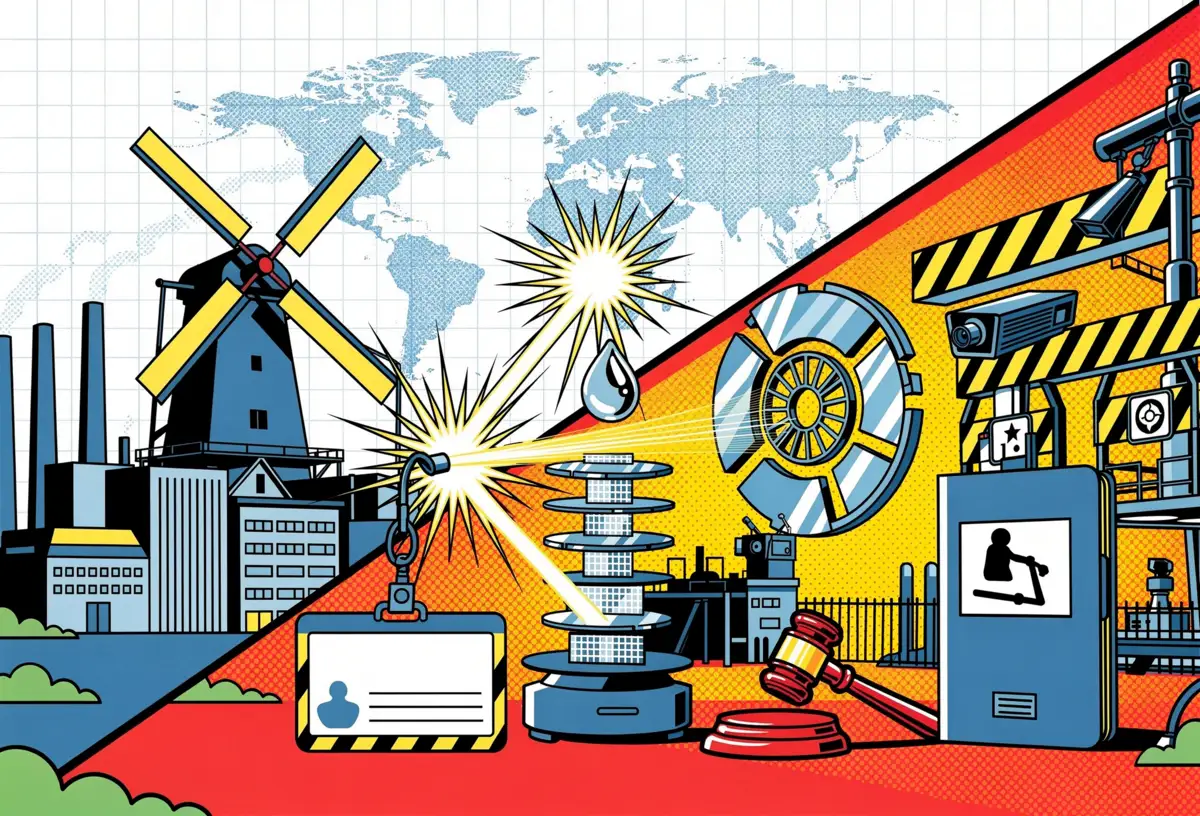
The three capitals still matter: Washington, The Hague, Beijing. DUV restrictions would hurt more than another EUV headline, because EUV is already blocked. But China is no longer the growth engine in this story. It is the downside band.
That shift changes ASML's political posture. A company that once needed China's mature-node demand to smooth the cycle now has memory and logic customers fighting for the same production slots. Relief, not triumph, is the emotion in that setup. Relief that non-China demand is strong enough to cover part of the policy risk. Relief that South Korea and Taiwan are pulling harder just as Washington is pushing harder. Relief that the range can rise while the risk section stays loud.
The old dashboard broke
ASML has stopped giving investors quarterly order numbers. The company says bookings were too lumpy to reflect business momentum. Fair enough. A single order can distort a quarter.
But the change also removes the market's favorite early-warning gauge.
So the market needs a new dashboard. Start with the guidance midpoint. Add installed-base sales. Add South Korea's share. Check whether memory stays above 50% of new-tool sales. Then look at TSMC's capital spending, the HBM orders from SK hynix, Samsung, and Micron, and ASML's own Low-NA EUV targets: 60 systems in 2026, capacity for 80 in 2027.
Those are not clean metrics. They are messier than one bookings number. They are also harder to game.
That 60-to-80 step is the number to track. Sixty Low-NA EUV systems this year, about 25% more than in 2025. Capacity for at least 80 next year if customers keep pushing. Not huge for its own sake. Useful because it tells investors whether the tollbooth can add lanes.
The next lane is throughput. Reuters got the other half of the answer in February from ASML's source team: a 1,000-watt EUV light source. If it works inside customer fabs, output rises from about 220 wafers an hour today to roughly 330 near decade's end. Not useful this quarter. Very useful for the tollbooth story. ASML is not only selling new machines. It is making each pass through the gate more valuable.
That matters because ASML is not a software vendor with a dial it can turn overnight. A lithography system is a traveling factory project: optics, lasers, stages, software, parts, installation, qualification, uptime. If one piece slips, the customer's AI schedule slips with it. That is why a throughput gain years away still changes bargaining power today. It tells customers the tollbooth operator is not just adding booths. It is trying to make each car move faster.
The real test is whether customers still wait
The bull case is simple. TSMC keeps spending. Memory stays tight. South Korea keeps buying. ASML turns backlog into shipments and upgrades. The 2026 raise becomes the early marker of a larger 2027 equipment cycle.
The bear case is not that AI demand vanishes. It does not have to. A slower hyperscaler capex cycle, a looser HBM market, a DUV export shock, or a supplier delay could all hit ASML while the AI story still looks healthy on stage. Long-lead-time systems do not forgive bad timing.
That is the part investors tend to miss. A supply chain can be both sold out and vulnerable. Scarcity creates pricing power. It also creates fragile schedules, political pressure, customer panic, and supplier choke points. ASML has all of them at once.
If you want the cleanest read on the AI buildout, ignore the word "AI" in ASML's statement. Look at who is paying for time. Memory customers are sold out. Logic customers are ramping several nodes. Installed-base upgrades are rising. China is shrinking but not breaking the range. Low-NA capacity is the number everyone will quietly track.
The tollbooth is still collecting.
And for now, the line is getting longer.
Frequently Asked Questions
Why did ASML raise its 2026 guidance?
ASML raised its 2026 sales outlook after strong first-quarter results and stronger customer demand for lithography capacity. The article argues the deeper signal is customers buying scarce machine time through new systems, upgrades, and service work.
Why does memory matter to ASML now?
HBM demand has pushed memory makers to expand advanced DRAM capacity. That capacity needs ASML lithography tools, which is why memory jumped to 51% of ASML's first-quarter new-tool sales.
How does China affect ASML's outlook?
China remains material, but its role has changed. Export controls and demand normalization moved China from a growth cushion to a downside band inside ASML's 2026 range.
What should investors watch after ASML stopped quarterly order disclosure?
Watch guidance midpoint, installed-base sales, memory share, South Korea's regional share, TSMC capex, memory-maker EUV orders, and ASML's Low-NA EUV capacity targets.
What is the tollbooth metaphor in the article?
The tollbooth is ASML's lithography bottleneck. AI companies, chipmakers, and memory suppliers can spend more, but advanced wafer capacity still has to pass through ASML's machines.
AI-generated summary, reviewed by an editor. More on our AI guidelines.

Free AI briefing · Weekdays
The AI stories that matter, sourced and explained.
Join the Morning Briefing. It goes out every weekday at 4:45 a.m. Pacific, with later sends for the East Coast, Berlin and Tokyo.
Free when you sign up: The Paperclip Compendium, our tested guide to running AI agents.
Free. Unsubscribe in one click.

Marcus Schuler
Editor-in-Chief and founder of Implicator.ai. Former ARD correspondent and senior broadcast journalist with 10+ years covering tech. Writes daily briefings on policy and market developments. Based in San Francisco. E-mail: editor@implicator.ai