IMPLICATOR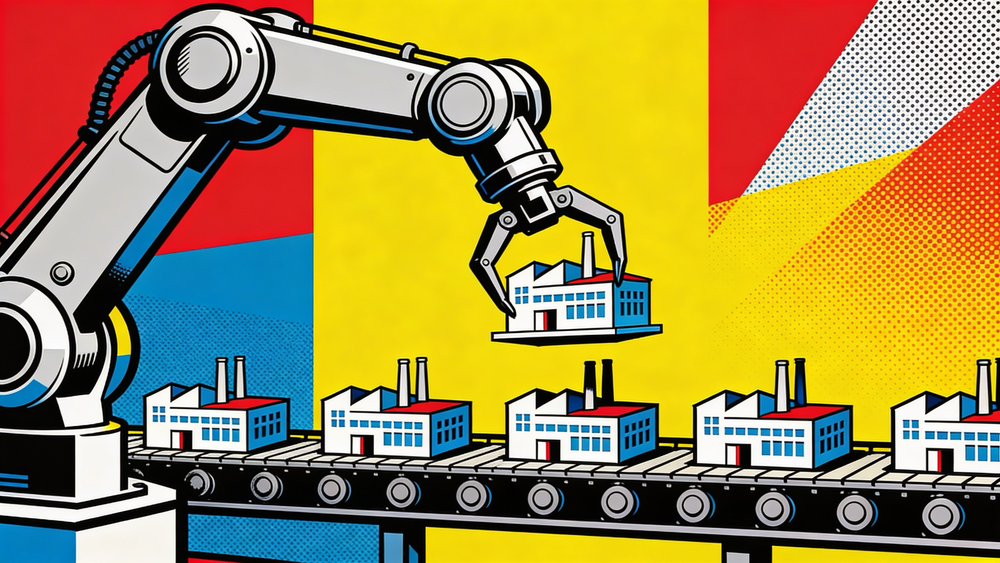
Jeff Bezos is raising as much as $100 billion for an investment fund that would acquire manufacturing companies and overhaul them with artificial intelligence, the Wall Street Journal reported Thursday. The Amazon founder has traveled to the Middle East and Singapore in recent months to pitch sovereign wealth funds and major asset managers on the project, according to people familiar with the discussions. The fund would operate alongside Project Prometheus, the AI startup where Bezos serves as co-CEO, the New York Times confirmed in a separate report citing three people briefed on the talks.
Internal investor documents describe the vehicle as a "manufacturing transformation fund." Its targets include chipmakers, defense contractors, and aerospace firms. At $100 billion, the fund would match SoftBank's Vision Fund in scale and dwarf most private equity buyout vehicles on the planet.
Bezos hasn't run a company since stepping down as Amazon's CEO in July 2021. Project Prometheus changed that. He took the co-CEO title last year alongside Vik Bajaj, a physicist and chemist who previously co-founded Google's life sciences division, now called Verily. Bajaj also worked closely with Google co-founder Sergey Brin at Google X, the research lab that incubated Waymo and Wing.
The Breakdown
• Bezos is pitching sovereign wealth funds on a $100B fund to buy and automate manufacturers in chips, defense, and aerospace
• Fund linked to Project Prometheus, his AI startup with $6.2B raised and 120 employees across San Francisco, London, and Zurich
• JPMorgan and Abu Dhabi Investment Authority among early backers in preliminary talks
• Sanders warns of mass job displacement as Amazon already nears a 1:1 robot-to-worker ratio in warehouses
What Prometheus actually builds
Prometheus isn't chasing the same AI that powers chatbots and code assistants. The startup develops models that simulate physical systems. Think airflow around a wing, stress fractures in metal parts, heat dissipation across circuit boards. Engineering simulation, not language generation.
On a factory floor, that means something specific. An aerospace manufacturer testing a new turbine blade design currently runs physical prototypes through wind tunnels and stress chambers. Weeks of work, millions in materials. Prometheus wants to replace chunks of that cycle with simulation, letting engineers iterate on designs inside software before cutting the first piece of titanium. The same logic applies to semiconductor fabrication, where modeling heat behavior across chip layers could reduce the trial-and-error that slows new process nodes.
The company raised $6.2 billion late last year and employs roughly 120 people across offices in San Francisco, London, and Zurich. Researchers hired from OpenAI and Google DeepMind fill its technical bench. Two of its founding advisors, Ashish Vaswani and Jakob Uszkoreit, co-authored the 2017 "Attention Is All You Need" paper. That paper introduced the transformer architecture behind every major language model today.
Prometheus also absorbed General Agents, a startup co-founded by former DeepMind researcher Sherjil Ozair and ex-OpenAI scientist William Guss. General Agents built Ace, a computer agent that performs tasks autonomously using a video-language-action model. That architecture matters for manufacturing. AI systems operating on a shop floor need to interpret physical environments, read sensor data, respond to equipment states. Text comprehension won't cut it.
The company is separately in talks to raise up to $6 billion more for its core AI operations, the Journal reported. David Limp, the CEO of Bezos-founded rocket company Blue Origin, recently joined the Prometheus board.
The fund's logic
Here's the playbook. Prometheus builds AI that understands physical engineering. The fund buys companies whose products live in that world, factories making chips, assembling aircraft components, machining defense hardware. Then Prometheus feeds its models into those operations to cut costs and speed up production cycles.
Some investment firms are already running a version of this strategy in sectors like accounting and property management, buying unsexy businesses and layering software on top to widen margins. Bezos wants to do the same thing at industrial scale.
That ambition has attracted serious backers. JPMorgan Chase is in preliminary talks to back the project through its Security and Resiliency Initiative, according to people familiar with the discussions. The bank launched a $10 billion fund for that effort last December and hired former Berkshire Hathaway investment manager Todd Combs to help lead it. JPMorgan's initiative focuses specifically on reinforcing American supply chains, a mandate that aligns with buying and upgrading domestic manufacturers. The Abu Dhabi Investment Authority is also among prospective backers, Forbes reported.
The sovereign wealth interest makes sense. Middle Eastern funds have been pouring capital into AI infrastructure for two years now, from data centers to chip investments. A fund that promises to bring AI into physical production, where the physics of materials and machines dictate the returns, offers a different kind of exposure. Bezos has the résumé to sell it. He built the company that turned warehouses into robot-operated fulfillment machines. Now he wants to do the same to factories.
Bezos told an audience at Italian Tech Week in October that AI would transform every company, including manufacturers. "It is going to make their quality go up and their productivity go up," he said. "I mean by every company I literally mean every company."
A crowded field with nervous incumbents
Bezos isn't alone in betting that AI will remake factories. Travis Kalanick, the former Uber CEO, relaunched his startup as Atoms with plans for AI-driven manufacturing. Elon Musk has pitched Tesla's humanoid robot Optimus as a factory floor revolution, though the program remains stuck in R&D with zero robots doing useful work in Tesla's own plants as of late January. Thrive Capital and General Catalyst have launched their own vehicles to buy legacy industrial firms and improve margins through software.
The difference is scope. Kalanick's Atoms operates at venture scale. Tesla's Optimus depends on a supply chain running through hundreds of Chinese component makers. Bezos is proposing something closer to a sovereign wealth fund with an AI thesis bolted on, and every target company comes with its own physics.
Private equity firms that specialize in industrial buyouts should be watching this closely. A $100 billion fund with proprietary AI technology entering their deal flow represents a new kind of competitor, one that can offer acquisition targets something beyond financial engineering. Traditional PE shops are already nervous about AI-native entrants bidding up prices on the same manufacturing assets they've been picking through for years.
But $100 billion pledges carry their own weight. When Apple committed that same figure to U.S. manufacturing last August, analysts quickly noted the pledge bundled existing supplier relationships and routine spending under a patriotic banner. The gap between announcement and execution in physical industries is measured in years and billions of dollars. Chipmaking infrastructure takes a decade to build. Defense manufacturing runs on government certification cycles that no AI model can accelerate.
Join 10,000+ AI professionals
Get implicator.ai delivered to your inbox every weekday morning.
Subscribe free
The automation question nobody wants to answer
Senator Bernie Sanders responded to the Journal's report within hours, posting on X that Bezos "plans to replace 600,000 Amazon workers with robots" and now aims to invest $100 billion to automate factories across the country. The 600,000 figure comes from internal Amazon documents reported last year suggesting the company could avoid hiring that many workers by expanding its robotics fleet.
Amazon already operates close to a one-to-one ratio of robots to human workers in its warehouses. Bezos built that system. The manufacturing fund would extend the same philosophy to chipmakers, defense plants, and aerospace suppliers, industries that employ millions of workers in jobs that have historically resisted automation.
Bezos has not addressed the workforce implications publicly. Neither has Prometheus. The investor documents reviewed by the Journal and the Times describe the fund in terms of efficiency and profitability, not headcount. But you don't raise $100 billion to buy factories and inject AI without someone on the shop floor losing a shift.
Physical AI meets physical constraints
Money is flowing. Billions of dollars have started moving toward companies that apply spatially focused AI to robotics and manufacturing, and the bets are getting larger. Physical Intelligence, a robotics startup Bezos invested in during 2024, raised capital to apply AI to robot dexterity. Periodic Labs, founded by researchers who left Meta, OpenAI, and DeepMind last year, is working on simulations to accelerate physics and chemistry discoveries.
Prometheus fits that wave. Its models aim to predict how materials behave and where components will fail, then feed those predictions back into production lines. If the technology works, the fund's portfolio companies become both customers and proving grounds.
That's a big if. Simulation AI for engineering is genuinely hard. The physical world doesn't cooperate the way a language corpus does. Airflow around a turbine blade involves equations that even supercomputers struggle to solve at production speed. And buying a chipmaker or defense contractor isn't like acquiring a SaaS company. You inherit union contracts, regulatory oversight, classified programs, supply chains stretching across continents. Every acquisition brings its own physics.
The talks remain early. No fund structure has been finalized, and the fundraising could take months or longer. Bezos did not respond to requests for comment. Prometheus co-founders Ozair and Guss did not reply to inquiries from Reuters.
What exists right now is a startup with 120 employees, $6.2 billion in the bank, and a co-CEO who just spent weeks flying between Riyadh and Singapore asking for the largest manufacturing buyout fund ever assembled. The pitch decks are circulating. The sovereign wealth funds are listening. The factories haven't changed yet.
Frequently Asked Questions
Q: What is Project Prometheus and what does it do?
A: Project Prometheus is an AI startup co-founded by Jeff Bezos and Vik Bajaj that builds models simulating physical systems like airflow, material stress, and heat dissipation. It raised $6.2 billion late last year and employs about 120 people. The company targets engineering simulation for aerospace, semiconductor, and defense manufacturing rather than language-based AI.
Q: How would the $100 billion fund work with Prometheus?
A: The fund would acquire manufacturing companies in chipmaking, defense, and aerospace. Prometheus would then deploy its physical simulation AI into those companies to improve efficiency and cut costs. The fund and Prometheus would operate under the same holding company, making portfolio companies both customers and proving grounds for the AI technology.
Q: Who is backing the fund so far?
A: JPMorgan Chase is in preliminary talks through its $10 billion Security and Resiliency Initiative, led by former Berkshire Hathaway manager Todd Combs. The Abu Dhabi Investment Authority is also among prospective backers. Bezos has pitched sovereign wealth funds across the Middle East and in Singapore over recent months.
Q: How does this compare to SoftBank's Vision Fund?
A: Both target $100 billion in scale, but the strategies differ. SoftBank's Vision Fund invested in tech startups across sectors. Bezos's fund would buy existing manufacturing companies and retool them with proprietary AI, closer to a private equity buyout model than a venture capital approach.
Q: What are the workforce implications?
A: Amazon already operates near a 1:1 robot-to-worker ratio in warehouses. Internal documents suggest Amazon could avoid hiring 600,000 workers through robotics expansion. The manufacturing fund would extend that automation philosophy to industries employing millions. Bezos and Prometheus have not publicly addressed workforce impact.

Marcus Schuler
Editor-in-Chief and founder of Implicator.ai. Former ARD correspondent and senior broadcast journalist with 10+ years covering tech. Writes daily briefings on policy and market developments. Based in San Francisco. E-mail: editor@implicator.ai