IMPLICATOR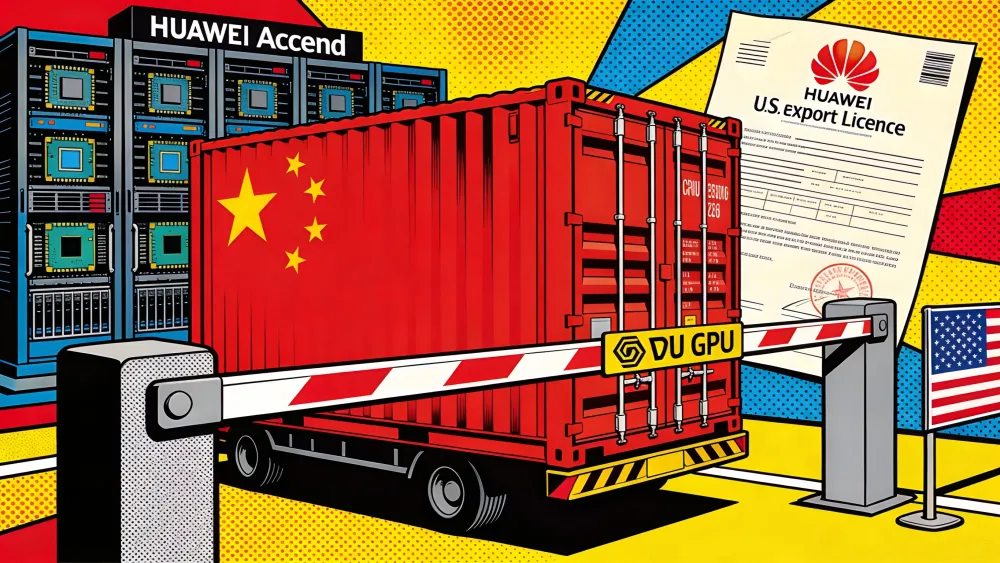
Nvidia CEO Jensen Huang said the company's direct share of China's AI accelerator market has fallen to zero, telling the Special Competitive Studies Project that U.S. export policy has "already largely backfired." The drop follows rules that cut off higher-end AI chips and then left H200 shipments caught between Commerce Department licenses, Chinese import limits and domestic-chip mandates. Huang framed the loss as a threat to American control of the AI software stack and to Nvidia's China sales.
Key Takeaways
- Huang said Nvidia's direct China accelerator share has fallen to zero after U.S. export rules.
- H200 approvals have not produced normal shipments amid U.S. license terms and Chinese import limits.
- Huawei Ascend demand is rising after DeepSeek V4, with 750,000 950PR units planned this year.
- Congress is pressing Commerce for H200 license, shipment and approval counts.
AI-generated summary, reviewed by an editor. More on our AI guidelines.
China sales stall
Tom's Hardware published the remarks Sunday, two years after Nvidia held most of China's AI accelerator market. Bernstein estimated earlier this year that Nvidia's China AI GPU share could fall from 66% in 2024 to about 8% as U.S. restrictions and domestic suppliers took hold.
Commerce Secretary Howard Lutnick told senators at an April 22 hearing that H200 chips had not been sold to Chinese companies, CNBC reported. Sen. Chris Coons asked Lutnick last week to detail how many H200 chips had received China export licenses, how many had shipped and how many more the Commerce Department planned to approve.
H200 approvals did not reopen the market
The Trump administration shifted H200 exports to case-by-case review in January, with third-party U.S. testing, security requirements and a cap limiting China shipments to no more than 50% of H200 volume sold to U.S. customers. Trump also tied the framework to a 25% government take on sales, a structure The Implicator covered when Washington turned China chip licenses into a revenue toll.
But those approvals did not translate into normal commerce. CSIS wrote in April that Nvidia had received limited H200 licenses but did not expect meaningful near-term shipments because both governments were restricting the market. Chinese customs officials had instructed agents in January that H200 chips were not permitted to enter China, according to the CSIS post.
Track the AI chip fight
Strategic AI news from San Francisco. No hype, no "AI will change everything" throat clearing. Just what moved, who won, and why it matters. Daily at 6am PST.
No spam. Unsubscribe anytime.
Huawei gains the opening
Huawei is now positioned to capture the largest share of China's AI chip market this year, according to a Financial Times report summarized by Tom's Hardware. Huawei expects AI chip revenue to rise to $12 billion from $7.5 billion in 2025, based on orders for its 950PR processor.
Reuters reported last week that Chinese internet companies were rushing to secure Huawei Ascend 950 chips after DeepSeek's V4 release. Huawei planned to ship about 750,000 950PR units this year, with mass production starting in April and full-scale shipments beginning in the second half of 2026.
Chinese buyers are redirecting compute demand through domestic suppliers while overseas Nvidia chips remain caught in licensing and import disputes. South China Morning Post cited Guotai Haitong Securities on Monday saying China's AI chip market could rise to 1.34 trillion yuan, or $196.2 billion, in 2029 from 142.5 billion yuan in 2024. Lutnick is due to answer Coons next week, putting shipment numbers back in front of Congress before the next U.S.-China talks.
Frequently Asked Questions
What did Jensen Huang say about Nvidia in China?
Huang said Nvidia's direct AI accelerator share in China had dropped to zero and argued that U.S. export policy had backfired by pushing demand toward local alternatives.
Why are H200 chips still stuck?
U.S. licenses require testing, security procedures and volume caps, while Chinese regulators have limited imports and pushed domestic hardware. That leaves shipments without normal clearance.
How does Huawei benefit?
Chinese buyers are ordering Huawei Ascend processors for inference and domestic AI deployments while H200 imports remain delayed. Huawei expects AI chip revenue growth in 2026.
Does China still have demand for AI chips?
Yes. South China Morning Post cited Guotai Haitong Securities forecasting China's AI chip market at 1.34 trillion yuan in 2029, up from 142.5 billion yuan in 2024.
What happens next?
Commerce Secretary Howard Lutnick is due to answer Sen. Chris Coons about H200 licenses, shipments and planned approvals, putting shipment data back before Congress.
AI-generated summary, reviewed by an editor. More on our AI guidelines.


Marcus Schuler
Editor-in-Chief and founder of Implicator.ai. Former ARD correspondent and senior broadcast journalist with 10+ years covering tech. Writes daily briefings on policy and market developments. Based in San Francisco. E-mail: editor@implicator.ai