IMPLICATOR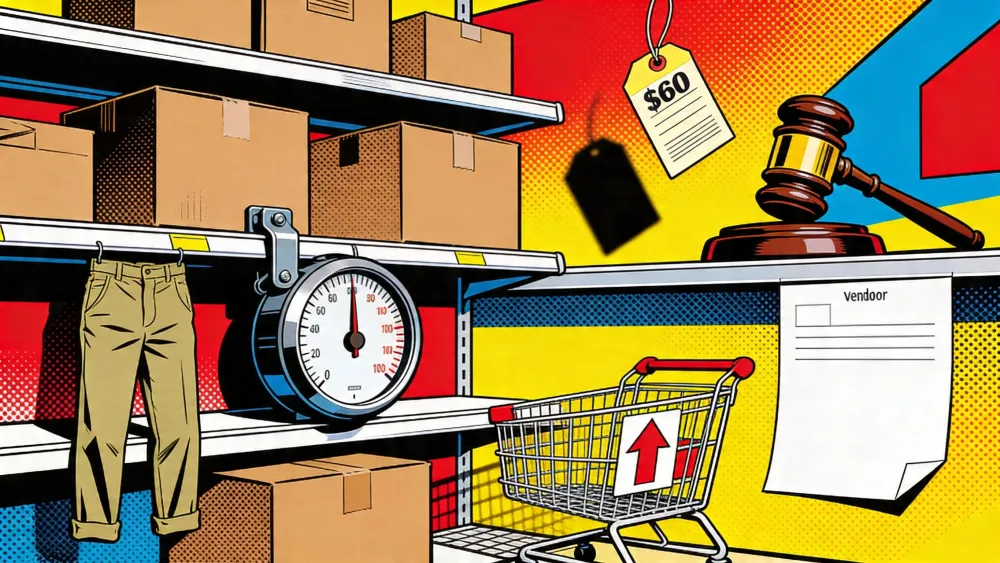
California accused Amazon on Monday of pressuring brands including Levi's and Hanes to ask rival retailers to raise prices, according to a newly unsealed filing and a state evidence release in California's antitrust case against the company. The pants are the giveaway. Amazon pointed Levi's to Walmart's lower khaki price, California says. Walmart later took that product to $29.99 from a $25.47-$26.99 range. Court now becomes the second marketplace: an injunction hearing on July 23, then a January 19, 2027 trial if the schedule holds.
That is the news. The argument underneath it is sharper: California is trying to prove that Amazon's low-price image works like a price thermostat for the rest of online retail. When the market cools below Amazon's comfort level, the state's motion says, Amazon does not always cut its own price and accept the margin hit. It allegedly finds the brand, points to the colder price somewhere else, and waits for the room to warm back up.
If that theory survives, Amazon has a problem larger than one state lawsuit. Its defense has always sounded simple. Customers see low prices. Sellers get access to demand. Rivals can compete. But the new filings put a different machine on the table, one where the lowest price you see may already have been adjusted before it reached you.
Key Takeaways
- California says Amazon used brands as go-betweens to push rival retailers toward higher prices.
- Levi's khakis moved from a $25.47-$26.99 range to $29.99 after Amazon flagged the gap, the state says.
- Amazon disputes the case and points to studies calling it America's lowest-priced online retailer.
- The test is whether online prices can fall without Amazon's permission.
AI-generated summary, reviewed by an editor. More on our AI guidelines.
California's case now has names, products and prices
The strongest part of California's new filing is not the legal language. It is the receipt drawer.
In the public evidence release, Attorney General Rob Bonta's office lists specific products and retailers. Levi's khaki pants. Hanes apparel. Allergan eyedrops. Agrothrive fertilizer. Canine Naturals pet treats. Songmic trash cans. The state says Amazon sent brands links to cheaper listings elsewhere, then brands reported back that rivals had raised prices or removed products.
The Levi's example does the most work because the math is so plain. According to the motion for a preliminary injunction, Walmart had Easy Khaki Classic pants at $25.47 to $26.99. Levi's later told Amazon that Walmart had moved one product to $29.99. Amazon then matched the higher price, the state says.
Call that a $3 to $4.52 difference on one pair of pants. Small enough to miss. Large enough to reveal the system. If the cheaper competitor's price disappears and Amazon matches the new higher price, the consumer never sees the fight. You just see a neat shelf.
Amazon rejects the state's account. In a statement quoted by The New York Times, spokesman Mark Blafkin called the filing an attempt to distract from weakness in California's case and said Amazon is identified as America's lowest-priced online retailer. That defense matters. It is also exactly why the case matters.
The low-price defense is also the pressure point
Amazon wants the court and the public to look at the final tag. California wants them to look at how the tag got there.
Those are different questions. Amazon can be cheaper than many rivals on average and still face legal risk if regulators prove that some prices stayed high because Amazon used brands to discipline cheaper channels. The company's public low-price story does not answer the mechanism claim. It leans on the outcome.
Amazon's own retail blog points to a 2025 Profitero study saying Amazon prices averaged 14% lower than 23 major online retailers across more than 10,000 items. Profitero's own write-up says Amazon led for the ninth straight year, with Walmart narrowing the gap. That is useful for Amazon. It is not a legal force field.
Here is the uncomfortable calculation. If a retailer wins the low-price study partly because lower outside prices get pulled up, then the study measures the after-market temperature, not the natural weather. The thermostat metaphor matters. A thermostat can keep a room comfortable while hiding how often the furnace had to fire.
For regulators, that is the opening. They do not need to prove Amazon never offers bargains. They need to prove Amazon used its gatekeeping power to blunt price cuts elsewhere. That is a narrower claim, and a more dangerous one for Amazon because it moves the debate from public reputation to emails, vendor testimony and product-level price paths.
Vendors look cornered, not loyal
The vendor role is the case's hinge.
Amazon's price machine is on trial
Strategic AI news from San Francisco. No hype, no "AI will change everything" throat clearing. Just what moved, who won, and why it matters. Daily at 6am PST.
No spam. Unsubscribe anytime.
California's theory depends on brands acting as the carrier wire between Amazon and rival retailers. That creates a proof problem because the state says Amazon did not always speak directly with competitors. But it also creates a business problem for Amazon. The more anxious and dependent those vendors look, the less this resembles ordinary bargaining.
The Guardian's review of previously redacted records gives that anxiety a human shape. A clothing-company owner testified about a Buy Box suppression after a one-cent price gap between Amazon and Walmart. A garden supplier testified that losing the Buy Box could cut his Amazon sales by about 80%. Those are not gentle nudges. Those are falling-elevator numbers.
If you sell through Amazon, the Buy Box is not a nice display slot. It is the door. Losing it can turn a product from visible to buried. That gives Amazon an answer to rivals without writing a cartel memo. It can tell a vendor that another site is cheaper, threaten margin or visibility consequences, then let the vendor do the awkward part.
That is why the motion's phone-call allegations matter. California says Amazon trained employees to avoid some written discussions about price matching and to handle sensitive vendor conversations verbally. Amazon will have its chance to contest that. Still, the optics are bad. A company proud of its price tools should not want a record filled with instructions to take pricing conversations off email.
The FTC backdrop makes this harder to isolate
Amazon would prefer to treat California's case as a state complaint built around old evidence. The broader regulatory record makes that harder.
The Federal Trade Commission and 17 states sued Amazon in 2023, alleging that the company used marketplace power to inflate prices on and off Amazon, overcharge sellers and block competition. Separate FTC allegations about Project Nessie claimed Amazon used a pricing algorithm to identify products where it could raise prices and other retailers would follow. Amazon has denied the FTC's account and said Nessie was mischaracterized.
These cases are not identical. The FTC case centers on monopoly maintenance. California's new injunction motion targets alleged first-party retail price fixing through vendors. But they rhyme. Both challenge the same public myth: that Amazon's price machine simply finds the lowest sustainable number and passes savings to shoppers.
Regulators now sound emboldened because they see a pattern. Amazon sounds defensive because the pattern threatens a story it has spent years teaching customers to believe. The company does not have to lose every antitrust argument for that story to bleed. It only has to lose the clean version.
And that is the strategic risk. If the court treats these vendor communications as ordinary retail management, Amazon gets a strong answer before trial. If the court sees them as price-fixing evidence, every brand relationship that touches off-platform pricing starts to look radioactive.
The test is whether prices can fall without permission
The consumer harm in this case is hard to feel because the numbers arrive as small deltas. A few dollars on pants. A few dollars on eyedrops. A penny in a pajama example from an earlier record. Nobody notices the thermostat moving one click.
But antitrust cases often turn on quiet mechanics. You do not need a dramatic invoice to have a market problem. You need a rule, explicit or implied, that keeps prices from falling when they otherwise would. California says it has found that rule in Amazon's vendor pressure. Amazon says the state is misreading conduct that helps keep prices competitive and products available.
The court's job now is to decide which version sounds more like the documents. The public's job is simpler. When a retailer says it has the lowest price, ask whether the market got to set that price freely.
The next Amazon discount may still be real. The question is who had to raise theirs first.
Frequently Asked Questions
What did California accuse Amazon of?
California says Amazon pressured brands including Levi's and Hanes to ask rival retailers to raise prices or remove cheaper listings. Amazon disputes the state's account and says its pricing practices help customers find low prices.
What is the Levi's khaki example?
California says Amazon flagged Walmart's lower price on Levi's Easy Khaki Classic pants through Levi's. Walmart later moved one product from a $25.47-$26.99 range to $29.99, and Amazon matched that higher price.
What is Amazon's defense?
Amazon says California is misreading its conduct and trying to distract from weakness in the case. The company also points to outside pricing studies that identify Amazon as America's lowest-priced online retailer.
Why does the Buy Box matter?
The Buy Box is the main purchase area on an Amazon product page. Sellers and vendors can lose visibility and sales when a product is suppressed there, which gives Amazon strong bargaining power over pricing behavior.
What happens next in court?
Judge Ethan P. Schulman is scheduled to hear California's preliminary injunction request on July 23, 2026. The trial calendar lists January 19, 2027, as the start date.
AI-generated summary, reviewed by an editor. More on our AI guidelines.
Free AI briefing · Weekdays
The AI stories that matter, sourced and explained.
Join the Morning Briefing. It goes out every weekday at 4:45 a.m. Pacific, with later sends for the East Coast, Berlin and Tokyo.
Free when you sign up: The Paperclip Compendium, our tested guide to running AI agents.
Free. Unsubscribe in one click.

Marcus Schuler
Editor-in-Chief and founder of Implicator.ai. Former ARD correspondent and senior broadcast journalist with 10+ years covering tech. Writes daily briefings on policy and market developments. Based in San Francisco. E-mail: editor@implicator.ai