


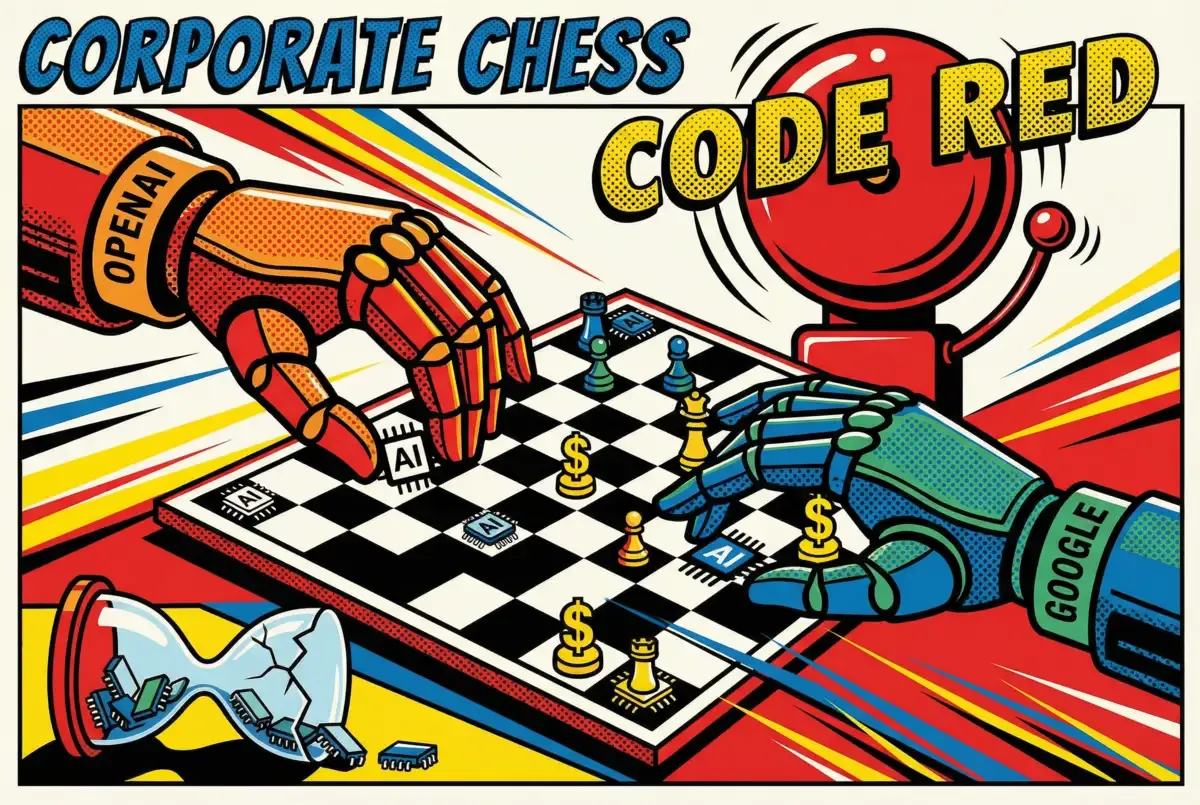
OpenAI dropped GPT-5.2 just one month after shipping 5.1. Nobody releases major model upgrades that fast unless something's wrong.
What was wrong: Sam Altman's December 1 "Code Red" memo. Google's Gemini 3 had become, in his words, the most credible threat OpenAI had faced. Ten days later, here we are.
The model itself? Genuinely impressive. Professional task scores nearly doubled. Coding benchmarks climbed to new records. Factual errors fell by more than a third. But you're paying for those gains. API costs jumped 40%. Free users got nothing. And whether the compressed timeline left enough room for proper testing remains an open question.
Quick Summary
• GPT-5.2 launched December 11, ten days after Altman's "Code Red" memo warning that Google's Gemini posed serious competitive threat
• Consumer pricing unchanged ($20 Plus, $200 Pro), but API costs rose 40% with Pro tier running $21/$168 per million tokens
• Professional task performance nearly doubled to 70.9% expert-level, coding benchmarks hit records, factual errors dropped 38%
• DeepSeek and Mistral now offer comparable models at a fraction of the cost, intensifying pressure on OpenAI's premium pricing
Pricing and Costs
Consumer subscriptions stayed flat while API rates climbed. OpenAI's argument is that better efficiency justifies the premium. Your mileage will vary.
Consumer Plans
- ChatGPT Plus holds at $20 monthly. That gets you GPT-5.2 Thinking mode when you need it for harder problems.
- ChatGPT Pro unchanged at $200 monthly. Full access to GPT-5.2 Pro, the heavy-duty variant OpenAI built for maximum accuracy. Unlimited usage.
- Business and Enterprise tiers keep their existing per-seat pricing. OpenAI didn't use the 5.2 launch to squeeze enterprise customers. Not yet, anyway.
API Pricing
- GPT-5.2 Thinking runs $1.75 per million input tokens, $14.00 per million output. Compare that to GPT-5.1 at $1.25 and $10.00. A meaningful jump.
- GPT-5.2 Pro gets expensive fast. $21.00 per million input, $168.00 per million output. Few commercial LLMs cost more to run at scale.
- The competition? Google's Gemini 3 Pro charges around $2.00 input and $12.00 output per million. Anthropic's Claude 4.5 sits between $1 and $5 per million input depending on which variant you're running.
Sign up for Implicator.ai
Strategic AI news from San Francisco. Clear reporting on power, money, and policy. Delivered daily at 6am PST.
No spam. Unsubscribe anytime.
The Efficiency Pitch
OpenAI points to dramatic compute savings to justify the price bump. That reasoning benchmark that cost $4,500 per run last year? GPT-5.2 Pro handles it for $11.64. Nearly 390 times cheaper.
The company also claims you'll need fewer back-and-forth exchanges to get usable results. Whether that math works out depends on what you're building.
What It Actually Costs OpenAI
Running these models bleeds money. OpenAI reportedly burned through its discounted cloud credits and now pays cash for GPU time. Every complex Thinking or Pro query triggers expensive parallel processing. The pricing has to cover that somehow.
Model Versions
Three configurations. Speed versus reasoning depth. Pick based on what you're actually trying to do.
GPT-5.2 Instant
The quick version. Email drafts, translations, information lookups, basic questions. GPT-5.2 running lean to prioritize response time over deep analysis.
GPT-5.2 Thinking
Where things get interesting. Code debugging, document analysis, financial modeling, multi-step planning. Takes longer. Uses more compute. Applies chain-of-thought reasoning to work through problems methodically rather than pattern-matching to an answer.
GPT-5.2 Pro
Maximum accuracy for maximum cost. Legal analysis, complex research, anything where being wrong creates real problems. OpenAI calls it their "smartest and most trustworthy option." Reserved for Pro subscribers and a dedicated API endpoint.
Context Window
The input ceiling sits at 400,000 tokens across all variants. Output maxes at 128,000. Rough translation: you can paste in something the length of a short novel and get back a small book. Lawyers testing contract review, analysts processing earnings calls, developers feeding in entire codebases. The use cases expand considerably at this scale.
Free Users Left Out
No GPT-5.2 Mini. No lightweight version for the free tier. If you're not paying, you're probably still on GPT-5 or a slimmed-down 5.1. OpenAI has always gated its best capabilities behind subscriptions, but the gap between free and paid just got wider.
Strengths
The improvements show up across professional work, coding, logical reasoning, and factual reliability. Early testing supports most of OpenAI's claims.
Professional Task Performance
GDPval simulates 44 different jobs worth of tasks. GPT-5.2 Thinking hit expert-level quality on 70.9% of them. The previous version managed around 38%.
Slide decks, multi-sheet spreadsheets, legal documents, marketing strategies. The model produces work with formatting and structure that human evaluators found genuinely usable. One tester said the output looked like it came from "a professional company with staff." High praise, though minor errors still snuck through.
Speed matters here too. GPT-5.2 finished those GDPval tasks 11 times faster than human experts, at less than 1% of the cost. Obviously humans still review the work. But the economics are shifting.
Coding and Debugging
SWE-Bench Pro tests real software engineering across Python, Java, C++, and JavaScript. GPT-5.2 scored 55.6%. That beats GPT-5.1's 50.8% and edges past what Google and Meta have shown publicly.
Python-specific testing (SWE-Bench Verified) came in at 80% correctness.
What does that mean practically? The model catches more bugs, suggests better fixes, and handles multi-step coding workflows with less hand-holding. Developers using it as a pair programmer report fewer obvious misses.
Reasoning and Accuracy
ARC-AGI-1 measures abstract reasoning. GPT-5.2 Pro became the first model to crack 90%, posting 90.5%. The Thinking variant scored 86%, climbing from roughly 73% in earlier versions.
Math performance hit 100% on AIME 2025. That's a legitimately difficult competition designed for top high school students.
Factual errors dropped by 38% in OpenAI's internal testing. Independent checks found similar reductions. The model seems more willing to acknowledge uncertainty rather than confidently making things up. Progress, not perfection.
Long-Context Capabilities
Four hundred thousand tokens of input means you can throw an entire annual report at this thing. Or a lengthy contract bundle. Or a substantial codebase.
More importantly, the model maintains coherence across that full span. Ask about something from page 200 and it still remembers page 3. Lawyers have tested contract review workflows. Data scientists have processed large datasets converted to text format. Financial analysts dump spreadsheet exports for interpretation.
Tool integration improved as well. OpenAI demoed a travel rebooking scenario where GPT-5.2 autonomously navigated airline websites, processed policies, and resolved a complex multi-flight cancellation. That kind of agentic behavior suggests the gap between chatbot and actual assistant is narrowing.
Visual Understanding
OpenAI positions GPT-5.2 as their strongest vision model for analysis. ScreenSpot-Pro tests how well AI understands GUI screenshots. GPT-5.2 scored 86.3% versus 64.2% for the previous version.
OCR performance jumped noticeably. Show it a chart, a diagram, a scanned form. It's substantially better at extracting meaning from visual inputs now.
Weaknesses
Every capability comes with a cost. Sometimes literal.
Computational Demands
Thinking and Pro modes are slow. They have to be. The reasoning that makes them useful requires substantially more processing than basic chat responses.
Complex queries can take noticeably longer than equivalent requests to GPT-4. Enterprise users running high volumes through the API need to provision accordingly. More GPU capacity. Bigger cloud bills. The performance gains don't come free.
Image Generation Stalled
GPT-5.2 did nothing for OpenAI's ability to create images. Still DALL-E 3 under the hood.
Meanwhile, Google shipped Gemini 3 with integrated image generation that reviewers called impressive. Text-to-image, image editing, the whole package. OpenAI acknowledged nothing on this front. Altman flagged it as a priority internally, but 5.2 didn't deliver. The gap with Google on visual content creation just got more obvious.
Hallucinations Haven't Disappeared
Down 38% isn't zero. The model still occasionally produces confident nonsense. Fabricated citations. Overgeneralized claims. Logically structured arguments built on incorrect premises.
For anything high-stakes, verification remains non-negotiable. Better isn't the same as reliable.
The Rushed Timeline Question
One month between major releases. That's not normal. Reports suggest some OpenAI employees pushed for delay, wanting more time for training refinement and safety work. Leadership overruled them.
OpenAI insists 5.2 had been in development for months, that the Code Red memo just sharpened focus. Maybe. But the optics of shipping a major upgrade ten days after your CEO declares competitive emergency aren't great. The question of whether adequate testing happened will follow this release.
The Personality Shift
Long-time ChatGPT users noticed something different. GPT-5.2 writes more formally. More businesslike. Some of the conversational spark from earlier versions seems muted.
OpenAI acknowledged this directly, keeping GPT-5.1 available because "some users may find they prefer the vibes of the previous model." Organizations with carefully tuned prompts built around 5.1's patterns found they needed adjustments. The upgrade wasn't seamless for everyone.
Lawsuits and Regulatory Heat
OpenAI still faces litigation over alleged use of copyrighted training data. Regulators keep pushing on transparency and safety practices.
Each capability improvement amplifies the concern. A model that produces professional-quality documents also produces professional-quality fakes. The scrutiny intensifies proportionally.
Competition
The comfortable lead OpenAI enjoyed eighteen months ago has evaporated. Multiple companies now field models that compete credibly across different dimensions.
Google Gemini 3
The reason for the Code Red. Gemini handles text, images, and multimodal inputs with deep integration across Google's product ecosystem.
Currently holds top position on several LMArena leaderboard categories. Pricing matches ChatGPT Plus at $20 monthly for Google AI Pro.
GPT-5.2 beats Gemini on coding and certain reasoning benchmarks. Gemini leads on image generation and some multimodal tasks. Neither dominates comprehensively.
Anthropic Claude 4.5
The safety-focused alternative. Claude handles contexts exceeding 200,000 tokens and emphasizes controllable, predictable behavior for enterprise deployments.
Claude Opus 4.5 edges GPT-5.2 on some coding benchmarks, including LMArena's WebDev ranking. But GPT-5.2 likely overtakes it on math and science evaluations. Pricing runs around $5 per million input for the Opus tier.
DeepSeek V3.2
The wild card. Chinese startup released two models a week before GPT-5.2 that match its performance on many benchmarks. Both open-source under MIT license.
The math is eye-catching: $0.70 per million tokens versus OpenAI's premium pricing. DeepSeek introduced sparse attention mechanisms that cut compute requirements by roughly 70%. Whether quality holds up under broad deployment remains to be seen, but the price pressure is real.
xAI Grok 4.1
Musk's entry briefly topped LMArena's text leaderboard in early December with an Elo of 1483. Marketed as ChatGPT with fewer guardrails. API pricing around $0.20 to $0.50 per million tokens makes it significantly cheaper than OpenAI's offerings.
Strong on general chat. Less extensively benchmarked on formal coding and math evaluations. Appeals to users who found ChatGPT's content policies too restrictive.
Mistral AI
European competitor valued at $13 billion. Their Devstral 2 targets coding specifically, with a 24B parameter open-source version and the full 123B model at $0.40 per million input.
That's an order of magnitude cheaper than GPT-5.2. Mistral pitches self-hosting options and GDPR-friendly data handling for companies wary of American AI providers.
Why This Matters
GPT-5.2 represents OpenAI defending territory rather than expanding it. The technical improvements are substantial and genuine. Professional task performance nearly doubled. Coding reached new highs. Factual reliability improved meaningfully.
But the circumstances of this release tell their own story. The Code Red memo. The compressed timeline. The pricing premium required to sustain compute costs. The widening capability gap on image generation. OpenAI shipped a strong model under pressure, and both parts of that sentence matter.
For users, the practical question is straightforward. State-of-the-art reasoning at premium prices, or credible alternatives at substantially lower costs? The answer depends on what you're building and how much accuracy margins matter.
The AI model market has become genuinely competitive. That's good for everyone except companies that built business plans assuming scarcity would persist.
Get Implicator.ai in your inbox
Strategic AI news from San Francisco. No hype, no “AI will change everything” throat clearing. Just what moved, who won, and why it matters. Daily at 6am PST.
No spam. Unsubscribe anytime.
❓ Frequently Asked Questions
Q: What's the actual difference between Thinking and Pro modes?
A: Both use chain-of-thought reasoning, but Pro throws more compute at each query. On the ARC-AGI-1 reasoning benchmark, Thinking scored 86% while Pro hit 90.5%. Pro costs roughly 12 times more via API ($21/$168 per million tokens versus $1.75/$14). For most tasks, Thinking suffices. Reserve Pro for work where small accuracy gains justify the cost.
Q: Can I still use GPT-5.1 if I don't like 5.2?
A: Yes. OpenAI kept GPT-5.1 available in the interface specifically because some users prefer its conversational style. The company acknowledged that 5.2 feels more formal and businesslike. If your workflows depend on 5.1's patterns or you find 5.2's tone too stiff, you can switch back through the model selector.
Q: When will free ChatGPT users get access to GPT-5.2?
A: OpenAI hasn't announced a timeline. Free users currently run on older models, likely GPT-5 or a distilled 5.1 variant. Historically, OpenAI waits several months before trickling advanced capabilities down to free tiers. Given 5.2's high compute costs, a lightweight "Mini" version would need to ship first. No such model was announced at launch.
Q: How much text can I actually paste into one GPT-5.2 conversation?
A: The 400,000-token input limit translates to roughly 300 pages of standard text. You could paste an entire novel, a full legal contract bundle, or a substantial codebase. The model maintains coherence across that span, remembering content from early pages when answering questions about later sections. Output caps at 128,000 tokens, around 100 pages.
Q: Is GPT-5.2 actually better than Claude 4.5 for coding?
A: Depends on the task. GPT-5.2 scored 55.6% on SWE-Bench Pro versus Claude's performance in the low 50s. But Claude Opus 4.5 still edges GPT-5.2 on LMArena's WebDev ranking. For general software engineering, GPT-5.2 holds a slight advantage. For web development specifically, Claude remains competitive. The gap between them is narrow enough that preference may matter more than benchmarks.
Q: What was the "Code Red" memo everyone keeps mentioning?
A: On December 1, 2025, Sam Altman sent an internal memo warning that Google's Gemini 3 posed the most serious competitive threat OpenAI had ever faced. Ten days later, GPT-5.2 shipped. OpenAI claims the model had been in development for months and the memo just sharpened focus. Critics argue the timeline suggests market pressure compressed necessary testing.
Q: Should I consider DeepSeek instead of GPT-5.2?
A: If cost matters, yes. DeepSeek V3.2 matches GPT-5.2 on many benchmarks at $0.70 per million tokens, a fraction of OpenAI's pricing. It scored 96% on AIME 2025 math problems and performs competitively on coding tasks. The catch: it's newer, less battle-tested in production, and comes from a Chinese startup, which may raise data handling questions for some organizations.
Q: Does the 38% reduction in hallucinations actually matter?
A: It's meaningful but not transformative. A 38% drop means roughly one-third fewer fabricated facts, invented citations, and confident wrong answers. That helps, especially at scale. But GPT-5.2 still hallucinates. For legal documents, medical information, financial analysis, or anything where errors create real problems, you still need human verification. Better isn't the same as reliable.
 Marcus Schuler
 Marcus Schuler
 Marcus Schuler