IMPLICATOR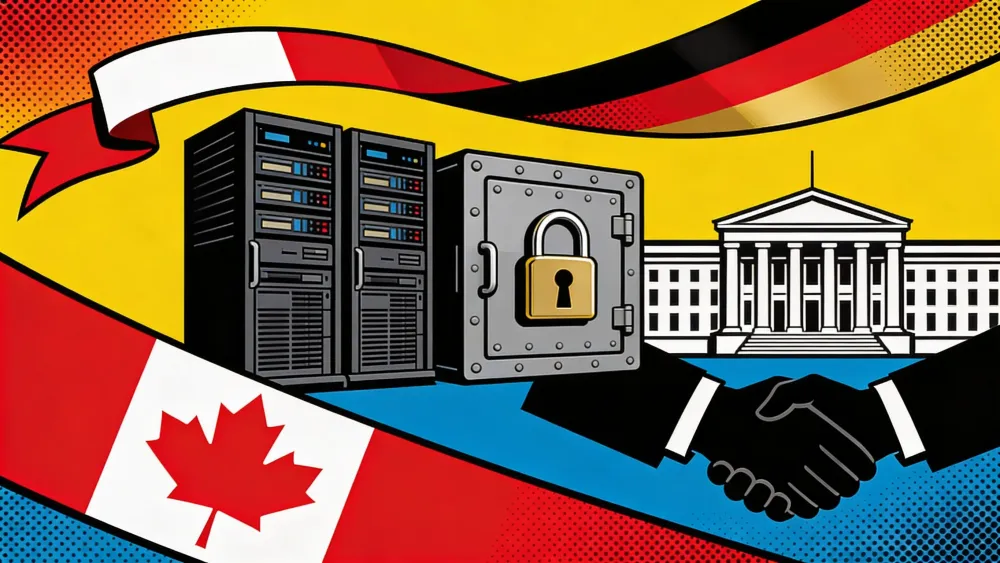
Cohere has agreed to buy Germany's Aleph Alpha in a transatlantic AI deal that people familiar with the terms put at about $20 billion. The planned combination would keep the Cohere name, run from Canada and Germany, and lean on a $600 million Schwarz Group commitment for Cohere's next funding round. The bet is plain: governments want AI they can procure without handing the keys to OpenAI, Google, or China.
The companies framed the deal as a sovereign AI alliance in a joint announcement published by Schwarz Digits, while the Financial Times reported the roughly $20 billion valuation and the one-for-nine share exchange for Aleph Alpha investors. That arithmetic matters. Aleph Alpha shareholders would receive about 10% of the combined company, according to multiple reports, making this a Canadian acquisition with German political armor.
Key Takeaways
- Cohere is buying Aleph Alpha in a deal reported at about $20 billion.
- Schwarz Group plans a $600 million structured commitment for Cohere's next funding round.
- The companies are pitching sovereign AI for governments and regulated enterprise buyers.
- The ownership split leaves Cohere shareholders with about 90% of the combined company.
AI-generated summary, reviewed by an editor. More on our AI guidelines.
The number is doing political work
The $20 billion figure gives Berlin and Ottawa a trophy big enough to place beside American AI labs. It also asks investors to believe that government trust, local infrastructure, and procurement access can reprice two smaller enterprise AI companies in one stroke.
Cohere was valued at $6.8 billion after a $500 million raise last year, according to Reuters coverage republished by The Economic Times. Aleph Alpha was valued at roughly EUR500 million in 2023, according to the FT. Even if you use Bloomberg's later Cohere mark near $7 billion, the reported merger value implies a large premium for access, not just code.
That is the deal in one line. About $600 million of fresh Schwarz money is being used to sell a $20 billion sovereignty story.
Schwarz brings the missing machine room
Schwarz Group is not just a financial backer. The Lidl and Kaufland owner has been a major Aleph Alpha shareholder, and its Schwarz Digits unit runs STACKIT, the cloud service that the companies say will host part of the sovereign offering.
That changes the pitch. A model company can promise data control in a slide deck. A retailer with German data centers can put the promise in a procurement document, with racks, contracts, and local law attached. For a ministry buyer, that paperwork is not cosmetic. It decides where citizen data sits, who can inspect the system, and which court has power when something breaks.
CNBC reported that Aleph Alpha's contracts with Germany's digital ministry and the Baden-Wuerttemberg regional government were part of the attraction for Cohere. That makes sense. Cohere already sells to enterprises. What it lacked was a fast lane into Europe's most symbolically loaded public AI market.
Follow the AI infrastructure race
Strategic AI news from San Francisco. No hype, no "AI will change everything" throat clearing. Just what moved, who won, and why it matters. Daily at 6am PST.
No spam. Unsubscribe anytime.
Aleph Alpha arrives humbled
Aleph Alpha was once pitched as Germany's answer to OpenAI. Then the cost of the frontier model race bit down. The Heidelberg company pivoted in 2024 toward applications, deployment, and its PhariaAI platform, a practical retreat from trying to outspend U.S. labs on general-purpose models.
That retreat now looks useful. Aleph Alpha brings public-sector relationships, European regulatory muscle memory, and a brand that still means something in Berlin. Cohere brings stronger model work, enterprise sales, and Canadian government backing. Neither side alone looked like a global counterweight. Together, they look more like a procurement vehicle with a model lab bolted to the front.
The human churn still matters. The Decoder reported that founder Jonas Andrulis left after losing the CEO role, and that Aleph Alpha cut about 50 jobs in early 2026. So this is not a victory lap for Europe's original AI dream. It is a rescue path after the dream got too expensive.
Sovereignty now has a share table
Canada and Germany both put ministers beside the announcement because the deal fits a larger mood. Middle powers no longer want to discover, after signing the cloud contract, that their AI stack answers to someone else's export policy, subpoena system, or pricing model.
That does not make the combined company European. Cohere keeps the name. Its shareholders would own roughly 90%. Toronto remains central. If you are a German buyer, that distinction matters, even if the data center sits on German soil.
Still, absence counts too. Without the deal, Aleph Alpha remains a weakened national champion and Cohere remains a Canadian enterprise AI company trying to win Europe one contract at a time. With it, both governments get a body they can point to when they say sovereign AI is more than a slogan.
The next proof is not another ministerial quote. It is the Series E close, a signed public contract, and a server invoice.
Frequently Asked Questions
What did Cohere announce?
Cohere agreed to buy Germany's Aleph Alpha and combine the companies under the Cohere name, with operations anchored in Canada and Germany.
How much is the deal worth?
The companies did not disclose financial terms. The Financial Times and other reports put the combined group's value at about $20 billion.
What is Schwarz Group contributing?
Schwarz Group intends to commit EUR500 million, about $600 million, to Cohere's next funding round and provide STACKIT cloud infrastructure through Schwarz Digits.
Why does Aleph Alpha matter to Cohere?
Aleph Alpha brings German public-sector relationships, European deployment experience, and contracts that can help Cohere sell sovereign AI into regulated markets.
Has the acquisition closed?
No. CNBC and the companies' announcement framed the transaction as planned and subject to shareholder and regulatory approvals.
AI-generated summary, reviewed by an editor. More on our AI guidelines.
Free AI briefing · Weekdays
The AI stories that matter, sourced and explained.
Join the Morning Briefing. It goes out every weekday at 4:45 a.m. Pacific, with later sends for the East Coast, Berlin and Tokyo.
Free when you sign up: The Paperclip Compendium, our tested guide to running AI agents.
Free. Unsubscribe in one click.

Marcus Schuler
Editor-in-Chief and founder of Implicator.ai. Former ARD correspondent and senior broadcast journalist with 10+ years covering tech. Writes daily briefings on policy and market developments. Based in San Francisco. E-mail: editor@implicator.ai