IMPLICATOR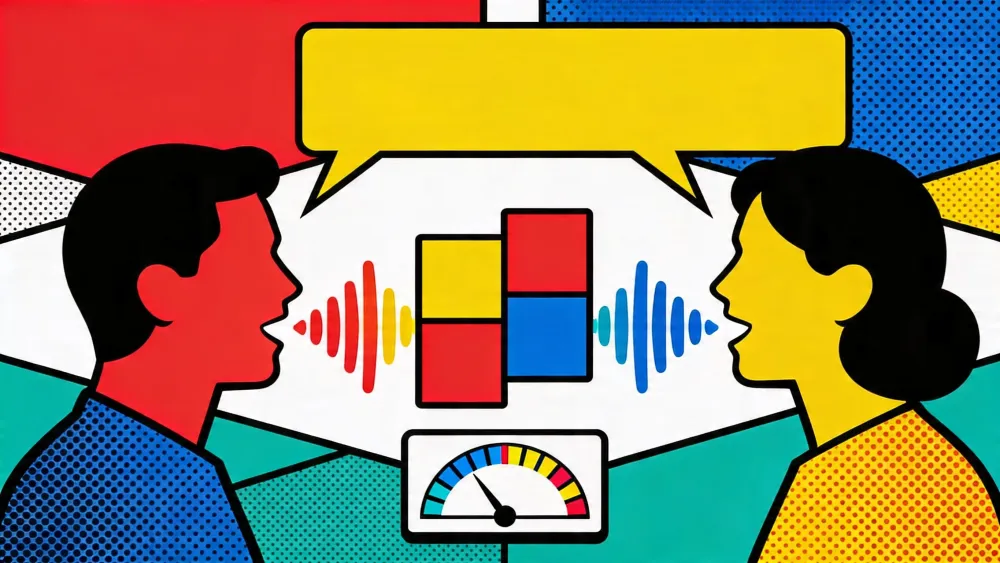
DeepL picked Thursday for the voice launch it has been circling for years. The new suite plugs into Zoom and Microsoft Teams, stretches to mobile conversations and training rooms, and gives contact centers an API path. The pitch is simple: speak German, Japanese, or French at work without making English the cover charge.
The catch sits inside the pipeline. DeepL told TechCrunch its current voice-to-voice system hears speech, writes it down, translates the text, and only then speaks the result back. That choice plays to DeepL's strength in text translation. It also exposes the bottleneck. Live conversation is not a document with a play button.
Key Takeaways
- DeepL launched Voice-to-Voice for meetings, conversations, group training, and contact-center APIs.
- The current system still routes speech through text before returning translated audio.
- A reported one-to-two-sentence delay is the core product risk, not a demo glitch.
- DeepL's edge is translation quality and custom terminology, but meeting apps already own the room.
AI-generated summary, reviewed by an editor. More on our AI guidelines.
What DeepL Actually Launched
The April 16 launch expands DeepL Voice from captions into spoken translation. According to DeepL's release, Voice for Meetings will add spoken translation inside Microsoft Teams and Zoom, with early access opening in June. Voice for Conversations is available on mobile and web. Group Conversations, joined by QR code, is scheduled for April 30. Spoken-terms customization and glossary support are scheduled for May 7.
The Voice-to-Voice API is aimed at internal apps and customer-facing tools. The company's developer documentation describes a WebSocket system that streams audio and returns transcripts, translations, and, in closed beta, translated speech. One session can translate into as many as five target languages. Audio chunks should stay under one second. Connections close after one hour.
That is the real shape of the product: not magic, but an enterprise streaming system with session tokens, chunk sizes, target-language caps, reconnection logic, and partner dependencies in some languages. DeepL's case is that quality justifies the layer. The April release says more than 200,000 business teams use DeepL, and a Slator evaluation commissioned by DeepL found that 96% of professional linguists preferred DeepL Voice over native translation from Google, Microsoft, and Zoom. Useful evidence. Not a trophy.
The Sentence Delay Problem
Live translation is not text translation played faster. In a document, the model can see the whole sentence. In a meeting, it must decide when to jump. Too soon, and it may pick the wrong verb, object, or emphasis. Too late, and the call starts to feel like satellite audio.
That trade-off showed up immediately. Seoul Economic Daily, covering DeepL's launch event in Korea, reported that a demonstration showed a delay of one to two sentences. A DeepL representative attributed the lag to differences in word order and sentence structure across languages.
That is not polish. It is the product. A one-sentence delay can survive a webinar. It can break a support escalation, negotiation, classroom discussion, or sales call where people interrupt, correct themselves, laugh, and change direction mid-thought.
DeepL's architecture explains why. The company controls the voice-to-voice stack, according to TechCrunch, but the current flow still passes through text. CEO Jarek Kutylowski told TechCrunch the company wants an end-to-end voice translation model that skips that step. Until then, every translated answer is a compromise between speed and confidence.
Get The AI Brief Before The Meeting
Strategic AI news from San Francisco. No hype, no "AI will change everything" throat clearing. Just what moved, who won, and why it matters. Daily at 6am PST.
No spam. Unsubscribe anytime.
The Rivals Are Already in the Room
DeepL is not walking into an empty market. It is walking into the meeting apps themselves.
Google said on April 8 that speech translation in Google Meet is rolling out to Android and iOS after its web launch. That mobile rollout supports English paired with Spanish, French, German, Portuguese, or Italian, with one language pair active in a meeting. Microsoft has translated Teams captions tied to Teams Premium and Microsoft 365 Copilot. Zoom says it supports translated captions in more than 36 languages.
So DeepL's pitch is narrower: better translation, better terminology, and enough security to justify adding another layer. That may be enough. Proper nouns wreck live translation. So do product names, legal terms, acronyms, regional names, and fast speech. DeepL says its spoken-terms capability and glossary integration will help preserve company and personal names in real time.
The buyer story is staffing. TechCrunch reported Kutylowski's argument that translation can help companies provide support in languages where qualified staff are scarce or expensive. A company with a German product team, a Polish factory, a French legal department, and customers across Asia does not want a pretty demo. It wants fewer dead zones where only two people can speak to each other.
The Real Winner Makes Translation Boring
DeepL's move matters because it joins three things that usually sit apart: strong text translation, business distribution, and live speech. It also closes gaps from the 2024 version, when TechCrunch reported that DeepL Voice produced text rather than audio, had no API, and supported Teams as the only video-calling integration.
The phrase "voice-to-voice" makes the product sound like one jump. DeepL's current system still makes at least three: speech to text, text to translated text, translated text to speech. Each jump adds timing pressure.
The decisive number is not the 96% preference score. It is the one-to-two-sentence delay reported in Korea. If DeepL can push that delay down while keeping its translation quality, the product becomes a serious enterprise layer. If it cannot, it becomes a better caption system with audio output attached.
That is still useful. It is not science fiction. DeepL starts from the right place: good translation. The next proof is harsher. In a live room, the right sentence still fails if it shows up after the moment has passed.
Quick Answers
What changed on April 16, 2026?
DeepL moved its voice push beyond captions. The new package covers Teams, Zoom, mobile and web conversations, QR-code group sessions, and API use in places like contact centers.
Is DeepL Voice-to-Voice fully voice-native?
Not yet. DeepL told TechCrunch the current system converts speech to text, translates that text, and then turns it back into speech. The company wants to move toward end-to-end voice translation later.
Why does latency matter so much here?
Live translation has to choose between speed and accuracy. If the system waits for more context, the translation improves but conversation lags. If it answers too fast, it can mistranslate sentence structure or names.
How is DeepL different from Google Meet, Teams, or Zoom translation?
Google, Microsoft, and Zoom already offer translated meeting features. DeepL's pitch is better translation quality, custom terminology, security, and a layer that can work across enterprise workflows.
Who is the likely buyer for this product?
The clearest buyers are companies with multilingual support, sales, legal, manufacturing, and training needs where hiring for every language pair is expensive or slow.
AI-generated summary, reviewed by an editor. More on our AI guidelines.


Free AI briefing · Weekdays
The AI stories that matter, sourced and explained.
Join the Morning Briefing. It goes out every weekday at 4:45 a.m. Pacific, with later sends for the East Coast, Berlin and Tokyo.
Free when you sign up: The Paperclip Compendium, our tested guide to running AI agents.
Free. Unsubscribe in one click.

Marcus Schuler
Editor-in-Chief and founder of Implicator.ai. Former ARD correspondent and senior broadcast journalist with 10+ years covering tech. Writes daily briefings on policy and market developments. Based in San Francisco. E-mail: editor@implicator.ai