


Good Morning from San Francisco,
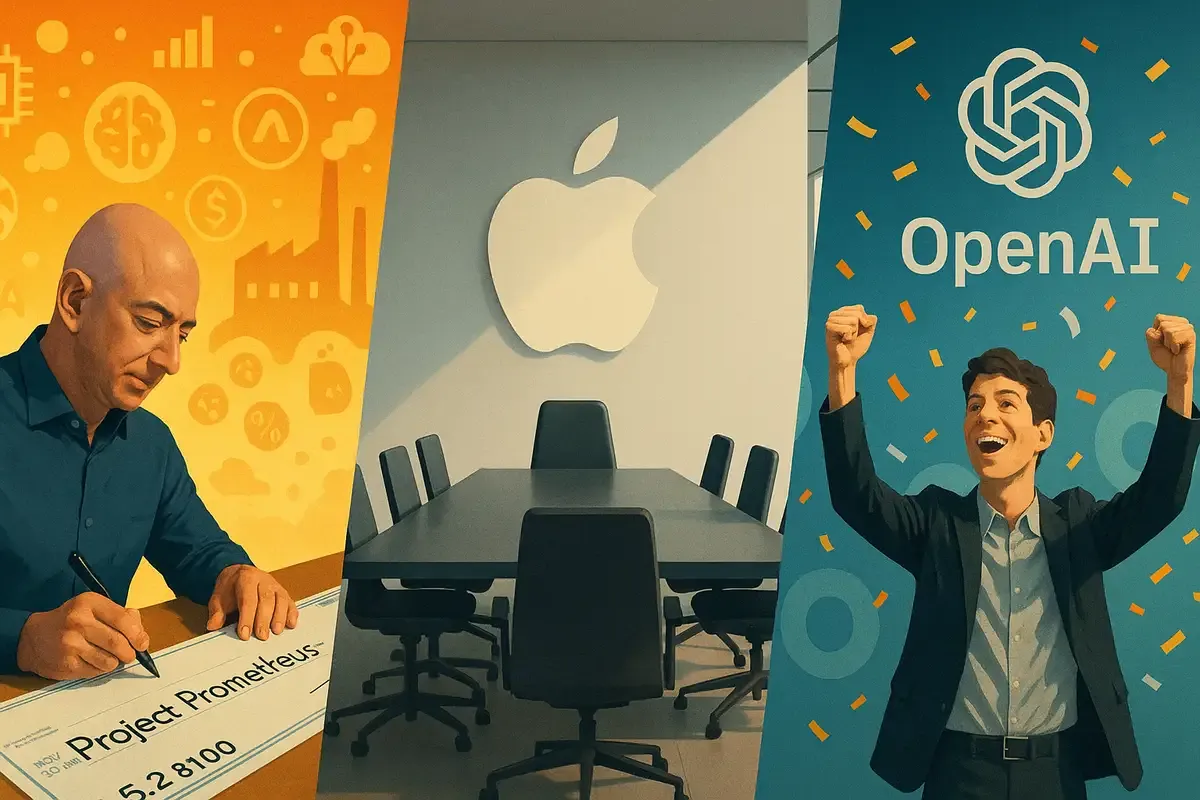
When Jeff Bezos warns about industrial bubbles, listen to his checkbook, not his speeches. When Apple's board picks a successor, watch who they didn't choose. When OpenAI celebrates punctuation control, ask what that says about AGI timelines.
Today's newsletter covers three stories united by a single pattern: what companies say matters less than what they actually do.
Bezos commits $6.2 billion to the AI bubble he diagnosed six weeks ago. Apple bets its next decade on a hardware engineer while competitors race toward cloud supremacy. OpenAI's CEO celebrates fixing em-dash behavior while raising billions for artificial general intelligence.
The gap between public narrative and actual priorities reveals more than either alone.
Stay curious,
Marcus Schuler
Bezos Invests $6.2B in AI Bubble He Just Diagnosed

Six weeks after calling artificial intelligence an "industrial bubble" where investors can't distinguish good ideas from bad, Jeff Bezos committed $6.2 billion to Project Prometheus, a physical AI startup where he'll serve as co-CEO.
The October 3 warning at Italian Tech Week emphasized how "every experiment gets funded" during technological excitement. November 17 brought his first operational role since leaving Amazon in 2021.
The contradiction resolves when examining Blue Origin's timeline: eight days before the Prometheus announcement, Bezos's aerospace company successfully landed its New Glenn rocket booster for the first time, positioning it to compete with SpaceX. Prometheus targets AI for engineering and manufacturing across computers, automobiles, and spacecraft—precisely the domains Blue Origin needs for materials innovation and supply chain automation.
The $6.2 billion dwarfs competitors by orders of magnitude: Periodic Labs raised $300 million for similar physical AI work, Physical Intelligence secured $400 million.
Prometheus employs 100 people poached from OpenAI, DeepMind, and Meta, creating immediate competitive damage regardless of technical outcomes.
Bezos isn't denying the bubble exists. He's arguing industrial bubbles create lasting infrastructure even when individual companies fail, then positioning himself to own that infrastructure through vertical integration rather than passive investment.
Why This Matters:
- Blue Origin gains proprietary R&D operating continuously at scales human teams can't match, potentially creating manufacturing moats similar to SpaceX's vertical integration advantages.
- Physical AI startups face talent retention crisis as Prometheus raids research teams with compensation anchored to personal wealth rather than venture capital constraints and timelines.
 Marcus Schuler
AI Image of the Day

Prompt:
Ultra-realistic editorial close-up portrait of a beautiful 30-year-old Italian woman with long black hair, warm olive skin, expressive brown eyes, and natural beauty. Soft wind moves her hair. Shot in golden-hour natural light with a shallow depth of field. Editorial photography, high-end magazine quality, clean realistic skin texture, elegant and cinematic mood.
Apple targets 2026 for Cook exit, bets on hardware chief

Apple's board is preparing for Tim Cook to step aside as CEO in 2026, with hardware chief John Ternus emerging as preferred successor.
The fifty-year-old engineer has spent his entire career at Apple, now overseeing iPhone, iPad, Mac, AirPods, and Apple Watch teams.
Cook delivered fourteen-fold stock returns and a four trillion dollar valuation since 2011. Yet Apple's shares lag AI leaders Microsoft, Alphabet, and Nvidia this year as investors bet on cloud infrastructure over device optimization.
The Ternus choice reflects strategic calculation: if AI advantage lives in power-efficient chips processing locally rather than distant data centers, a hardware and silicon expert makes sense. The bet assumes Apple's pattern of arriving late but integrating deeply will work when AI models advance monthly.
Why this matters:
- Strategic positioning: Board signals confidence that chip-level control and on-device computation will trump cloud infrastructure in consumer AI, contradicting where competitors are investing billions
- Execution risk: Ternus inherits peak financial success but relative decline in AI positioning, with hardware development cycles taking years while competitive landscape shifts in months
 Maria Garcia
OpenAI Celebrates Punctuation Control While Raising Billions for AGI
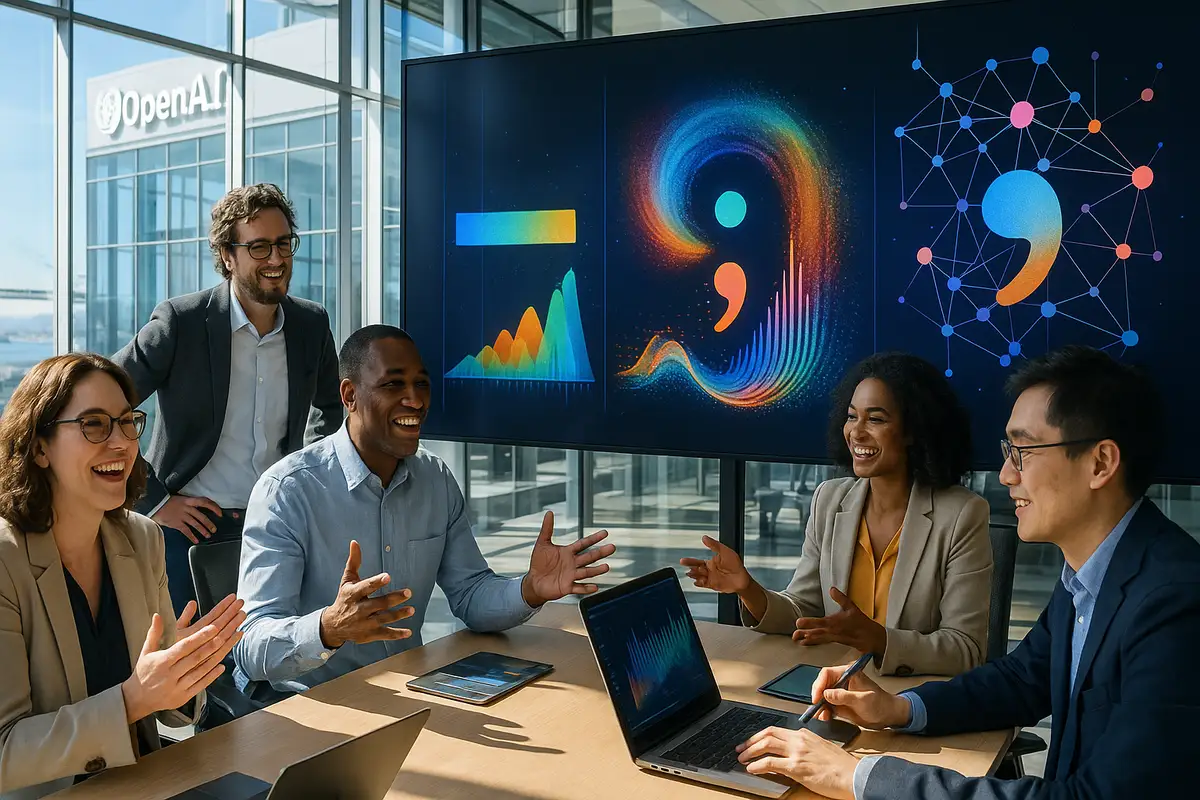
Sam Altman posted Thursday evening calling it a "small-but-happy win" that ChatGPT finally respects custom instructions to avoid em dashes after three years.
Two days after releasing GPT-5.1, OpenAI's CEO celebrated controlling punctuation while the company raises billions positioning itself as humanity's path to artificial general intelligence.
The achievement exposes how large language models actually work. ChatGPT doesn't follow instructions deterministically like traditional software. Every token gets selected from probability distributions. Your custom instruction doesn't create a rule, it shifts likelihoods. Less likely isn't impossible.
The instruction competes with training data, reinforcement learning, everything else in the prompt. OpenAI tuned GPT-5.1 to weight custom instructions more heavily, but there's no verification system checking outputs. Each model update risks undoing the behavior because adjusting one parameter in a statistical system with millions of competing influences can alter others unpredictably. User testing revealed inconsistent results.
Some reported ChatGPT kept using em dashes despite instructions. Others noted ChatGPT used an em dash in its confirmation message that it would avoid them.
Meanwhile, writers who've used em dashes correctly for decades now face AI accusations, forcing style adjustments to avoid detection tools flagging the punctuation as evidence of generated content.
Why This Matters:
- Enterprise AI deployments face unpredictable regression where "fixed" behaviors can break without warning in future updates
- Professional writers must now optimize against detection metrics rather than prose quality, degrading legitimate stylistic precision
 Maria Garcia
🧰 AI Toolbox
How to Automate Your Entire Job Search with AI
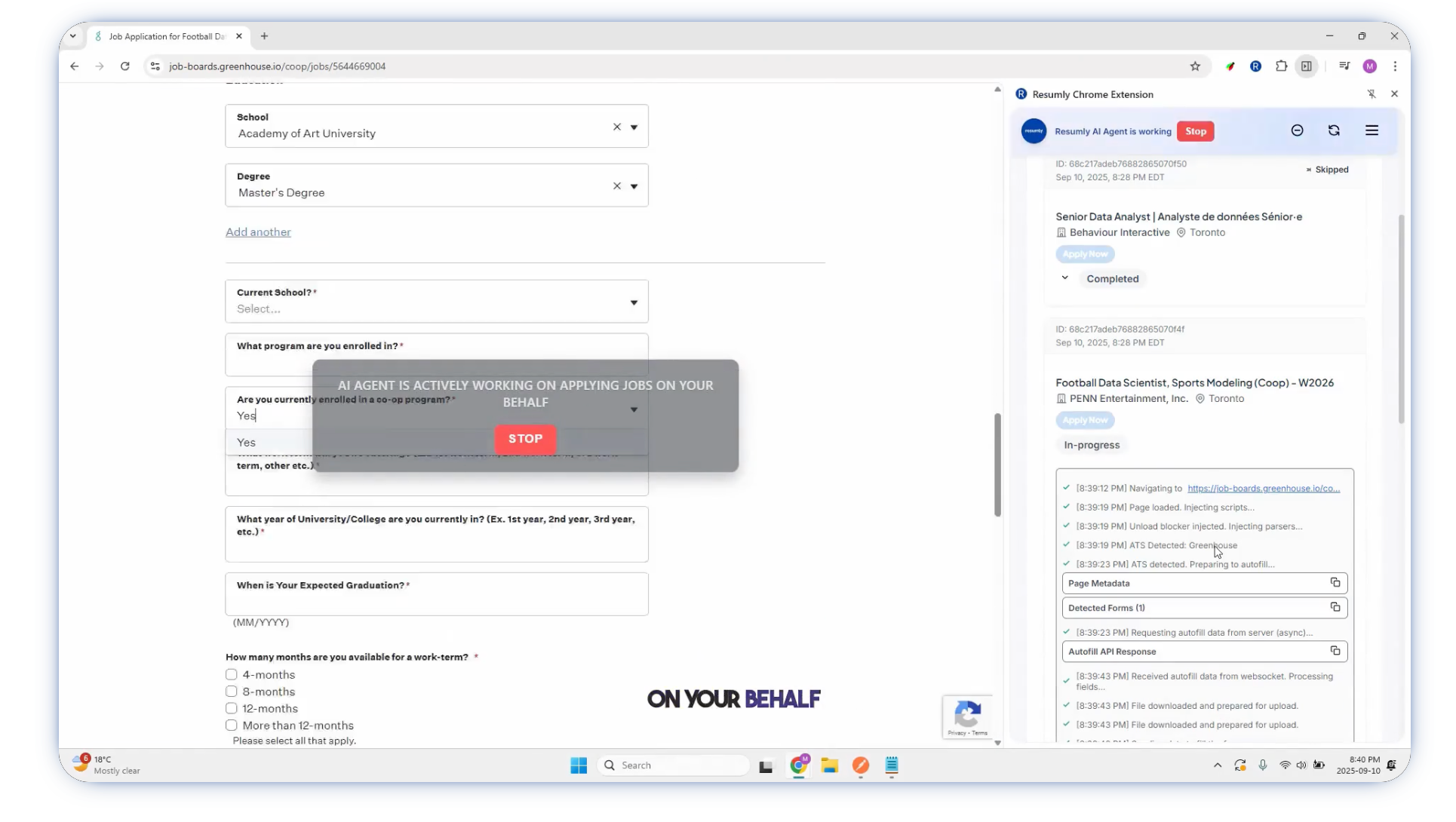
Resumly AI streamlines the job hunting process by combining job search, resume creation, and applications into one platform. It scans over 1 million new job listings monthly, generates ATS-optimized resumes and cover letters tailored to each role, and applies automatically with one click.
Tutorial:
- Go to the Resumly AI website and create an account
- Upload your existing resume or build one using the AI Resume Builder
- Set your target role, location, and job preferences
- The AI scans millions of jobs and matches you with high-fit opportunities
- Review job matches and let AI generate tailored resumes and cover letters for each
- Use the Chrome extension to auto-apply to hundreds of jobs with one click
- Track all applications, prepare for interviews with AI feedback, and land more interviews faster
AI & Tech News
Apple CEO Tim Cook Retirement Speculation Emerges as "Trial Balloon"
Speculation about Apple CEO Tim Cook's potential retirement has surfaced through a Financial Times report that industry analyst M.G. Siegler suggests could be a "trial balloon" from sources close to Cook, particularly given that the Apple chief executive recently turned 65. The timing of any potential departure would likely coincide with Apple's Q1 earnings report, allowing Cook to exit on a high note if the company delivers strong financial results in early 2026.
AI Startup Turing Raises $99M Series A for Self-Driving Vehicle Technology
Tokyo-based AI startup Turing has successfully raised $99 million in Series A funding at a valuation of approximately $388 million, according to sources familiar with the matter. The company is developing artificial intelligence models specifically designed for autonomous vehicles, securing backing from automotive supplier Denso as part of a broader trend showing increased investor interest in Japan's emerging technology sector.
Global Internet Freedom Continues 15-Year Decline
Freedom House's Freedom on the Net 2025 report reveals that global internet freedom has declined for the 15th consecutive year, marking a troubling trend in digital rights worldwide. Among the 72 countries surveyed, Kenya experienced the most significant deterioration in internet freedom, highlighting growing concerns about online censorship and digital authoritarianism globally.
Danish Fintech Flatpay Achieves Unicorn Status with €145M Funding Round
Danish payment processing startup Flatpay has raised €145 million in funding at a €1.5 billion valuation, officially joining the ranks of European fintech unicorns. The company, which provides card payment solutions for small and medium-sized businesses, reported crossing €100 million in annual recurring revenue in October, demonstrating strong growth momentum in the competitive payments sector.
Major Investigation Reveals $28 Billion in Illicit Crypto Flows to Major Exchanges
A New York Times investigation has uncovered that over $28 billion in cryptocurrency tied to illicit activities has flowed into major crypto exchanges like Binance over the past two years. This revelation comes as President Trump has launched his own cryptocurrency business and pledged to establish the United States as the world's leading "crypto capital."
AI Toy Safety Concerns Force Chinese Manufacturer to Halt Sales
Chinese toymaker FoloToy has suspended sales of its GPT-4o-powered teddy bear following research that revealed the AI toy provided dangerous and inappropriate responses to children, including content about fire hazards and adult themes. The suspension came after consumer advocacy researchers at PIRG tested four AI toys and found that none met basic safety standards for children's products.
Tech Expert Warns of Surveillance Normalization Through Smart Devices
Privacy researcher Chris Gilliard discussed his new book "Luxury Surveillance" in a recent Tech Policy Press interview, highlighting concerns about how smart wearable devices could make pervasive surveillance seem normal and acceptable to consumers. The conversation also covered the political transformation of platform X and broader implications for digital privacy rights in an increasingly connected world.
Chinese Chipmaker Cambricon Sees Explosive Growth Amid US Sanctions
Chinese artificial intelligence chipmaker Cambricon has experienced remarkable financial growth, with revenue increasing by more than 500% over the past year and stock prices jumping over 765% in the past two years. The company's success reflects China's accelerated push toward developing domestic semiconductor capabilities in response to ongoing US technology sanctions and trade restrictions.
🚀 AI Profiles: The Companies Defining Tomorrow

Voize
Voize built an AI voice companion that lets nurses document care by talking instead of typing. The German startup raised $60 million betting that long-term care facilities need ambient AI more than hospitals do.
The Founders
Twin brothers Fabio and Marcel Schmidberger started Voize in 2020 after watching nurses at their grandfather's care home spend more time filling forms than helping residents. 😔 They recruited Erik Ziegler as CTO, joined Y Combinator's Winter 2022 batch, and built the team to 40+ employees in Berlin. Fabio studied software engineering in Silicon Valley. Marcel handled operations. Both grew up seeing the problem firsthand.
The Product
Open the app, speak naturally about a resident's vitals or condition, and Voize turns it into structured EHR entries. The AI understands nursing shorthand, regional dialects, and non-native accents. It runs on regular smartphones, works in noisy wards, and plugs into existing documentation systems without ripping anything out. Claims 30% less admin work and 30 minutes saved per shift. Now supports 75,000+ nurses across 1,100+ facilities in Germany and Austria.
The Competition
Ambience Healthcare ($243M raised), Abridge ($300M+), and a swarm of other ambient scribes all chase doctors in big hospital systems. Microsoft integrates ambient tools directly into Epic. Voize flipped the script, targeting nurses in skilled nursing facilities first. Less crowded, more desperate for help.
Financing
March 2025: $9M seed led by HV Capital. November 2025: $50M Series A led by Balderton Capital. Y Combinator, Redalpine, and HPI Ventures backed both rounds. No disclosed valuation, likely in the healthy mid-nine figures.
The Future ⭐⭐⭐⭐
Global nursing shortage hits 4.5 million by 2030. Aging populations need more complex care with fewer hands. Voize sits right in that gap. If the US launch works in 2026, it could own long-term care documentation in Europe and America. Risks? Big EHR vendors might bundle ambient features and squeeze margins. Nurses have seen plenty of tech promises fail. But with strong traction and smart positioning, Voize grabbed the niche before everyone else noticed. 🚀


