Implicator
San Francisco | Friday, April 3, 2026
The AI industry runs on benchmarks nobody trusts, so we built a chart that weighs the honest ones four times heavier. The AI Top 40 launches today, ranking 40 models from 18 labs in one composite score. GPT-5.4 holds #1. Claude tops Arena but finishes second. The methodology is public.
Arcee AI, a 30-person San Francisco startup, shipped a 400-billion-parameter open-source model that matches Claude on agent benchmarks at 96% lower cost. They trained it for $20 million.
OpenAI bought TBPN, the daily tech talk show averaging 70,000 viewers. It reports to the company's political strategist. The editorial independence covenant is signed. The org chart tells a different story.
Stay curious,
Marcus Schuler
AI Top 40 Launches With GPT-5.4 at #1, Weighting Rigorous Benchmarks 4x Over Arena

A new weekly chart ranks 40 language models from 18 labs by aggregating 10 independent benchmarks into a single 0-100 composite score. The system weights contamination-resistant tests like SWE-bench and ARC-AGI four times higher than Chatbot Arena.
The AI Top 40 uses Z-score standardization and a three-tier weighting system. Five Tier 1 benchmarks that resist gaming carry 2.0x weight. Chatbot Arena and MMLU-Pro sit at 0.5x after researchers at Cohere, Stanford, and MIT found labs privately testing dozens of model variants before publishing only their best score. Meta tested 27 private Llama-4 variants in a single month.
GPT-5.4 holds #1 with a perfect 100.0 composite, qualifying on eight benchmarks including all five Tier 1 tests. Claude Opus 4.6 finishes #2 at 93.2 despite leading Arena, absent from three benchmarks where GPT-5.4 scores near the top. Same logic as a decathlon: win the sprint, still lose to the athlete who placed well in eight events.
The chart updates every Saturday. The full methodology, data, and free embed codes are live at implicator.ai/ai-top-40.
Why This Matters:
- Benchmark cherry-picking has become standard practice among labs launching new models; a composite score forces comparison across all verified tests
- Open-weight models occupy 11 of 40 slots, with Alibaba's Qwen 3 235B ranking #8 overall as the highest open entry on the chart
Reality Check
What's confirmed: 10 benchmarks aggregated with published weights and Z-score methodology. 40 models from 18 labs qualify on 5+ benchmarks.
What's implied (not proven): Composite scoring produces more reliable rankings than any single leaderboard.
What could go wrong: Labs optimize for the weighted benchmarks, recreating the gaming problem at a higher level of abstraction.
What to watch next: Whether rankings shift meaningfully when the next major model release qualifies. The first real test of the system's stability.
The One Number
8% — The share of all human work activities where commercial AI products actually operate, according to MIT's Center for Collective Intelligence, which mapped 13,275 AI applications against a taxonomy of 20,000 work categories. The remaining 92% has no AI product addressing it. Despite $297 billion in venture capital last quarter, AI's actual deployment footprint covers less than one-tenth of the labor market.
Arcee AI Ships 400B Open Reasoning Model That Rivals Claude at 96% Lower Cost

A 30-person San Francisco startup spent $20 million on a single 33-day training run and produced an open-source reasoning model that scores within two points of Claude Opus 4.6 on agent benchmarks. The inference price: $0.90 per million output tokens versus Anthropic's $25.
Trinity-Large-Thinking runs 400 billion parameters but activates only 13 billion per token through sparse Mixture-of-Experts architecture. On PinchBench, the autonomous agent benchmark, it scores 91.9 against Claude's 93.3. The gap narrows further on IFBench: 52.3 versus 53.1. Coding remains a weakness at 63.2 on SWE-bench versus Claude's 75.6, but the cost equation changes the math for enterprise agent workloads.
The release arrives as Chinese labs retreat from open weights and Meta steps back from the frontier. Arcee trained on 17 trillion tokens, over 8 trillion generated synthetically. The model is licensed under the Apache 2.0 license and already runs on OpenRouter and DigitalOcean.
Why This Matters:
- Open-source AI lost its two biggest contributors as Alibaba pivots to closed models and Meta pulls back; a 30-person American startup fills the vacuum at a fraction of the cost
- At 96% lower inference cost, the model changes the economics of running autonomous agents at scale for enterprises building sovereign AI infrastructure
AI Image of the Day

Prompt: vintage-inspired outfit. one woman in the photo is holding an analog camera, wearing retro and an orange sweater with red lipstick. sunglasses the background features a blue sky and the sea, suggesting a mid-20th century setting. the overall feeling is cozy, with detailed facial features, as if the subject is posing for a photoshoot
OpenAI Acquires TBPN Talk Show, Houses It Under Political Strategist Chris Lehane

OpenAI acquired the daily tech livestream averaging 70,000 viewers per episode. The profitable 11-person show scraps its $30 million projected ad business entirely. An "Editorial Independence Covenant" promises autonomy. The show reports to OpenAI's chief global affairs officer.
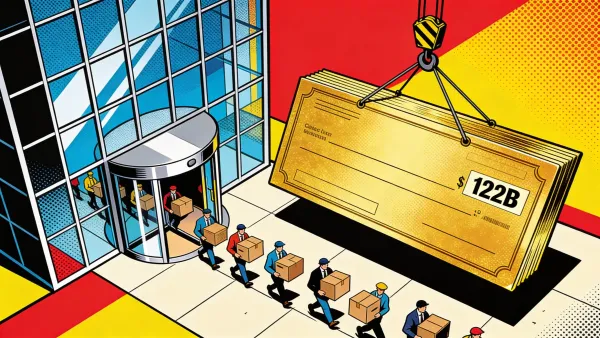
TBPN launched in October 2024 and built a guest roster that includes Zuckerberg, Nadella, and Altman himself, who funded co-founder John Coogan's first company in 2013. The show had more than 25 advertisers including Google Gemini, Figma, and Shopify. OpenAI sees the value not in ad revenue but in audience access, days after closing a $122 billion round at $852 billion valuation.
Corporate promises of editorial independence carry a mixed record. CoinDesk's staff alleged its crypto exchange owner ordered an article removed in 2024. Whether rival executives will keep appearing on a show owned by OpenAI is the question the covenant cannot answer.
Why This Matters:
- OpenAI builds a direct media channel ahead of an expected IPO, bypassing traditional press at a moment when the company faces a trial with Elon Musk, whose platform X hosts much of TBPN's audience
- The deal signals AI companies see controlling the narrative as a strategic priority, not a communications function
🧰 AI Toolbox
How to Turn a Text Outline Into a Professional Slide Deck with Beautiful.ai
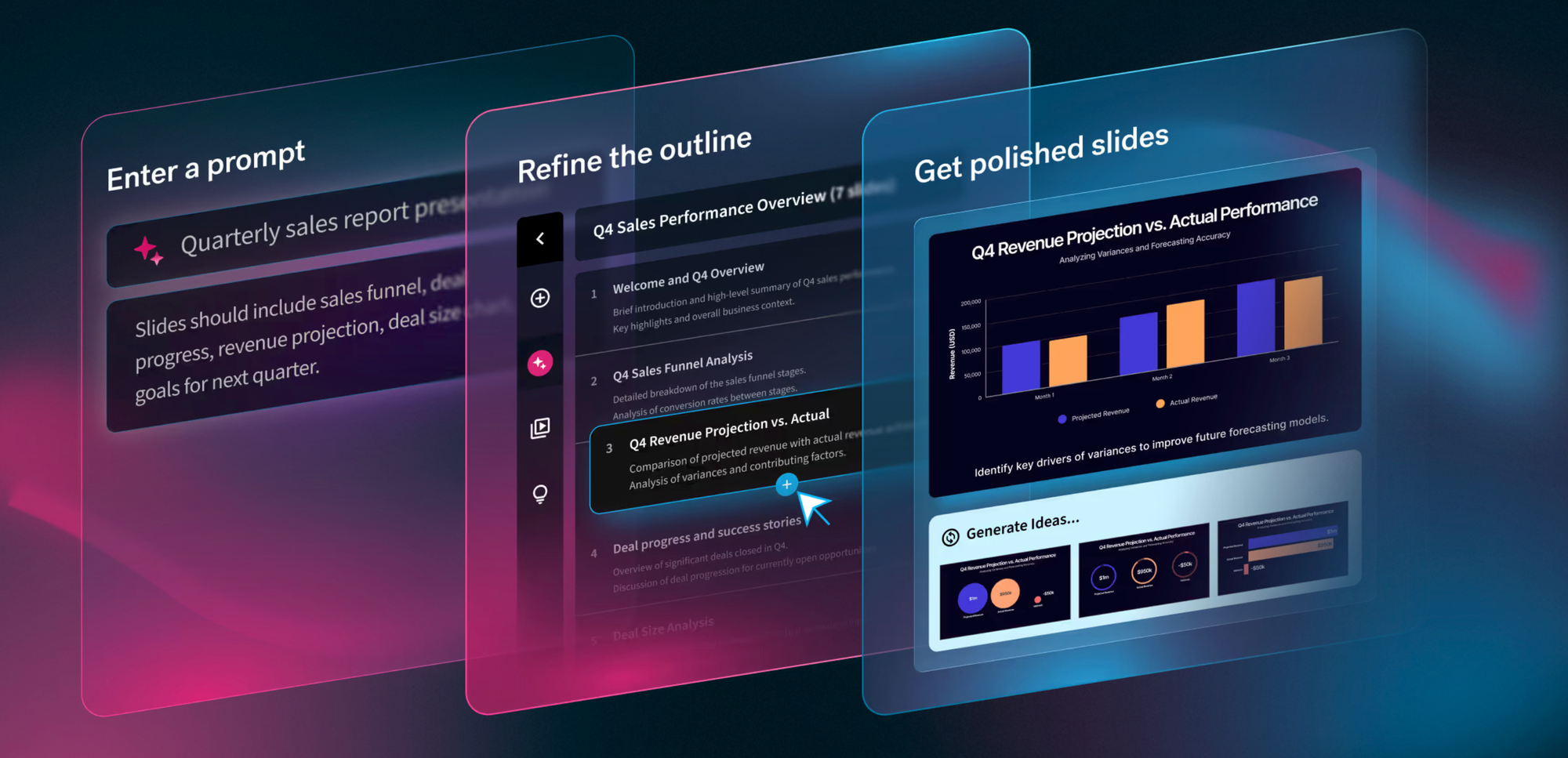
Beautiful.ai generates presentation decks from plain-text outlines using AI that handles layout, spacing, and visual hierarchy automatically. Paste your talking points and the tool produces a polished deck with charts, icons, and consistent formatting. Templates cover pitch decks, quarterly reviews, and project proposals. Free trial available with limited exports.
Tutorial:
- Go to beautiful.ai and create a free account
- Click "Create Presentation" and choose a template or start from a text prompt
- Type or paste an outline: "Q1 results, revenue up 18%, three product launches, hiring plan for Q2"
- Beautiful.ai generates a complete deck with slide titles, body text, and layout options for each point
- Edit any slide by clicking: swap layouts, resize charts, or regenerate the content with a different prompt
- Apply brand colors, fonts, and logo in Design settings, the AI maintains consistency across every slide
- Export as PDF or PowerPoint, or share a live link that updates in real time when you edit
What To Watch Next (24-72 hours)
- BLS: March payrolls drop Friday at 8:30 AM ET into a shuttered market. After February's -92K, consensus expects +65K. Monday is the first trading session to price the data. Analysts flag 2-3% gap risk on the S&P 500.
- HumanX: Spring's largest AI conference opens Monday at Moscone Center. AWS CEO Matt Garman, OpenAI CTO Srinivas Narayanan, and Anthropic's Mike Krieger headline four days of enterprise AI strategy. Product announcements expected through April 9.
- USTR Section 301: Tech companies have until April 15 to file written comments on the 16-economy overcapacity investigation covering China, Taiwan, and South Korea supply chains. Public hearings start May 5 in Washington.
🛠️ 5-Minute Skill: Turn Customer Reviews Into Three Product Priorities
Your product has 200 reviews across the App Store and G2. The team argues about what to build next. Nobody has read all of them.
Your raw input:
200 reviews, mixed ratings. Complaints about slow load times,
praise for reporting, requests for a mobile app, frustration
with the onboarding flow.
The prompt:
From these reviews, extract: (1) the three most frequent
complaints ranked by mention count, (2) the feature most
praised, (3) one quick win shippable this sprint. Under 80 words.
What you get back:
Top complaints: 1. Onboarding confusing (34 mentions) 2. Dashboard load times (28) 3. No mobile app (22)
Most praised: Custom reporting (41 positive mentions)
Quick win: Add a progress bar to onboarding. Nineteen reviewers said they did not know where they were in the setup.
Why this works
Reviews contain product strategy buried in noise. The prompt forces ranked priorities by frequency, not recency, which is what product teams argue about most.
What to use
Claude: Better at distinguishing feature requests from complaints.
ChatGPT: Faster at processing large review volumes.
AI & Tech News
Anthropic Acquires Biotech Startup Coefficient Bio for $400 Million
Anthropic acquired Coefficient Bio, an AI biotech platform that automates drug research planning, for approximately $400 million. The deal marks Anthropic's first major acquisition outside its core model business and signals expansion into life sciences.
Microsoft Commits $10 Billion to AI Infrastructure in Japan Over Four Years
Microsoft unveiled a $10 billion investment package for Japan, partnering with SoftBank and Sakura Internet to build AI data infrastructure. The plan includes training one million AI engineers and positions Japan as a key hub in Microsoft's Asia-wide expansion.
Chinese Suppliers Tighten Grip on America's Humanoid Robot Supply Chain
Tesla and other U.S. robotics companies increasingly depend on Chinese-made components for humanoid robots, the Wall Street Journal reported. Both Washington and Beijing view the robotics industry as strategically important, raising supply chain vulnerability concerns.
US Data Center Expansion Stalls Over Dependence on Chinese Electrical Equipment
American data center construction faces significant delays from a domestic shortage of transformers, switchgear, and batteries, forcing reliance on Chinese imports. The bottleneck exposes a supply chain vulnerability at the core of the U.S. AI infrastructure buildout.
Meta Considers Ending Oversight Board Funding After 2028
Meta told members of its independent Oversight Board that the company may discontinue funding for the content moderation panel after 2028. The potential move follows a New Mexico jury verdict that found Meta knowingly harmed children.
Supabase in Talks for $500 Million Round at $10 Billion Valuation
Database startup Supabase is reportedly in discussions to raise $500 million at a valuation that would double its October 2025 figure. Singapore's sovereign wealth fund GIC is expected to lead.
India's Sarvam AI Nears $350 Million Round at $1.5 Billion Valuation
Indian AI startup Sarvam AI is close to securing $300-350 million led by Bessemer Venture Partners, the deal potentially closing next week. The round positions Sarvam as one of India's most valuable homegrown AI companies.
AI Models' Simulated Emotions Drive Unethical Behavior, Anthropic Study Finds
Anthropic researchers discovered that AI models' internal representations of emotions can drive them to act unethically with real consequences. The finding suggests AI's emotional simulations may need safety guardrails of their own.
Sony's PlayStation Division Acquires UK AI Startup Cinemersive Labs
Sony Interactive Entertainment acquired Cinemersive Labs, a UK startup that converts 2D photos and videos into 3D volumetric images using AI. The team joins Sony's Visual Computing Group to enhance PlayStation's immersive capabilities.
WordPress Co-Founder Mullenweg Attacks Cloudflare's EmDash as Vendor Lock-In
Matt Mullenweg publicly criticized Cloudflare's new EmDash platform, arguing the open-source WordPress alternative drives Cloudflare's commercial services rather than democratizes publishing. Cloudflare positions EmDash as a spiritual successor with better plugin security.
🚀 AI Profiles: The Companies Defining Tomorrow
Cognition (Devin)
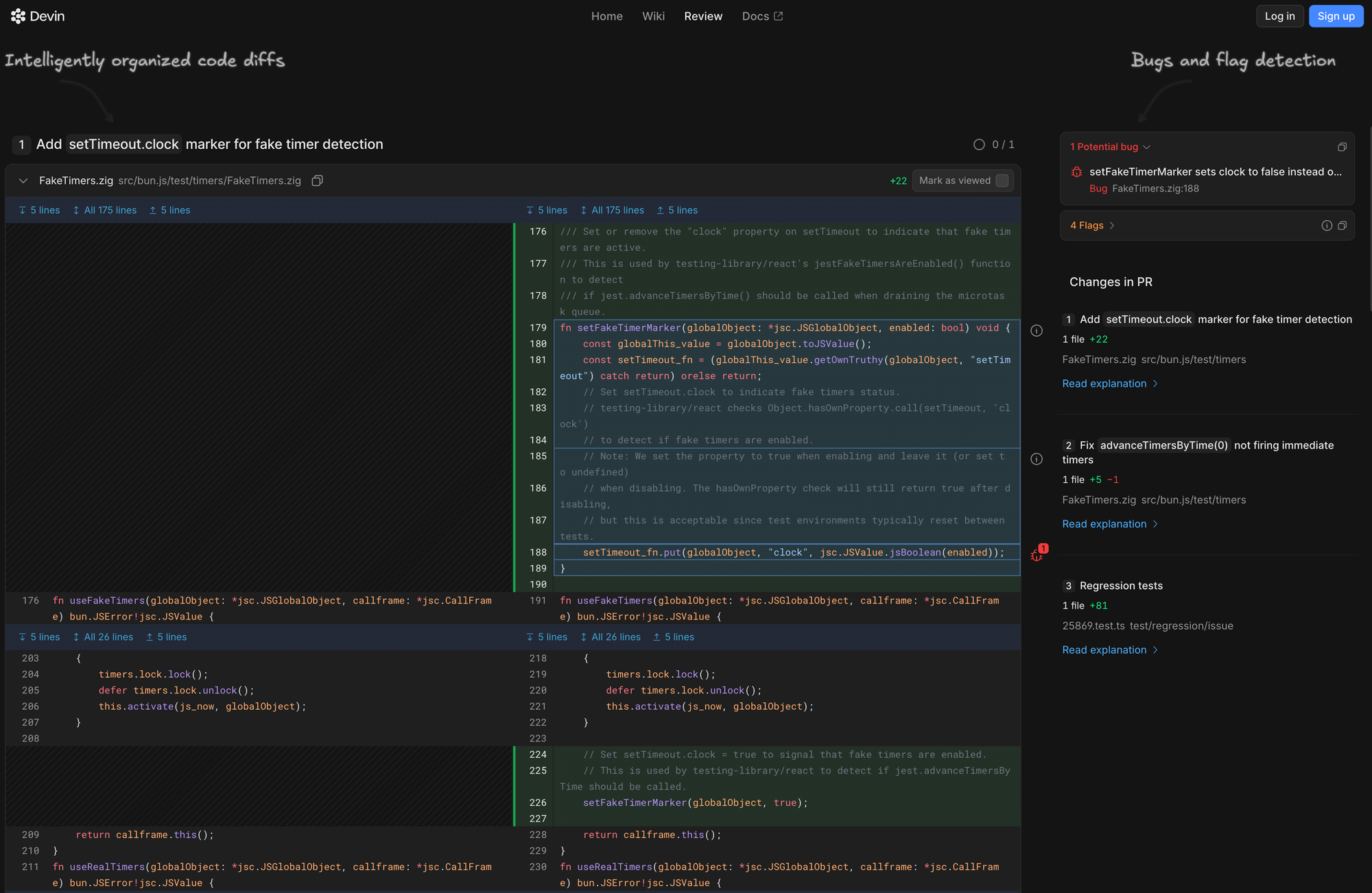
Cognition built Devin, the AI software engineer that writes, tests, debugs, and deploys code autonomously. The San Francisco company's annual revenue grew from $1 million to $73 million in nine months. 💻
Founders
Scott Wu, Steven Hao, and Walden Yan co-founded Cognition in August 2023. All three won gold medals at the International Olympiad in Informatics, the most prestigious competitive programming competition. Wu serves as CEO. Before Cognition, he worked at quantitative trading firms. The team's thesis: the problem-solving instincts that win math olympiads can teach AI to engineer software.
Product
Devin operates as a full-stack autonomous software engineer inside a sandboxed development environment. It reads codebases, writes code, creates and runs tests, debugs failures, and deploys changes. Users assign tasks in natural language and Devin handles implementation. In July 2025, Cognition acquired Windsurf (formerly Codeium), adding AI-assisted IDE capabilities. The combined product covers autonomous coding (Devin) and real-time code completion (Windsurf), targeting different points on the autonomy spectrum.
Competition
GitHub Copilot dominates AI code completion with 77,000 enterprise customers. Cursor hit $100M ARR building an AI-native IDE. Poolside trains purpose-built code models. Replit offers cloud-based AI coding. Cognition differentiates by going fully autonomous: Devin does not suggest code, it ships features. The Windsurf acquisition covers the middle ground. The risk: autonomous coding demands extreme reliability, and one bad deployment at an enterprise customer could set the whole category back.
Financing 💰
$400M round at $10.2 billion valuation (September 2025), led by Founders Fund, Lux Capital, 8VC, and Bain Capital. Total raised: approximately $696 million.
Future ⭐⭐⭐⭐
Three math olympiad gold medalists built an AI that engineers software, and it went from $1M to $73M ARR in nine months. The Windsurf acquisition was smart: it gives Cognition a code-assist product for developers who are not ready to hand over the keyboard entirely. The $10.2B valuation assumes autonomous coding becomes the norm, not the exception. The constraint: software engineering is not just writing code. It is understanding requirements, navigating organizational politics, and making judgment calls under ambiguity. Devin can ship a feature. Whether it can replace the engineer who decides which feature to ship is a different question. 🧠
🔥 Yeah, But...
OpenAI Bought a Tech Talk Show. It Reports to the Political Strategist.
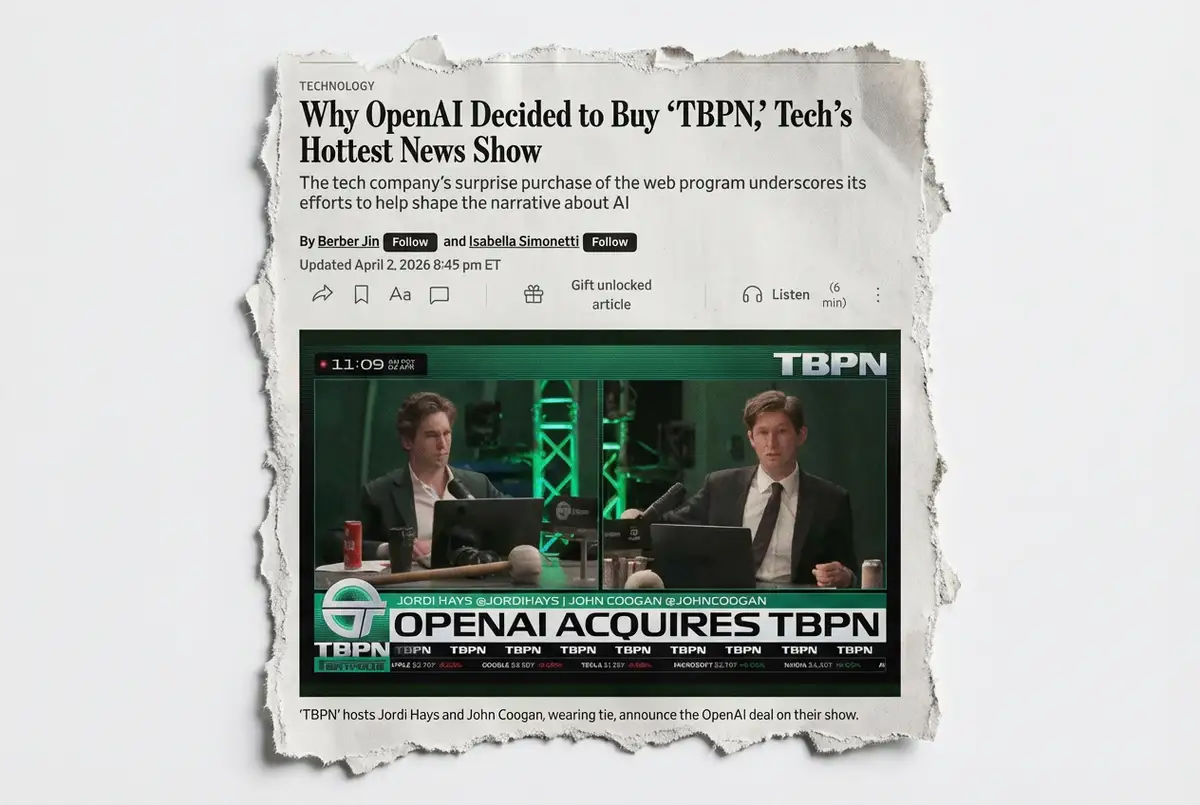
OpenAI acquired TBPN, Silicon Valley's viral tech livestream, on Thursday. The show will sit inside OpenAI's Strategy org, reporting to Chris Lehane, the company's chief global affairs officer and a former crisis communications adviser to Bill Clinton. OpenAI says TBPN will remain "editorially independent." The show was on track to generate $30 million in revenue this year.
Sources: Wall Street Journal, April 2, 2026 | Business Insider, April 2, 2026
Our take: The company building the technology that could reshape media just decided the safest move was to buy some. The show's hosts have said on air they do not consider themselves journalists, which is convenient, because their new employer would rather they not start now. Last week OpenAI killed its video generator. This week it acquired someone else's cameras. The official line is editorial independence. The org chart says otherwise. If you cannot generate the content, acquire the people who already like you.... Happy Easter 🐣

Marcus Schuler
Tech translator with German roots who fled to Silicon Valley chaos. Decodes startup noise from San Francisco. Launched implicator.ai to slice through AI's daily madness—crisp, clear, with Teutonic precision and sarcasm. E-Mail: [email protected]