IMPLICATOR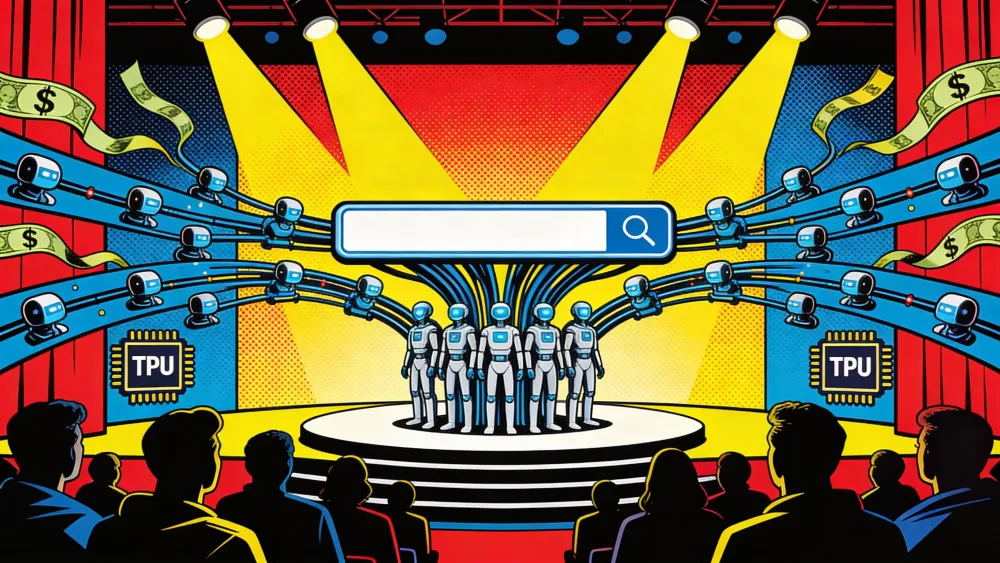
"Give us until next month to get it to you," Sundar Pichai told the developers seated in front of him on Tuesday, after Google's most-anticipated model, Gemini 3.5 Pro, slipped past its I/O slot. The crowd groaned. Pichai pivoted to the rest of the keynote: a roughly two-hour argument that the 27-year-old search box was no longer Google's most important product.
The argument has a number. In 2022, Alphabet spent $31 billion in capex. This year, Pichai said, the company expects to spend $180 to $190 billion. That is six times the earlier figure. It sits behind a bet that the most important user actions will happen inside agentic workflows, not inside the box at the center of Search. I/O 2026 was the keynote where Google said so on the record.
Key Takeaways
- Sundar Pichai used I/O 2026 to launch Gemini 3.5 Flash, Spark, Universal Cart, and agentic Search at a planned $180-190 billion capex year.
- AI Mode crossed 1 billion users in roughly a year; Mizuho says 93% of AI Mode searches now end without an outbound click.
- Google AI Ultra was cut from $249.99 to $200, with a new $100 tier introduced underneath it, matching OpenAI's structure.
- Gemini 3.5 Pro slipped to June, drawing audible groans from the developer crowd; Alphabet reports Q2 earnings in late July.
AI-generated summary, reviewed by an editor. More on our AI guidelines.
The search box Google decided not to defend.
Elizabeth Reid, Google's head of Search, called the redesign the biggest upgrade to the search box in over 25 years. The box now expands for conversational queries and accepts text, images, files, video, and Chrome tabs as input. AI Overviews has 2.5 billion monthly active users. AI Mode, rolled out at I/O 2025 after Labs testing earlier that year, crossed 1 billion monthly active users in roughly twelve months. The Gemini app went from 400 million monthly active users to 900 million in the same period.
The trade is in the click data. Mizuho estimates that 93% of AI Mode searches end without an outbound click, and organic click-through rates on AI Overview queries are down 15%. The Implicator covered the link economy's collapse last June; Tuesday's announcements are likely to intensify that pressure. "The era of the 'ten blue links' is officially over," TechCrunch's Sarah Perez wrote.
The agent layer Pichai built to replace it.
Gemini Spark is the new always-on agent in the Gemini app. It runs on dedicated virtual machines in Google Cloud, powered by Gemini 3.5 and the Antigravity development harness. Pichai said it will connect to third-party tools via MCP in the coming weeks. It rolls out to Google AI Ultra subscribers in the U.S. next week.
Search gets its own agent layer. Reid said information agents, background workers that track topics across the web, including blogs, news sites, and social posts, plus Google's real-time finance, shopping, and sports data, will launch this summer for AI Pro and Ultra subscribers. Search will also build custom dashboards and "mini apps" with Antigravity for repeated tasks like planning a wedding or managing a home move; those arrive in the coming months for AI Pro and Ultra subscribers in the U.S. The generative UI layer rolls out free this summer.
The demo onstage was sharper. Google engineer Varun Mohan showed agents in Antigravity spawning sub-agents that worked in parallel, then reassembling to build a full operating system from scratch. Google says Gemini 3.5 Flash runs four times faster than other frontier models in output tokens per second, with an internal variant twelve times faster. "3.5 Pro becomes your orchestrator, your planner," Tulsee Doshi, Google's senior director and head of product, told TechCrunch. Flash, in the same architecture, runs as the various sub-agents underneath.
The Wall Street trade behind the slide deck.
Google Cloud grew 63% year-over-year in the first quarter, outpacing Azure and AWS. The backlog stands at $462 billion, up roughly 90% quarter-over-quarter; generative AI product revenue grew about 800% year-over-year. Alphabet's stock is up 140% over the past year. The Anthropic relationship sits near the center of the backlog math: Google has committed up to $40 billion in total investment, and The Information has reported a $200 billion Anthropic commitment to Google Cloud and TPUs that Reuters could not independently verify.
"Google is probably the best-positioned company to monetize AI at scale because it controls almost every layer of the stack," Lo Toney, founding managing partner at Plexo Capital and an early Anthropic investor, told CNBC ahead of the keynote. "We've never really seen a company that has that complete vertical integration from top to bottom." Gene Munster of Deepwater Asset Management gave the operational version: "There is a benefit to owning the full stack in terms of the speed that you can innovate."
Track Google's agentic playbook
Strategic AI news from San Francisco. No hype, no "AI will change everything" throat clearing. Just what moved, who won, and why it matters. Daily at 6am PST.
No spam. Unsubscribe anytime.
Pichai brought the silicon argument on stage. Google's training infrastructure now spans more than one million TPUs globally, distributed across multiple data centers and stitched together by JAX and Pathways. The eighth-generation TPUs, split into TPU 8t for training and TPU 8i for inference, deliver up to twice the performance per watt of the previous generation. External TPU sales begin in the second half of 2026. "For model builders, this means training larger, more capable models in weeks rather than months," Pichai said.
And Google AI Ultra dropped its price. Last year's $249.99-a-month flagship was cut to $200, with a new $100 tier introduced underneath it, matching OpenAI's structure. Google framed the new entry tier as an advanced-user and developer subscription.
What did not ship.
Gemini 3.5 Pro will not be available until June. "I know you can't wait to get your hands on it," Pichai said onstage. Business Insider reported that the delay drew audible groans in the auditorium; Google did not immediately respond to a request for comment.
Other things stayed in preview. Universal Cart, the agentic shopping hub that lets users add products from Search, Gemini, YouTube, and Gmail into a single cart on Google with participating brands as the merchant of record, rolls out across Search and the Gemini app in the U.S. this summer; YouTube and Gmail come later. Project Aura, the Xreal-built display glasses that run a full Android XR interface, was shown on stage but ships in the fall. Audio-only smart glasses from Warby Parker and Gentle Monster also wait for fall. Google Pics, the new image editor, opens to trusted testers first.
The safety scrutiny is real. Google is facing a lawsuit after a man allegedly nearly carried out a mass-casualty event and died by suicide following weeks of conversations with Gemini, TechCrunch reported. Spark begins its beta rollout to Ultra subscribers in the U.S. next week. Google said it will bring AP2, its agent-payments protocol, to Spark in the coming months, and will extend the assistant to local files on the desktop later this summer.
Google's training infrastructure spans more than one million TPUs globally, Pichai said. Pichai also said Gemini 3.5 Pro will not be available until June.
Pichai asked the crowd for one more month. Alphabet's stock is up 140% over the year that preceded the ask. The company is expected to report its second-quarter earnings in late July.
Frequently Asked Questions
What did Google announce at I/O 2026?
Gemini 3.5 Flash as the new default model, Gemini Spark personal agent, Universal Cart for agentic shopping, information agents and mini apps in Search, a redesigned search box that accepts files and video, AI Ultra pricing tiers at $100 and $200, eighth-generation TPUs split into training and inference variants, and audio and display smart glasses from Warby Parker, Gentle Monster, and Xreal.
When does Gemini 3.5 Pro launch?
Sundar Pichai said it ships in June. He did not explain the delay onstage. Business Insider reported audible groans from the developer crowd when the slip was announced, and Google did not immediately respond to TechCrunch's request for comment.
How much is Google spending on AI capex?
Pichai said Alphabet expects $180 to $190 billion in 2026 capex, roughly six times the $31 billion it spent in 2022. Google Cloud grew 63% year-over-year in Q1, outpacing Azure and AWS, with a $462 billion backlog up about 90% quarter-over-quarter and generative AI product revenue up roughly 800% year-over-year.
What is Gemini Spark?
Gemini Spark is Google's always-on personal agent inside the Gemini app, powered by Gemini 3.5 on the Antigravity harness and running on dedicated virtual machines in Google Cloud. It enters beta for Google AI Ultra subscribers in the U.S. next week and will integrate with Google's AP2 agent-payments protocol in the coming months.
What does this mean for publishers?
Mizuho estimates 93% of AI Mode searches end without an outbound click and that organic click-through rates on AI Overview queries are down 15%. The new agentic Search experience, including information agents and Antigravity-built mini apps, is likely to intensify the traffic pressure that has already pushed several ad-dependent media operations out of business.
AI-generated summary, reviewed by an editor. More on our AI guidelines.

Free AI briefing · Weekdays
The AI stories that matter, sourced and explained.
Join the Morning Briefing. It goes out every weekday at 4:45 a.m. Pacific, with later sends for the East Coast, Berlin and Tokyo.
Free when you sign up: The Paperclip Compendium, our tested guide to running AI agents.
Free. Unsubscribe in one click.

Marcus Schuler
Editor-in-Chief and founder of Implicator.ai. Former ARD correspondent and senior broadcast journalist with 10+ years covering tech. Writes daily briefings on policy and market developments. Based in San Francisco. E-mail: editor@implicator.ai