IMPLICATOR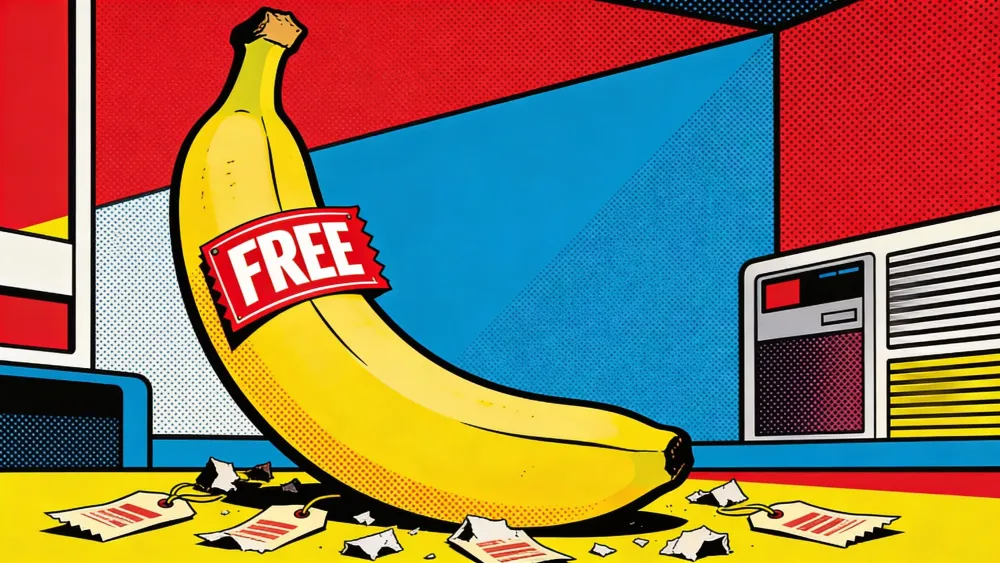
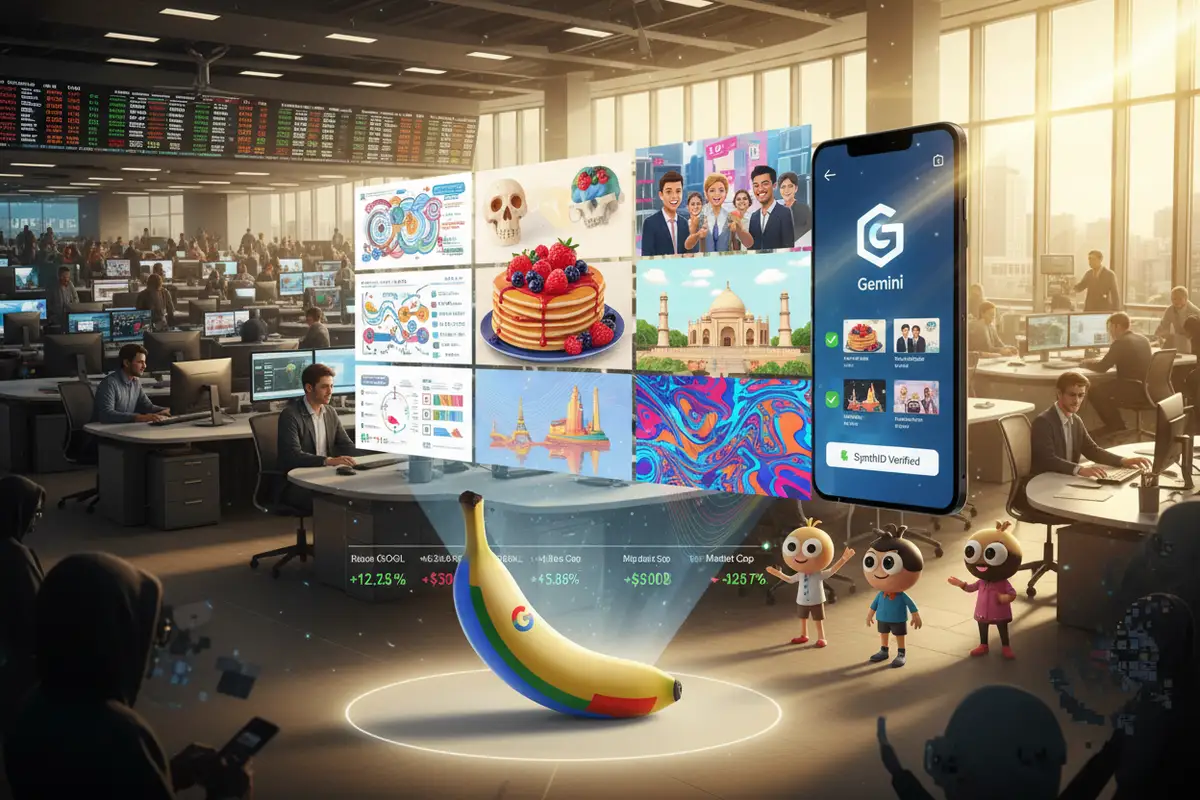
Google didn't hold a press conference for Nano Banana 2. No keynote, no countdown. Just a blog post on a Thursday morning and a model update pushed silently to billions of devices. The company embedded its most capable free image generator into Search, Lens, Ads, and Flow all at once, then moved on to other announcements.
If you opened Google Search on your phone Thursday afternoon, the image generator was already there, waiting in AI Mode like it had always been part of the furniture. That quiet rollout tells you everything about what Nano Banana 2 actually is. When a company launches a product, it sells. When it launches a feature, it bundles. Nano Banana 2 is a feature.
The distinction matters more than any benchmark or spec sheet. Google's latest image model takes the advanced capabilities that drove Nano Banana Pro's paid tier and distributes them for free across every major Google surface. Text rendering, world knowledge grounding, 4K resolution, character consistency across five subjects. All of it, available to anyone with a browser and a Google account. OpenAI still charges for comparable image generation. Midjourney requires a subscription. Adobe bundles it into Creative Cloud at enterprise prices. Google just made it part of Search.
If you sell AI image generation as a standalone product, this is the morning the economics shifted underneath you.
The Breakdown
- Google made Nano Banana Pro's paid features free in Nano Banana 2, bundling image generation into Search, Lens, Ads, and Flow simultaneously
- API pricing dropped 50% in three months, from $0.134 to $0.067 per image at 1K resolution
- Alibaba's Qwen-Image-2.0, released 16 days earlier with 7B parameters, pressured Google to lock in distribution before open weights arrive
- Standalone image generators like Midjourney face pricing pressure as Google gives away comparable quality to 750 million Gemini users
The six-month escalation
The timeline compresses fast. Google released the original Nano Banana in August 2025. It attracted 13 million first-time users to the Gemini app in four days that September. By mid-October, the tool had generated more than five billion images. Google was emboldened. The Gemini app passed 750 million monthly active users by December, and Alphabet's stock surged 47% in six months.
Five billion images in two months. That number matters because it proved something Google needed confirmed: consumer demand for AI image generation is massive, habitual, and sticky. People weren't trying Nano Banana once and leaving. They were generating images daily, sharing them on social media, building workflows around the tool. The engagement data gave Google permission to go bigger.
Google followed in November with Nano Banana Pro, built on the Gemini 3 Pro backbone. Better quality, accurate text in images, stronger reasoning. Also paywalled. Google AI Plus, Pro, and Ultra subscribers got the good stuff. The company even charged premium users extra to remove the AI watermarks it publicly called "critical" for content authenticity. That contradiction never got resolved. It just got abandoned.
Three months later, the premium features are free. Nano Banana 2 runs as the default across Fast, Thinking, and Pro modes in the Gemini app. Paid subscribers can still access the original Pro model through a buried menu option for "specialized tasks." But the pricing experiment is over. Distribution won.
The Android playbook, applied to pixels
You've seen Google run this play before. Take a product category where competitors charge money. Build a competitive version. Give it away to drive adoption of a broader product suite. Android buried Windows Mobile this way, and Chrome hollowed out the standalone browser market by shipping free with every Google account. The mechanism never changes: absorb the product into the platform until competing on the product alone becomes economically irrational.
Nano Banana 2 fits the template with uncomfortable precision.
The API pricing tells the developer story. Nano Banana Pro costs $120 per million output tokens, roughly $0.134 per image at 1K resolution. Nano Banana 2 runs on the Flash backbone at $60 per million tokens. About $0.067 per image. A 50% price cut in three months. And in Flow, Google's AI creative studio, Nano Banana 2 is the default at zero credits.
For consumers, the product is just free. No announced usage caps for the base tier. No subscription gate. If you use Google Search in any of 141 countries, you already have Nano Banana 2 through AI Mode and Lens. You didn't opt in. It's already there.
The economics work because image generation doesn't need to be a profit center for Google. It needs to keep users inside Search, inside Ads, inside Gemini's product suite. Every image generated in Search is a query that didn't go to Midjourney. Every marketing mockup created in Gemini is a workflow that didn't start in Adobe Firefly. Every greeting card rendered through Lens is engagement that stays on Google's surface.
That's the bundling kill. You don't compete on product quality. You compete on surface area. And Google has more surface area than anyone in technology.
Stay ahead of the curve
Strategic AI news from San Francisco. No hype, no "AI will change everything" throat clearing. Just what moved, who won, and why it matters. Daily at 6am PST.
No spam. Unsubscribe anytime.
Consider how this looked from inside Midjourney's offices. Three months ago, your primary competitor charged money for premium image generation. Your pitch to users was straightforward: better aesthetics, more control, a dedicated creative community. Now that same competitor gives away comparable quality for free, wrapped inside a search engine that touches billions of people who never heard of your product. Your user acquisition cost just went up. Your churn risk just spiked. Nothing about your product changed. Everything about your market did.
Alibaba forced the clock
Google's timing here was not casual. Anyone scrolling through developer forums in mid-February could see the mood shift. Sixteen days before the Nano Banana 2 launch, Alibaba's Qwen team released Qwen-Image-2.0. The model runs on just seven billion parameters, down from 20 billion in its predecessor, while matching Nano Banana Pro on key quality benchmarks. It generates at 2K resolution natively, handles both creation and editing in a single architecture, and ranks near the top of AI Arena's blind human evaluation leaderboard.
But the real threat isn't the model's quality. It's the licensing trajectory. Alibaba released the previous Qwen-Image under Apache 2.0 about a month after its initial announcement. The developer community expects the same for version 2.0. If open weights land, organizations can run a Nano Banana Pro competitor on their own hardware, with no per-image API fees and no data leaving their infrastructure.
Google can't outcompete free self-hosting on price forever. No API vendor can. So it's competing on integration instead, embedding Nano Banana 2 so deeply into Search, Ads, Flow, AI Studio, Vertex AI, Chrome, and Gemini that switching costs aren't measured in dollars. They're measured in convenience, in workflow friction, in the dozens of small integrations that make leaving painful. That's a moat Alibaba cannot replicate from its cloud platform.
And the integration advantage compounds at speed. HubX, one of Google's early partners on the model, reported a 74 to 76 percent reduction in latency after adopting Nano Banana 2. That made their face editing workflows roughly four times faster. Speed improvements at that margin don't just upgrade existing products. They enable new ones that weren't possible before.
Who gets exposed when image generation becomes a feature
The companies most at risk aren't the obvious names. OpenAI has ChatGPT's sprawling product line and deep enterprise contracts to cushion the blow. Adobe has Creative Cloud lock-in and professional users who need surgical precision, not casual generation.
The exposed players are the pure-play image generators. Midjourney charges $10 to $120 per month for image generation. That's the whole business. When Google offers comparable quality for free, distributed through a search engine handling billions of daily queries, defending a standalone subscription gets significantly harder. Midjourney still has a devoted creative community and better aesthetics for certain art-forward use cases. But "better for some things" is a fragile moat when the free alternative improves every three months.
Not impossible. But the pitch changes from "our images are better" to "our images are so much better that they justify paying when the alternative costs nothing." That's a tougher sell with every model generation. And it's a pitch that gets harder to make to casual users who generate a few images a week, the exact demographic that drives volume growth.
And here's where the provenance story cuts deeper than it appears. Nano Banana 2 ships with SynthID watermarking and C2PA Content Credentials baked in. Google says SynthID verification has been used over 20 million times since November. For enterprise legal and compliance teams evaluating AI image tools under emerging transparency rules, that's not a feature. It's a requirement. Open-weight alternatives don't provide content provenance natively. For regulated industries, the choice between Google's built-in compliance tooling and assembling your own gets decided by lawyers, not engineers.
The market is bifurcating along a line nobody drew on purpose. Consumer image generation is now a distribution game, and Google owns the distribution. Enterprise image generation is a cost-and-compliance game, and Google just halved its prices while Alibaba threatens to undercut everyone with open weights. The standalone image generation company, selling quality alone, occupies the shrinking territory between those two pressures. It's the same squeeze that killed MapQuest, that hollowed out standalone email providers, that turned web browsers from products into platform features. The pattern doesn't change. Only the category does.
The feature that ate the product
Google Maps was a product once. Then it became a feature embedded in every Android phone, every rideshare app, every restaurant listing. Nobody thinks about choosing Google Maps anymore. They use it because it's already running.
Nano Banana 2 signals the same transition for image generation. Not a better model, though it is better. Not a faster model, though it is faster. A model that shows up everywhere, built into the surfaces where people already spend their time, priced at a level that makes competing on product alone feel like selling bottled water next to a drinking fountain. The quality differences between Nano Banana 2, Midjourney, and a self-hosted Qwen model will narrow. They always do. Distribution advantages don't narrow. They compound.
The next concrete test comes when Alibaba open-sources Qwen-Image-2.0's weights. If self-hosted quality truly matches Google's API output, the enterprise pricing war gets vicious. But for consumer image generation, the contest is already decided. Google made it a feature of Search. And nobody competes with Search.
Frequently Asked Questions
What is Nano Banana 2 technically?
Nano Banana 2 is officially Gemini 3.1 Flash Image, Google's latest image generation model. It combines Nano Banana Pro's advanced capabilities with the speed of the Flash architecture, supporting resolutions from 512px to 4K and character consistency across up to five subjects.
How much does Nano Banana 2 cost?
Free for consumers through the Gemini app and Google Search. For developers, Flash-tier image output is priced at $60 per million tokens, roughly $0.067 per image at 1K resolution. That's 50% cheaper than Nano Banana Pro's $120 per million tokens.
What happened to Nano Banana Pro?
It's not gone. Google AI Pro and Ultra subscribers can still access Nano Banana Pro for specialized tasks through the three-dot menu in the Gemini app. But it's no longer the default model anywhere in Google's products.
What is Qwen-Image-2.0 and why does it matter?
Alibaba's 7-billion parameter image model released February 10, 2026. It matches Nano Banana Pro on quality benchmarks at a fraction of the compute cost. If released under Apache 2.0 like its predecessor, organizations could self-host it with no per-image API fees.
Does Nano Banana 2 include AI content watermarks?
Yes. All images carry SynthID watermarks and C2PA Content Credentials. Google reports the SynthID verification tool has been used over 20 million times since November 2025. C2PA verification is also coming to the Gemini app.

Maria Garcia
Tech culture and generative AI reporter covering the intersection of AI with digital culture, consumer behavior, and content creation platforms. Focusing on technology's beneficiaries and those left behind by AI adoption. Based in California.