 IMPLICATOR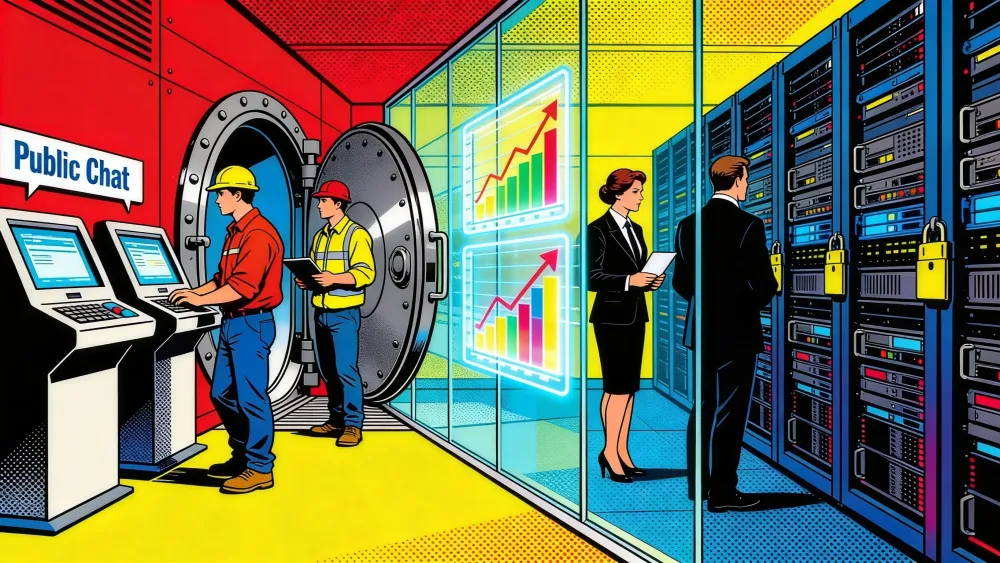
On Thursday morning, halfway down OpenAI's GPT-5.5 launch page, the most revealing line was not a benchmark bar. GPT-5.5 would ship immediately in ChatGPT and Codex, while the API would wait because "API deployments require different safeguards." OpenAI put the model inside products it controls and kept the open building interface closed a little longer. Anthropic had made the opposite symbolic move on April 7, 2026 with Project Glasswing, limiting Mythos Preview to launch partners and more than 40 additional infrastructure organizations while saying it did not plan general availability. Same frontier. Different airlocks.
That line tells you more than the leaderboard does. GPT-5.5 may be better than GPT-5.4 across OpenAI's own table. But OpenAI did not stage this as a pure proof-of-intelligence event. It staged it as a controlled distribution system, broad inside the company's own rooms, delayed on the surface that lets everyone else build. The help article about GPT-5.5 availability sharpens the picture: paid ChatGPT tiers get the model picker, Pro and enterprise tiers get more, and the API still waits. That is the tell.
Key Takeaways
- OpenAI launched GPT-5.5 inside ChatGPT and Codex, but held back the API, turning access control into part of the product.
- Double the list price, cut output tokens by 40%, and the modeled bill rises about 20%, not 100%.
- Anthropic kept Mythos behind a tighter gate, offering a rival template for selling frontier capability.
- The next model fight will turn on distribution, quotas, and safety wrappers more than one benchmark chart.
AI-generated summary, reviewed by an editor. More on our AI guidelines.
The door mattered more than the demo
OpenAI wants you to focus on what GPT-5.5 can do with a messy task. Fair enough. The model looks stronger on coding, computer use, and broad knowledge work, and the launch page gives it real gains over GPT-5.4 on Terminal-Bench, OSWorld-Verified, and BrowseComp. But the more important choice was where OpenAI let that capability live on day one. Not the API. Not third-party software. Not arbitrary agent stacks. ChatGPT and Codex first.
That is a business decision disguised as a safety decision, though the safety part is real. OpenAI can meter usage, tune guardrails, watch failure patterns, and price access more cleanly inside products it operates itself. The company gets the upside of a broad rollout without taking the full risk of open-ended programmatic use. You can see the confidence in the launch breadth. You can also see the anxiety in the holdback. Frontier labs are behaving as if they trust their own surfaces more than outside ones.
This is why the GPT-5.5 release reads less like a knockout punch and more like a doctrine. Control the interface. Control the defaults. Control the quota. Then widen the aperture later, once the safety stack, pricing story, and enterprise packaging are ready. Anthropic has been more explicit about this logic on the high-end cyber side, but OpenAI is converging on the same principle from the other direction. The model is not the whole product anymore. The airlock is part of the product.
The benchmark fight missed the real math
OpenAI's headline benchmark claim deserves respect, not surrender. Its launch page puts GPT-5.5 at 82.7 percent on Terminal-Bench 2.0. The benchmark-owner leaderboard showed 82.0 percent plus or minus 2.2 the same day. That gap is small in product terms and big in editorial terms. It tells you that launch-day benchmark numbers are still soft objects, shaped by harnesses, dates, and evaluator choices. If you want a decimal-perfect winner, you are still shopping in the wrong market.
The harder point is economic. OpenAI doubled GPT-5.4's posted token pricing, which looks brutal if you stop at the price list. But Artificial Analysis said GPT-5.5 xhigh used roughly 40 percent fewer output tokens on its index while ending up about 20 percent more expensive overall than GPT-5.4. Put that in plain English. Start with a workflow that needed 100 units of output before. Cut usage to 60. Double the unit price. The bill becomes 120, not 200. That is still an increase. It is not a doubling.
That calculation compresses the whole launch. OpenAI is arguing that cost per completed job now matters more than cost per token. If the model finishes the spreadsheet, closes the bug, or survives the long research task with fewer retries, the sticker shock becomes easier to hide inside the workflow. This is not a consumer-internet move. It is enterprise software logic. Good enough beats elegant if you own the budget line.
Anthropic chose a thicker airlock
Anthropic's Mythos posture makes OpenAI's choice easier to read. Anthropic did not merely say Mythos was powerful. It said the model would stay narrow, live with vetted partners, and skip general availability for now. That is caution, yes. It is also market design. Anthropic is treating top-end cyber capability as something to distribute through trust relationships before it becomes a normal product.
Read between the model launches
Strategic AI news from San Francisco. No hype, no "AI will change everything" throat clearing. Just what moved, who won, and why it matters. Daily at 6am PST.
No spam. Unsubscribe anytime.
OpenAI's posture is almost the mirror image. GPT-5.5 goes broad inside consumer and enterprise chat surfaces, while the API waits. Anthropic keeps the most sensitive capability behind a thicker airlock across the board. OpenAI keeps the model broad where it can supervise the experience and narrow where customers can wire it into anything. You should read those differences as institutional emotion turned into product policy. From the outside, Anthropic's posture reads as fear of uncontrolled spread. OpenAI's posture reads as confidence, with a visible layer of impatience underneath it.
Neither lab is pure. Anthropic still sells broad-use models like Sonnet and Opus. OpenAI still uses trusted-access programs for cyber work and says safeguards are the reason the GPT-5.5 API is delayed. But the emphasis has split. Anthropic is selling restraint as part of the product. OpenAI is selling managed abundance.
The frontier is becoming a distribution business
This is where the GPT-5.5 launch stops being a model story and becomes a market story. The frontier is getting good enough, across enough tasks, that intelligence alone no longer settles the argument. Distribution does. Which surface gets the best model first. Which customers get the long leash. Which interface absorbs the safety burden. Which billing model turns a scary price into a tolerable monthly line item.
OpenAI's own system card explains why this matters. UK AISI found a universal jailbreak for GPT-5.5's cyber safeguards during testing, and OpenAI says it later updated the safeguard stack. That should kill the lazy reading that broad rollout means the company thinks the model is harmless. It thinks the product wrapper is strong enough. Big difference.
Winners and losers start to look different under that frame. Chat interfaces and first-party work platforms win because they can bundle frontier capability with guardrails, quotas, and sales motion. Enterprise buyers may like that bargain because it feels legible. Independent API builders lose bargaining power when the best model arrives late or under tighter conditions. So do customers who hoped the raw frontier would stay open by default. The airlock has revenue attached now.
Look back at the launch page, then back at Glasswing. One company widened the door inside its own building and narrowed the hallway outside. The other kept the whole building under tighter guard. Those are not temporary quirks. They are competing answers to the same question: how do you sell dangerous, expensive intelligence without letting it blow out your safety posture or your margins?
The next time a frontier model drops, ignore the chest-thumping for a minute. Ask where it ships first, what surface is held back, and who still has to wait in the lobby. The benchmark table tells you who had a good week. The access chart tells you who thinks it can own the market. On April 23, 2026, OpenAI showed its hand. The next model war will be won at the airlock, not on the leaderboard.
Frequently Asked Questions
Why did OpenAI launch GPT-5.5 in ChatGPT and Codex before the API?
OpenAI said API deployments require different safeguards. Shipping first inside ChatGPT and Codex lets the company meter usage, tune guardrails, and watch failure patterns inside products it controls before exposing the model through broader programmatic access.
How much more expensive is GPT-5.5 than GPT-5.4?
On OpenAI's posted API pricing, GPT-5.5 doubles GPT-5.4 on text tokens, moving from $2.50/$15 to $5/$30 per 1M input/output tokens. Artificial Analysis argued the effective increase can be smaller on some workloads because GPT-5.5 used about 40% fewer output tokens on its index.
What does Anthropic's Mythos launch have to do with GPT-5.5?
Mythos shows the opposite release posture. Anthropic kept it limited to launch partners and additional critical-infrastructure organizations, while saying it does not plan general availability. That contrast makes GPT-5.5 look like a statement about distribution, not just model quality.
Why doesn't the Terminal-Bench result settle who won?
OpenAI's launch page said GPT-5.5 scored 82.7% on Terminal-Bench 2.0, while the benchmark-owner leaderboard showed 82.0% plus or minus 2.2 the same day. The gap is small, but it shows how launch-day benchmark numbers still depend on harnesses, timing, and evaluator setup.
What should enterprise buyers watch next?
Watch the access map, not just the benchmark chart. Which surface gets the best model first, how long the API waits, what quotas or trust tiers appear, and whether the workflow cost holds up under real usage will tell you more than a one-day leaderboard snapshot.
AI-generated summary, reviewed by an editor. More on our AI guidelines.


Free AI briefing · Weekdays
The AI stories that matter, sourced and explained.
Join the Morning Briefing. It goes out every weekday at 4:45 a.m. Pacific, with later sends for the East Coast, Berlin and Tokyo.
Free when you sign up: The Paperclip Compendium, our tested guide to running AI agents.
Free. Unsubscribe in one click.

Marcus Schuler
Editor-in-Chief and founder of Implicator.ai. Former ARD correspondent and senior broadcast journalist with 10+ years covering tech. Writes daily briefings on policy and market developments. Based in San Francisco. E-mail: editor@implicator.ai