IMPLICATOR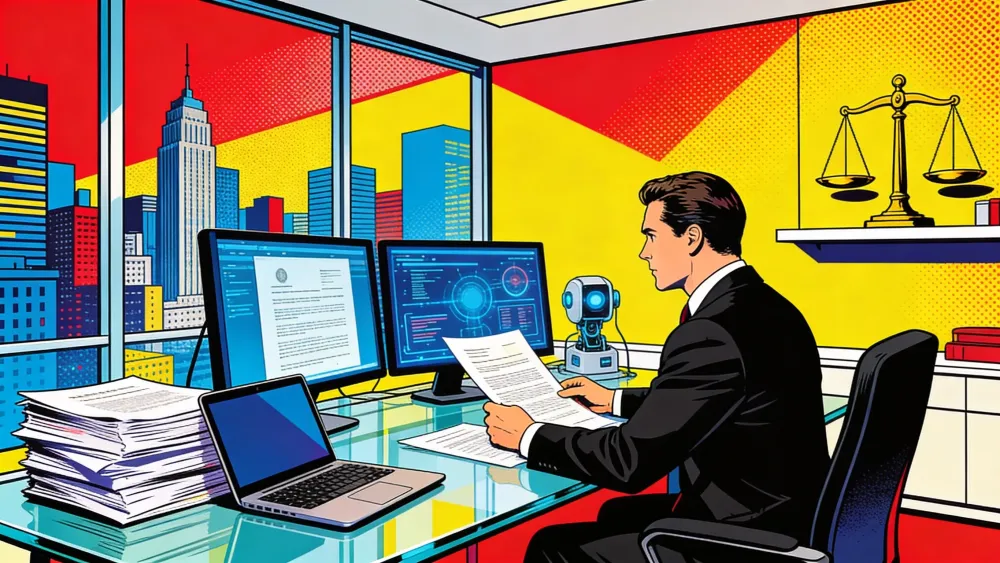
Harvey raised two hundred million dollars Wednesday at an eleven billion dollar valuation, with Singapore's GIC sovereign wealth fund and Sequoia Capital splitting the lead. Fourth fundraise in fourteen months. The math works out to roughly 58 times the company's annual revenue of $190 million, a multiple that would make any traditional software investor flinch. Three years ago, the founder was a junior associate cold-emailing Sam Altman. The distance between that inbox and this valuation tells you more about where venture capital is heading than any single company story.
Key Takeaways
- Harvey raised $200 million at an $11 billion valuation, its fourth fundraise in fourteen months
- Revenue nearly doubled to $190 million ARR, with over half the AmLaw 100 as clients
- AI venture capital has split between model companies and application-layer startups like Harvey
- Legal market faces structural shift as AI-native firms and new competitors emerge
Fourteen months, seven times the price
A billion and a half in July 2024. Sequoia wrote a three hundred million dollar check the following February at three billion. Kleiner Perkins and Coatue matched that amount four months later at five billion. Andreessen Horowitz came in with $160 million at eight billion in December. Now GIC and Sequoia bring it to eleven billion, with Google Ventures and Elad Gil along for the ride.
More than $1.2 billion in total capital. Even by the standards of an industry where startups routinely raise three times a year, Harvey's pace stands out.
What separates Harvey from most AI funding stories is that the revenue is real, and it comes from buyers who actually pay their invoices. Revenue nearly doubled in six months, from a hundred million in August to $190 million by January. More than 100,000 lawyers across 1,300 organizations. Sixty countries. Over half the AmLaw 100 are signed up, alongside corporate legal teams at PwC, KKR, HSBC, and NBCUniversal.
"They sort of wrote the playbook for what it means to be an AI-native application company, which is the same thing Salesforce did back in the day with the cloud transition," Pat Grady, a partner at Sequoia, told CNBC.
Sequoia has now led three of Harvey's rounds. Venture firms will sit on a company's board for years without deploying fresh capital. Leading three rounds in fourteen months is something else entirely.
From junior associate to $11 billion CEO
Winston Weinberg was 27 and working as a junior associate at O'Melveny & Myers in 2022 when he started experimenting with OpenAI's GPT-3 alongside his roommate, Gabe Pereyra, then a research scientist at Google DeepMind and Meta. They ran a blind test. Real legal questions. Attorney reviewers who did not know they were evaluating AI output. The results were clear enough for both to quit their jobs.
Weinberg cold-emailed Sam Altman. The OpenAI Startup Fund wrote the first check. Now Weinberg has offices in ten cities, San Francisco to Bangalore. Thirty-one years old, running a company worth more than most of the firms whose contracts his software reviews.
Harvey gets its name from Harvey Specter, the Suits character. Weinberg noticed something odd during early testing: when users addressed prompts to a human name, they wrote more naturally than when typing into a product interface. Better prompts meant the AI actually understood what the lawyer was asking. Macht, the actor behind Specter, came on board this year for a branding deal. The branding insight sounds small. It stuck hard enough that over half the AmLaw 100 now associate the name with legal AI.
Harvey acquired a startup called Hexus in January 2026 to strengthen its tools for in-house legal departments and recently hired its first chief product officer, Anique Drumright. The company plans to use the fresh capital to build out AI agents that can independently handle tasks like negotiating standard non-disclosure agreements or managing entire discovery processes with limited human oversight.
A trillion-dollar profession starts to split
The legal market generates an estimated $1 trillion in annual fees. For decades, law firms have bundled two distinct kinds of work under one roof. High-judgment strategy earns partners their $2,000-an-hour rates. Process-heavy tasks like document review and due diligence get ground out by junior associates billing at scale.
Eric Greenberg, general counsel at Cox Media Group, described the dynamic in Bloomberg Law last week. "It's movie theater economics," Greenberg wrote. "The star sells tickets, but the theater makes its money on popcorn." AI tools like Harvey threaten the popcorn. If machines handle document review at a fraction of the cost, the bundled model that sustains law firm economics starts to crack.
Cracks are already showing up in unexpected places. Mike Schmidtberger spent seven years chairing the executive committee at Sidley Austin, one of the nation's largest firms. Last month he walked out and became chairman of Norm Law, a two-month-old AI-native legal platform backed by Bain Capital, Blackstone, and Vanguard. When he arrived, he told Bloomberg Law he "confronted the future." KPMG has opened a U.S. law practice under Arizona's Alternative Business Structure rules, which allow non-lawyer ownership. Eudia launched an ABS-licensed firm last fall. None of these operations look like the AmLaw 100. That is precisely the point.
Chief Justice John Roberts, speaking at Rice University on March 19, put the pressure on young lawyers directly. "Four or five years out, a partner's going to come to you and say, 'I need you to analyze this statute,'" Roberts said. "If AI is going to give an answer in three minutes, it's going to take the young lawyer, who knows, three days more than that."
Roberts acknowledged that AI makes mistakes. "But so do young lawyers," he added. The audience laughed. The junior associates in the room probably did not.
Stay ahead of the AI shift reshaping billion-dollar industries
Strategic AI news from San Francisco. No hype, no "AI will change everything" throat clearing. Just what moved, who won, and why it matters. Daily at 6am PST.
No spam. Unsubscribe anytime.
Two orbits in AI capital
Harvey's raise arrived the same day OpenAI disclosed plans to raise an additional $10 billion, lifting its latest round toward $120 billion. The coincidence is instructive. AI venture capital has split into two distinct orbits that barely interact.
Model companies occupy one. OpenAI's February round valued the company at $840 billion. Anthropic raised $30 billion at a $380 billion valuation last month. Together they carry a combined value above $1 trillion.
Application-layer companies like Harvey compete for different investors with a different pitch. The argument comes down to one sentence. We take the model's output and sell it to an industry that will pay. Law firms pay. Hospitals pay. Insurance companies pay. Model companies sell picks and shovels. Harvey sells finished goods.
AI startups accounted for 41% of the $128 billion in venture dollars raised on Carta last year, a record share. But the distribution is harsh. Ten percent of startups captured half the capital. "Fewer bets, but more capital," Peter Walker, head of insights at Carta, told TechCrunch. "AI startups are raising bigger rounds not because they have lots of employees. They don't. But because the cost of running AI models is high."
At 58 times ARR, Harvey's valuation is expensive by traditional enterprise software standards. It aligns, roughly, with what investors pay for dominant positions in fast-growing verticals. ElevenLabs, the voice AI company, reached the same $11 billion valuation in February on $330 million in ARR. The premium is not for the revenue. It is for the position.
The competition question
Harvey does not operate in an empty market. Legora, the Stockholm-based rival, reached a $5.5 billion valuation after raising $550 million and acquiring Canada's Walter AI this month. Thomson Reuters rebuilt CoCounsel on generative AI. Clio acquired vLex for $1 billion. Legal tech is in full consolidation mode, and the buyers have billions to spend.
Weinberg is candid about the bigger threat. "Long-term, the model companies are the most likely competitors in vertical A.I.," he told Observer. OpenAI, Anthropic, and Google all supply Harvey's underlying models. They are also building enterprise products that could, in theory, bypass the application layer entirely.
Harvey's defense is depth. A contract dispute in Singapore plays by different rules than one in Delaware. Each firm carries decades of institutional memory baked into its workflows. ChatGPT does not know how Clifford Chance structures a due diligence review. Harvey does. Harvey's platform integrates with firm knowledge management systems and captures reasoning patterns across thousands of matters. Every new client makes the product harder to displace.
Whether that depth translates into a durable moat or a temporary lead is the central question of vertical AI investing. Weinberg's answer is to keep moving. "The worst mistake you can possibly do is become complacent, because how you build a company is completely changing," he told CNBC.
What the price tag claims
Harvey is worth more, on paper, than most of the law firms it serves. Kirkland & Ellis, the world's highest-grossing firm, pulled in $10 billion in revenue last year. Harvey generated $190 million. The gap between the two numbers measures the distance between what legal AI does today and what investors believe it will do when the profession finishes rearranging itself.
That belief carries specific risks. Law firms buy slowly, with procurement committees that take their time and partners who have spent decades guarding client data. Regulatory barriers shift across jurisdictions. And a 58x revenue multiple leaves no room for the growth deceleration that has punished other enterprise software companies trading at similar premiums.
But Weinberg is not building for the law firms that exist today. He is building for the ones that will exist when partners expect AI answers in minutes and junior associates compete against software for the work that once defined their early careers. Roberts can see it from the bench. Managing partners can see it from conference rooms where hiring plans get discussed in language that sounds more tentative each quarter.
Three years ago, a junior associate cold-emailed a startup founder and bet his career on a hunch about legal AI. Eleven billion dollars says the hunch was right. The open question is whether 100,000 lawyers will agree fast enough to justify the price, or whether the profession will do what it has always done and bill another six-minute increment while the future sits open on a second monitor.
Frequently Asked Questions
How much has Harvey raised in total?
More than $1.2 billion across multiple funding rounds since July 2024, with the latest $200 million round co-led by GIC and Sequoia Capital at an $11 billion valuation.
What does Harvey's software actually do?
Harvey provides AI tools for legal professionals covering contract analysis, compliance review, due diligence, and litigation support. The platform integrates with firm knowledge management systems and is building autonomous AI agents for tasks like NDA negotiation.
Who are Harvey's main competitors?
Harvey faces competition from Legora ($5.5 billion valuation), Thomson Reuters' CoCounsel, and established legal data providers like LexisNexis. CEO Winston Weinberg has identified model companies like OpenAI and Anthropic as the biggest long-term threat.
Why is Harvey's valuation significant for the AI industry?
At $11 billion, Harvey represents the thesis that vertical AI companies applying models to specific industries can generate substantial value alongside the model companies themselves. Its 58x revenue multiple reflects investor conviction in legal AI as a category.
How might AI change the legal profession?
Chief Justice John Roberts warned it will be 'really tough for young lawyers' as AI handles work once reserved for junior associates. AI-native law firms backed by private equity are already emerging, and traditional firm economics face pressure as process-heavy work gets automated.
Free AI briefing · Weekdays
The AI stories that matter, sourced and explained.
Join the Morning Briefing. It goes out every weekday at 4:45 a.m. Pacific, with later sends for the East Coast, Berlin and Tokyo.
Free when you sign up: The Paperclip Compendium, our tested guide to running AI agents.
Free. Unsubscribe in one click.

Marcus Schuler
Editor-in-Chief and founder of Implicator.ai. Former ARD correspondent and senior broadcast journalist with 10+ years covering tech. Writes daily briefings on policy and market developments. Based in San Francisco. E-mail: editor@implicator.ai