Implicator
San Francisco | March 26, 2026
Two juries in two states did what thirty years of congressional hearings never managed: held Meta accountable. Combined penalty: $381 million. Federal child safety laws passed in the same period: zero.
GitHub chose the same week to reverse course on Copilot data. Starting April 24, it trains AI on user interactions by default. Millions of developers enrolled without consent. Enterprise gets a wall. Everyone else gets a toggle.
In Beijing, regulators grounded Manus co-founders, barring them from leaving the country while probing Meta's $2 billion acquisition. The deal closed in December. The founders cannot leave.
Stay curious,
Marcus Schuler
Meta Faces $381 Million in Jury Penalties as Congress Enters Fourth Decade Without a Law

Two juries, two states, one week. A New Mexico panel imposed $375 million on Meta for exposing minors to sexual exploitation. A Los Angeles jury awarded $6 million after finding Meta and YouTube negligent in harming a young woman's mental health. Zuckerberg took the stand. Jurors said he seemed inconsistent and detached.
The verdicts follow a pattern identical to Big Tobacco. Congress knew for decades. Hearings happened. Bills stalled. The Senate passed the Kids Online Safety Act 91-3 last July. The House let it die without a vote. Meta spent $26 million on federal lobbying in 2025 alone. The money buys inertia, not votes. Bills die in committee. Amendments vanish.
The plaintiffs' lawyers found a route around Section 230 by arguing the platform itself is the defective product. Infinite scroll, autoplay, algorithmic feeds tuned for engagement. That theory now underpins thousands of pending lawsuits with further trials scheduled through the year.
Judicial correction fills a gap but cannot replace legislation. A verdict in Santa Fe does not become a rule for Menlo Park. Courts punish. They do not regulate.
Why This Matters:
- Jury verdicts create financial consequences that Congress never imposed, but they cannot write national regulations or staff enforcement agencies
- The product-design liability theory, if upheld on appeal, gives every state attorney general a template to sue
Reality Check
What's confirmed: Two juries found Meta liable. Combined penalties: $381 million. KOSA passed the Senate 91-3. The House never voted.
What's implied (not proven): Tech lobbying ($26M from Meta in 2025) correlates with inaction, but causation is unproven.
What could go wrong: Meta appeals both verdicts. Section 230 has survived broader challenges. The product-design liability theory faces its first appellate test.
What to watch next: State AGs citing the NM verdict in pending filings. Phase 2 starts May 4 with demands for forced platform changes.

The One Number
$410 billion — Total U.S. corporate spending on AI in 2025, which Goldman Sachs says produced zero measurable impact on GDP growth. Investors are projected to spend $660 billion more in 2026. Economists at the National Bureau of Economic Research found that perceived productivity gains consistently exceed measured ones, with revenue realization lagging behind deployment. The structural problem: when American companies buy chips fabricated in Taiwan, the economic activity registers abroad, not domestically.
GitHub Reverses Copilot Policy, Will Train AI on User Data Starting April 24

GitHub announced it will use interaction data from Copilot Free, Pro, and Pro+ subscribers to train AI models, reversing a policy that excluded all plan tiers. The change enrolls millions of developers by default. Users who want out must find a settings toggle before April 24.
The scope covers everything: accepted code, prompts, surrounding context, file names, repository structure, and feedback. Code from private repos processed during active Copilot sessions is eligible for collection. Enterprise and Business customers are fully exempt, creating a two-tier privacy system where protection costs more.
Developer response has been lopsided. In GitHub's community discussion, users posted 59 thumbs-down votes against three rocket emojis. Nobody besides GitHub's VP of developer relations endorsed the change. The anger connects to a longer grievance: Copilot's original models trained on publicly available code without explicit consent. Now real-time interactions get folded back in.
Why This Matters:
- Over 100 million developers use GitHub, and most will never see the policy change or find the opt-out page before April 24
- The reversal establishes opt-out data harvesting as the AI industry default, with Europe's GDPR opt-in standard increasingly isolated

AI Image of the Day

Prompt: futuristic mech female character, dynamic floating pose, body composed of smooth streamlined industrial design shells, white and mint green color scheme, partial exposed human skin contrast, full helmet with glossy black visor, no facial features, limbs are modular mechanical structures, clean seamless surfaces, rounded joints, back features three wing-like mechanical thrusters with circular energy cores, minimal and premium design language, resembles high-end consumer electronics, slender elegant proportions, strong industrial design aesthetic, clean white background, studio lighting with soft and hard light mix, crisp shadows, high-end product render style, octane render, ultra detailed, industrial design showcase, futuristic, smooth curves --ar 3:4 --raw --profile qywhqqj
China Bars Manus Founders From Leaving Country Over Meta's $2 Billion AI Deal

China barred Manus co-founders Xiao Hong and Ji Yichao from leaving the country after the NDRC questioned them about foreign investment violations tied to Meta's $2 billion acquisition. No formal charges. No trial. Just no passport.
The exit bans escalate January's administrative review into personal restriction. Regulators are examining whether core AI intellectual property transferred to Singapore without government approval. Manus relocated from Beijing to Singapore after a Benchmark Capital financing round, but its original Chinese entities remain registered. Beijing calls this pattern "Singapore-washing."
Meta completed the acquisition in December. Integration has started. Pulling it apart would require separating deployed technology, transferring back IP, and deciding which team members stay where. One person close to the process called a forced unwinding "messy."
Why This Matters:
- If Beijing establishes that completed acquisitions can be reversed, every cross-border AI deal faces retroactive risk
- Chinese AI startups weighing offshore relocations are repricing the exit strategy as of this week

🧰 AI Toolbox

How to Save, Summarize, and Search Everything You Read Online with Recall
Recall captures articles, PDFs, YouTube videos, and podcasts, then uses AI to summarize them and connect related ideas automatically. Save a link and Recall generates a summary, extracts key points, and links the content to everything else in your knowledge base by topic. Search your entire library in natural language months later. Free tier available with 100 saves per month.
Tutorial:
- Go to getrecall.ai and create a free account
- Install the browser extension for Chrome, Firefox, or Safari
- Click the Recall button on any article, PDF, or YouTube video to save and summarize it instantly
- Open your library to see AI-generated summaries with key takeaways highlighted
- Browse the knowledge graph to see how saved items connect to each other by topic and concept
- Search your entire library using natural language: "What did I read about supply chain automation?"
- Review weekly digests that surface patterns and connections across everything you saved
What To Watch Next (24-72 hours)
- OpenAI: Pretraining is complete on a new model codenamed Spud, with release expected within weeks. Altman handed product control to Fidji Simo under a new "CEO of AGI Deployment" title and killed the Sora video tool to free compute. The model reveal will test whether OpenAI can regain ground lost to Anthropic and Google.
- Meta: A New Mexico jury ordered $375 million in penalties for misleading users about child safety on Instagram and Facebook. Meta will appeal, but Phase 2 starts May 4 with demands for forced platform changes and additional fines. State attorneys general with pending suits are expected to cite the verdict in their own filings.
- Arm: The chip designer's first in-house processor, a 136-core AGI CPU built on TSMC 3nm, ships samples to lead partner Meta with full production in H2 2026. OpenAI, Cloudflare, and Cerebras have also signed on. Intel and AMD now face an Arm-designed competitor claiming double the performance per watt of x86.
🛠️ 5-Minute Skill: Turn a Weekly Status Email Into a Slide for the All-Hands
Your manager sends a 500-word status email every Friday. The VP wants one slide summarizing three teams for Monday's all-hands. You have three emails and 10 minutes.
Your raw input:
Three Friday emails. Team A shipped auth v3, on schedule. Team B
is 2 weeks behind on the migration, blocked by a vendor. Team C
closed 12 deals, 140% of quota, largest deal $380K.
The prompt:
From these three updates, produce one slide: a headline, three
bullets (team name, status emoji, one sentence each), and one
"attention needed" callout. Under 60 words total.
What you get back:
Q1 Sprint: Week 12 of 13
🟢 Platform: Auth v3 shipped on schedule.
🔴 Data: Migration 2 weeks behind. Blocked on vendor.
🟢 Sales: 12 deals closed, 140% of quota. Largest: $380K.
Needs attention: Data team vendor dependency. Escalation recommended by Wednesday.
Why this works
The emoji forces a status judgment that narrative updates avoid. One slide, one glance, done.
What to use
Claude: Better at honest status assessments.
ChatGPT: Cleaner slide-ready formatting.
AI & Tech News
US Army Taps Carlyle and KKR to Build $4 Billion in Data Centers on Military Bases
The Pentagon selected Carlyle and KKR to construct two data centers on military bases at $2 billion each as AI token usage surged eightfold since the start of the Iran conflict. The Army secretary cited the war as underscoring AI's growing role in modern warfare.
Shield AI Raises $2 Billion at $12.7 Billion Valuation, More Than Doubling in One Year
The defense tech startup secured $2 billion in new funding, up from a $5.3 billion valuation just twelve months earlier. Shield AI derives half its revenue from autonomous software and plans to acquire a simulation software maker.
CXMT Revenue Surges 130% to $8 Billion as Chinese Chipmaker Eyes IPO
ChangXin Memory Technologies more than doubled revenue and projected $435 million in adjusted net income as it prepares for an initial public offering. The Chinese chipmaker is positioning to challenge SK Hynix, Samsung, and Micron in the AI-driven HBM market.
Anduril Faces Safety and Project Concerns From Dozens of Internal Sources
A Wired investigation based on interviews with 37 current and former employees revealed significant safety concerns at the $30.5 billion defense startup's manufacturing operations spanning drones, missiles, and submarines. Anduril called the claims inaccurate.
Melania Trump Showcases Figure AI's Humanoid Robot at White House
The First Lady appeared alongside Figure 3, a humanoid robot, advocating for "humanoid educators" in American classrooms. The event signals a White House push to bring advanced robotics into classrooms.
Pony AI Reports First Profitable Quarter in Company History
The autonomous driving firm posted Q4 net income of $75.5 million, though driven by investment gains rather than core robotaxi operations. Full-year revenue grew 20% as Pony AI plans to launch robotaxis in 20 cities.
Mistral Releases Voxtral TTS, an Open-Source Text-to-Speech Model for Enterprise
The French AI company unveiled Voxtral TTS, built on its Ministral 3B foundation and supporting nine languages including Hindi and Arabic. The model targets voice AI assistants and enterprise customer support.
🚀 AI Profiles: The Companies Defining Tomorrow
Poolside trains AI models that write code, not chat. The San Francisco startup is building the largest foundation model purpose-built for software engineering, backed by up to $1 billion from Nvidia. 💻
Founders
Jason Warner and Eiso Kant co-founded Poolside. Warner served as CTO of GitHub, where he oversaw engineering during the Microsoft acquisition. Kant co-founded two developer tooling companies. The team includes researchers from DeepMind, Meta, and Google.
Product
Two models anchor the platform. Malibu handles complex tasks like multi-file code generation, test creation, and large-scale refactoring. Point is a smaller, quantized model built for sub-200-millisecond code completion inside IDEs. Both train on proprietary synthetic data generated by reinforcement learning from code execution, a technique the company calls RLCE. Poolside runs on AWS through Amazon Bedrock and builds its own inference infrastructure at Project Horizon, a 2-gigawatt AI campus in West Texas with 40,000+ Nvidia GB300 GPUs.
Competition
GitHub Copilot runs on OpenAI models and ships to 77,000 enterprise customers. Cursor hit $100M ARR building an AI-native IDE. Cognition's Devin automates entire engineering workflows. Poolside differentiates by training code-specific foundation models rather than adapting general-purpose LLMs. The risk: general-purpose models keep getting better at code, and OpenAI's o3 already rivals specialized approaches on benchmarks.
Financing 💰
$500M Series B led by Bain Capital, valued at $3 billion. Nvidia reportedly investing up to $1 billion in a subsequent round pushing valuation to $12 billion. Total raised: approximately $626 million with more incoming.
Future ⭐⭐⭐⭐
Warner built GitHub's engineering organization. Now he is building the AI that replaces it. The RLCE training approach, generating synthetic code and testing whether it actually runs, is the closest anyone has come to teaching AI to program rather than autocomplete. Project Horizon signals ambition that extends beyond model training into infrastructure ownership. The $12 billion valuation prices in execution that has not shipped yet. If purpose-built code models outperform general LLMs, Poolside owns the category. If they don't, $1 billion from Nvidia buys a very expensive experiment. 🏊
🔥 Yeah, But...
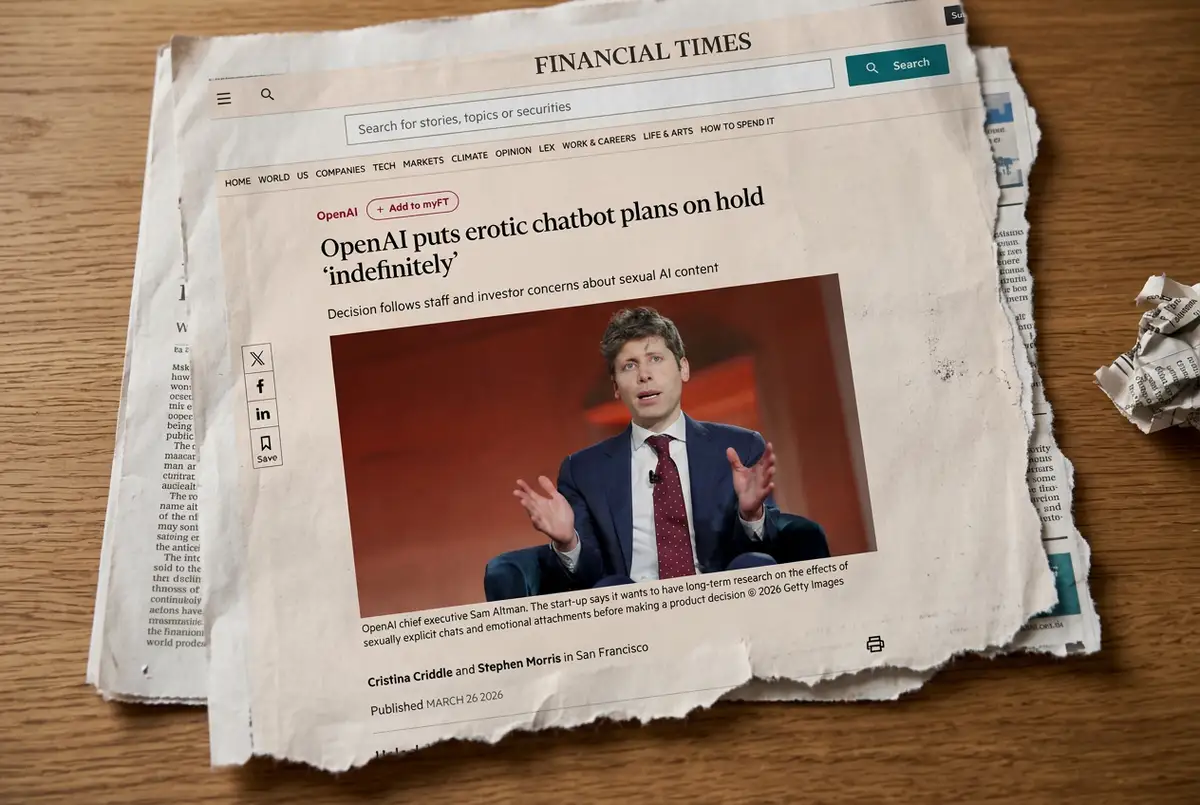
OpenAI Built an Erotic Chatbot. Its Age Check Was Wrong 10% of the Time.
Financial Times, March 26, 2026
OpenAI shelved its "adult mode" chatbot indefinitely after pushback from staff and investors over the effect of sexualized AI content on society. The company faced technical challenges training safety-tuned models to produce explicit content. The product, codenamed Citron, joins Sora on the scrap heap two days after OpenAI killed the video tool.
Our take: Teaching an AI that spent three years learning to refuse sexual conversations to suddenly have sexual conversations is a product roadmap only a growth team could love. The training data required filtering out bestiality and incest.
The age verification was wrong one time in ten. Investors who valued the company at $730 billion politely asked why. OpenAI is now calling these things "side quests," which is corporate for "please forget we spent six months on this."
Sora on Tuesday. Citron on Wednesday. At this rate, by Friday the only surviving product will be ChatGPT and a press release about focus.

Marcus Schuler
Tech translator with German roots who fled to Silicon Valley chaos. Decodes startup noise from San Francisco. Launched implicator.ai to slice through AI's daily madness—crisp, clear, with Teutonic precision and sarcasm. E-Mail: [email protected]