IMPLICATOR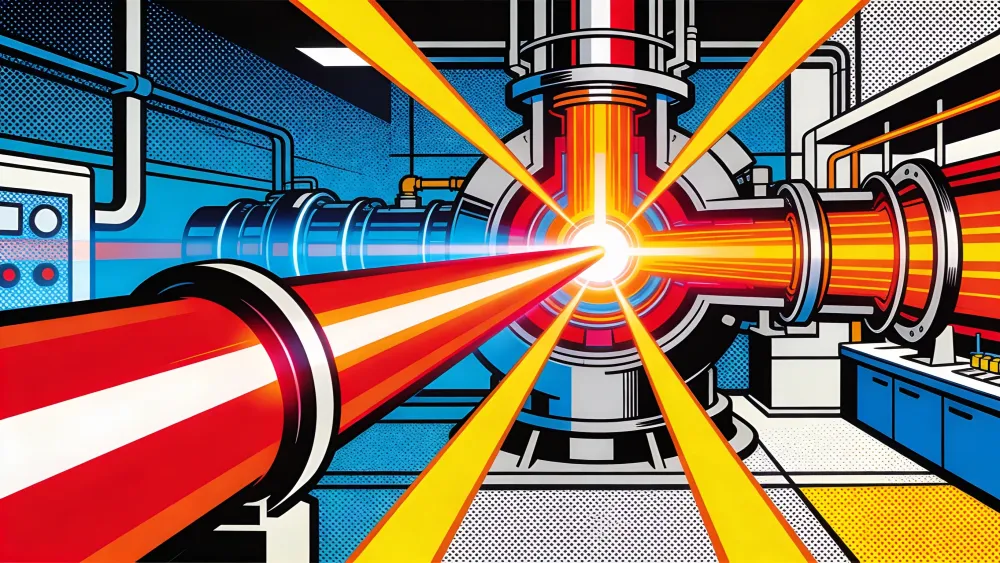
Munich-based Marvel Fusion GmbH told investors it plans to sell its laser technology for defense, medical, and industrial uses, Bloomberg reported Tuesday. The billion-dollar fusion startup needs revenue while its core technology, a nuclear fusion power plant, remains years from commercial reality. Executives also told investors the company may relocate its headquarters from Germany to the United States to improve access to capital.
More than $10 billion flowed into fusion startups in the past few years, according to TechCrunch, and a dozen of those companies pulled in upwards of $100 million apiece. Most of them face the same problem. Physics moves slowly. Investors want returns. And the defense sector, with its appetite for new laser weapons, has money to spend today, not in a decade. The DIW, Germany's economic research institute, noticed the pattern. Fusion companies are selling magnets and specialty materials on the side. They are not waiting for a reactor that works. They cannot afford to.
Key Takeaways
- Marvel Fusion plans to sell its femtosecond laser technology for defense, medical, and industrial applications while fusion commercialization remains years away
- The Munich startup, valued at roughly one billion euros, is considering relocating its headquarters to the United States to improve access to capital
- A $150 million research facility at Colorado State University has slipped from 2026 to early 2027, delaying the company's proof-of-technology phase
- A Nature Energy study found fusion cost projections are overly optimistic, reinforcing the case for intermediate revenue from spin-off technologies
A Laser Built for Stars, Aimed at Drones
Marvel Fusion fires femtosecond laser pulses at tiny nanostructured fuel targets packed with protons and boron-11. How fast is a femtosecond? Light moves less than a hair's width in that time. NIF in California used the same basic inertial confinement principle when it produced the first controlled fusion energy gain back in 2022, but NIF's lasers are decades-old hardware that fire once per experiment and then need hours to reset. Marvel wants lasers that pulse ten times a second, relentlessly, inside something that resembles an actual power plant.
Building one of those plants would take roughly 500 individual laser systems, according to Pulsed Light Technologies, the German government-backed startup that is developing prototype lasers alongside Marvel Fusion. Two prototypes exist so far. A commercial plant target sits around the mid-2030s, assuming nothing else slips.
Those same lasers could earn money much sooner. Analysts at MarketsandMarkets estimate the counter-drone market will triple to more than $20 billion by 2030, driven by the painful economics of shooting down cheap drones with expensive interceptor missiles. Marvel Fusion's femtosecond pulses dump energy in concentrated bursts rather than holding a continuous beam on a moving target. The U.S. Army just scrapped its marquee continuous-wave weapon, the 300-kilowatt IFPC-HEL, chopping four planned prototypes down to one. Soldiers who tested a smaller 50-kilowatt system in the Middle East reported a gap between lab performance and what happened in sand and wind. Pulsed systems face different physics entirely, and nobody has tested Marvel's approach outside a research facility. But the Pentagon is looking for new options as its Golden Dome defense architecture takes shape, and Marvel Fusion wants to be in the conversation.
Bloomberg's sources were vaguer on the medical and industrial side. Oncologists already use high-power lasers in tumor surgery, and every advanced chip fabrication line relies on them. Colorado State University designed the ATLAS facility that Marvel Fusion is building to host research across defense, medicine, and industrial photonics alongside fusion work, so the infrastructure already supports the pivot.
Other laser companies smell the same opportunity. NUBURU, publicly traded on NYSE American, recently rebranded from a photonics company into what it now calls a "dual-use Defense and Security platform provider." Its subsidiary Lyocon finished a proof-of-concept counter-drone system in March. One company pivoting is an outlier. Three companies pivoting in the same quarter is something else.
The Colorado Delay
ATLAS, the $150 million laser research center that Marvel Fusion is building with Colorado State University in Fort Collins, was supposed to start running experiments this year. Not anymore. The building itself wraps up by late 2026, the spokeswoman told Bloomberg, but lasers go in next year. Experiments begin in early 2027 at the soonest.
Until now, Marvel Fusion ran all its experiments on borrowed time, renting hours at Ludwig Maximilian University's laser lab in Garching, outside Munich, and at the Extreme Light Infrastructure facility in Romania. Colorado is where the company builds its own hardware for the first time. The plan calls for three multi-petawatt laser systems. The Department of Energy kicked in $12.5 million through the LaserNetUS program. Private investors and the university covered the rest.
Bloomberg also reported a possible prototype factory in Denver. Von der Linden says he still prefers Germany for the first prototype power plant. He has also spent three years telling reporters how frustrated he is with European investors. "In America, people like Bill Gates, Marc Benioff, and Jeff Bezos invest enormous sums in fusion research," he told the Frankfurter Allgemeine Zeitung. "Here, everyone just looks to the government."
A Billion Dollars and a Funding Gap
Four hundred million dollars raised from public and private sources. A valuation around one billion euros. Backers that include Siemens Energy, EQT Ventures, the European Innovation Council Fund, Deutsche Telekom, and Bayern Kapital. COO Heike Freund called the last Series B extension, worth 113 million euros, the largest financing round any laser fusion company had ever closed. She said it on a Handelsblatt podcast, and nobody argued.
Get Implicator.ai in your inbox
Strategic AI news from San Francisco. No hype, no "AI will change everything" throat clearing. Just what moved, who won, and why it matters. Daily at 6am PST.
No spam. Unsubscribe anytime.
Freund made partner at McKinsey in her early thirties, then jumped to a company with roughly 100 employees and a product that does not exist yet. She sits on the board of Germany's startup association and has spent the past two years telling anyone who will listen that European deep-tech is starved for private capital.
And she has the receipts. When Marvel Fusion went looking for money to build the Colorado facility, not a single European venture capitalist or family office put in an offer. The company ended up with operations scattered across four countries because it patched together funding from wherever it could find it. Berlin committed 2.7 billion euros to fusion research over three years. Bavaria signed a deal with Proxima Fusion and RWE for a stellarator plant. Six German states formed a consortium. Government money is flowing. Private money is not. Moving the headquarters to the U.S. would formalize what has been happening since 2023.
The Skeptics Have Data
Not everyone buys the timeline. A Nature Energy paper published March 22 called cost projections for fusion power plants "overly optimistic." The industry assumes costs will fall 8 to 20 percent each time cumulative production doubles. The study's authors pegged the actual rate at 2 to 8 percent, a gap that would keep fusion expensive for decades. Laser-based inertial fusion has a specific complication: any tweak to the fuel pellet design forces matching changes to the fabrication system, the injection hardware, and the laser driver itself.
A separate analysis covered by the Suddeutsche Zeitung was blunter. Fusion electricity, whenever it arrives, will likely cost more than solar and wind. Germany is funding it anyway. A Markt und Mittelstand piece made the counterargument that the reactor matters less than the technologies developed on the way there. Lasers, cryogenics, advanced materials. All of those have paying customers today regardless of whether a fusion plant ever delivers a watt to the grid.
Marvel Fusion's defense pivot fits that logic. But selling to militaries is a different business. Export controls. Procurement cycles that run for years. And customers who do not care about your lab results. They want to know if the thing works when it is 45 degrees Celsius and the optics are coated in dust. A femtosecond laser that fuses boron in a Munich lab is not the same machine that blinds a drone at two kilometers in the Negev. Closing that gap takes years of engineering that have not started yet.
What Gets Built
The company's scientific advisor is Gerard Mourou, who picked up his Nobel Prize for inventing chirped pulse amplification, the technique that made ultrashort-pulse lasers practical. Von der Linden brings a different pedigree. Before fusion, he built 360T, a forex trading platform. Deutsche Borse bought it for 750 million euros in 2015. Focused Energy in Darmstadt and Proxima Fusion, practically next door in Munich, are chasing the same prize, along with more than a dozen other startups worldwide.
The biggest gamble is the fuel. Deuterium-boron instead of the standard deuterium-tritium mix. Crack it and you eliminate neutron radiation and radioactive waste entirely. Miss, and you have spent billions chasing a fuel cycle that cannot produce enough energy to matter. Max Planck Institute physicists have said publicly they doubt the approach works. The temperatures required run far higher, the energy yield per reaction is lower, and nobody has demonstrated it at scale. Marvel Fusion says its own experiments tell a different story. Fort Collins will settle it, one way or the other.
Defense money pays the bills in the meantime. Munich pulled in more than 1.7 billion euros in defense-tech deals over the past few years, more than any other European city, per Tagesschau. Across the Atlantic, the Trump administration put $1 trillion toward defense in 2026, and Silicon Valley's bets on laser weapons and military AI are producing real revenue for the first time. Marvel Fusion is chasing the same dollars.
Prototype plant, early 2030s. Defense contracts, now. One company, two horizons, same laser. Whether that dual identity holds is the bet Marvel Fusion's investors will make with their next check.
Frequently Asked Questions
What is Marvel Fusion and what does it do?
Marvel Fusion is a Munich-based startup valued at about one billion euros that is developing laser-based nuclear fusion energy. It fires femtosecond laser pulses at nanostructured fuel targets to trigger fusion reactions, aiming to build a commercial power plant by the mid-2030s.
Why is Marvel Fusion pivoting to defense applications?
The company needs revenue while fusion commercialization drags on. Its femtosecond lasers could be used for counter-drone defense, tapping a market projected to exceed $20 billion by 2030. Defense contracts generate income now while the fusion timeline stretches into the next decade.
What is the ATLAS facility in Colorado?
ATLAS is a $150 million laser research center being built with Colorado State University in Fort Collins. It will house three multi-petawatt laser systems to prove Marvel Fusion's technology works at the repetition rates a power plant requires. Operations are now expected in early 2027.
Why might Marvel Fusion move to the United States?
European private investors have been reluctant to fund fusion at scale. When Marvel Fusion sought money for its Colorado facility, no European VC or family office made an offer. The U.S. offers larger defense budgets, more venture capital for deep-tech, and a DOE grant the company secured in September 2025.
What makes Marvel Fusion's approach different from other fusion companies?
Marvel Fusion uses deuterium-boron fuel instead of the standard deuterium-tritium mix. If it works, the process would eliminate neutron radiation and radioactive waste entirely. But the required temperatures are far higher and energy yield per reaction is lower, making it the company's biggest scientific gamble.



Free AI briefing · Weekdays
The AI stories that matter, sourced and explained.
Join the Morning Briefing. It goes out every weekday at 4:45 a.m. Pacific, with later sends for the East Coast, Berlin and Tokyo.
Free when you sign up: The Paperclip Compendium, our tested guide to running AI agents.
Free. Unsubscribe in one click.

Marcus Schuler
Editor-in-Chief and founder of Implicator.ai. Former ARD correspondent and senior broadcast journalist with 10+ years covering tech. Writes daily briefings on policy and market developments. Based in San Francisco. E-mail: editor@implicator.ai