IMPLICATOR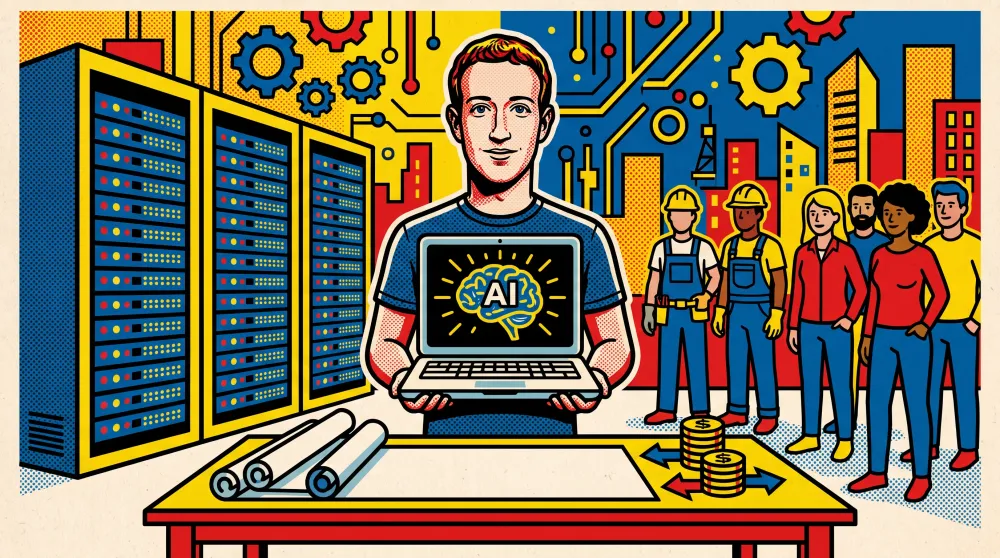
On Aug. 10, 2026, Meta released Muse Glimmer, a 30-billion-parameter model whose weights developers can download. It was built for agents that run on a Mac or PC.
The release carried a policy argument.
In a roughly 6,500-word essay published the same day, Mark Zuckerberg, Meta’s founder and chief executive, called for wider access and fewer U.S. barriers to model development. Meta’s decision to open Glimmer gives his Washington push a product, even after the company kept its more capable Muse Spark behind a paid cloud interface.
What Changed
- Meta released Muse Glimmer, a 30-billion-parameter open-weight model for agents that run on a Mac or PC.
- Zuckerberg paired the release with a call for fewer U.S. barriers around training data and distillation.
- Meta plans up to $145 billion in capital spending during 2026 and $600 billion through 2028 as investors press for clearer AI returns.
- The company also tied the buildout to a $1 billion community fund, though the spending details are still unspecified.
AI-generated summary, reviewed by an editor. More on our AI guidelines.
A model for the laptop
Muse Glimmer is designed for agents that complete multistep jobs, such as working through a coding task or handling administrative work. Meta says the model can run with a single consumer graphics card, keeping files and computation on the user’s machine instead of sending every request to a remote data center.
Unlike a chatbot waiting for one prompt, an agent can hold a plan, call software tools and recover when one step fails. Local execution does not remove every outside dependency, but it can keep sensitive material closer to the owner.
Open weights are the numerical settings a model learned during training. Releasing them lets developers download the system, adapt it and run it on their own hardware, though the license still determines what they may do with it.
Meta trained Glimmer through distillation. In plain terms, a smaller student model studies the answers of a larger teacher, in this case Muse Spark, and learns to imitate its useful behavior with less computing power. The method is central to Zuckerberg’s request that U.S. policy protect a model’s ability to learn from another model’s output.
Alexandr Wang, the former Scale AI chief executive who leads Meta’s Superintelligence division, took a different approach with Muse Spark. Meta launched that model as a closed service, even though the company had built its earlier Llama identity around downloadable weights. Muse Glimmer reopens one part of that path.
The policy push
Zuckerberg argues that American developers face more restrictions on training data than foreign rivals. He wants the United States to reconsider rules for distillation and data use, while rejecting restrictions on access to Chinese open models as a way to protect domestic companies.
Get Implicator.ai in your inbox
Strategic AI news from San Francisco. No hype, no "AI will change everything" throat clearing. Just what moved, who won, and why it matters. Daily at 6am PST.
No spam. Unsubscribe anytime.
Neil Shah, co-founder of Counterpoint Research, described the commercial pressure behind that argument. If Western companies offer only closed systems, developers and corporate buyers could turn to Chinese open-weight models, he said. Running smaller agents on personal computers could also avoid cloud-computing charges.
Zuckerberg used his essay to oppose concentrating advanced systems inside a few companies or government bodies. Meta said its independent board will approve safety criteria for releases and review whether each model meets them, despite Zuckerberg’s control of the company.
The performance gap
The company plans as much as $145 billion in capital spending during 2026, largely for data centers, and has outlined $600 billion in spending through 2028. Investors want clearer returns, and Meta’s shares sold off after its July 2026 earnings call gave little detail about a possible cloud business.
Know someone who'd find this useful? ✉️ Email it to a friend in one click, or they can subscribe free here.
Larry Dignan, editor in chief at Constellation Research, offered the skeptical reading. Zuckerberg’s essay could be an attempt to keep Meta in the industry conversation, he wrote, while Muse Glimmer was more compelling because companies may want local models for privacy and control of their data.
Meta’s broader model performance record is mixed. One Muse Spark 1.2 test reported on Aug. 5, 2026 ran for more than 1,000 tool calls over as long as 24 hours. The published charts put Muse Spark 1.2 close to the leading coding models, not clearly ahead of them. That evidence shows Meta’s broader model standing, not an independent benchmark of Muse Glimmer.
The community bargain
In his Aug. 10, 2026, essay, Zuckerberg paired the model pledge with a $1 billion fund for communities that host Meta data centers. He cited Richland Parish, Louisiana, where a local sales-tax earmark produced $50,000 bonus checks for teachers in 2026 near the company’s Hyperion campus.
The offer arrives as residents and lawmakers contest the AI buildout. New York imposed a ban of up to one year on large new data-center construction in 2026. Meta has not said how the new fund will divide its money or what local spending it will cover.
Meta says it will release open weights for Muse Spark 1.2 in the coming weeks.
Frequently Asked Questions
What is Muse Glimmer?
Muse Glimmer is a 30-billion-parameter open-weight model from Meta that is built for agents running on a Mac or PC. Developers can download its weights and run or adapt the system under the license terms.
Why is Zuckerberg linking Muse Glimmer to policy?
Zuckerberg argues that U.S. rules should leave room for open models, distillation and training-data use. The release gives that argument a product example after Meta kept Muse Spark behind a paid cloud interface.
What is distillation in this story?
Distillation is a training method where a smaller student model learns from a larger teacher model. Meta trained Glimmer from Muse Spark, according to the source material.
What is the counterweight?
Meta is still trying to catch up with the strongest AI labs. Its broader model record is mixed, investors want clearer returns, and data-center communities are contesting the buildout.
What did Meta promise data-center communities?
Zuckerberg paired the open-model pledge with a $1 billion fund for communities that host Meta data centers. The draft notes that Meta has not said how the fund will divide its money or what local spending it will cover.
AI-generated summary, reviewed by an editor. More on our AI guidelines.


Marcus Schuler
Editor-in-Chief and founder of Implicator.ai. Former ARD correspondent and senior broadcast journalist with 10+ years covering tech. Writes daily briefings on policy and market developments. Based in San Francisco. E-mail: editor@implicator.ai