IMPLICATOR
On Tuesday, Meta emailed Horizon Worlds users: the VR platform shuts down June 15. Bosworth went on Instagram Stories the next day and walked it back, replying to a fan who said she was "heartbroken."
The reversal? Under 24 hours. Bosworth recorded it on his phone, talking into the camera between Instagram story slides. And it told you everything about Meta's metaverse era more cleanly than any corporate postmortem could.
Horizon Worlds, the virtual world that convinced Mark Zuckerberg to rename his entire company, never found an audience. Meta's own figures put Horizon Worlds and Horizon Venues at 300,000 monthly users in early 2022, though other reporting later found Worlds alone sitting at about 200,000. Roblox does over 100 million a day.
The $80 billion figure thrown around for Reality Labs covers the whole division over the metaverse era: headsets, AR glasses, software, content, all of it. By contrast, Appfigures estimates only $1.1 million in consumer spending through Horizon's mobile app, a much narrower metric. Those numbers track different things entirely. But the gap still tells you everything about the mismatch.
About 1,500 Reality Labs positions disappeared in January. Nobody has pulled the plug on VR worlds yet. But Meta pulled back from new VR games and shelved the bigger investments. Mobile keeps going. VR sits on life support.
But the metaverse story was never really about VR headsets or floating torsos without legs. The real question is why Meta's institutional machinery produced this outcome. And whether the same machinery is producing the next one.
The Breakdown
- Meta reversed the Horizon Worlds VR shutdown within 24 hours after CTO Bosworth responded on Instagram Stories.
- Reality Labs spent roughly $80 billion over the metaverse era while Horizon Worlds peaked at around 200,000 monthly users.
- Wall Street rewarded Meta for abandoning the metaverse, with shares up 5.7% on cuts alone and tripling from 2022 lows.
- Meta now guides $115-135 billion in AI capex, following the same institutional pattern that produced the metaverse.
The most expensive keynote demo ever built
Horizon Worlds was not a product. A proof of concept with a $10 billion annual budget and a rebrand bolted on top.
The name change came in October 2021, when Facebook was out of room to maneuver. Haugen had already leaked the internal research on Instagram and teen mental health. Congress spent weeks dragging executives through hearings. Hostile coverage everywhere. And Apple's ATT rollout had started eating Meta's ad revenue alive.
The metaverse was his escape hatch. "From now on, we're going to be metaverse-first, not Facebook-first," Zuckerberg told the world in that same keynote. He promised teleportation "like clicking a link on the internet" and painted a commute-free future where people spend more time "doing things that matter."
Corporate America followed his lead with alarming speed. Disney, Crate & Barrel, and others rushed to appoint "chief metaverse officers." McKinsey put out a report projecting up to $5 trillion in metaverse value by 2030. More than 15% of the executives they surveyed expected that share of revenue to come from the metaverse within five years.
Nobody involved had used the product. The product barely existed.
Early versions of Horizon Worlds shipped with avatars that were floating torsos. No legs. Meta added leg functionality months later, but only after becoming a global meme. What shipped felt buggy. Half-empty. It had the energy of mandatory fun at a corporate offsite nobody wanted. A first-time user reported being sexually harassed by multiple avatars before a minute had passed. The EU dropped roughly €387,000 on a metaverse gala. Six attendees.
THE METAVERSE'S WEIRDEST MOMENTS
- The legless avatars. Horizon Worlds launched with floating torsos. Meta added legs months later, after sustained public mockery.
- The EU's €387K party. The European Union hosted a Metaverse gala. Six people showed up.
- Harassment in 60 seconds. A user reported sexual harassment by multiple avatars within a minute of her first login.
- McDonald's in the Metaverse. Users could order virtual food from a virtual restaurant, then eat real food. The value proposition was never made clear.
- Walmart's digital shopping aisle. In an environment where everything is digital, they recreated the experience of walking down a fluorescent-lit aisle.
- VICE rented metaverse real estate. VICE Media paid for virtual property in Decentraland, a platform with fewer concurrent users than a moderately popular blog post.
- Wendy's baconator basketball. Legless avatars threw fast-food sandwiches at basketball hoops in an official brand activation.
- China's collectivism simulator. Chinese state media promoted a metaverse training camp where comrades could "discover the warmth of collectivism."
- The $5 trillion McKinsey forecast. In 2022, McKinsey predicted up to $5 trillion in metaverse value by 2030. Over 15% of surveyed executives expected that share of revenue within five years. Actual contribution: roughly zero.
Wagner James Au wrote the book on this subject, literally. His verdict in The New York Times was blunt: "They glommed onto the term 'metaverse' without really understanding the concept. Their efforts on their metaverse strategy seemed completely indifferent to what previous platforms had learned."
The platforms that actually built thriving virtual worlds, VRChat for social VR, Roblox and Fortnite for gaming, all grew from communities upward. Meta tried to build from a keynote downward. The keynote was polished. The product never caught up.
Wall Street rewarded every retreat
Here is what makes the metaverse saga more than a punchline about floating torsos. The market didn't just tolerate $80 billion in Reality Labs losses. It actively rewarded Meta for walking away.
When Meta started cutting its metaverse budget in late 2025, shifting money toward AI glasses and wearables, the stock climbed. Investors cheered the retreat, pushing shares up 5.7% on the news of metaverse cuts alone. By early 2024, the stock had nearly tripled off its 2022 bottom. Not despite walking away from the metaverse. Because of it.
That pattern creates a specific incentive structure, and you should pay attention to it. A CEO can deploy tens of billions chasing a vision that never finds product-market fit, absorb the losses across quarterly earnings that analysts have learned to shrug off. Then pivot to the next vision while the stock price rewards the correction. The capital is gone. The employees are out. And nobody in the C-suite lost a dime.
Zuckerberg didn't face a board revolt. No pay cut. No loss of operational control. He just stopped saying "metaverse" at keynotes and started saying "AI" instead. At his September 2025 developer conference, the same event where he renamed the company four years earlier, he mentioned the metaverse twice. Both times in the final minutes. He mentioned AI 23 times.
Get Implicator.ai in your inbox
Strategic AI news from San Francisco. No hype, no "AI will change everything" throat clearing. Just what moved, who won, and why it matters. Daily at 6am PST.
No spam. Unsubscribe anytime.
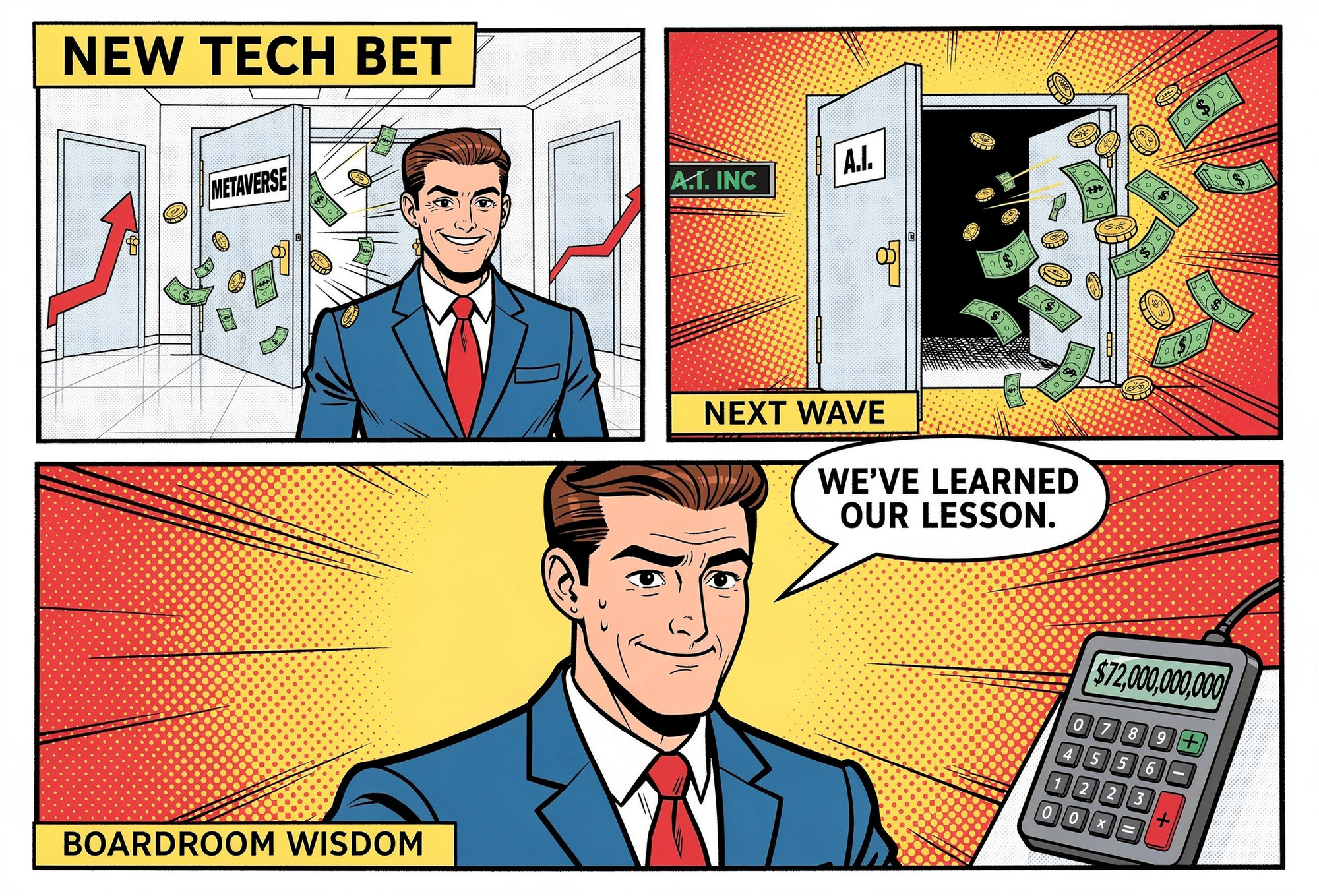
Samantha Ryan, VP of Content at Reality Labs, put up a blog post in February. It had the kind of corporate candor that reads like someone wrote it at gunpoint. "Sometimes, we knock it out of the park," she offered. "Other times, we get things wrong. And when we do, we look at the data, take in feedback, make decisive adjustments to our business strategy, and keep building." Getting things wrong, in this case, meant $80 billion in Reality Labs losses.
The whole transition happened so cleanly it barely registered as a reversal at all. Meta's leadership, riding the stock recovery, treated the pivot as vindication. Not retreat. That smoothness? That's the tell.
Same conviction, different slide deck
This year, Meta has guided between $115 billion and $135 billion in capital expenditures. Most of it goes to AI infrastructure. Zuckerberg now talks about "superintelligence," godlike AI that doubles as your personal companion. Meta and EssilorLuxottica moved more than seven million Ray-Ban and Oakley AI glasses last year. The two companies have reportedly talked about scaling production to 20 million units annually by late 2026.
The glasses are a genuine bright spot. But look at the institutional pattern underneath the numbers, and ask yourself if it feels familiar.
One leader's personal conviction drives capital allocation at a scale no competitor matches. Internal skeptics get reorganized or shown the door. Public messaging shifts to match the new bet before that bet has proven out. And the market rewards the boldness of the spending because the alternative, admitting the company doesn't know what comes next, would be worse for the stock.
This is exactly how the metaverse started. Zuckerberg was personally charmed by VR after buying Oculus for $2 billion in 2014. He spent the next seven years trying to will the technology into mass adoption, overriding signal after signal that consumers weren't interested. Beat Saber and Supernatural never hit critical mass. Quest headset sales fell 16% between 2024 and 2025, per IDC. Even Apple's $3,500 Vision Pro couldn't manufacture demand where none existed.
Eric Seufert, an independent mobile analyst, described the institutional calculus plainly. "They're basically winding that whole experiment down, because they see that trying to will VR into existence as a stand-alone platform would take many more years and many more hardware cycles."
The AI bet might work. Meta's ad machine already benefits from AI-driven targeting, and the company carries real research depth through Yann LeCun's team. But the structural question isn't whether AI will be valuable. The question is whether one person's conviction about what AI should become, deployed at over $100 billion a year in capex with no meaningful governance check, produces better outcomes than the last time this happened.
Who absorbs the cost
The human cost of the metaverse era vanishes inside the quarterly filings. Reality Labs posted $6 billion in operating losses in Q4 alone. Three VR game studios went dark in January. Supernatural, the fitness app that cost Meta $400 million in 2021, stopped putting out new content. No announcement. Just silence. Reporters keep hearing about yet another layoff round. Potentially 20% of the company.
And the wreckage, as always, rolls downhill. Take Ouro Interactive. Meta opened it in 2023 specifically to make first-party Horizon Worlds content. Dead before it shipped anything that mattered. Engineers and designers who signed on to build the future of social interaction ended up building for fewer people than you'd find in a school gymnasium.
Then there are the independent creators. More than 10,000 worlds were built inside Horizon Worlds by volunteer developers who invested thousands of hours in a platform that peaked at the population of a small college town. Their digital items now exist in mobile-only limbo. If a creator hasn't rebuilt their world for mobile, your purchases there are effectively inaccessible. Meta says digital items and currency will remain tied to accounts. But accessibility and existence are not the same thing.
The writer Stephen Johnson visited Horizon Worlds before the shutdown and found something unexpected at the Soapstone Comedy Club. A small but genuine community. Nightly comedy shows. Friendly regulars. Some users were housebound, and VR gave them social connections the physical world denied them.
"Horizon Worlds is a gigantic dead mall, a capitalist cathedral with no congregation, the ultimate liminal space," Johnson wrote. But within that dead mall, a few dozen people had built something real. A comedy club on a phone screen just isn't the same thing. Those communities didn't fail. The platform failed them.
The next slide deck
Bosworth's Instagram reversal will fade from memory fast. Horizon Worlds will sit in maintenance mode for months or years, a product too small to matter and too symbolic to kill. The company that renamed itself after a virtual world will keep that world on life support indefinitely. Pulling the plug forces a conversation nobody at Meta wants to have about what the name means now.
But watch how Meta talks about AI over the next twelve months. Watch for the same confidence that preceded the metaverse, the same scale of capital deployment, the same gap between the keynote and the product people actually use. If the AI glasses take off, Zuckerberg will look prescient. If they don't, the correction will follow the same pattern. Quiet layoffs followed by a stock bump, then a fresh slide deck about whatever comes next.
Reality Labs burned through $80 billion. Horizon Worlds never cracked a few hundred thousand users. The playbook that produced both numbers is still running.
Frequently Asked Questions
Why did Meta reverse the Horizon Worlds shutdown so quickly?
CTO Andrew Bosworth reversed the decision within 24 hours via Instagram Stories, responding to a fan who said she was "heartbroken." VR worlds remain accessible but Meta has stopped building new VR games and shelved major VR investments. The platform continues on mobile only.
How much did Meta actually spend on the metaverse?
Reality Labs spent roughly $80 billion over the metaverse era, covering headsets, AR glasses, software, and content. Consumer spending through Horizon's mobile app totaled just $1.1 million according to Appfigures. The two figures measure different things but the gap captures the mismatch.
What happened to Horizon Worlds' user base?
Meta reported Horizon Worlds and Horizon Venues reached 300,000 monthly users in early 2022. Later reporting put Horizon Worlds alone at about 200,000. For comparison, Roblox has over 100 million daily users. More than 10,000 worlds were built by volunteer developers.
Why did Meta's stock go up after abandoning the metaverse?
Investors rewarded Meta for redirecting spending from VR to AI glasses and wearables. Shares climbed 5.7% on metaverse cut news alone and nearly tripled from 2022 lows by early 2024. The market preferred capital discipline over continued VR investment without traction.
How does Meta's AI spending compare to its metaverse spending?
Meta has guided $115 billion to $135 billion in capital expenditures this year, primarily for AI infrastructure. The company sold over seven million AI glasses last year and has reportedly discussed scaling to 20 million units annually by late 2026.

Marcus Schuler
Editor-in-Chief and founder of Implicator.ai. Former ARD correspondent and senior broadcast journalist with 10+ years covering tech. Writes daily briefings on policy and market developments. Based in San Francisco. E-mail: editor@implicator.ai