IMPLICATOR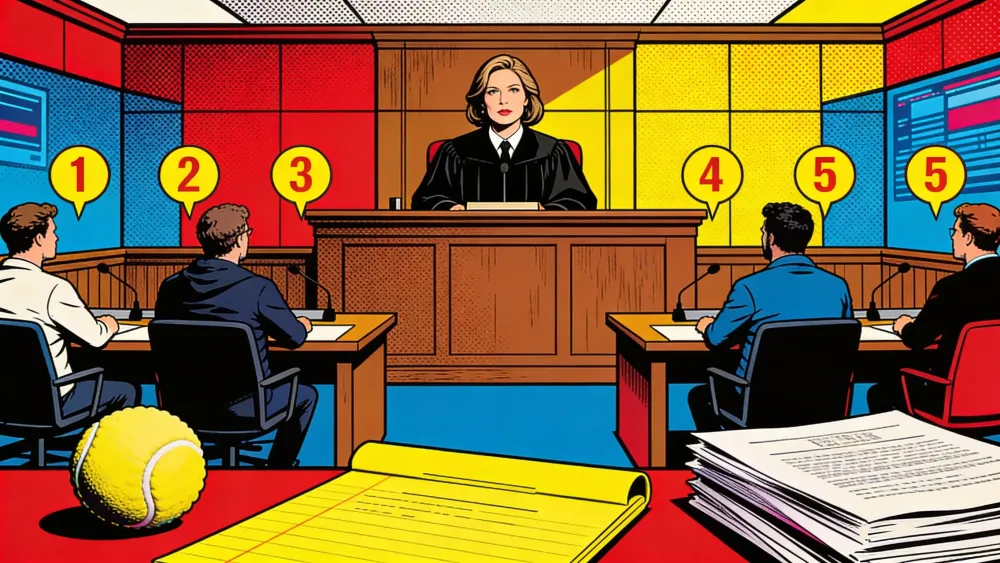
Start with the ball. Not metaphorically. The Times saw Musk leave court squeezing a small soft ball, and that detail has stayed with me longer than the grand speeches about humanity. Musk v. Altman began Monday with jury selection. Tuesday brought the fight over OpenAI's soul. By Thursday the week had narrowed into five odd scenes: a judge, a witness who kept correcting the process, a rival AI company, a courthouse line, and a fixer with a price tag.
Key Takeaways
- Musk v. Altman has become stranger than the daily trial frame suggests.
- Judge Gonzalez Rogers kept narrowing the case away from AI extinction and back to documents.
- Musk's testimony turned comic when he tried to object from the witness stand.
- xAI, courthouse rituals and Birchall's $97.4 billion bid supplied the week's sharpest scenes.
AI-generated summary, reviewed by an editor. More on our AI guidelines.
When the apocalypse is sent outside
Apocalypse minutes had to be rationed. Foundation and relevance did not.
The first cut came before the jury returned Thursday. Steven Molo, one of Musk's lawyers, wanted more room for AI safety testimony. Extinction was in the mix, as it tends to be when this crowd gets comfortable. Rogers kept pointing him back to the case on the table: charitable trust, control, and documents. The lawyers kept pushing. She raised her voice. The Guardian reported her telling Musk's side, "We are not going to talk much about extinction in this case."
That line works because no normal trial judge should have to ration apocalypse minutes. Musk wanted "Terminator" danger and a lawsuit big enough for humanity. The judge wanted foundation and relevance. The end of the world, for once, was overruled without prejudice.
When the witness starts objecting
The witness wanted to be his own counsel. The judge declined.
William Savitt, OpenAI's lead lawyer, came armed with old emails, deposition answers, tax questions, and funding promises. Musk did what Musk often does when a system displeases him: he tried to debug the system while still inside it. "Your questions are not simple," he said Wednesday. They were "designed to trick me, essentially." Later, after Savitt withdrew a question, Musk asked, "OK, after all that?" The room laughed.
By Thursday, Musk was objecting to Savitt's leading questions from the witness stand. Rogers reminded him that leading questions are allowed on cross-examination and that he was not a lawyer. Musk replied that he had technically taken "Law 101." The gallery laughed again. Fine, technically. The richest man in the room had found one more credential.
When the rival becomes the exhibit
"Partly," Musk said. The word did not settle anything. It just sat there.
Savitt's cleanest move was a small one. Had xAI used OpenAI models to train its own systems? Musk first went broad: AI companies generally use other AI models. Savitt pressed. Was that a yes? "Partly," Musk answered, according to coverage of the exchange.
The word did not settle anything. It just sat there, nicely awkward. Musk says OpenAI betrayed a nonprofit mission by joining the commercial AI race. xAI launched in 2023 as a for-profit rival, five years after Musk left OpenAI. The industry's rule on model copying often seems to be: disgraceful when they do it, engineering when we do it. In Oakland, that rule got read back in court.
Track the OpenAI Trial Without the Theater Smoke
Strategic AI news from San Francisco. No hype, no apocalypse karaoke. Just what moved, who won, and why it matters. Daily at 6am PST.
No spam. Unsubscribe anytime.
When the courthouse turns into a queue
By 6 a.m., the future of humanity had a sandwich line.
The New York Times' courtroom diary read like a very nerdy stakeout log. By about 6 a.m., sometimes before, people were already outside the Oakland federal courthouse hoping for a seat or a glimpse. Some young AI safety researchers came prepared, Subway sandwiches included. The cameras stayed outside too, which left photographers lunging at glass doors for whatever they could get.
Rogers had to police the overflow room as well: no recording, no photos, or devices could be taken and the room closed. Altman kept a lower profile. Before jury selection Monday, he reportedly told a Times reporter, "I hope you enjoy this." Musk later left with the soft ball. Greg Brockman sat behind OpenAI's lawyers with yellow paper, at one point passing a note after Musk denied Tesla had concrete AGI plans. The future, for once, came with a lunch line.
When the fixer brings the price tag
A charity case became a valuation fight. The apocalypse can come back Monday.
After Musk's testimony ended, Jared Birchall, Musk's money manager, took the stand to describe donations. That sounded like courtroom oatmeal until a note passed among Musk's lawyers led to the Musk-backed $97.4 billion bid for OpenAI's assets. Birchall described the bid as an attempt to set value and repeated the accusation that "Sam Altman was on both sides of the table."
OpenAI objected. The jury left early. Rogers questioned Birchall herself and was weighing how to handle parts of the testimony. It was a fitting end to the first week: a charity case becoming a valuation fight, a mission dispute becoming a control dispute, and the supposed trial about humanity ending with everyone staring at the paperwork. The apocalypse can come back Monday, provided it has proper foundation.
Frequently Asked Questions
What is the Musk v. Altman trial about?
Musk claims OpenAI betrayed its nonprofit mission and shifted value toward a for-profit structure. OpenAI argues Musk wanted control, left in 2018, later founded xAI, and is now attacking a rival.
Why did the judge limit AI extinction testimony?
Judge Yvonne Gonzalez Rogers pushed lawyers back toward the legal claims: charitable trust, corporate control, donations and documents. She told Musk's side the trial would not spend much time on extinction.
What was the Law 101 moment?
Musk tried to object to leading questions during cross-examination. Rogers reminded him he was not a lawyer. Musk replied that he had technically taken Law 101, drawing laughter.
Why did xAI matter in the testimony?
OpenAI's lawyer asked whether xAI had used OpenAI models to train its own systems. Musk answered partly, giving OpenAI a compact way to argue that Musk is also in the commercial AI race.
Who is Jared Birchall?
Birchall manages Musk's money and testified about donations to OpenAI. His testimony also brought up the Musk-backed $97.4 billion bid for OpenAI's assets, which OpenAI challenged.
AI-generated summary, reviewed by an editor. More on our AI guidelines.

Marcus Schuler
Editor-in-Chief and founder of Implicator.ai. Former ARD correspondent and senior broadcast journalist with 10+ years covering tech. Writes daily briefings on policy and market developments. Based in San Francisco. E-mail: editor@implicator.ai