 IMPLICATOR
On Wednesday in London, Jensen Huang praised Nscale, the data-center company founded by Josh Payne, an Australian former coal miner. “You could be the most valuable UK startup they have created in the last 10 years,” Nvidia’s chief executive said. His company supplies the chips and has invested in the business.
By Sunday, Microsoft’s withdrawal from Nscale’s Loughton project had become public.
The cancellation removes the Essex development’s only publicly announced customer amid a gap between its early-2027 delivery target and reported power availability in the early to mid-2030s. For investors entering the October 19-23 trading week, that gap brings construction financing into Nscale’s listing negotiations alongside falling AI infrastructure shares and forthcoming technology earnings.
What Changed
- Microsoft has withdrawn from Nscale’s Loughton project. Nscale says its other Microsoft contracts remain intact.
- The site planned 23,040 Nvidia processors for early 2027, but sufficient grid power reportedly faces a much longer wait.
- Nscale reported $103.4 billion in active and contracted value at August 31, versus $140.6 million in first-half revenue.
- The October 19–23 trading week brings scrutiny of AI infrastructure financing and Meta’s Wednesday earnings.
AI-generated summary, reviewed by an editor. More on our AI guidelines.
The power timetable
Nscale’s September 2025 announcement envisaged 23,040 Nvidia GB300 graphics processors at Loughton, with delivery targeted for the first quarter of 2027. The initial electrical capacity was to be 50 megawatts, with room to expand.
By September this year, UK Power Networks had reportedly indicated that sufficient electricity would be unavailable until the early to mid-2030s. The network operator would not discuss the individual project. It explained that large data centers connecting to its local distribution network often need upgrades to the national transmission system before they can operate.
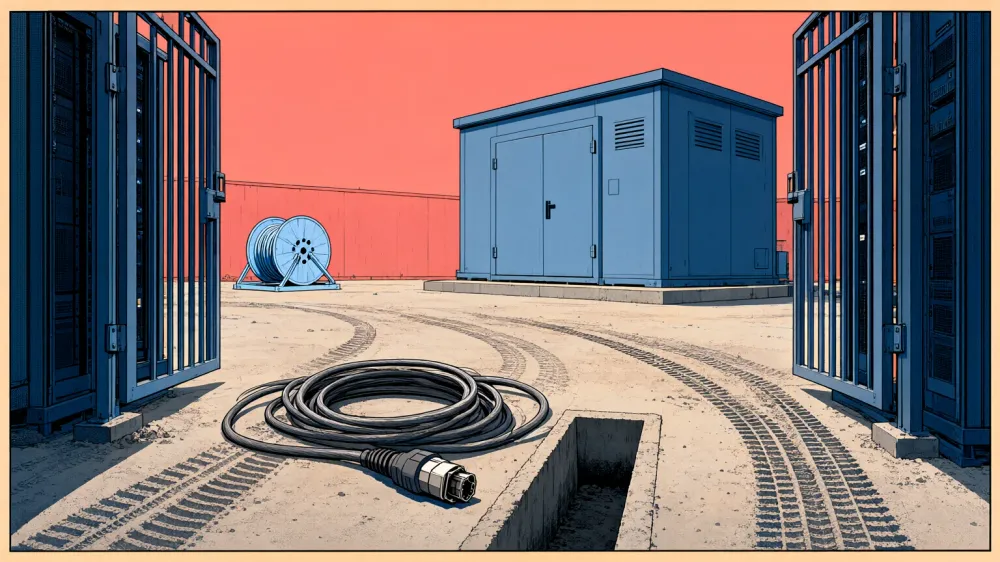
The yard previously used by a scaffolding business had been cleared by September. Nscale was examining generation on the site and ways to accelerate a grid connection. No replacement timetable has been established.
Microsoft declined to comment on its withdrawal. Nscale describes the problem as a London-wide grid issue and says its Microsoft relationship remains strong and long-term, with other contracts unaffected.
Microsoft has not explained its exact grounds for withdrawing. The termination date, project value, cancellation terms and replacement tenant remain undisclosed; no canceled Nvidia equipment order or firm IPO date has been established. Without the project’s value, investors cannot measure the loss against Nscale’s whole Microsoft contract book.
The listing negotiations
Payne’s company is seeking public capital while potential buyers dispute its price. Nscale’s March 2026 funding round valued it at $14.6 billion. It is now reportedly pursuing a valuation of about $30 billion, while a group of investors has suggested $16 billion to $19 billion. These are positions in continuing discussions, with no final decision.
The company filed publicly on September 18. Formal marketing had not begun as of Sunday, while it worked through Securities and Exchange Commission comments.
Nscale announced $3.36 billion in pre-IPO convertible financing in September, led by Dan Loeb’s Third Point. The financing can convert into equity. The total represents announced commitments rather than cash all received, with Nvidia’s $1 billion expected in mid-November.
FREE WEEKDAY MORNING BRIEFING
Follow the financing behind the AI buildout.
The Implicator Morning Briefing filters the AI news cycle to the stories worth your attention and explains their consequences. From San Francisco, every weekday at 4:45 a.m. Pacific, 7:45 a.m. Eastern.
About five minutes. No hype. No spam.
The valuation disagreement affects how many new shares Nscale would have to issue to fund construction. Raising the same amount at the investors’ suggested $16 billion to $19 billion valuation would dilute existing shareholders more than at Nscale’s $30 billion ambition. The construction proceeds would go to Nscale. Buyers considering the listing have to assess what price compensates them for construction and financing still ahead, before the associated service revenue arrives.
When contracts become revenue
Nscale is a neocloud, a specialist cloud provider renting computing capacity for AI development and operation. Its business requires it to assemble the buildings, electricity and processors before customers can use the service.
Its IPO filing records $103.4 billion of active and contracted total contract value at August 31, 2026, with only $2.6 billion active. Both measure value over contract terms, rather than annual sales or cash collected. Actual first-half 2026 revenue was $140.6 million, up from $10.4 million a year earlier.
Nscale describes its arrangements as primarily take-or-pay, with contract terms beginning upon successful delivery of the GPU clusters. In general, take-or-pay means customers commit to paying for reserved capacity even if they do not use all of it, but the installation must first be delivered. A signed agreement therefore does not produce the same revenue stream as an operating installation.
Microsoft agreements signed between September 2025 and April 2026 provide for payments up to $43.8 billion through December 2033. Anthropic agreements provide for up to $44.6 billion. Both are subject to delivery and service availability. Together, they represent roughly 85% of August’s contract total.
The September 18 prospectus said financing required for the Anthropic agreements lacked binding commitments. It already disclosed the pre-IPO subscription agreement; the announced financing does not establish the current position of those project financings.
Construction spending can precede service payments, and a delay can extend that funding gap even when a customer still wants the computing capacity.
Credit and operating results
Listed peers were already under pressure before Sunday’s news. CoreWeave lost about 25% in the week ended Friday, October 16. Nebius fell 32% over the preceding two weeks.
CoreWeave’s bonds due in 2032 recently traded near a 15% yield. A secondary-market yield describes the return available at the bond’s trading price. It does not reset the bonds’ stated coupons or automatically increase the issuer’s current interest payments.
The concern is the terms available for new borrowing and refinancing. If lenders demand more, a developer may have less money left for shareholders from a given customer contract, or may need more equity to complete construction.
Bernstein analyst Madison Rezaei says CoreWeave needs lenders offering terms that leave shareholders an attractive return.
In its second quarter ended June 30, revenue reached $2.575 billion, compared with $1.212 billion a year earlier. Net interest expense rose to $640 million from $267 million, and the net loss widened to $626 million from $290 million.
Know someone who'd find this useful? ✉️ Email it to a friend in one click, or they can subscribe free here.
Its backlog was about $104 billion at June 30, conditional on delivery and service availability.
Michael Intrator, CoreWeave’s co-founder and chief executive, previously co-founded and ran Hudson Ridge Asset Management, a natural-gas hedge fund, from 2013 to 2018. He defended the company in a reported staff memo. “We are confident in our backlog which more than supports all of our debt obligations,” he wrote. He described periods when markets misunderstand a new technology business and act irrationally.
The listed exposures
For CoreWeave, trading as CRWV, and Nebius, NBIS, this week’s immediate analytical question is whether financing remains available on workable terms. New loan terms, an equity commitment funding a powered site or a completed deployment would give investors company-specific evidence about the path from construction spending to customer payments.
Their exposure is closest to the construction-to-revenue gap. Investors can examine whether funded projects have usable power and whether customer payments begin soon enough to support the obligations incurred building them. The cost of new financing would help show how much of a contract’s revenue could remain for shareholders after construction and debt costs. Loughton provides a reason to scrutinize those details without proving equivalent problems at either listed peer.
Nvidia, NVDA, faces a different question: whether neocloud commitments become equipment purchases. Loughton’s plan called for its processors, but no lost order has been established. Evidence that purchases move to another powered site or get deferred would help distinguish a location’s delivery problem from financing constraints restricting aggregate chip purchases.
For Microsoft, MSFT, the question is how it obtains the capacity it needs. Evidence of spending moving toward sites that can deliver electricity could preserve aggregate demand while changing which developers receive the revenue. Investors looking for a broad budget cut would need evidence about Microsoft’s overall planned purchases, beyond the withdrawal from this project.
The earnings week
Meta’s results after the close on Wednesday, October 21, provide the coming week’s most relevant scheduled test of a large AI infrastructure buyer. Its call begins at 4:30 p.m. Eastern.
In its July 29 release for the quarter ended June 30, Meta reported $31.08 billion of capital expenditures, including finance-lease principal, against $31.86 billion of operating cash flow. Company-defined free cash flow was $784 million. Its 2026 capital-spending guidance was $130 billion to $145 billion, narrowed from $125 billion to $145 billion. Those figures cover company capital spending, not solely AI.
That gives Wednesday’s disclosures a concrete baseline. Investors can compare any revised spending guidance with cash generated by the business and look for evidence about when new capacity becomes usable. Continued appetite for computing, supported by cash, would strengthen the case that developers face delivery and funding constraints even while customers want more service.
If spending commitments outrun the cash available to support them, investors would have another reason to examine who finances the difference.
Tesla also reports after Wednesday’s close, with its call at 5:30 p.m. Eastern. Its results could affect broader technology sentiment. They offer limited direct evidence about demand for rented AI computing from neoclouds.
Microsoft’s next earnings release is October 28, outside the coming trading week. Will those disclosures show spending moving toward capacity that can be delivered, and how much financing developers still need before customer payments begin?
Frequently Asked Questions
What did Microsoft cancel?
Microsoft withdrew from a contract for Nscale’s planned data center in Loughton, Essex. The cancellation concerns one project. Nscale says its wider Microsoft relationship and other contracts remain intact. The contract value, exact termination date and any cancellation payment have not been disclosed.
Why does the power connection matter?
Nscale’s September 2025 plan targeted 23,040 Nvidia GB300 processors for the first quarter of 2027. Sufficient grid power reportedly would not be available until the early to mid-2030s. Nscale has examined generation on the site and a faster connection. Microsoft has not publicly explained its precise reason for withdrawing.
Is Nscale’s $103.4 billion contract value revenue?
No. The figure measures active and contracted value over contract terms at August 31, 2026. Only $2.6 billion was active then, and active contract value is not cash collected. Recognized revenue for the first half of 2026 was $140.6 million. Customer service payments depend on delivering usable computing capacity.
What does the cancellation mean for listed AI companies?
CoreWeave and Nebius face scrutiny of financing terms and project delivery. Nvidia’s exposure depends on whether planned purchases move, slip or disappear; no canceled equipment order has been established. Microsoft’s withdrawal from one site does not establish a reduction in its overall AI spending.
Which earnings reports matter in the coming week?
Meta and Tesla report after the close on Wednesday, October 21. Meta’s call starts at 4:30 p.m. Eastern and Tesla’s at 5:30 p.m. Microsoft’s next earnings release is October 28, outside the October 19–23 trading week.
AI-generated summary, reviewed by an editor. More on our AI guidelines.
Related stories
Free AI briefing · Weekdays
The AI stories that matter, sourced and explained.
Join the Morning Briefing. It goes out every weekday at 4:45 a.m. Pacific, with later sends for the East Coast, Berlin and Tokyo.
Free when you sign up: The Paperclip Compendium, our tested guide to running AI agents.
Free. Unsubscribe in one click.

Marcus Schuler
Editor-in-Chief and founder of Implicator.ai. Former ARD correspondent and senior broadcast journalist with 10+ years covering tech. Writes daily briefings on policy and market developments. Based in San Francisco. E-mail: editor@implicator.ai