
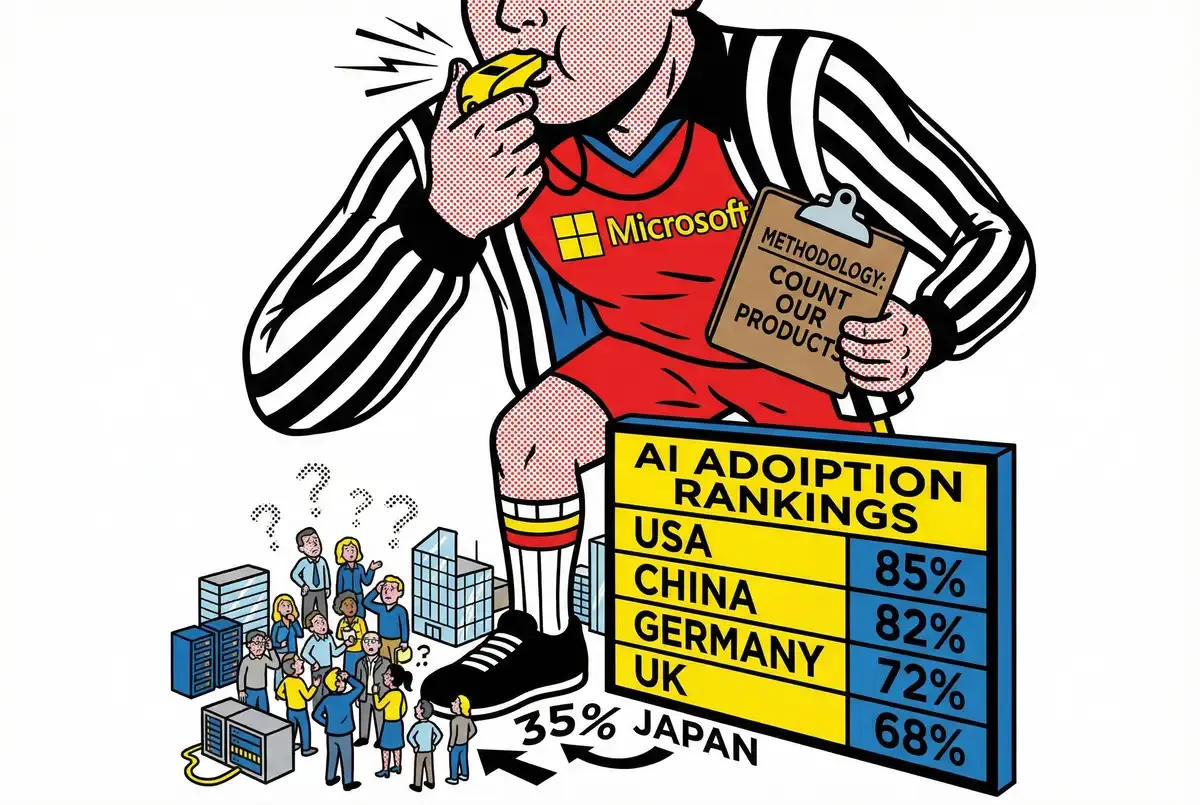
Microsoft wants you to know that one in six people worldwide now use generative AI. The company published this finding last week through its AI Economy Institute, complete with country rankings, methodology papers, and calls to close the "digital divide." The framing positions Microsoft as concerned global citizen, tracking humanity's technological progress.
The methodology section tells a different story. Microsoft measures AI adoption through "aggregated and anonymized Microsoft telemetry." Translation: they're counting how many people use Bing Chat, Copilot, and services running on Azure. The company selling AI infrastructure has appointed itself the official scorekeeper of AI adoption. The ref owns the team.
The Breakdown
• Microsoft measures AI adoption using its own telemetry—the company selling infrastructure grades the homework
• The US ranks 24th in adoption despite hosting OpenAI, Anthropic, and DeepMind within a fifty-mile radius
• South Korea jumped seven spots largely because a Ghibli-style selfie filter went viral on Korean social media
• BIS data shows AI's GDP contribution rose just 15 basis points—half the dot-com boom, one-fifth of Japan's 1980s surge
The measurement problem
Consider what this methodology captures and what it misses. A teenager in Dubai asking ChatGPT to write a birthday message counts the same as a pharmaceutical researcher using Claude to analyze drug interactions. A student in Singapore generating Ghibli-style selfies registers identically to a lawyer in London reviewing contracts with AI assistance. Microsoft's metric treats all AI usage as equivalent, then presents the resulting percentages as evidence of national technological advancement. It isn't.
The company acknowledges this limitation in a single paragraph, buried after the headline findings. "No single metric is perfect," the report concedes, promising to "complement it over time with additional indicators." But the press release doesn't mention these caveats. The number gets quoted. The methodology gets ignored.
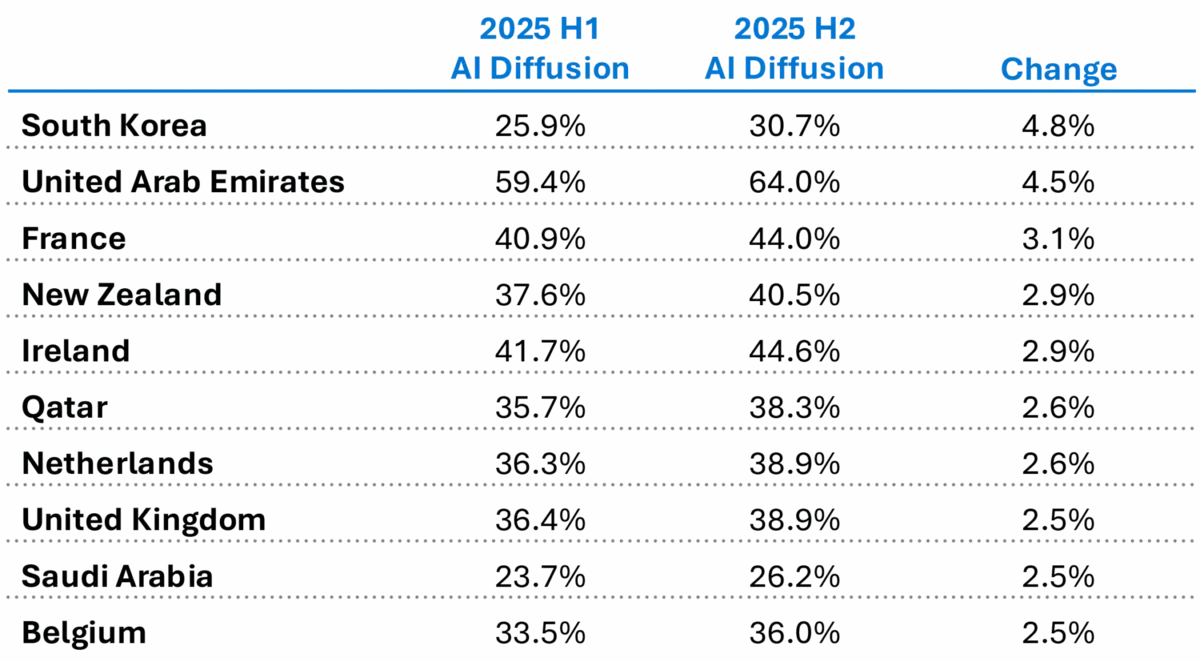
This matters because the rankings create their own reality. The UAE now leads globally with 64% AI adoption, according to Microsoft. Singapore follows at 61%. These figures will appear in government presentations, investment pitches, and policy debates. They'll shape decisions about where to build data centers, which markets to prioritize, which countries are "winning" the AI race. Microsoft has manufactured a scoreboard that happens to favor markets where it wants to expand.
America's uncomfortable position
The most revealing data point isn't at the top of the rankings. Look further down: the United States, 24th place, 28.3% adoption. Slipped from 23rd. Sam Altman testifies before Congress from this country. Dario Amodei warns about existential risk from a few blocks away. Zuckerberg pivoted Meta toward AI and stayed in Menlo Park. The headquarters cluster in a fifty-mile radius: OpenAI in San Francisco, Anthropic across town, DeepMind down in Mountain View. American companies trained the models. American venture capital funded the infrastructure. American electricity powers the data centers.
And Americans, apparently, aren't that interested in using the results.
Microsoft frames this as smaller nations being "more highly digitized and AI-focused." That's one interpretation. Another: the people closest to AI development are the most skeptical of its current utility. Silicon Valley feels misunderstood by its own country. The engineers see the future; everyone else sees a chatbot that hallucinates legal citations. They understand the gap between demo and deployment, between benchmark performance and practical value. The hype works better at a distance.
The report doesn't explore this possibility. Doing so would undermine the narrative that AI adoption equals progress, that higher percentages mean better outcomes. Microsoft needs that narrative. The company has bet $13 billion on OpenAI and integrated Copilot across its entire product suite. Questioning whether adoption metrics reflect genuine value would be questioning its own strategy.
Daily at 6am PST
The AI news your competitors read first
No breathless headlines. No "everything is changing" filler. Just who moved, what broke, and why it matters.
Free. No spam. Unsubscribe anytime.
The economic data tells a similar story. Last week the Bank for International Settlements published its own analysis of the AI investment boom. The contribution to US GDP growth from data centers, IT manufacturing, and related spending? An average of 0.59 percentage points since ChatGPT launched. Before that, 0.44 percentage points. A pickup of 15 basis points. Real, but hardly transformational. The BIS compared the current boom to historical precedents: half the size of the dot-com surge in the 1990s, one-fifth the scale of Japan's property investment boom in the 1980s. The shale oil boom of the mid-2010s moved the needle about the same amount.
South Korea and the Ghibli effect
South Korea offers Microsoft's preferred success story. Seven spots up in six months. From 25th to 18th. Adoption cleared 30%, up from 26%. The report attributes this surge to "government policies, improved frontier model capabilities in the Korean language, and consumer-facing features that resonated with the population."
Read the fine print and a different picture emerges. The report mentions, almost in passing, that "Ghibli-style images generated with ChatGPT-4o went viral across Korean social platforms" in April 2025. This feature let users transform photos into Studio Ghibli animation style. No technical skills required. Instantly shareable. The kind of thing that spreads through group chats and social feeds.
Microsoft's own data suggests "many continued exploring additional AI capabilities after the trend faded, turning a viral moment into lasting adoption." In other words, South Korea's AI surge was substantially driven by a meme. People downloaded ChatGPT to make cartoon versions of their selfies.
This isn't a criticism of South Korean users. It's a criticism of treating their behavior as evidence of national AI strategy success. The report presents policy initiatives—the AI Basic Act, the National AI Strategy Committee, expanded AI education—as drivers of adoption. But the timeline suggests the Ghibli trend did more for ChatGPT downloads than any government committee.
DeepSeek and the access question
The report's most geopolitically charged section covers DeepSeek, the Chinese AI platform that has gained significant traction in markets "long underserved by traditional providers." Microsoft notes adoption surging across China, Russia, Iran, Cuba, Belarus, and Africa. DeepSeek usage in Africa runs 2 to 4 times higher than in other regions.
Microsoft frames this as concerning, mentioning how "open-source AI can function as a geopolitical instrument, extending Chinese influence." The language positions DeepSeek as threat rather than competitor.
But read the explanation for DeepSeek's success: "By releasing its model under an open-source MIT license and offering a completely free chatbot, DeepSeek removed both financial and technical barriers that limit access to advanced AI." The platform doesn't require credit cards, paid upgrades, or accounts tied to Western payment infrastructure.
Microsoft and OpenAI charge subscription fees. Their free tiers have limitations. Their services require payment methods that millions of potential users in the Global South simply don't have. DeepSeek found users by making AI genuinely free and accessible.
The report treats this as unfair competition rather than market feedback. When users choose the free, open option over the paid, proprietary one, Microsoft's analysis focuses on geopolitical influence rather than asking whether its own pricing and access barriers are the problem.
The trust gap Microsoft doesn't explain
One data point deserves more attention than Microsoft gives it. The 2025 Edelman Trust Barometer shows UAE AI trust at 67%. The United States registers 32%. Western Europe averages the same. That's a 35-point gap.
Microsoft attributes this to the UAE's early investment in AI governance and public deployment. But there's another explanation the report doesn't explore: exposure breeds skepticism. Americans have watched AI promises for longer. The chatbot that couldn't book a restaurant. The hallucinated legal citations. The layoff announcements that blamed automation. Anyone who followed the 2024 election read about deepfakes and AI-generated misinformation daily.
Abu Dhabi controls the AI narrative differently. State media covers AI as national achievement. Critics don't get op-ed space in Gulf News. The government shapes public discourse in ways democratic societies cannot replicate. High trust scores might reflect successful communication—or they might reflect limited criticism.
Microsoft doesn't distinguish between these possibilities. The company presents trust as straightforwardly good, adoption as straightforwardly beneficial. Markets where people ask harder questions rank lower on both metrics. That might tell us something about the metrics.
What the scorekeeper wants
Trust is hard to measure. Downloads are easy. So Microsoft counts the downloads.
Every year, the company will release updated adoption figures. Every year, countries will be ranked. Every year, the findings will generate headlines about who's winning and who's falling behind in the AI race.
And every year, the methodology will measure something that serves Microsoft's interests: usage of services that run on Microsoft infrastructure, adoption metrics that justify enterprise AI spending, narratives that position AI skepticism as falling behind rather than thinking critically.
The company has built a measurement system where its products define success. The UAE ranks first partly because Emirati users engage heavily with Microsoft services. South Korea's surge correlates with ChatGPT usage, which runs on Azure. The "digital divide" Microsoft wants to close would be closed by expanding Microsoft's market reach.
None of this makes the underlying data fabricated. One in six people probably do use generative AI tools. The Global North probably does adopt faster than the Global South. South Korea's usage probably did surge in 2025.
But a company selling AI infrastructure has little incentive to ask whether that usage creates value, whether adoption metrics capture meaningful productivity gains, whether the countries ranking highest are actually better off. Microsoft has built a scoreboard. The score is adoption. And Microsoft sells what gets adopted.
Meanwhile, the financing has shifted. AI companies once funded expansion through cash flow and equity. Now they're borrowing. Loans to AI-related firms have grown from almost nothing a few years ago to north of $200 billion today. The BIS calls it "circular financing within the AI ecosystem." Plain English: AI companies paying each other with borrowed money, building capacity for demand that hasn't arrived. The projections require $7 trillion a year in IT capital expenditure by 2030 to hold together. That's not adoption metrics. That's debt on a bet.
The numbers are real. The story they tell depends entirely on who's asking the questions.
Frequently Asked Questions
Q: How does Microsoft measure global AI adoption?
A: Through "aggregated and anonymized Microsoft telemetry"—essentially counting usage of Bing Chat, Copilot, and Azure-hosted services. The methodology treats a teenager generating meme images the same as a researcher analyzing drug interactions.
Q: Why does the US rank so low despite leading AI development?
A: The US sits at 24th place with 28.3% adoption. One explanation: proximity breeds skepticism. Engineers who build these systems understand the gap between benchmark demos and practical utility. The hype works better at a distance.
Q: What actually drove South Korea's AI adoption surge?
A: Microsoft credits government policy, but the timeline suggests otherwise. ChatGPT-4o's Ghibli-style image generator went viral on Korean social platforms in April 2025. Users downloaded the app to make cartoon selfies, then stayed.
Q: Why is DeepSeek gaining ground in Africa and the Global South?
A: DeepSeek removed barriers that Western platforms maintain. No subscription fees, no credit card requirements, no paid upgrades. Usage in Africa runs 2 to 4 times higher than other regions. Microsoft frames this as geopolitical threat rather than market feedback on its own pricing.
Q: How big is the AI investment boom compared to historical precedents?
A: Smaller than headlines suggest. The BIS found AI-related investment adds 0.59 percentage points to US GDP growth—up from 0.44 before ChatGPT. That's half the dot-com boom and one-fifth of Japan's 1980s property surge. Loans to AI firms now exceed $200 billion.
 Robert Brown
 Marcus Schuler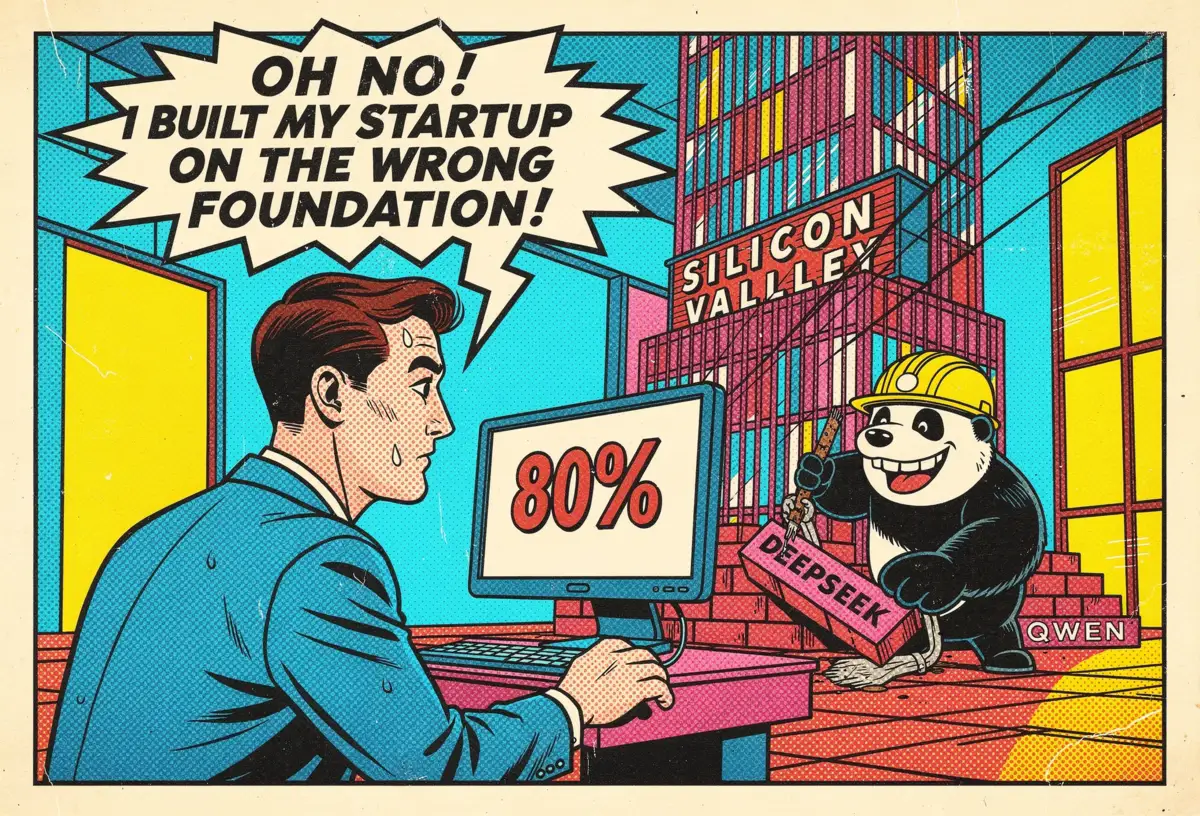
 Maria Garcia