IMPLICATOR
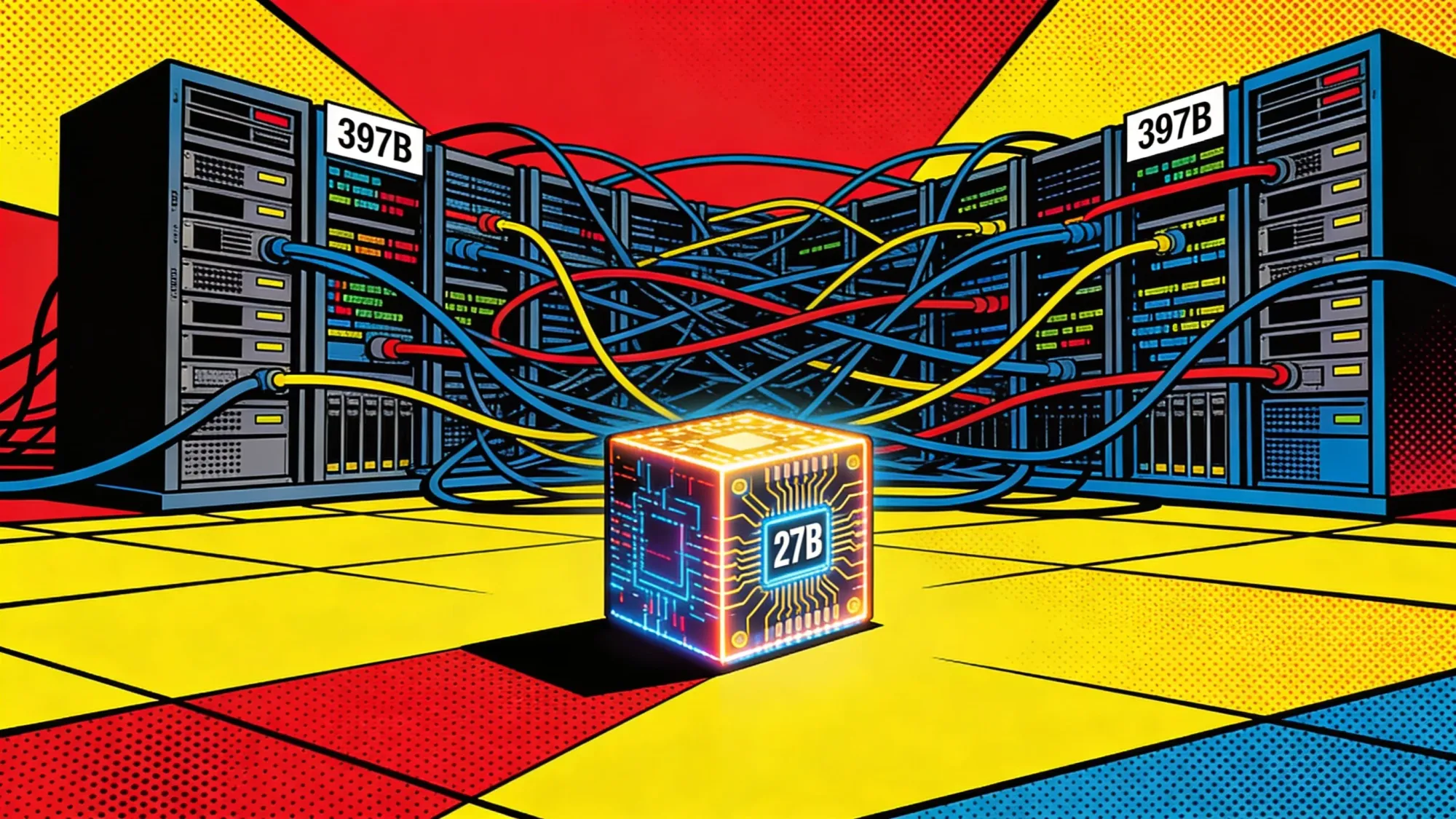
Moonshot AI's new Kimi K3 is too large to fit on a single Nvidia DGX B200, even when compressed to a four-bit format, the research firm SemiAnalysis said Friday. The assessment came one day after the Beijing startup unveiled what it calls the world's largest open-weight model.
K3 has 2.8 trillion parameters. SemiAnalysis said serving it requires newer accelerators with 288 gigabytes of memory, such as Nvidia's B300 and AMD's MI355X, or a system such as the GB300 NVL72. Even then, operators may need to connect multiple nodes and use WideEP, a technique that distributes the model's expert layers across many GPUs.
What Changed
- Moonshot's 2.8-trillion-parameter Kimi K3 is too large to run on a single Nvidia DGX B200 and needs a GB300 NVL72, B300, or MI355X cluster, SemiAnalysis said.
- Moonshot's own serving guide recommends supernodes of 64 or more accelerators for the open-weight model, whose free weights are due July 27.
- The K3 API is priced at $0.30 / $3 / $15 per million tokens, identical to Claude Sonnet 5 and 3.75 times K2.6's output price.
- The Friday launch sent Chinese rivals lower: Z.ai fell as much as 30 percent and MiniMax 16 percent, while US labs were largely untouched.
AI-generated summary, reviewed by an editor. More on our AI guidelines.
"Kimi K3 2.8T is so large that it will not fit on a single NVIDIA DGX B200, even at FP4," SemiAnalysis wrote on X, referring to the four-bit numerical format used to reduce a model's memory requirements.
Moonshot's own guidance points to similarly demanding infrastructure. In its announcement, the company recommends serving K3 on supernodes containing at least 64 accelerators, with communication between the model's experts kept inside a single high-bandwidth domain.
Moonshot plans to publish K3's full weights on July 27, allowing developers to download and adapt the model. The weights will be free, but operating K3 at full scale will require the kind of accelerator cluster typically found in a data center.
The API costs the same as Claude Sonnet 5
Customers who use Moonshot's API instead of hosting the model themselves will pay prices identical to those of a U.S. competitor. K3 costs $0.30 per million cached input tokens, $3 per million uncached input tokens and $15 per million output tokens. Anthropic charges the same rates for Claude Sonnet 5.
That marks a shift from the aggressive pricing associated with Chinese AI developers. Moonshot's previous flagship, Kimi K2.6, cost $0.16 per million cached input tokens, $0.95 per million uncached input tokens and $4 per million output tokens. With K3, the output price has risen 3.75-fold in a single generation. Bank of America analyst Alex Liu, in a note cited by CNBC, called K3 "the most expensive Chinese model to date" and "a sharp step up from K2.6 at $0.95/$4."
K3 still undercuts the top American models on the list price of a single token. Claude Fable 5 runs $1, $10, and $50 for the same three tiers; OpenAI's GPT-5.6 Sol runs $0.50, $5, and $30. But the gap has narrowed to the point where a Chinese open-weight model and a mid-tier Western closed model now cost the same to call.
Cost per task tops GLM-5.2 and DeepSeek
Measured by the cost of finishing a task rather than the price of a token, K3 sits above the open-weight field it claims to lead. The evaluation firm Artificial Analysis put K3's average cost per task at $0.94 on its Intelligence Index, close to GPT-5.6 Sol at $1.04 and roughly half of Anthropic's Opus 4.8 at $1.80. Against the open-weight models K3 outranks on benchmarks, the comparison runs the other way. Z.ai's GLM-5.2 costs $0.32 per task and DeepSeek's V4 Pro just $0.04, according to the same firm, which makes K3 three times and 23 times more expensive than the two open models nearest it.
Part of that cost is structural. K3 launched in max thinking effort only, with lower-effort modes promised in later updates, so every query runs the model at its most compute-hungry setting. The developer Simon Willison ran a single prompt asking K3 to generate an SVG of a pelican on a bicycle; the model spent 13,241 reasoning tokens to produce 3,417 tokens of output, at a cost of 25 cents for the one image.
The economics of serving the model concern some analysts more than the price a customer pays. The research account FUNDA, quoted in Tae Kim's Key Context newsletter, wrote that "given the 2.8-trillion-parameter model size, the current max-reasoning-only mode, and Moonshot's relatively small user base and lower compute utilization, K3 most likely consumes more underlying compute to complete the same task, and its inference gross margins are very likely well below those of Anthropic and OpenAI."
Get Implicator.ai in your inbox
Strategic AI news from San Francisco. No hype, no "AI will change everything" throat clearing. Just what moved, who won, and why it matters. Daily at 6am PST.
No spam. Unsubscribe anytime.
Z.ai fell as much as 30 percent on Friday
The market reaction on Friday fell hardest on Moonshot's domestic rivals. Z.ai, the company behind GLM-5.2, dropped as much as 30 percent in Hong Kong trading, its steepest single-day decline since it listed in January. MiniMax fell as much as 16 percent. Alibaba, which builds the Qwen model series and backs Moonshot, slid 4 percent. Bloomberg's Asian semiconductor index lost more than 6 percent, and Nasdaq 100 futures fell about 2 percent.
Liu, the Bank of America analyst, framed K3 as pressure on China's other model builders rather than on the US frontier. "K3 raises the capability ceiling for China AI models, shifting the burden of proof to other independent AI labs," he wrote. On Alibaba specifically, he added that "Alibaba Qwen's 'open-source leader' narrative may face some tests." Liu also credited the achievement, noting that "despite persistent hardware/compute capacity constraints in China, K3 demonstrates that pre-training scaling, paired with architectural innovation, can still deliver step-change gains for flagship Chinese models."
Moonshot is raising at a $31.5 billion valuation
K3 arrives as Moonshot raises money. The company is being valued at $31.5 billion in an ongoing funding round, people familiar with the matter told The Wall Street Journal, up from the more than $20 billion valuation it reached in May when it raised $2 billion. Its financial advisor said annual recurring revenue exceeded $200 million, according to Fortune, and the company has begun preparing an initial public offering in Hong Kong.
The Chinese tech outlet 36Kr read the timing as a message to investors. Positioning K3 as "the world's largest model approaching the frontier of AI capabilities" gives Moonshot proof to support the valuation, the outlet wrote, before posing the question the company has not yet answered: what task is "too complex for GLM to handle, too demanding for DeepSeek to execute well, and too expensive to run on Claude, where K3 is the only optimal choice?"
Whether the benchmark claims survive outside inspection is still unresolved. Every K3 number published so far comes from Moonshot or from API access to the hosted model, and none can be independently checked until the weights are public. Artificial Analysis found that K3's hallucination rate rose to 51 percent from the predecessor's 39 percent, even as its accuracy climbed to 46 percent from 33 percent, so the model answers more questions correctly and also fabricates more often. Moonshot's own benchmark table drew scrutiny for using different agent harnesses depending on the test, running some evaluations through KimiCode, others through Claude Code or OpenAI's Codex, which means the scores were not all collected under identical conditions. The weights land July 27, and the first independent runs will follow.
Know someone who'd find this useful? ✉️ Email it to a friend in one click, or they can subscribe free here.
Frequently Asked Questions
What hardware does Kimi K3 need to run?
SemiAnalysis says the 2.8-trillion-parameter model will not fit on a single Nvidia DGX B200, even at four-bit precision. Serving it takes accelerators with 288 gigabytes of memory, such as Nvidia's B300 or AMD's MI355X, or a GB300 NVL72 system. Moonshot's own guidance recommends supernodes of at least 64 accelerators.
When are Kimi K3's weights released, and are they free?
Moonshot plans to publish the full open weights on July 27. The weights are free to download and adapt, though running the model at its full one-million-token context requires data-center-scale hardware.
How much does the Kimi K3 API cost?
K3 costs $0.30 per million cached input tokens, $3 per million uncached input tokens and $15 per million output tokens. Those rates are identical to Anthropic's Claude Sonnet 5, and the output price is 3.75 times higher than Kimi K2.6's.
Is Kimi K3 cheaper than other open-weight models?
No. Artificial Analysis puts K3's average cost per task at $0.94, against $0.32 for Z.ai's GLM-5.2 and $0.04 for DeepSeek's V4 Pro, making K3 roughly three times and 23 times more expensive than the two open models nearest it.
Why did Chinese AI stocks fall on the K3 launch?
The Friday launch repriced Moonshot's domestic rivals. Z.ai fell as much as 30 percent in Hong Kong and MiniMax as much as 16 percent. Bank of America's Alex Liu wrote that K3 shifts the burden of proof to other independent Chinese labs.
AI-generated summary, reviewed by an editor. More on our AI guidelines.


Free AI briefing · Weekdays
The AI stories that matter, sourced and explained.
Join the Morning Briefing. It goes out every weekday at 4:45 a.m. Pacific, with later sends for the East Coast, Berlin and Tokyo.
Free when you sign up: The Paperclip Compendium, our tested guide to running AI agents.
Free. Unsubscribe in one click.

Marcus Schuler
Editor-in-Chief and founder of Implicator.ai. Former ARD correspondent and senior broadcast journalist with 10+ years covering tech. Writes daily briefings on policy and market developments. Based in San Francisco. E-mail: editor@implicator.ai