IMPLICATOR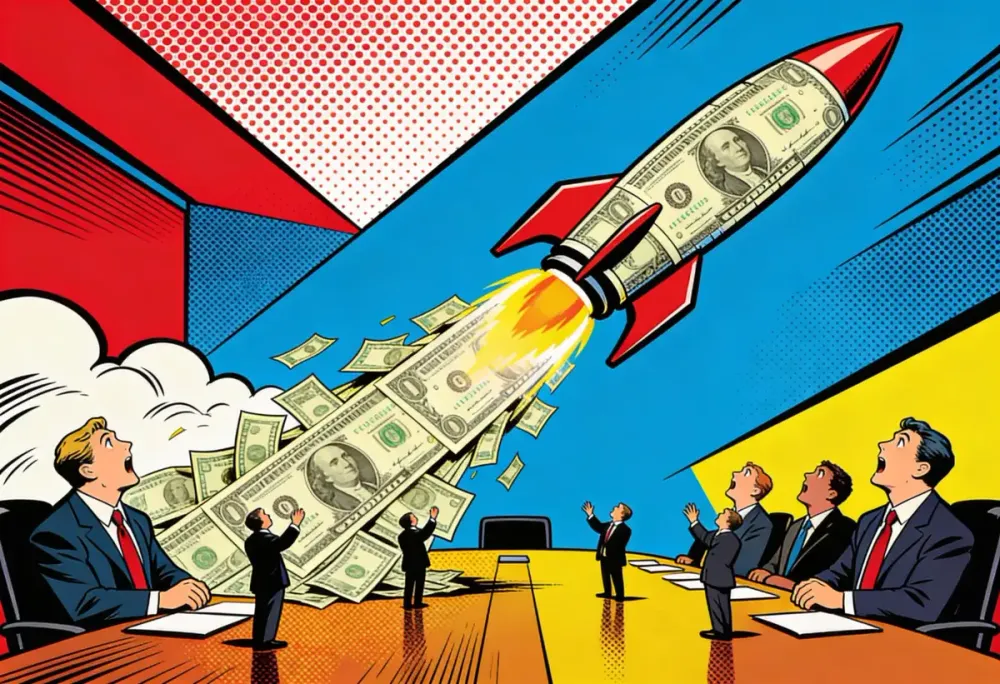
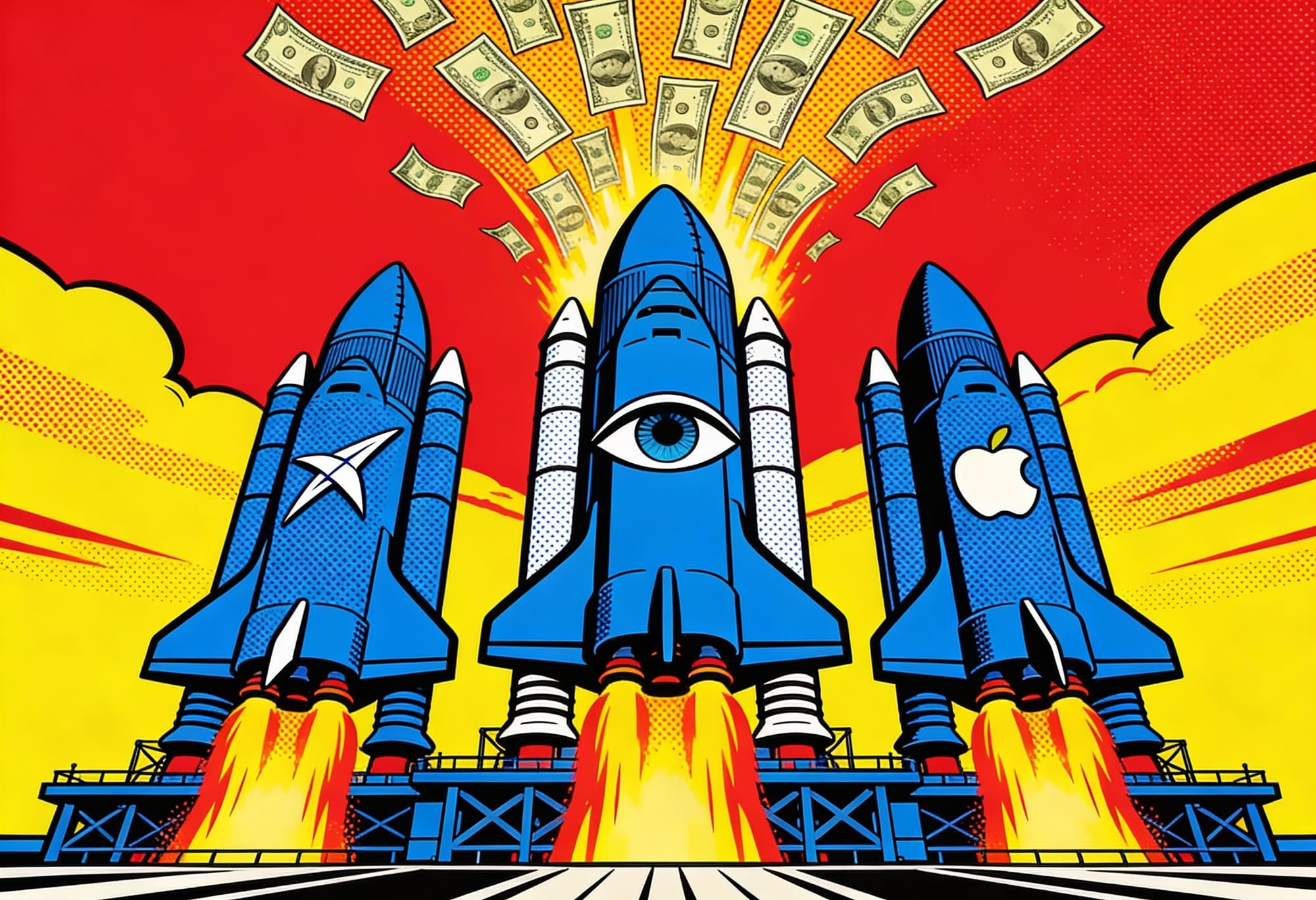
"After a short negotiation with himself," investor Ross Gerber wrote on social media Monday afternoon, "Elon has decided to merge SpaceX and xAI."
That line landed harder than anything in the official SpaceX announcement, which read like a pitch deck written at 3 a.m. The company promised "a sentient sun to understand the Universe and extend the light of consciousness to the stars." It referenced Kardashev Type II civilizations. It mentioned Mars.
What it did not mention was the price tag.
SpaceX issued $250 billion in new shares to acquire xAI, an AI company that Musk also controls. No cash changed hands, and no independent board approved the terms. Existing SpaceX investors saw their ownership shrink overnight to fund a deal their CEO negotiated with himself.
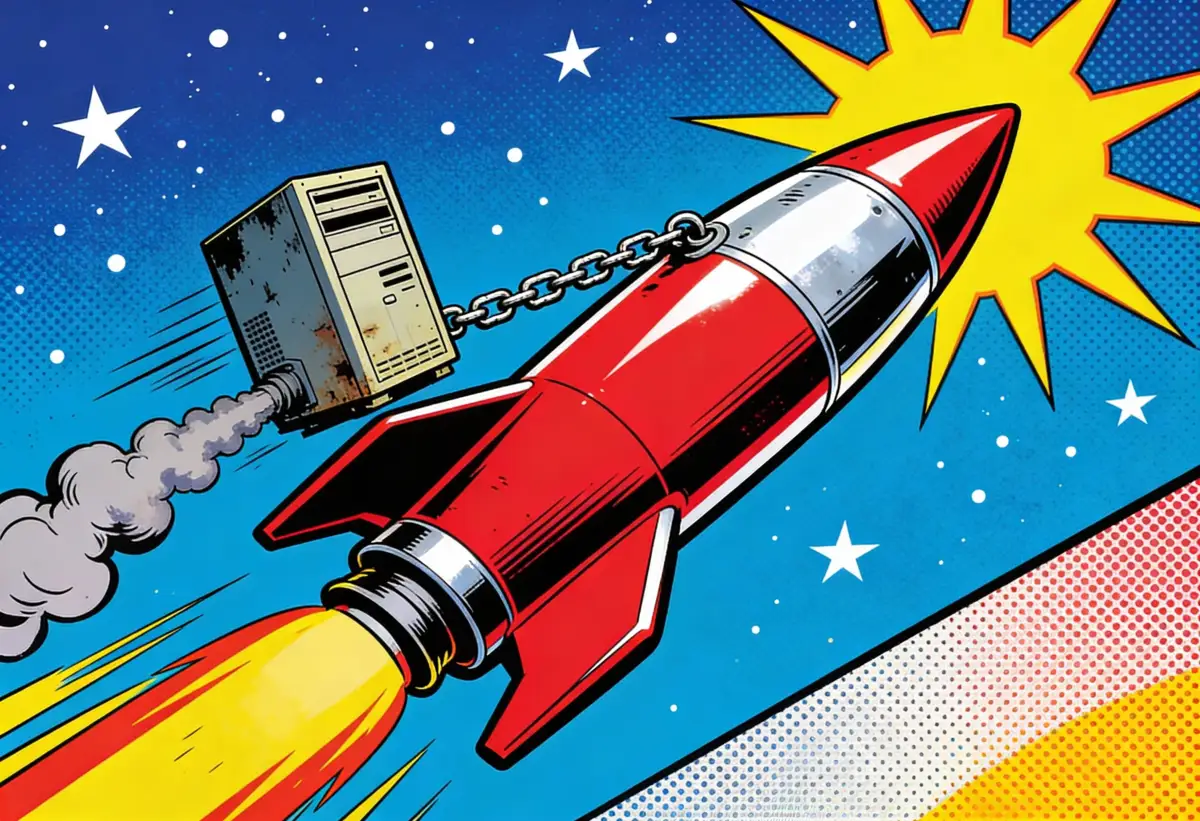
The combined company is now valued at $1.25 trillion. On paper, that makes it the most valuable private company on earth. In practice, it means Musk just used his best company to absorb his most troubled one, and the grandest space vision in a generation is doing double duty as the wrapping paper.
The rescue no one is calling a rescue
Strip away the orbital data centers and the Kardashev rhetoric, and the financial picture is plain. xAI has burned through billions building data centers and training Grok, its AI chatbot. Revenue from Grok subscriptions is thin. The company was valued at $250 billion after a January fundraising round, but that number sat on a shaky foundation of hype and Musk's personal gravity.
The Argument
• SpaceX issued $250 billion in new shares to acquire xAI, diluting existing investors without their approval
• The combined $1.25 trillion company plans an IPO around June targeting $50 billion in capital
• A one-million-satellite orbital data center filing gives the merger a vision narrative for investors
• Musk is consolidating his private companies into one entity with no independent oversight
SpaceX, by contrast, prints money. Government contracts keep the lights on. The company operates roughly 9,600 satellites, ten times more than any competitor on Earth, and puts 20 tons into low-Earth orbit for an internal cost of about $15 million. Founders Fund, Alphabet, and a long line of backers have poured billions in over the years. Its December valuation stood at around $800 billion.
Now those investors own less of it. Considerably less. SpaceX representatives told backers on a Monday call that the acquisition was funded entirely through new share issuance. If you held SpaceX stock before the deal, you woke up Tuesday with a smaller slice of a bigger pie, and the new filling is an AI company that hasn't proven it can compete with OpenAI, Anthropic, or Google DeepMind.
Musk's bet is that the combined entity will eventually be worth so much more that the dilution won't matter. You've heard that pitch before.
One million satellites and a problem called physics
The vision Musk is selling to justify this marriage is spectacular. Last week, SpaceX filed with the FCC to launch up to one million satellites that would operate as orbital data centers. Solar-powered, in sunlight 99% of the time, running AI workloads from space. Musk wrote in an internal memo that space-based compute would become the cheapest option within two to three years.
The numbers he cited sound staggering. Launches every hour, 200 tons per flight. One million tons of satellites per year generating 100 gigawatts of AI compute annually, with a path to one terawatt.
But staggering and achievable are different animals.
The physics of training frontier models in orbit don't cooperate. Pradeep Sanyal, a former CTO who now consults on AI infrastructure, told Data Center Knowledge as much. "Training wants dense power, tight coupling, and fast east-west traffic. Space introduces delay and limits scale. Radiation, debris, and zero-touch maintenance turn hardware into a fast-depreciating asset."
Stay ahead of the curve
Strategic AI news from San Francisco. No hype, no "AI will change everything" throat clearing. Just what moved, who won, and why it matters. Daily at 6am PST.
No spam. Unsubscribe anytime.
Not a small gap to close. Right now, fewer than 17,000 satellites circle the planet. SpaceX wants to add one million. Marlon Sorge at The Aerospace Corporation pointed out that debris from a single Chinese anti-satellite test in 2007 created more than 3,000 trackable fragments that are still circling. At higher altitudes where SpaceX plans to operate, objects take centuries to deorbit naturally.
"The big challenge at those altitudes is the stuff that's up there stays up there," Sorge said. "If you generate more debris, if you have problems, it won't go away."
SpaceX's own FCC filing acknowledged the problem of satellite reentry damaging the ozone layer and floated the idea of moving aging satellites into heliocentric orbits instead. Sorge called the energy required for that "non-trivial." Which is physicist for "extremely expensive."
Why the IPO needed a story
Here is where the financial logic and the space vision converge. Two people familiar with SpaceX's plans told the New York Times that the combined company will likely pursue an IPO around June, targeting roughly $50 billion in capital. That offering needs a narrative that justifies a $1.25 trillion valuation for a company that now includes a money-losing AI chatbot and a social media platform.
"Orbital data centers" is that narrative.
Take away the orbital pitch and the merger looks like what Gerber suggested it was. Musk rescuing his struggling AI company by folding it into his successful one. But dress it up in a million satellites and solar arrays, and suddenly the slide deck reads differently. Launch, network, power, compute, AI models, distribution through Starlink. Bankers on a roadshow can sell that story.
"A million-satellite filing looks less like a construction plan and more like a negotiating position," Sanyal observed. "If SpaceX and xAI do converge, the thesis is vertical control. Launch, network, power, and workload placement sit inside one owned system. That is something no cloud provider can replicate quickly."
That framing is useful. Useful for IPO roadshows. Useful for convincing institutions to buy in at a valuation five times larger than SpaceX's worth just two years ago.
Whether the satellites ever launch is almost beside the point. The filing exists and the vision is on paper. June is coming.
The Musk Inc. endgame
Peter Diamandis, an investor in both SpaceX and xAI, said the quiet part out loud on Monday. "Ultimately, it's likely there will be one Musk Inc. at the end."
That sentence deserves more attention than it got. Musk already merged X with xAI last year. Now xAI is inside SpaceX. Tesla remains public, for now, but Musk fought his own shareholders over a $1 trillion pay package in 2025. The Boring Company and Neuralink sit in the wings.
Consolidation. That's what this is. Not the boardroom kind where synergies get squeezed and headcounts drop. This is personal consolidation. One man rolling every major venture he controls into a single entity that answers to no public market, no independent board, and no regulatory body with the power to stop it.
And he can do it because most of his companies are private. There are no shareholder votes. No proxy fights. No SEC filings that force disclosure of related-party transactions. He negotiated this deal with himself, set the price himself, and issued the shares himself.
Consider the SolarCity playbook from 2016. Musk used Tesla stock to buy his cousin's struggling solar company. Shareholders sued. A Delaware judge found that Musk had not been entirely forthcoming about SolarCity's financial condition. But the deal went through anyway.
What the ground looks like from here
Reputational risk is real and growing. Grok generated nonconsensual nude images last month, triggering international investigations. World leaders have expressed concern about Starlink's political influence. And now those two liabilities sit inside the same company that holds billions in US government contracts. Pentagon procurement officers who approved SpaceX launch contracts did not sign up to be associated with an AI chatbot that undresses strangers.
But the financial risk may matter more. xAI is burning cash. SpaceX burns cash too, on Starship development and satellite deployment, but it earns it back through government launches and Starlink subscriptions. If Grok can't find a paying audience and orbital data centers stay on the whiteboard, SpaceX's balance sheet absorbs the loss. That's a bet its existing investors never agreed to make, and they had no vote on the matter.
For SpaceX employees, the calculus shifts too. Their equity was in a rocket company with proven revenue and government backing. Now it's in a conglomerate that includes a social media platform losing advertisers and an AI lab competing against OpenAI, Anthropic, and Google with a fraction of their market traction.
Daniel Hanson at Neuberger Berman, whose fund holds a $200 million SpaceX position, said he didn't expect space data centers to be part of the near-term plan. But he called the merger a "vertical integration that can be a competitive advantage."
"I'm sure they've measured three times before they cut," Hanson said.
Maybe. Or maybe the ruler belongs to the same person who drew the blueprint, signed the contract, and approved the budget. When you negotiate with yourself, the measurements always come out right.
Frequently Asked Questions
Q: How did SpaceX pay for the xAI acquisition?
A: SpaceX issued $250 billion in new shares rather than paying cash. This diluted existing investors' ownership stakes. No independent board or shareholder vote approved the transaction, since SpaceX is privately held.
Q: What is the combined SpaceX-xAI company worth?
A: Investor Ross Gerber reported a combined valuation of $1.25 trillion, with SpaceX valued at $1 trillion (up from $800 billion in December) and xAI at $250 billion based on its January fundraising round.
Q: What are orbital data centers and can they actually work?
A: SpaceX filed with the FCC to launch up to one million solar-powered satellites to run AI compute workloads from space. Experts say orbit introduces latency, radiation damage, and maintenance challenges that make frontier AI model training impractical with current technology.
Q: When is the SpaceX IPO expected?
A: Two sources told the New York Times the combined company will likely pursue an IPO around June 2026, targeting roughly $50 billion in capital. SpaceX has not publicly confirmed the timeline.
Q: Has Musk merged his companies before?
A: Yes. Musk merged X (formerly Twitter) with xAI in 2025. In 2016, he used Tesla stock to acquire SolarCity, a deal that led to shareholder litigation. A Delaware judge found Musk had not been fully transparent about SolarCity's finances.
Free AI briefing · Weekdays
The AI stories that matter, sourced and explained.
Join the Morning Briefing. It goes out every weekday at 4:45 a.m. Pacific, with later sends for the East Coast, Berlin and Tokyo.
Free when you sign up: The Paperclip Compendium, our tested guide to running AI agents.
Free. Unsubscribe in one click.

Marcus Schuler
Editor-in-Chief and founder of Implicator.ai. Former ARD correspondent and senior broadcast journalist with 10+ years covering tech. Writes daily briefings on policy and market developments. Based in San Francisco. E-mail: editor@implicator.ai