IMPLICATOR
Taipei, Saturday night. Jensen Huang showed up to face reporters with his jacket off, sleeves pushed up, and did something he almost never does. He played defense.
"Complete nonsense," he said, waving away a Wall Street Journal report that his company's $100 billion infrastructure agreement with OpenAI had stalled. Nvidia would "absolutely" participate in OpenAI's next funding round. It would be "probably the largest investment we've ever made." He believed in OpenAI. He believed in Sam Altman.
Then a reporter asked if the investment would top $100 billion. Huang pulled back. "No, no, nothing like that."
Anyone who has watched Huang hold up a GPU like a holy relic or call his own chips "the iPhone moment of AI" could see Saturday was different. He was choosing his words with visible care. The public performance and the private retreat, the distance between those two Jensen Huangs, tells you where AI's most important business relationship actually stands.
The original September deal, a memorandum of understanding for Nvidia to build 10 gigawatts of computing power and invest up to $100 billion to help OpenAI pay for it, never made it past preliminary talks. OpenAI expected to close negotiations within weeks of that announcement. The paperwork has not moved since.
A smaller arrangement replaced it, an equity stake likely worth tens of billions of dollars, folded into OpenAI's broader $100 billion fundraising round with Amazon, Microsoft, and SoftBank. Still enormous by any normal standard. But a fraction of what both companies stood on stage and promised last September, when Huang called it "the largest computing project in history" and Nvidia's stock jumped 4%.
The private complaints
Behind the public praise, Huang has been running two conversations at once, like a contractor who praises your renovation plans at the kitchen table and calls his crew on the drive home to say the foundation is cracked.
The Breakdown
• Nvidia's $100 billion infrastructure deal with OpenAI, announced in September, never progressed past preliminary talks
• Jensen Huang privately criticized OpenAI's business discipline and worried about competition from Google and Anthropic
• Nvidia is instead making a smaller equity investment in OpenAI's $100 billion funding round alongside Amazon, SoftBank, and Microsoft
• Nvidia hedged further by committing $10 billion to Anthropic, OpenAI's top rival
To industry associates over recent months, he stressed that the September agreement was nonbinding. Never finalized. He criticized what he described as a lack of discipline in OpenAI's business approach, according to people familiar with the conversations cited by the Journal. He worried about Google's Gemini, which slowed ChatGPT's user growth enough to trigger an internal "code red" at OpenAI. He worried about Anthropic, whose Claude Code agent has been pulling developers away from OpenAI's products.
Nvidia's own regulatory filings backed up the skepticism months before the Journal story broke. A November filing disclosed there was "no assurance" the company would "enter into definitive agreements with respect to the OpenAI opportunity." At a UBS conference in Scottsdale, Arizona, the following month, CFO Colette Kress confirmed no definitive agreement existed.
None of this squares with the September press event, where Nvidia discussed guaranteeing loans OpenAI planned to take out for building its own data centers. A chip company offering to backstop a customer's debt. Gone now.
Join 10,000+ AI professionals
Strategic AI news from San Francisco. No hype, no "AI will change everything" throat clearing. Just what moved, who won, and why it matters. Daily at 6am PST.
No spam. Unsubscribe anytime.
Why Huang can't walk away
So why does a man with this many doubts keep writing checks? Because Nvidia and OpenAI need each other in a way that neither company controls. Call it codependence, call it a trap. Huang can't let his biggest customer fail, and Altman can't build models without Huang's GPUs.
The math is blunt. If OpenAI stumbles, if its market position erodes against Google and Anthropic, Nvidia's GPU revenue takes a direct hit. And the competitive map makes the exposure worse. Anthropic trains its models on a mix of Amazon's Trainium chips and Google's TPU processors. Google runs Gemini almost entirely on TPUs. Both architectures compete directly with Nvidia's GPUs. Every dollar OpenAI loses in market share is a dollar that might flow toward chips Nvidia doesn't make.
So Huang hedged. Nvidia put up to $10 billion into Anthropic back in November, backing OpenAI's primary rival. The bet bought Nvidia a seat at more than one table. It also sent Altman a message he couldn't miss. You need us. But we have options.
For OpenAI, the message landed in an uncomfortable place. The company that spent 2025 announcing deal after deal, projecting an image of inevitability, suddenly looked like a partner that its most important supplier was backing away from. Defensive. Exposed. An OpenAI spokesman responded with careful corporate language about "actively working through details," the kind of phrasing companies reach for when they're trying not to confirm what everyone already suspects.
Altman's $1.4 trillion problem
Think of OpenAI's compute strategy like a home buyer who signed letters of intent on a dozen properties before getting approved for a mortgage. Each deal looked great on its own. Stack them up and the obligations look insane.
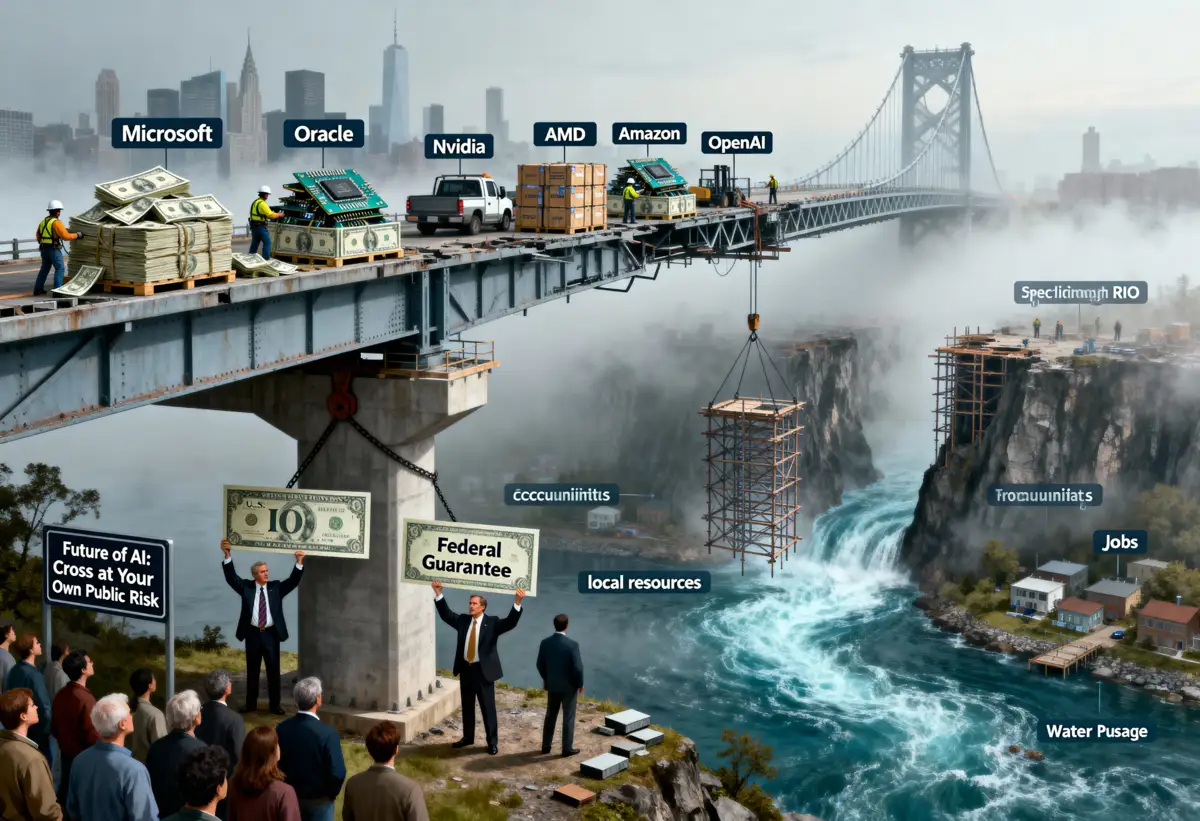
Altman burned through most of 2025 chasing computing capacity, trying to lock it all down before OpenAI's planned IPO at the end of 2026. After the September Nvidia announcement, OpenAI signed a string of additional agreements with chip and cloud companies. The deals fueled a global stock rally. They also piled up obligations that Altman himself acknowledged: $1.4 trillion in computing commitments, more than a hundred times the revenue the company was on pace to generate last year.
OpenAI executives have since tried to soften that figure, pointing to overlap between deals and long timelines for delivery. But the number spooked investors. Tech stocks tied to OpenAI sold off. The mood inside OpenAI shifted from expansion fever to damage control, with executives scrambling to explain why the numbers weren't as alarming as they appeared.
The Nvidia deal collapsing makes that damage control harder. OpenAI needs to show potential public-market investors that it can secure the chips and data center capacity required to run its models at scale, at prices that don't bleed the company dry. A nonbinding memorandum that quietly dissolves five months after the press conference doesn't build that confidence.
Other investors are lining up. SoftBank wants to double down with another thirty billion on top of the thirty billion it already put in for an 11% stake last year. Amazon is circling at somewhere north of $10 billion, maybe $20 billion. Microsoft, less than $10 billion. Add Nvidia's scaled-back equity check and the round could still reach $100 billion, pushing OpenAI's valuation toward $830 billion.
Daily at 6am PST
Don't miss tomorrow's analysis
No breathless headlines. No "everything is changing" filler. Just who moved, what broke, and why it matters.
Free. No spam. Unsubscribe anytime.
But the money arrives in a different vehicle than Altman originally designed. Equity from multiple partners is not the same as a single company building and guaranteeing your infrastructure. OpenAI traded a locked-in capacity agreement for a pile of cash and a collection of investors who all have competing interests. That's a weaker hand, even if the dollar figure looks similar on a slide deck.
What the shrinkage tells you
Strip away the diplomatic statements and Huang's Saturday night performance in Taipei, and the pattern is straightforward. Nvidia announced a $100 billion partnership when the AI hype cycle peaked. As the competitive picture fragmented, as Google's Gemini ate into ChatGPT's growth, as Anthropic gained ground with developers, Nvidia recalculated. The original deal concentrated too much risk on one company in a market that was splitting apart faster than anyone expected.
Huang will still write a large check. Tens of billions, probably. Nvidia can't afford to let its biggest customer starve. But the era of blank-check AI partnerships, where a memorandum of understanding and a press conference substituted for a binding contract, is over. Nvidia's November filing said the quiet part out loud, months before the Journal caught up.
OpenAI will keep raising money. It will probably go public. The compute will get built somewhere, by someone. What changed is the terms, and the tone. Five months ago, Jensen Huang stood next to Sam Altman in Santa Clara and called their deal historic. Saturday night he stood in Taipei, alone, jacket off, insisting the relationship was fine while carefully avoiding any number with a "b" after it.
The $100 billion memorandum sits in a drawer in Santa Clara. Nobody is opening it.
Frequently Asked Questions
Q: What was the original Nvidia-OpenAI deal announced in September?
A: Nvidia signed a memorandum of understanding to build 10 gigawatts of computing power for OpenAI and invest up to $100 billion to finance the infrastructure. OpenAI would lease Nvidia's chips to train and run its AI models. The deal never progressed beyond preliminary talks.
Q: How much will Nvidia actually invest in OpenAI now?
A: Huang said it would be "probably the largest investment we've ever made" but confirmed it would be "nothing like" $100 billion. Nvidia will participate in OpenAI's broader equity funding round with an investment likely worth tens of billions of dollars.
Q: Why did Nvidia also invest in Anthropic?
A: Nvidia committed up to $10 billion to Anthropic in November. The move diversifies Nvidia's exposure across multiple AI developers, reducing dependence on OpenAI alone. Anthropic relies partly on Amazon's Trainium chips and Google's TPUs, which compete with Nvidia's GPUs.
Q: What is OpenAI's $1.4 trillion computing commitment?
A: After the September Nvidia announcement, OpenAI signed multiple deals with chip and cloud companies. Sam Altman acknowledged these combined commitments total $1.4 trillion, more than 100 times OpenAI's projected annual revenue. Executives say overlap and long timelines reduce the actual obligation.
Q: How does this affect OpenAI's planned IPO?
A: OpenAI aims to go public by the end of 2026. The collapsed Nvidia deal complicates that effort because public-market investors want clear visibility into infrastructure costs and capacity. OpenAI must now demonstrate it can secure computing resources without guaranteed capacity from a single partner.

Marcus Schuler
Editor-in-Chief and founder of Implicator.ai. Former ARD correspondent and senior broadcast journalist with 10+ years covering tech. Writes daily briefings on policy and market developments. Based in San Francisco. E-mail: editor@implicator.ai