Implicator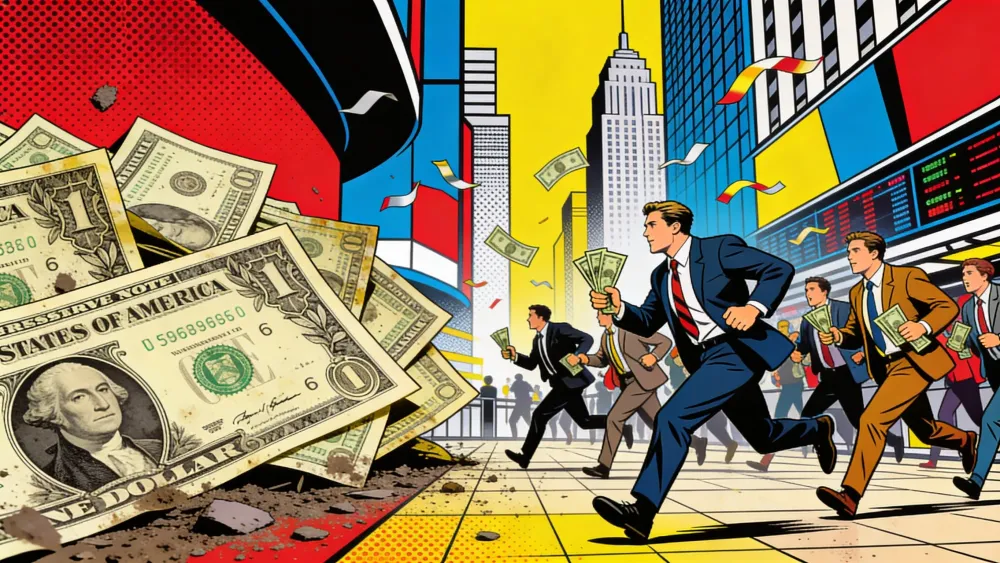
Institutional investors holding roughly $600 million in OpenAI shares have been unable to find a single buyer on secondary markets, Bloomberg reported Wednesday. The shift comes just one day after OpenAI closed a record $122 billion fundraising round at an $852 billion valuation. Buyers across multiple secondary platforms have instead indicated they're sitting on $2 billion in cash ready to deploy into Anthropic.
Key Takeaways
- $600 million in OpenAI shares sit unsold on secondary markets as six institutional investors fail to find a single buyer
- Buyers have $2 billion ready for Anthropic, with Hiive logging $1.6 billion in demand at a $600 billion implied valuation
- Goldman Sachs waives carry fees on OpenAI shares while charging full 15-20% carry on Anthropic equity
- OpenAI's enterprise API share dropped from 50% to 25% while Anthropic climbed from 12% to 32%, per PitchBook
Shares that moved in days now sit for weeks
A year ago, OpenAI equity vanished from secondary marketplaces within days of listing. Not anymore.
About six institutional investors, including hedge funds and venture capital firms with large stakes, approached Next Round Capital in recent weeks looking to offload their positions. "We literally couldn't find anyone in our pool of hundreds of institutional investors to take these shares," founder Ken Smythe told Bloomberg. His firm has handled $2.5 billion in total transactions.
The bids that do surface price OpenAI at roughly $765 billion. A 10% discount from the pre-round $850 billion, applied within days of the fundraising close.
Anthropic is the trade now
Every secondary marketplace tracking AI stocks tells the same story. Augment, Hiive, and Next Round all report record demand for Anthropic shares.
Bids value the company at approximately $600 billion, more than 50% above its last funding round at $380 billion. Hiive alone has logged $1.6 billion in demand, according to co-founder Prab Rattan. "The demand is one of the highest we've ever seen," Augment co-founder Adam Crawley said. "It's essentially unlimited interest."
Risk-reward arithmetic drives the rotation. Anthropic at $380 billion offers more room to run than OpenAI at $852 billion. "People are betting that Anthropic's valuation will catch up with OpenAI's," Crawley said. "But if you buy OpenAI shares, it's less clear what the return will be in the near term."
Banks already picked a side
Goldman Sachs and Morgan Stanley have begun offering OpenAI shares to wealth management clients without charging carry fees, according to a person familiar with the arrangements. That's a concession you don't make for a stock people want.
For Anthropic, Goldman charges its standard 15% to 20% carry on profits. Full freight.
Get Implicator.ai in your inbox
Strategic AI news from San Francisco. No hype, no "AI will change everything" throat clearing. Just what moved, who won, and why it matters. Daily at 6am PST.
No spam. Unsubscribe anytime.
Enterprise math drives the split
The investor rotation tracks a shift in competitive position that goes beyond valuation gaps.
OpenAI's share of the enterprise API market dropped from 50% to 25% over the past year, according to PitchBook. Anthropic climbed from 12% to 32% over the same period. Among companies buying AI services for the first time, Anthropic's selection rate runs triple OpenAI's.
OpenAI flagged Anthropic's enterprise lead as a "red alert" during a March all-hands meeting led by applications chief Fidji Simo, according to Forbes. Its response: consolidating ChatGPT, its Codex programming tool, and the Atlas browser into a single desktop application. An acknowledgment of what secondary buyers already priced in.
And the spending gap keeps widening. OpenAI is projected to lose $14 billion this year, burning through roughly $150 million per day, according to PitchBook estimates. Anthropic is narrowing its losses. Next Round Capital projects Anthropic will post $18 billion in profit by 2029, while OpenAI accumulates losses approaching $215 billion over the same period.
Primary rounds and secondary demand don't agree
OpenAI's $122 billion raise attracted Amazon ($50 billion commitment), Nvidia ($30 billion), and SoftBank ($30 billion). It also opened to retail investors for the first time, pulling in $3 billion through bank channels.
But primary rounds and secondary markets run on different logic. Existing investors often buy into new rounds to maintain their stakes, then quietly sell exposure through special-purpose vehicles. The $122 billion headline and the $600 million nobody wants can coexist.
Both companies are expected to pursue IPOs as early as Q4 2026. PitchBook ranks OpenAI weakest among the three major AI IPO candidates on business quality fundamentals, despite commanding the highest valuation. If Anthropic lists first, OpenAI's board reportedly fears it could absorb the pent-up retail demand for AI exposure before OpenAI reaches the public market.
Six hundred million in OpenAI equity sits waiting for a buyer. Two billion in Anthropic cash sits waiting for a seller. The secondary market picked its horse.
Frequently Asked Questions
Why can't OpenAI shares find buyers on the secondary market?
About six institutional investors tried to sell $600 million in OpenAI shares through Next Round Capital, but no buyers emerged. A year ago, similar offerings sold within days. Investors now see better risk-reward in Anthropic, whose $380 billion valuation offers more upside than OpenAI's $852 billion.
How much demand exists for Anthropic on secondary markets?
Buyers have indicated $2 billion in cash ready for Anthropic. Hiive has logged $1.6 billion in demand. Bids value Anthropic at roughly $600 billion, more than 50% above its last funding round. Augment's co-founder called the interest 'essentially unlimited.'
Why are banks waiving fees on OpenAI but not Anthropic?
Goldman Sachs and Morgan Stanley are offering OpenAI shares without carry fees to attract wealth management clients. For Anthropic, Goldman charges its standard 15-20% carry on profits. The fee waiver signals weaker demand for OpenAI equity among institutional investors.
How does OpenAI's enterprise performance compare to Anthropic's?
OpenAI's enterprise API market share dropped from 50% to 25%, while Anthropic rose from 12% to 32%, according to PitchBook. Among first-time AI buyers, Anthropic's selection rate is triple OpenAI's. OpenAI labeled this gap a 'red alert' internally.
Could the secondary market slump affect OpenAI's IPO plans?
Both companies may pursue IPOs as early as Q4 2026. PitchBook ranks OpenAI weakest among major AI IPO candidates on business fundamentals. If Anthropic lists first, it could absorb pent-up retail demand for AI exposure before OpenAI reaches the public market.

Harkaram Grewal
Maps the India–Germany–U.S. AI triangle from New Delhi. Background in cross-market operations and business development. Writes about supply chains, enterprise adoption, and talent—the unsexy forces that actually move global AI.