IMPLICATOR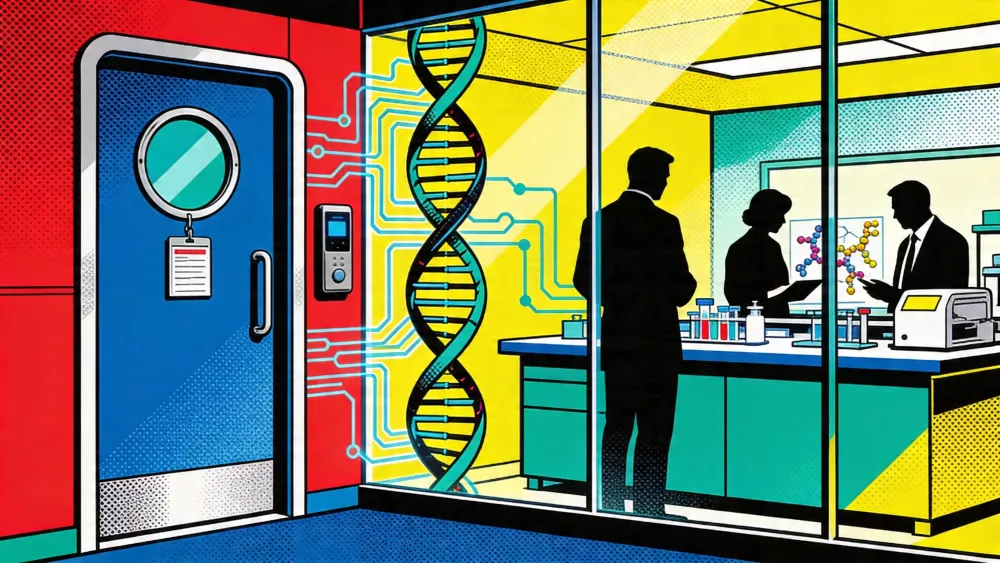
OpenAI did not put GPT-Rosalind behind a velvet rope by accident. The company announced the life sciences model on April 16 with the usual ingredients of an AI science launch: drug discovery, genomics, protein engineering, famous pharma logos, and a name borrowed from Rosalind Franklin. Then came the more revealing detail. The model is available only as a research preview for qualified customers through a trusted-access program.
That is the product.
The public story is acceleration. OpenAI says drug development in the United States can take roughly 10 to 15 years from target discovery to regulatory approval, and GPT-Rosalind is built to help scientists synthesize evidence, generate hypotheses, plan experiments, and use scientific tools. Axios reported the same launch with a useful caveat: only about one in ten drugs that enter clinical trials ultimately wins approval, and no fully AI-discovered or AI-designed drug has cleared phase 3.
The private math is harsher. A model that helps a researcher sort papers faster is useful. A model that changes which experiments get run is powerful. A model that can reason across genes, proteins, pathways, and biological tools also sits near the biosecurity line that every major AI lab now fears crossing.
So OpenAI built an airlock. GPT-Rosalind is not simply a model for biology. It is a test of whether OpenAI can sell access, governance, and domain tools as one package before regulators or rivals define that package for it. The company is not only asking scientists to trust its answers. It is asking the market to trust its gate.
Key Takeaways
- GPT-Rosalind matters most as a governed-access product, not as proof of AI-made drugs.
- OpenAI is packaging biology reasoning with Codex tools, audit trails, and vetted users.
- Biosecurity risk turns gating into a business feature for pharma and research buyers.
- The real test is whether the model helps teams avoid dead-end experiments earlier.
AI-generated summary, reviewed by an editor. More on our AI guidelines.
The benchmark story is smaller than the sales story
GPT-Rosalind arrives with numbers, because every model launch now needs a scoreboard. OpenAI says it achieved leading published-score performance on BixBench, a benchmark built around practical bioinformatics and data analysis. It says the model beat GPT-5.4 on six of eleven LABBench2 tasks, with the clearest gain in CloningQA. In a Dyno Therapeutics evaluation using unpublished RNA sequences, best-of-ten submissions in Codex ranked above the 95th percentile of 57 historical human-expert scores on prediction and around the 84th percentile on sequence generation.
Those numbers matter. They do not settle the question.
BixBench is closer to real computational biology than a multiple-choice science exam. The paper describes more than 50 biological analysis scenarios and nearly 300 open-answer questions. LAB-Bench also targets research work, including literature extraction, database retrieval, protocol troubleshooting, sequence manipulation, and difficult cloning scenarios. These are better tests than "does the model know molecular biology trivia?"
Still, benchmarks are an airlock too. They control what gets in and what gets measured. A score on a curated RNA task does not prove that a system will pick better targets, cut failed experiments, or speed a regulated program without creating new audit work around every recommendation. Biology punishes confident shortcuts. A plausible hypothesis can burn months. A bad one can send a team toward expensive noise.
That is why the strongest GPT-Rosalind claim is not "the model beat humans." It is more modest and more commercial: the model can act inside the workbench where scientists already search, compare, compute, and document. If you are a pharma executive, the appeal is not a magic drug. It is fewer cold trails before the expensive part begins.
Codex is the lab bench OpenAI can actually control
The Codex plugin may tell you more about OpenAI's plan than the model name does.
OpenAI says the Life Sciences research plugin connects models to more than 50 public tools and data sources. The GitHub directory lists a research-router-skill that routes broad life sciences questions, normalizes biological entities, selects downstream skills, and synthesizes answers. Its skill families cover OpenTargets, GWAS Catalog, ClinVar, gnomAD, Ensembl, GTEx, FinnGen, UK Biobank, and other data sources researchers already use.
That is not a chatbot wrapper. It is a workflow map.
OpenAI cannot make a wet lab less messy by decree. It cannot make clinical biology obey a demo. What it can do is turn Codex into an operating surface for repeatable research chores: literature review, sequence search, protein lookup, variant evidence checks, protocol planning, and database retrieval. The model is the voice. The plugin is the bench.
This also explains why GPT-Rosalind starts in ChatGPT, Codex, and the API rather than as a public model card with open weights. OpenAI wants the system close to user identity, tool logs, enterprise permissions, and audit trails. The company is selling confidence to institutions that already carry compliance anxiety. Amgen, Moderna, Thermo Fisher Scientific, the Allen Institute, and similar buyers do not just want a better answer. They want a system they can defend in a review meeting.
The airlock image fits here. A lab does not open every freezer to every visitor. It logs who entered, what they touched, and why. OpenAI is trying to make its life sciences model feel like that kind of controlled room.
Biosecurity turned gating into a feature
The uncomfortable part is that OpenAI's safety story also helps its business story.
The company says trusted access rests on beneficial use, strong governance and safety oversight, and controlled access with enterprise security. Its Help Center describes a special access program for vetted institutions with service agreements, biosafety and security controls, and approved use cases. Models in that program may provide more detailed responses in dual-use areas while still blocking weaponization or acute-risk requests.
Get The AI Brief Before The Lab Meeting
Strategic AI news from San Francisco. No hype, no "AI will change everything" throat clearing. Just what moved, who won, and why it matters. Daily at 6am PST.
No spam. Unsubscribe anytime.
That is a policy answer. It is also a market answer.
In February, Axios reported that more than 100 researchers endorsed a framework for limiting access to certain biological datasets that could help AI systems design dangerous viruses. The concern, as Johns Hopkins researcher Jassi Pannu framed it, was less ordinary ChatGPT use than high-risk biological data that can be copied, fine-tuned on, and reused by actors outside the original safeguard system.
Implicator covered the same Biosecurity Data Levels proposal as a five-tier access model for pathogen data. The central idea was narrow: keep most biology open, but control the slice of data that could provide real risk uplift. GPT-Rosalind now puts that logic into a commercial product. Not as law. As onboarding.
That is the tension OpenAI is exploiting and managing at the same time. Scientists feel impatience because biology is slow, expensive, and fragmented. Security teams feel anxiety because biology is also dual-use. Executives feel pressure because rivals, especially Google DeepMind, have owned much of the AI-for-science narrative. GPT-Rosalind packages those emotions into one answer: faster work, but only through our gate.
If you work inside a research institution, that trade may look reasonable. You get better tool use and fewer generic refusals. OpenAI gets account control, data boundaries, and a defensible answer when critics ask why a biology model exists at all.
The customer list is the real benchmark
The pharma logos are not decoration. They are evidence of the market OpenAI wants.
Amgen's AI chief Sean Bruich said the company wants to apply OpenAI's advanced tools in ways that could accelerate how it delivers medicines to patients. VentureBeat also quoted Moderna, NVIDIA, and the Allen Institute describing GPT-Rosalind in terms of complex evidence, repeatable agent workflows, and compressed R&D cycles. Reuters and Bloomberg both framed the launch around business customers and drug discovery, with Bloomberg casting it as a move onto Google territory.
That framing matters because "AI for science" has often been sold as a research achievement before it became a usable enterprise product. AlphaFold changed biology, but it did not hand every pharma company a governed agent stack. Specialized biotech AI firms can build deep systems, but they often lack OpenAI's distribution. GPT-Rosalind tries to split the difference: enough domain focus to be credible, enough enterprise packaging to sell.
The decisive calculation is simple. If a drug program takes 10 to 15 years and only about one in ten clinical candidates succeeds, the biggest commercial gain is not shaving seconds from a literature search. It is avoiding one wrong branch early. One killed dead-end program can be worth more than thousands of faster summaries.
That is also why the claim will be hard to prove. A model can show a better benchmark score this week. It may take years to show that its advice changed the fate of a real pipeline. OpenAI knows this. Its launch points to early discovery, hypothesis quality, and workflow speed because those are measurable sooner than approved drugs.
Investors and customers may accept that. Regulators will not accept it forever. The closer GPT-Rosalind moves to experiment selection, the more every recommendation starts to look like a record that someone may later need to inspect.
The gate becomes the moat
OpenAI is not alone in this market. Google DeepMind has scientific credibility, a long AlphaFold tail, and serious internal biology expertise. Startups are building narrower drug-discovery systems. Anthropic has pushed lab and enterprise tooling from a different angle. Universities and national labs will keep using open tools where they can.
OpenAI's bet is that the winning layer is not just model quality. It is governed capability. The company wants a buyer to say: this system is strong enough to help, restricted enough to approve, and connected enough to fit into the work.
That turns access into more than a safety measure. It becomes a moat. The more OpenAI can tie model capability to verified users, approved institutions, Codex plugins, auditability, and advisory support from firms like McKinsey, BCG, and Bain, the harder it becomes for a cheaper general model to replace the package. The model may be copied in spirit. The trust wrapper is harder.
There is a risk in that wrapper. Too much gatekeeping can slow the same science OpenAI says it wants to speed. Too little can turn biology into the next safety crisis. The company is walking between institutional impatience and institutional fear, and it has chosen to make the corridor itself the product.
For OpenAI, GPT-Rosalind is a biology launch. For the rest of the AI industry, it is a template.
The next frontier model may not arrive as a public chat box at all. It may arrive as a locked room with a badge reader, a logbook, and a sales team waiting outside.
Frequently Asked Questions
What is GPT-Rosalind?
GPT-Rosalind is OpenAI's life sciences reasoning model for biology, drug discovery, genomics, protein work, and translational medicine. It is available through a trusted-access research preview for qualified customers.
Why is GPT-Rosalind restricted?
OpenAI says life sciences work carries dual-use risks. The company is limiting access to vetted institutions with governance, biosafety, security controls, and approved use cases.
Did GPT-Rosalind beat human scientists?
OpenAI says one Dyno Therapeutics evaluation ranked best-of-ten model submissions above the 95th percentile of historical human-expert scores on one RNA prediction task. That does not prove drug-pipeline impact.
Why does the Codex plugin matter?
The plugin connects models to scientific tools and databases. That makes GPT-Rosalind less like a chat model and more like an agent layer for repeatable research workflows.
What is the main risk for OpenAI?
The model must prove useful without making biology safety harder to defend. Too much gatekeeping slows research, while too little could invite regulatory or biosecurity backlash.
AI-generated summary, reviewed by an editor. More on our AI guidelines.


Free AI briefing · Weekdays
The AI stories that matter, sourced and explained.
Join the Morning Briefing. It goes out every weekday at 4:45 a.m. Pacific, with later sends for the East Coast, Berlin and Tokyo.
Free when you sign up: The Paperclip Compendium, our tested guide to running AI agents.
Free. Unsubscribe in one click.

Marcus Schuler
Editor-in-Chief and founder of Implicator.ai. Former ARD correspondent and senior broadcast journalist with 10+ years covering tech. Writes daily briefings on policy and market developments. Based in San Francisco. E-mail: editor@implicator.ai