IMPLICATOR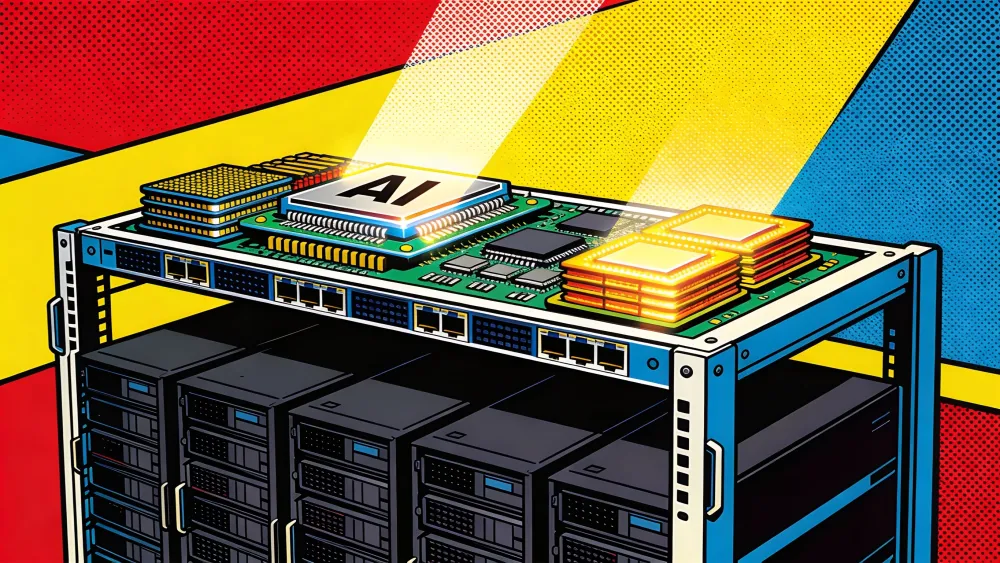
Dell Technologies said Thursday it booked $16.1 billion of AI-optimized server revenue in its fiscal first quarter, up 757% from a year earlier, alongside $24.4 billion of AI orders and a $51.3 billion backlog. The stock rose about 32%, CNBC reported. The same release showed Dell's non-GAAP gross margin rate fell to 18.1% from 21.6% a year earlier, even as gross-margin dollars grew 57%.
That gap frames the spring 2026 hardware rally. The companies that assemble AI servers are booking the revenue, while the suppliers of the scarce parts inside them, Nvidia's accelerators and the high-bandwidth memory stacked beside them, are keeping the margin. It is the same move down the technology stack that has been reshaping software, now running through hardware. Dell's quarter is the clearest version of the split.
Key Takeaways
- Dell booked $16.1 billion in AI servers, up 757%, but its non-GAAP gross margin rate fell to 18.1% from 21.6%.
- Nvidia (74.9% gross margin), Micron (74.4%), and SK Hynix (72% operating margin) hold the profit; Supermicro runs 6.3% to 9.9%.
- Dell discloses AI-server revenue but not AI-server margin, the one number the rally turns on.
- HBM scarcity is the bull case; the 2019 and 2023 DRAM crashes are the caution.
AI-generated summary, reviewed by an editor. More on our AI guidelines.
Nvidia runs a 74.9% gross margin, Supermicro 6.3%
Nvidia reported $81.6 billion of revenue for its fiscal first quarter, including $75.2 billion from data centers, at a 74.9% GAAP gross margin, the company said. Micron, which supplies memory for AI servers, reported $23.86 billion of fiscal second-quarter revenue, nearly triple the $8.05 billion a year earlier, and CNBC put its GAAP gross margin at 74.4%, up from 36.8%. SK Hynix, the leading supplier of high-bandwidth memory by revenue share, posted a 72% operating margin on 52.58 trillion won of first-quarter revenue, CNBC reported. Micron crossed a $1 trillion valuation this month.
The integrators that build the finished systems sit far below those levels. Supermicro, the closest public comparison for a high-volume AI-server assembler, reported a 6.3% gross margin on $12.7 billion of sales in its December quarter, recovering to 9.9% the next quarter. The Next Platform estimated AI servers carry gross margins "on the order of 5 percent," with most of a system's margin going to the GPU, memory and storage suppliers. One public teardown of Meta's 24,000-chip H100 cluster put the GPUs alone at 65.8% of the bill of materials.
The margin line Dell does not disclose
Dell's release proves demand. AI-optimized servers were 36.8% of total company revenue in the quarter, management raised its fiscal 2027 AI-server target to roughly $60 billion, and the infrastructure unit's operating margin reached 10.5%, the company said. Gross-margin dollars grew 57% to $7.947 billion.
What the release does not contain is a margin for the product driving the rally. Dell discloses AI-server revenue, traditional server and networking revenue, storage revenue and segment operating income, but not the gross or operating margin of AI servers on their own. On the earnings call, management attributed the lower companywide gross-margin rate "primarily to mix shift to AI servers" and said the rate rose excluding that mix, according to a transcript. The question the rally turns on, whether an AI server earns a software-like margin or a thin assembly margin, is the one number Dell's release does not provide.
Get Implicator.ai in your inbox
Strategic AI news from San Francisco. No hype, no "AI will change everything" throat clearing. Just what moved, who won, and why it matters. Daily at 6am PST.
No spam. Unsubscribe anytime.
HBM scarcity against the 2019 and 2023 memory record
The strongest case that this cycle is different rests on memory. SK Hynix's 2026 outlook cited Bank of America estimating the high-bandwidth memory market at $54.6 billion this year, up 58%, and Counterpoint Research putting SK Hynix at 57% of HBM revenue as of the third quarter of 2025. TrendForce projected conventional DRAM contract prices rising 55% to 60% in the first quarter and another 58% to 63% in the second, citing for the second quarter the long-term agreements cloud providers signed to lock in supply. UBS analyst Timothy Arcuri tripled his Micron price target to $1,625 from $535, arguing those contracts give memory earnings the visibility that warrants a higher multiple.
The record argues for caution. The same research house tracking the surge, TrendForce, forecast server DRAM prices falling nearly 30% in early 2019 after the prior boom financed too much capacity. Gartner data show memory revenue fell 37% in 2023, with DRAM down 38.5% to $48.4 billion. Memory has looked structurally short near the top of past cycles, until high prices paid for enough new capacity to break it.
Snowflake rose 33%, Salesforce fell 33% this year
The market drew the same line this week between scarce capacity and everything else. Snowflake committed $6 billion to Amazon Web Services over five years for Graviton compute and AI spending, called it its largest commitment to date, and reported product revenue up 34% to $1.33 billion while raising its full-year guide. The shares rose about 33%, Reuters reported. Salesforce reported $11.1 billion of revenue, up 13%, and a 34.8% operating margin. Its stock is still down about 33% this year, on a soft current-quarter forecast and questions about AI disrupting software, Reuters reported.
Investors paid up for the data company after it secured five years of AWS compute and showed accelerating consumption, and marked down a profitable software vendor whose growth is in doubt. Goldman Sachs Research has put consensus 2026 capital spending by the major AI hyperscalers at $527 billion, up from $465 billion at the start of the prior earnings season. That spending is what keeps the suppliers upstream scarce, and the math behind it is the demand the whole rally rests on.
What clears within days
The spring rally treated AI hardware as a single trade. The margin data separate it into a scarce-component business that earns Nvidia-like rates and an assembly business that does not. Hewlett Packard Enterprise reports on June 1 and Broadcom on June 3, with Computex opening in Taipei the same week. HPE's server margin and backlog conversion are the near test of whether the box builders can hold profit on AI systems, or whether the revenue keeps passing through to the suppliers upstream.
Frequently Asked Questions
Who is capturing the profit in the AI hardware boom?
The scarce-component suppliers. Nvidia reported a 74.9% gross margin, Micron 74.4%, and SK Hynix a 72% operating margin. The companies that assemble finished AI servers, Dell and Supermicro, book large revenue at far thinner margins, with Supermicro between 6.3% and 9.9% and Dell's company gross margin rate at 18.1%.
Why did Dell's gross margin fall while revenue surged?
Dell said the lower companywide gross margin rate, 18.1% versus 21.6% a year earlier, came primarily from the mix shift toward AI servers, which were 36.8% of revenue. Gross-margin dollars still grew 57%, so the rate fell even as absolute profit rose.
Does Dell disclose its AI-server margin?
No. Dell reports AI-server revenue ($16.1 billion, up 757%), orders, backlog, and segment operating income, but not the gross or operating margin of AI servers on their own. The filing cannot confirm whether AI servers earn a software-like margin or a thin assembly margin.
Is the memory boom sustainable?
It is the strongest structural case, resting on HBM scarcity; Bank of America put the 2026 HBM market at $54.6 billion. But memory has looked short near past peaks too. TrendForce data show server DRAM fell nearly 30% in early 2019, and Gartner data show memory revenue dropped 37% in 2023.
What should investors watch next?
Near-term tests come within days. Hewlett Packard Enterprise reports June 1 and Broadcom June 3, with Computex in Taipei the same week. HPE's server margin and backlog conversion will show whether box builders can hold profit on AI systems, or whether the revenue keeps flowing upstream to chip and memory suppliers.
AI-generated summary, reviewed by an editor. More on our AI guidelines.

Free AI briefing · Weekdays
The AI stories that matter, sourced and explained.
Join the Morning Briefing. It goes out every weekday at 4:45 a.m. Pacific, with later sends for the East Coast, Berlin and Tokyo.
Free when you sign up: The Paperclip Compendium, our tested guide to running AI agents.
Free. Unsubscribe in one click.

Marcus Schuler
Editor-in-Chief and founder of Implicator.ai. Former ARD correspondent and senior broadcast journalist with 10+ years covering tech. Writes daily briefings on policy and market developments. Based in San Francisco. E-mail: editor@implicator.ai